
What happens when photography no longer represents the world, but instead records the conditions of its own becoming? Marta Djourina's practice begins where the camera recedes. Working directly with analogue photographic paper, light, movement, and chemistry, she treats photography less as a medium of depiction than as a site of material encounter. Light is not simply what makes images possible — it becomes their subject, their agent, and their residue.
Occupying the intersections of photography, performance, painting, and scientific inquiry, Djourina's works register events rather than representations. Color emerges through the unstable relationships between wavelength, chemistry, and perception; abstraction becomes the trace of physical processes unfolding in real time. In an era of frictionless digital images, her analogue experiments insist on contingency, duration, and the generative potential of the unseen.
In this conversation, Djourina reflects on photography beyond the camera, the material intelligence of light, and the productive tension between scientific precision and wonder.

Untitled (from the series FOLDS), Marta Djourina, 2021
Light as Material
You often describe your practice as an exploration of the "essence of light." What does light represent for you beyond its physical properties? Is it a material, a subject, or perhaps even a collaborator?
My motivation to work with light is very fundamental: without light, we would not be able to see. Our entire visual perception depends on it. Because of this, light is both the starting point and the subject of my work. I think of it as a material, but also as an active force that shapes what becomes visible. Rather than illuminating something else, light becomes the protagonist. In many of my works, I create conditions in which light leaves traces, activates materials, or becomes an active collaborator in the work itself.
Your work in Color As Concept was created through the direct exposure of folded analogue photo paper using different light sources, without relying on traditional photographic representation. At what point does a trace of light become an image?
For me, an image is created when light produces a transformation. Photography is often understood as a way of representing the world, but I am interested in photography as a process. A trace of light becomes an image when it is registered by a material surface and leaves behind a visible trace. In these works, there is no camera and no depicted subject. The image emerges from the direct encounter between light, folded paper, time, and movement. What we see is not a representation of something else, but evidence of an event that has taken place.
“Rather than illuminating something else, light becomes the protagonist.”
The exhibition presents your work under the theme "Color as Light." Do you think color exists independently, or is it always inseparable from the conditions of illumination and perception?
I see color as inseparable from light and perception. Objects do not possess color as an inherent property; what we perceive as color depends on the spectrum of the illuminating light, the way a material reflects or absorbs it, and how our visual system interprets the reflected wavelengths. In that sense, color is always relational rather than fixed.
One of the reasons I have worked with photographic paper for many years is that it "perceives" light differently from howwe do. It translates wavelengths in unexpected ways: a red light source may appear blue in the final image, while green can become magenta. These transformations reveal that color is not an absolute property but something that emerges through the interaction of light, material, chemistry, and perception.
Photography Beyond the Camera
Many of your works occupy an intriguing space between photography, painting, and performance. Do these disciplinary categories still matter to you, or has your practice moved beyond them?
I still find these categories useful, but mostly as points of reference. My work often begins with photography, yet it borrows from painting, performance, installation, and sculpture. In the darkroom, the process is highly performative. The resulting works sometimes resemble drawings or paintings more than photographs. Rather than trying to fit within one discipline, I am interested in what happens at their intersections. The image becomes a meeting point for different ways of thinking and making.
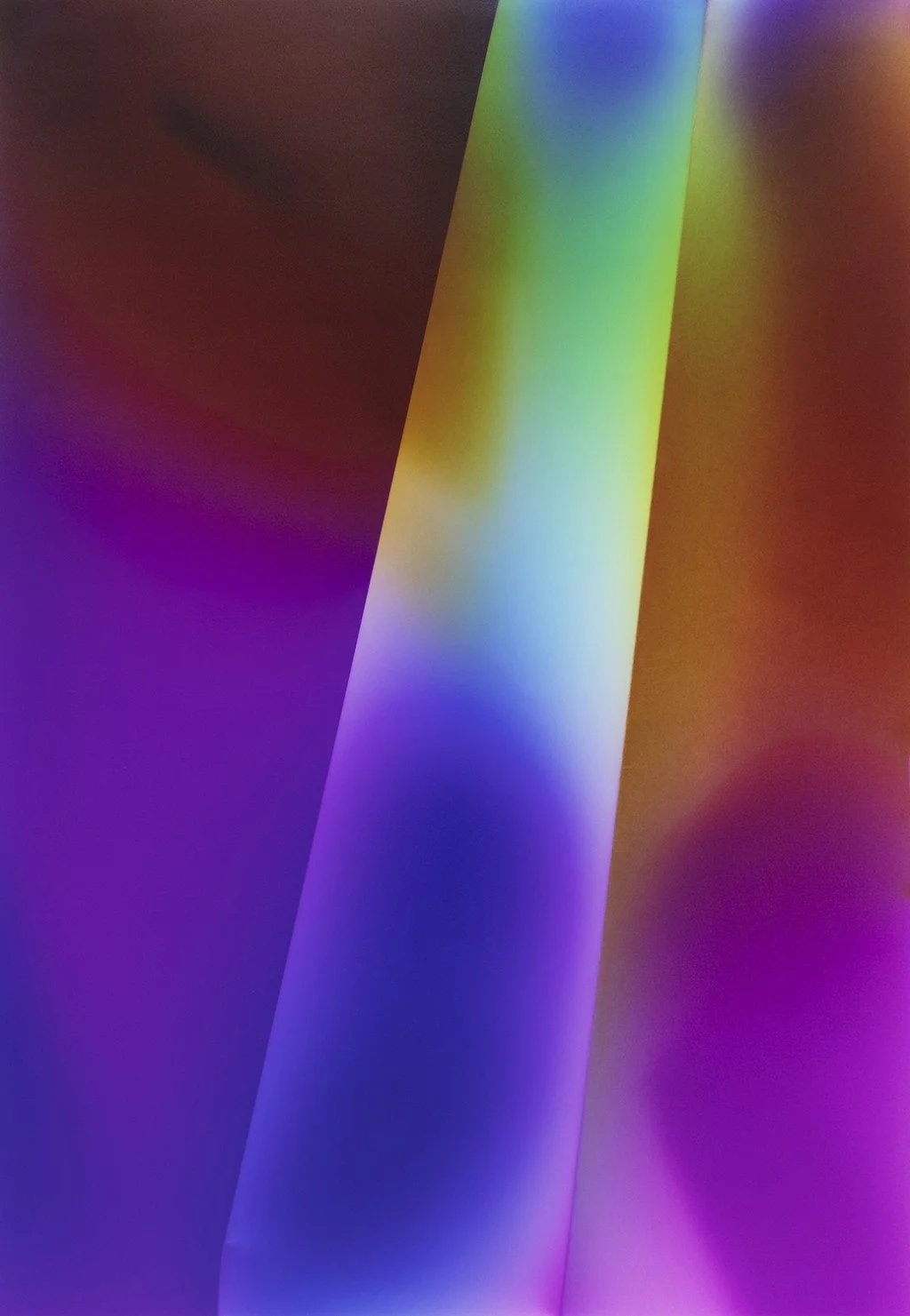
Untitled (from the series FOLDS), Marta Djourina, 2021
Your process often involves performative gestures — moving light sources, folding paper, or even using unconventional devices like pinhole cameras attached to birds. How important is the body and movement in making these seemingly immaterial images?
The body is central to my work. Even when the final image appears abstract or immaterial, it is often the result of very physical actions. In the darkroom, I move through space carrying light sources, following choreographies that I have developed over many years. The body becomes part of the photographic apparatus. It measures distance, directs light, and shapes the image. I am interested in the relationship between movement and trace, how an action can become visible long after it has disappeared.
The blue and violet hues in your exhibited work evoke atmosphere, depth, and even cosmic space. Do you consciously think about the emotional or symbolic associations of color, or do they emerge organically through experimentation?
Most of the colors in my work emerged through experimentation rather than through symbolic intention. I often used to begin with a particular light source or physical phenomenon and only later discovered how the photographic paper translates it. What fascinates me is that color frequently behaves independently of our expectations.
Over the past fourteen years, I have built an extensive archive of photographic test strips and color experiments. This empirical color catalogue has become an important part of my practice. Rather than trying to control color, I study how it emerges through the interaction of light, photographic materials, chemistry, environmental conditions, and bodily intervention. Each experiment contributes to a growing body of knowledge about the behavior of color in analogue photography.
At the same time, I am aware that viewers inevitably bring their own emotional and cultural associations to color. Blue may evoke depth, distance, or night; violet may suggest something cosmic or mysterious. I welcome these interpretations, but I prefer to leave space for them to emerge naturally rather than prescribing a symbolic meaning.
Your works make visible phenomena that are usually fleeting or invisible. Are you interested in photography's ability to preserve time, or rather in its capacity to reveal things we cannot ordinarily perceive?
I am interested in both, but if I had to choose, I would say revelation. Many of my projects begin with something that is difficult to see directly or even impossible to see with our eyes: the glow of bioluminescent organisms, the trace of a touch, the movement of light through space, or the interaction between different materials. The photographic medium allows these phenomena to become visible and tangible. The resulting image preserves a moment, but more importantly, it gives access to processes that usually remain hidden from the viewer completely.
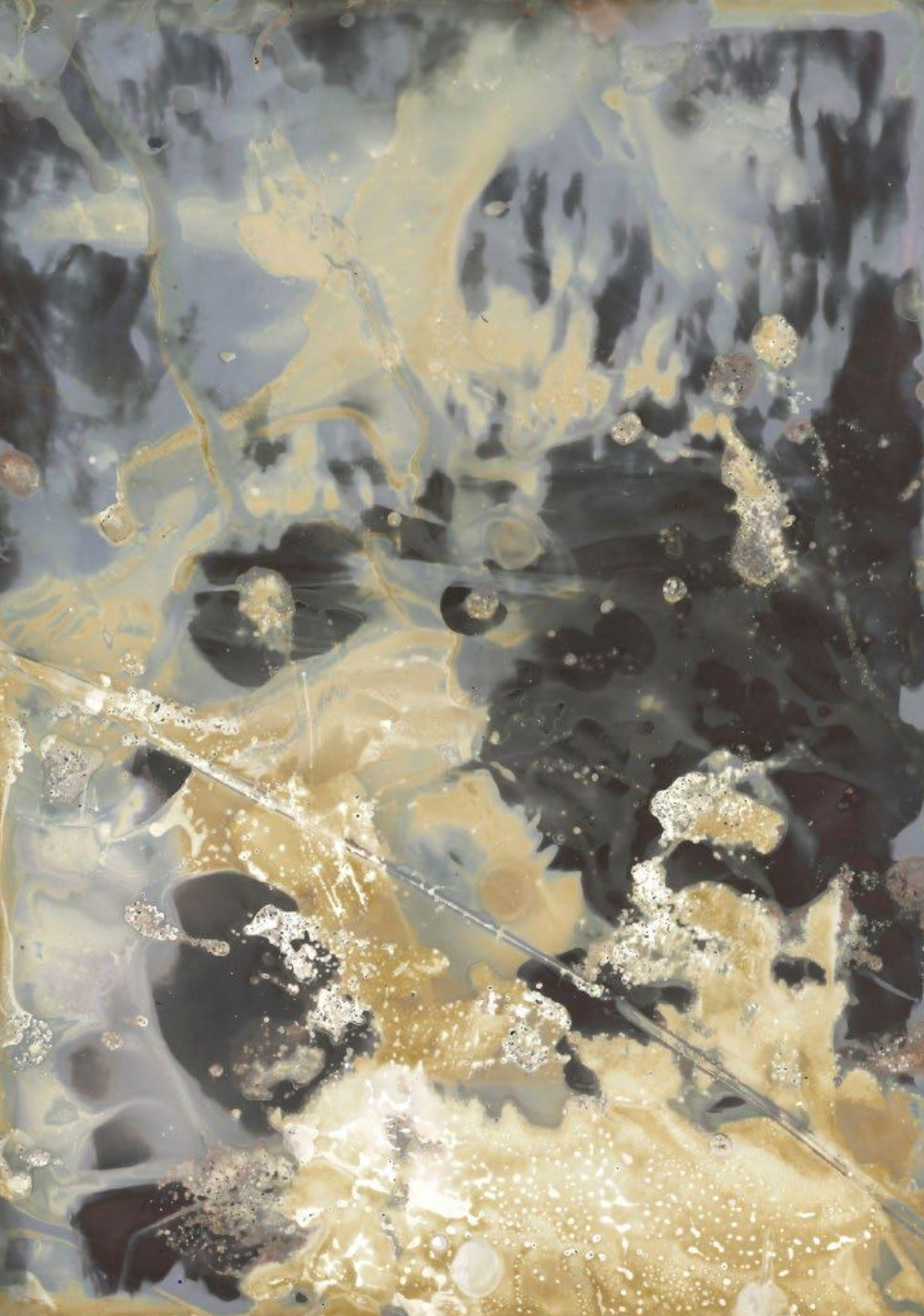
Untitled (from the series Foxfire), Marta Djourina, 2024
Ephemerality, Perception, and Wonder
There is a certain paradox in your work: you fix ephemeral light onto a permanent surface, yet the resulting images often retain a sense of transience and movement. Is this tension important to you?
Yes, very much. I am interested in the moment where something fleeting leaves a lasting trace. The image becomes a record of an event or moment that can never be repeated in exactly the same way again. Even though the photograph records this specific moment, it still carries within it a sense of movement, duration, and transformation. I think this tension between permanence and impermanence is one of the main reasons I continue to work with photography.
In an era saturated with digital images and instant photographic production, your commitment to analogue processes feels almost radical. What possibilities does analogue experimentation offer that digital technologies cannot?
Yes, I think it is. Analogue processes allow me to work directly with physical phenomena. Light, chemistry, water, temperature, distance, speed, gesture, and touch all become active participants in the creation of the image. The work is not generated through simulation but through actual encounters between materials. This direct relationship to the physical world remains very important to me. It is a visual research of a space for unpredictability, attention, and discovery that I find increasingly valuable especially today.
Your recent monograph is titled Foxfire — a phenomenon of natural bioluminescence. Throughout your practice, light seems to oscillate between science, magic, and wonder. What continues to surprise you about light as an artistic medium?
What continues to surprise me is that light can be both measurable and mysterious at the same time. Science can explain many of its properties, yet the experience of light still retains a sense of wonder. The more I learn about light, the more complex and fascinating it becomes. Whether I am working with lasers, sunlight, bioluminescent organisms, or photographic paper, I am constantly reminded that light is never static. It is always in motion, always transforming, and always revealing something new. That sense of discovery is what keeps me returning to it and what keeps fueling my curiosity.
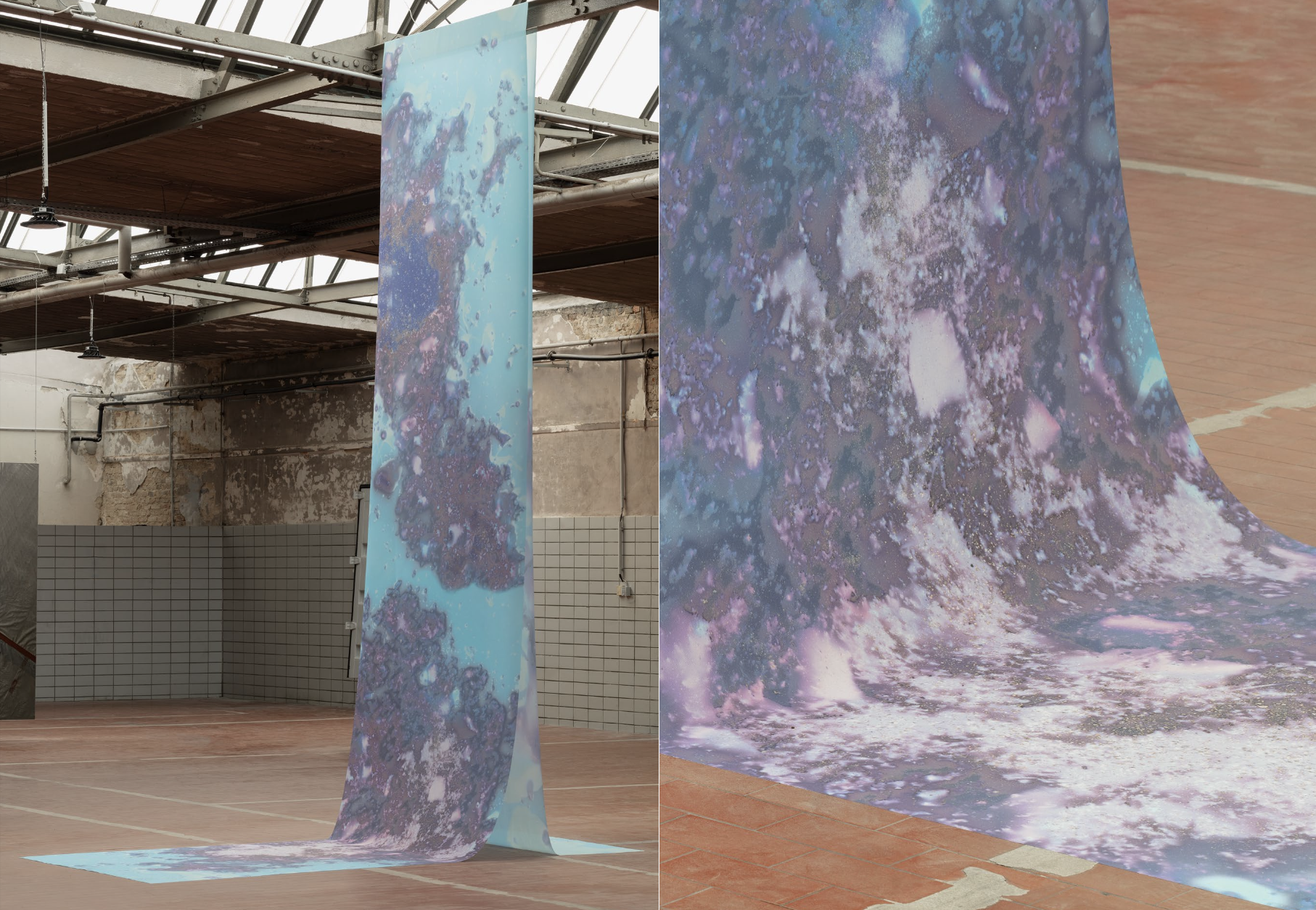
Untitled (from the series Foxfire), Marta Djourina, 2024
To learn more about Marta Djourina's practice, visit her website.
Her work ‘Untitled’ is featured in the online exhibition Color as Concept, on view from 5 June to 20 July 2026, and is available for acquisition through Ambrose Creatives.
Article by Alexandra Vîstraș
Alexandra Vîstraș is a Brussels-based cultural observer, policy professional and lifelong theatre enthusiast. With a background spanning cultural management, European policy and communications, she is interested in the ways art, politics and collective imagination intersect, particularly through the lenses of gender, identity and social change.