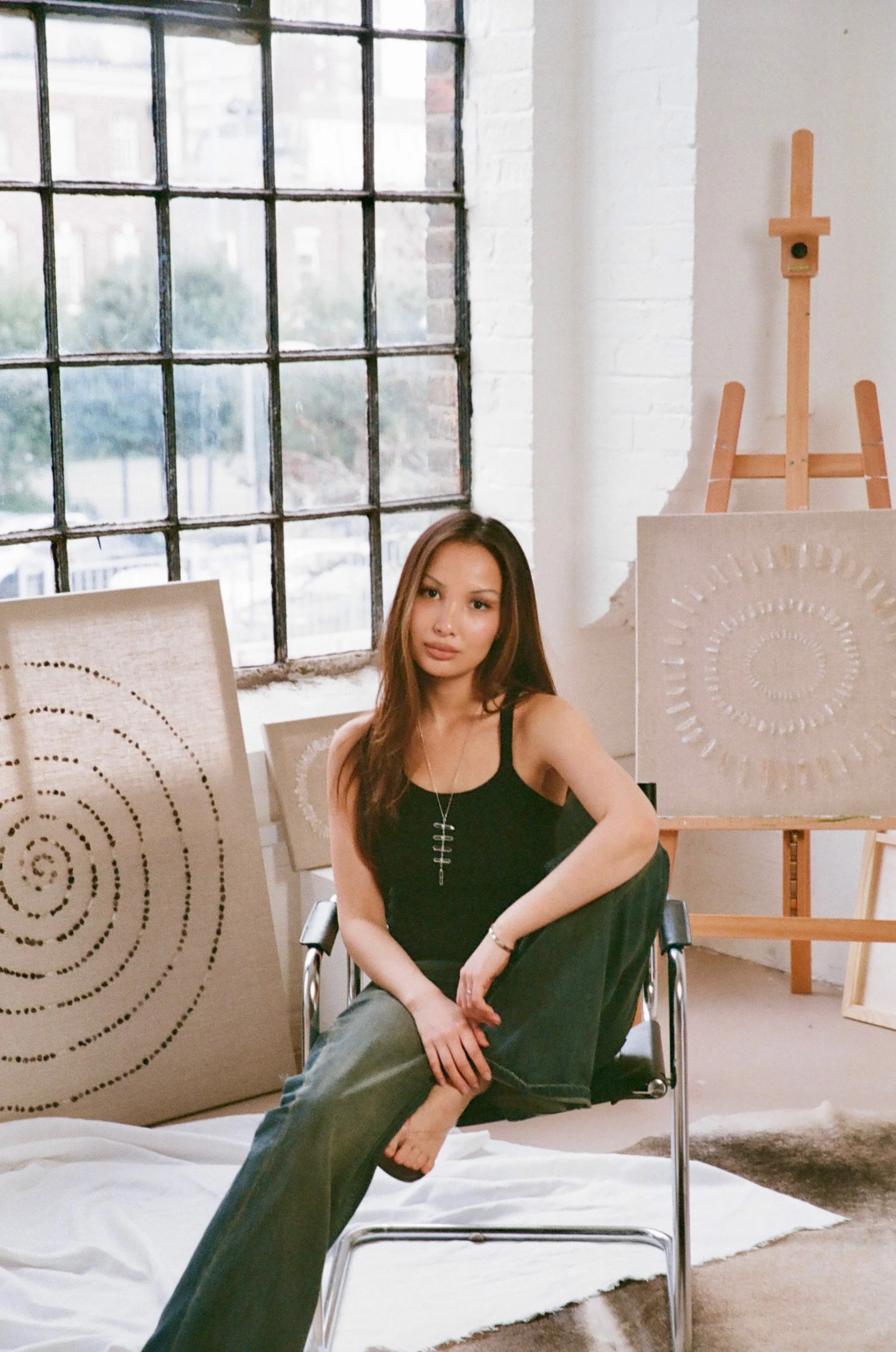
Geneva Arystan; courtesy of the artist
Connection with ancestral heritage and with nature, exploration of collective memory and of the interaction between the self and the wider world: these are the threads running through Geneva Arystan’s practice, which is deeply rooted in spirituality. A Kazakh-born artist based in London, Arystan explores the relationship between spirituality, collective memory, and nature – and how the self is connected to these and other invisible forces that drive everything – through mixed-media works that combine different materials and visual elements, including crystals, colours, and even text.
In fact, coming from a background in poetry, Arystan has explored both writing and painting throughout her artistic journey, including the use of words in her visual art. For her, these represent different expressions of the same creative vision, and each medium has allowed her to explore specific themes or has emerged from a necessity to do so: her writing explored the self, while her painting, which she defines as inherently ‘communal’, investigates the connection between the self and the universe.
The artist herself positions her work between spiritual abstraction and metamodernism, contributing to the conversation about the search for meaning and hope in our times. This places her practice within a wider contemporary search for meaning, where spirituality and ancestral traditions are increasingly rediscovered as ways of rethinking the relationships between individuals, society, and the Earth.
Drawing on her Kazakh heritage and Tengri traditions, Arystan approaches her art first as a spiritual practice. The materials and the visual elements she uses participate equally in a process shaped by rituals and aimed at exploring how everything belongs to the same whole.
Her work running through an open field, selected for Ambrose Creatives’ Color as Concept exhibition, exemplifies this dialogue between colour and materials and invites the viewer to experience this sense of connection that inspired its creation.
In the following conversation, Geneva Arystan delves into these themes and guides us through her artistic vision and practice.
SPIRITUAL PRACTICE & ANCESTRAL MEMORY
Do you have any rituals or habits that help you enter a creative state when beginning a new work?
Honestly, I tend to follow inspiration whenever it strikes, and for some reason that is often very early in the morning. I do, however, have rituals around preparing my crystals before they become part of a work. They are cleansed, either with water where appropriate or through smoke cleansing using sage or wild rue, a plant native to Kazakhstan, before being left to charge in sunlight or moonlight. Over the years I’ve become fascinated by the distinct properties associated with different crystals, and learning how to work with each one has become an important part of my process. Selenite, for example, can’t come into contact with water because it dissolves, yet it is often used to cleanse and charge other crystals. These small rituals help me slow down and approach each work with a sense of intention. It’s a science of sorts.
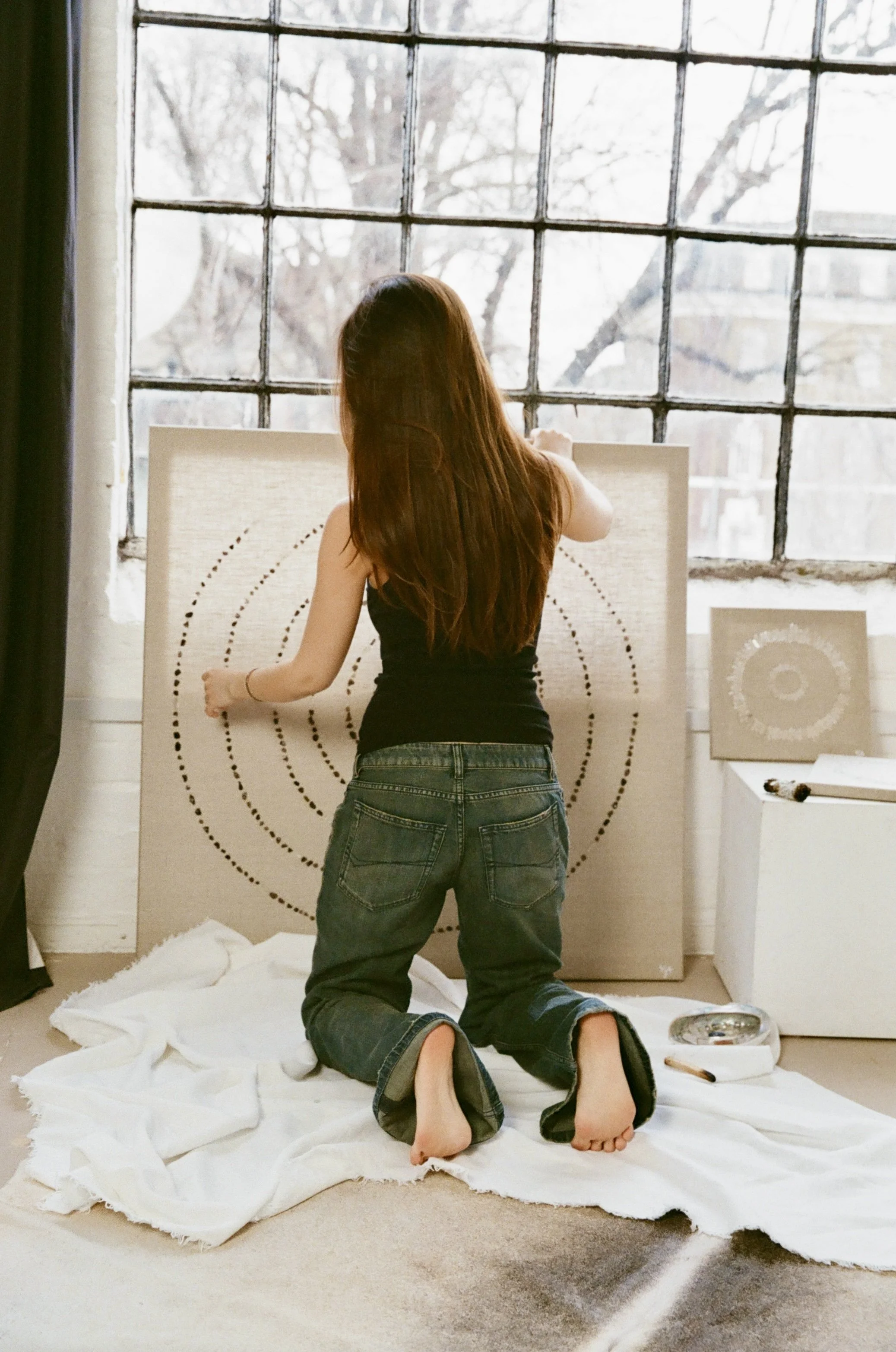
Geneva Arystan; courtesy of the artist
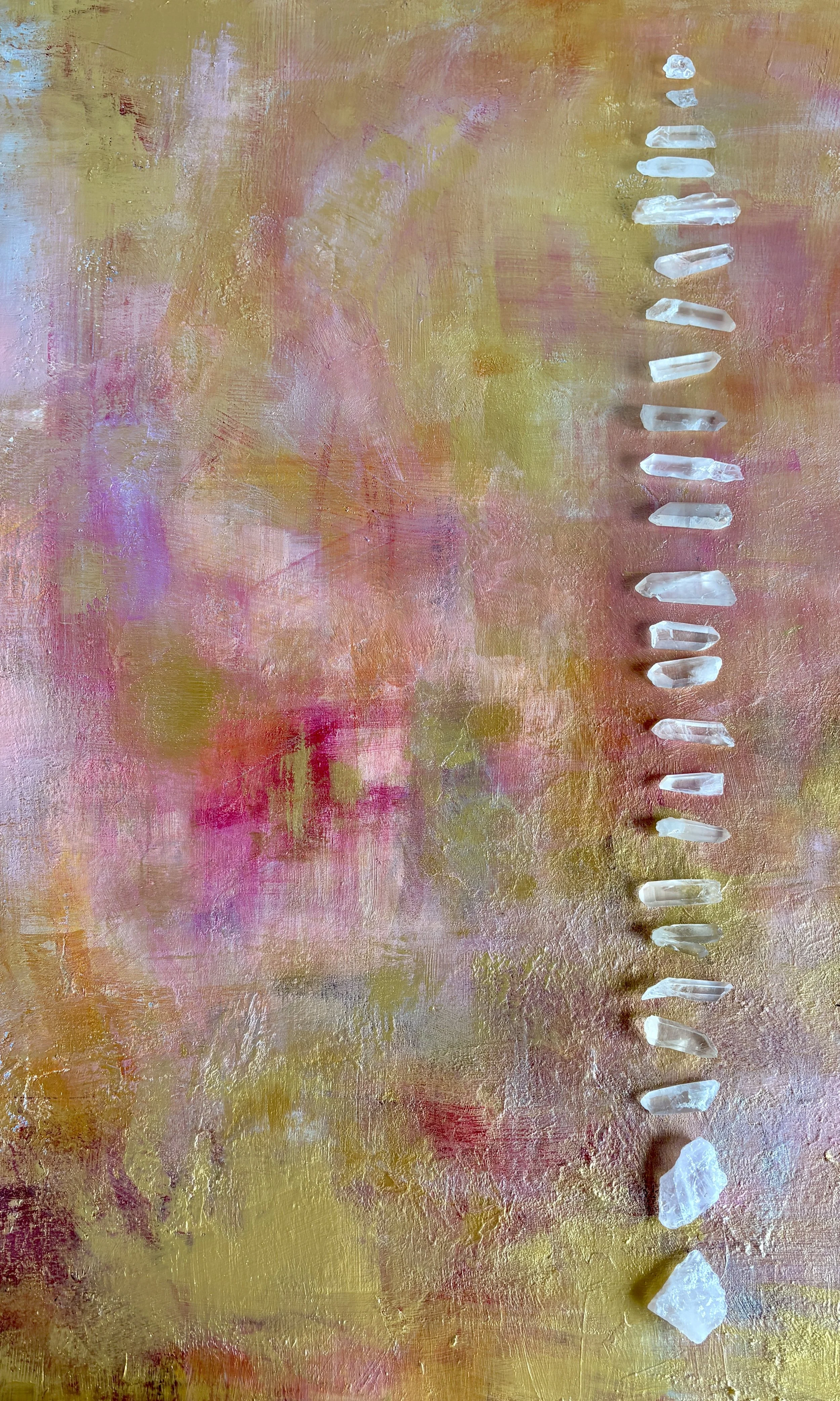
Close-up of mojave meditation II, Geneva Arystan, 2026. Clear quartz, rose quartz, and acrylic on wood
Spirituality appears as a recurring presence throughout your work and in the way you speak about it: what role does it play in your life, and how does it influence your creative practice?
Spirituality, for me, is a way of life. It comes from a set of beliefs that feel true to me: that we are each the universe experiencing itself in human form, that everyone is here for different callings and lessons, and that there may be such things as reincarnation and past lives. My idea of God and the universe are one and the same, and I find comfort in believing that our ancestors continue to guide and protect us.
I grew up culturally Muslim, as Kazakhstan is a predominantly Muslim country. As I got older, though, I realised that describing myself as Muslim no longer felt entirely accurate, as I don’t actively practice the religion and wouldn’t want to misrepresent it. Instead, I’ve followed what resonates with my intuition, whether it’s meditation, prayer, or other spiritual practices. So I would probably identify as agnostic, believing in a higher power but uncommitted to any one faith. Above all, I have a deep respect for every religion and for the many ways people seek connection, oneness and a relationship with the universe.
Indeed, your Kazakh heritage is a recurring element: how has it shaped your artistic practice, particularly your interest in ancestral memory and Tengri?
My curiosity towards all forms of spiritualism has naturally led me towards Tengrism, the pre-Islamic belief system of the Turkic and Central Asian steppe. I’m still learning about it, but my paintings tengri and umai draw inspiration from two central figures: Tengri, the sky deity, and Umai, the earth and mother spirit. More broadly, I see this as part of an ongoing cultural conversation in Kazakhstan, where many people are becoming interested in reconnecting with aspects of our ancestral heritage following decades of Soviet rule and, more recently, independence in 1991. My work grows out of that search, not as historical reconstruction, but as a personal exploration of nomadic identity and tribal spirituality that guided the steppe.
I’m also interested in the idea that memory can be carried across generations, through intuition, ritual, and our relationship with the natural world. That has become a recurring thread throughout my practice. Rather than trying to reconstruct history, I’m exploring what it means to reconnect with an ancestral identity that feels both deeply familiar and partially forgotten.
Works such as tengri and umai reflect this ongoing research, but more broadly my practice is about creating spaces where mythology, spirituality, and personal memory can coexist. I’m less interested in providing historical answers than in asking how inherited beliefs continue to shape the way we understand ourselves today, the way I am untangling my way back to my roots.
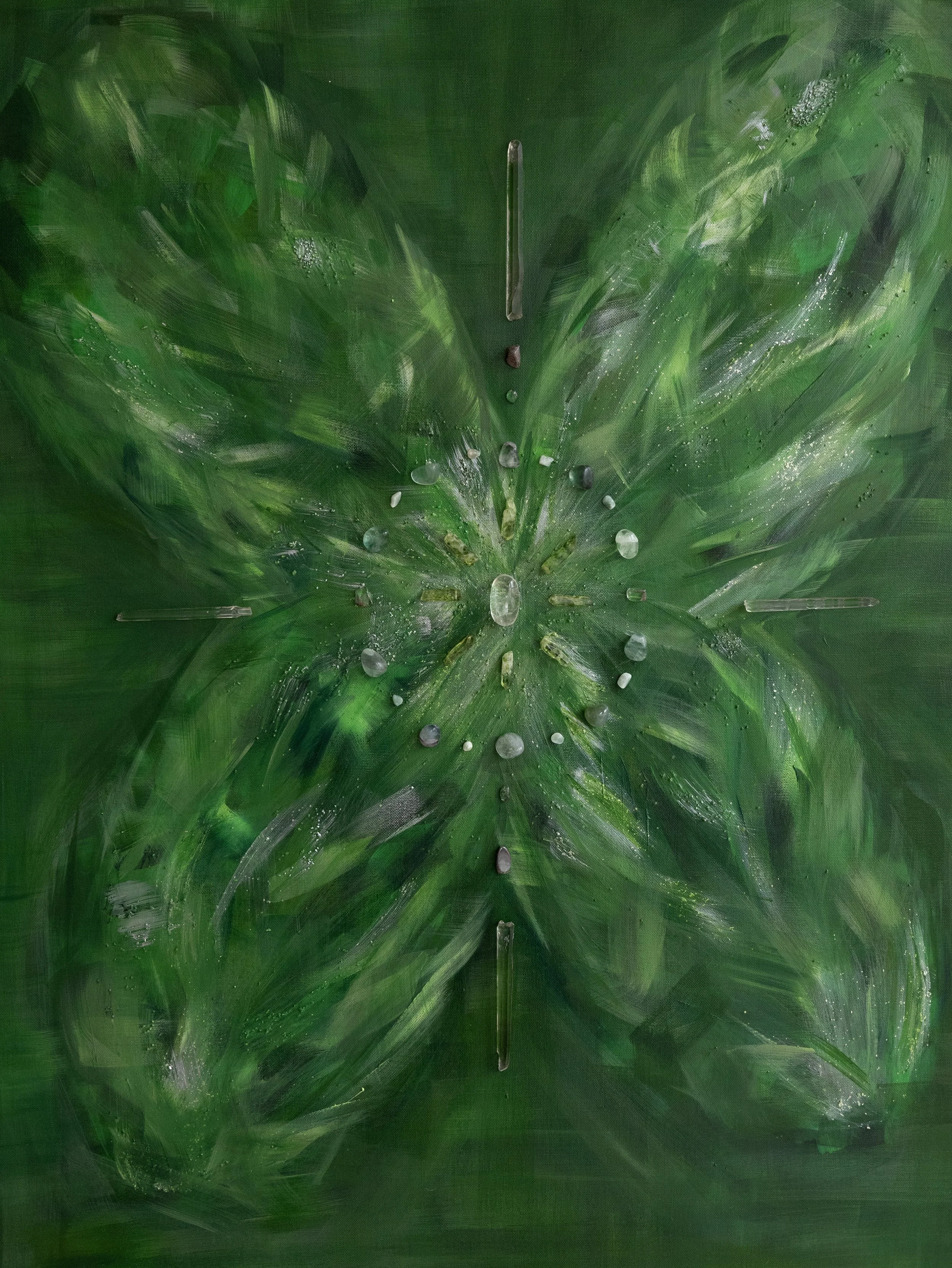
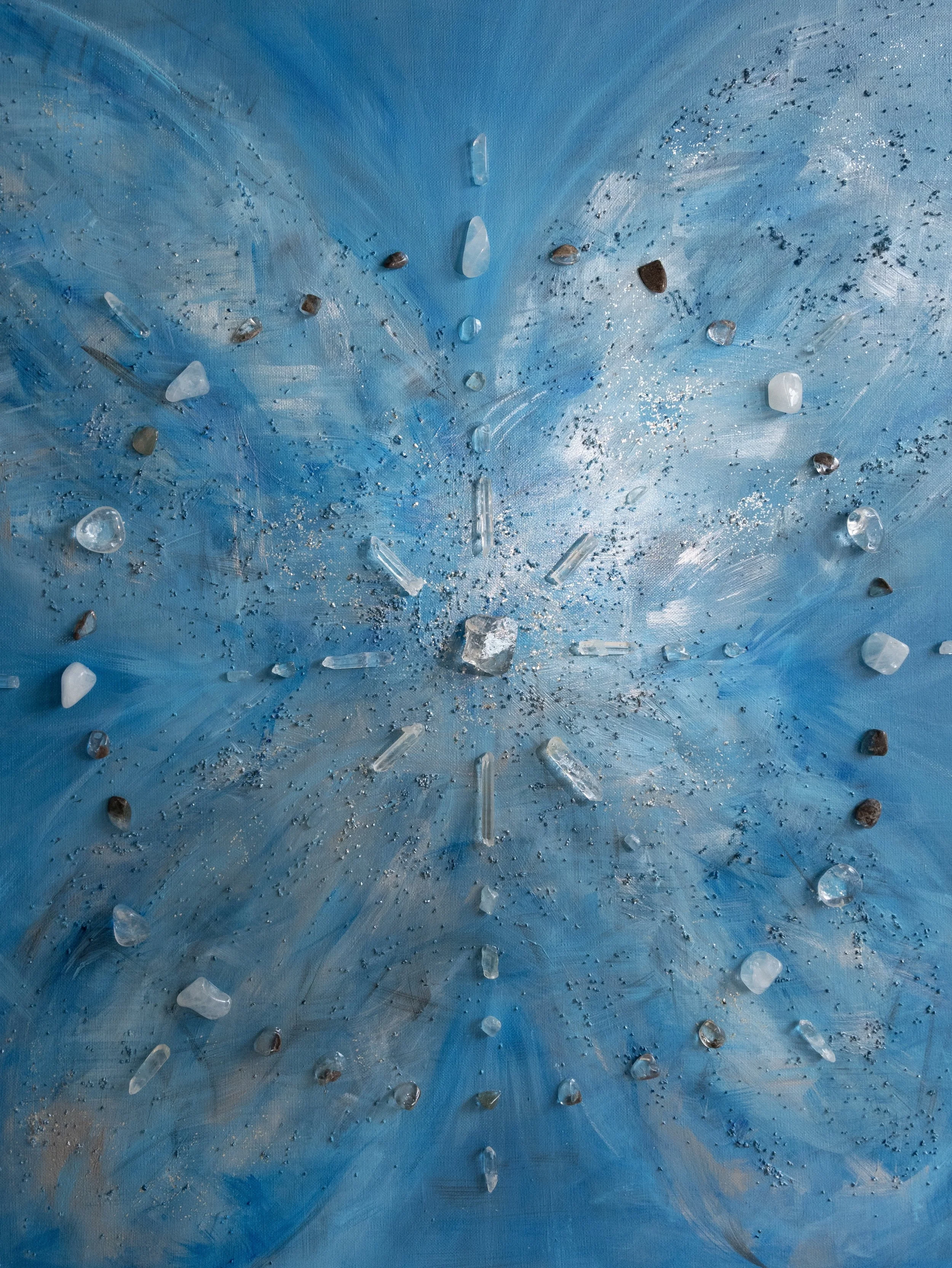
Fig. 1: umai, Geneva Arystan, 2026. quartz points, lodolite, moss quartz, peridot, aquamarine, clear quartz and acrylic on linen
Fig. 2: Close-up of tengri, Geneva Arystan, 2026. topaz, clear quartz, smoky quartz and acrylic on linen
MATERIAL LANGUAGE & COMPOSITION
These works featuring crystals are organised around circular or radiating compositions. Does this geometry carry a particular symbolic or spiritual significance within your practice?
I think my work exists somewhere between spiritual abstraction and metamodernism. The circles, or ripples, emerged quite intuitively; however, they echo ideas found in sacred geometry and symbolism found across many cultures. I’m interested in circles as symbols of wholeness, continuity, cycles, and interconnectedness. The spiral is also a recurring symbol I’m grappling with: the idea of life being cyclical, recurring, repeating on an infinite loop. These symbols are universal, ancient, sacred. They are of the earth, as are the crystals themselves, as are we.
The crystal formations are carefully arranged into what resemble grids or constellations. Each piece is built through a balance of intuitive making, material relationships, and the individual qualities of each crystal. The geometry creates a sense of order, but I work following my eyes, with no pre-existing plan or drawing. I think the asymmetry gives a wabi-sabi quality to the work.
Nature is where I feel most connected spiritually. It’s where I go to pray, reflect, and practice gratitude. Both Kazakhstan and California have profoundly shaped that relationship: Kazakhstan through its vast steppes, mountains, and lakes, and California through its deserts, forests, and the Pacific. Many of my works, such as earth altar and opal altar, were inspired by these landscapes.
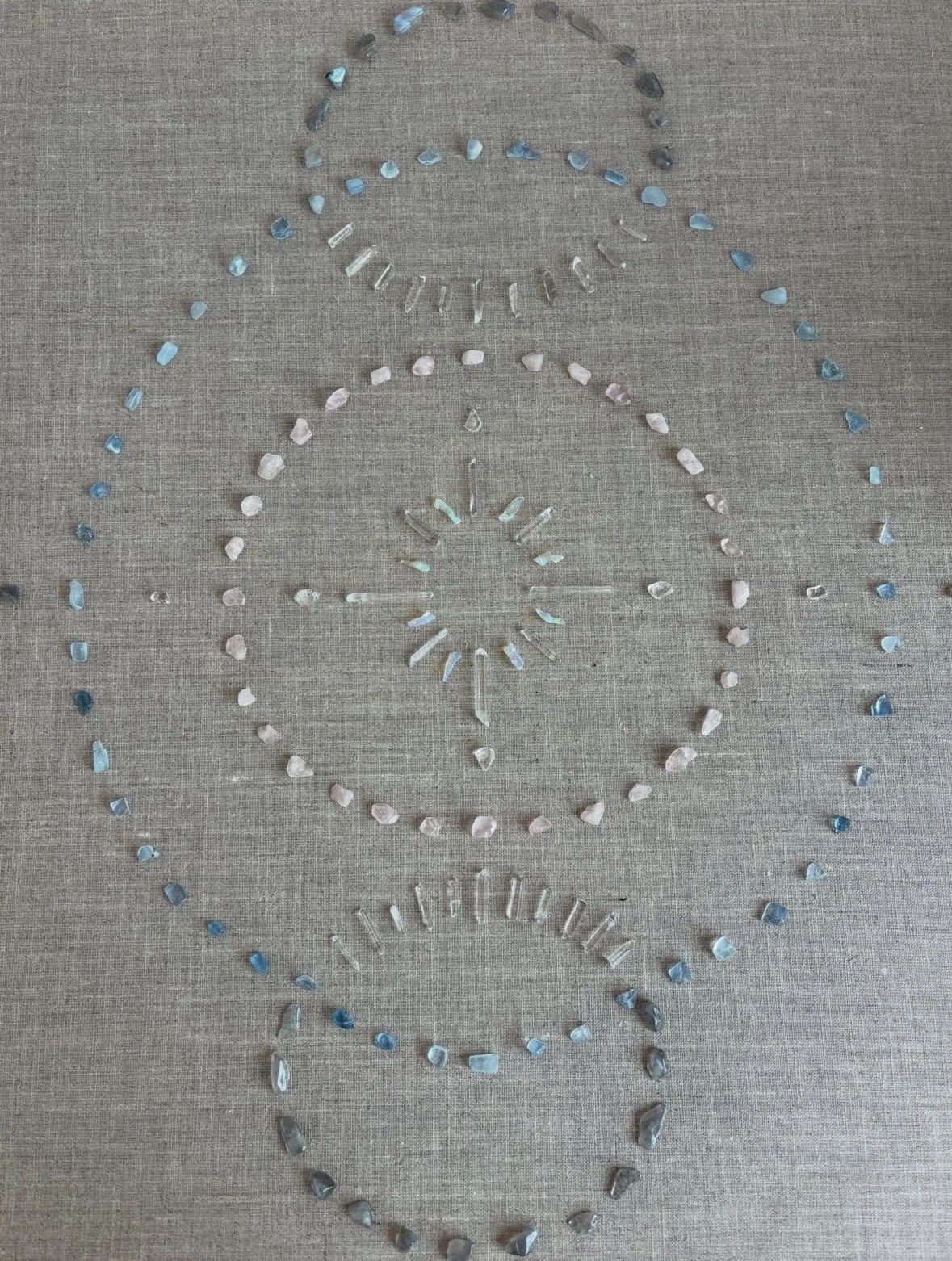
Close-up of altar of love and expansion, Geneva Arystan, 2026. Opal, clear quartz, labradorite, rose quartz, and aquamarine on linen
Your work running through an open field, selected for Ambrose Creatives’ Color as Concept exhibition, stands out for its interplay of colours, whereas many of your other works are built around a more monochromatic palette. Could you explain the ideas behind it and what led you to explore colour in this way?
running through an open field emerged from an interest in exploring colour as something that extends beyond pigment alone. I’ve always painted in this abstract style, ever since I was a child, but only recently began incorporating crystals into my work. This painting became a way of investigating how colour could exist in conversation with the crystals.
I’m interested in the transparency of clear quartz, and how it comes alive with colour, becoming whatever the paint underneath wants it to be, once it’s embedded. There are many elements at play simultaneously: the energetic properties associated with each crystal, their transparency or opacity, matte and iridescent surfaces, colour and light relationships. My works are really best experienced in natural sunlight, where the crystals reveal themselves under the rays.
Alongside these more vibrant pieces, I’m also developing a quieter body of work consisting of crystals arranged directly on raw linen. In these pieces, the linen functions as a neutral field, allowing the crystals to take centre stage, no distractions. Together, these two approaches explore different ways that colour, light and material can shape a work.
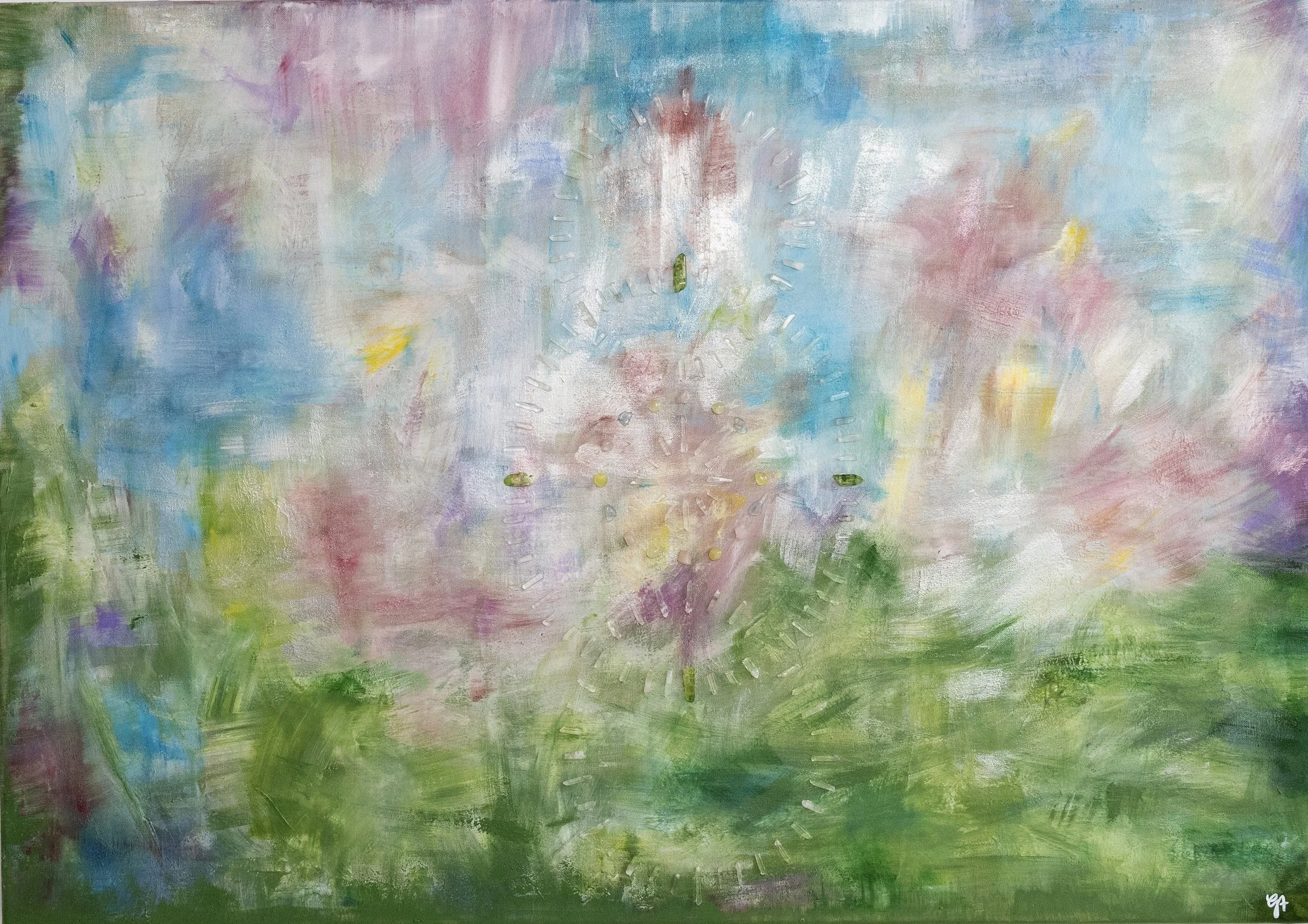
running through an open field, Geneva Arystan, 2026. Clear quartz, moss quartz, rose quartz, prehnite, aquamarine, and acrylic on linen
WRITING, WORDS & MULTI-SENSORY WORK
Another distinctive aspect of your practice is your use of words, not only in your book Three People Ago but also in works on canvas and mirror. Did writing come before visual art for you, and how do the two relate: do they emerge from the same place, or do they allow you to explore different kinds of questions?
Writing came before visual art, and I think it will always be my first language. Even now, it’s probably my primary tool of expression, and I know I will always be writing, but perhaps not sharing everything I write, as it feels like it is a more intimate and therefore private medium.
Painting, on the other hand, feels inherently communal. I think we’re living through a moment in which many people are searching for meaning, hope, and perhaps a renewed sense of spirituality, which is a pillar of the metamodern movement. I’ll be happy if my work can contribute to that conversation in some way.
For me, writing and painting emerge from the same place, but they ask different questions. My writing has often been about exploring my relationship with the self, whereas my visual practice explores my relationship with spirit. My paintings are born from meditation, and I hope they invite viewers into a similar state, bringing a sense of peaceful energy to any space they inhabit, whether that’s a gallery or a home.
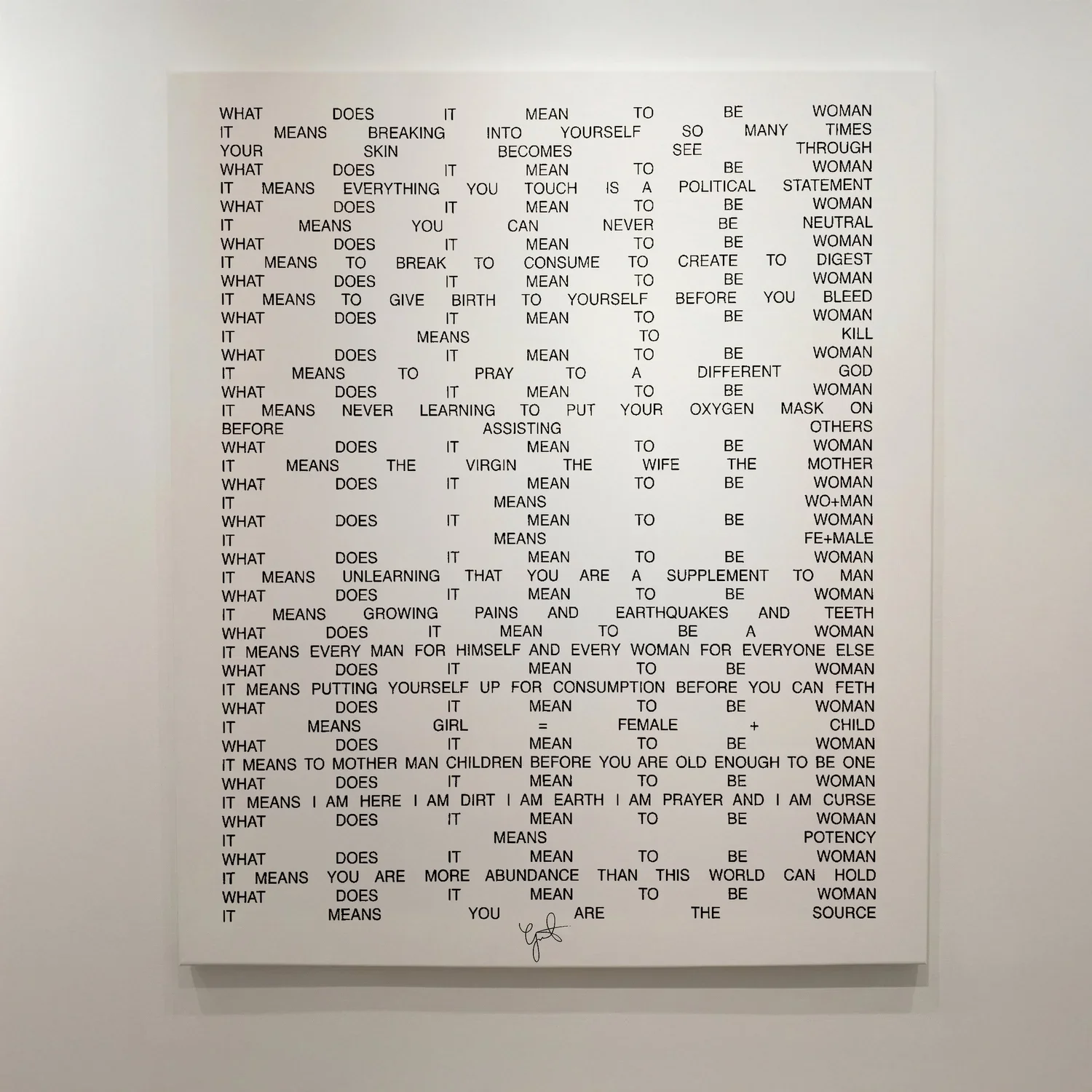
divine feminine, Geneva Arystan, 2022. Ink on canvas
Your work is tactile through its use of crystals, incorporates words, and evokes overall a multi-sensory experience. Does sound or music also play a role in your creative practice?
Yes, sound plays an important role in my creative practice. I’m a big admirer of sound healing, sound baths, and ambient music, although I prefer to paint in silence. When I was younger, I also explored music myself and performed at a few underground gigs in Paris. My EP Transparent Affection is still available on SoundCloud, and my singles Ash and Nostalgic for the Future can be found on Spotify and Apple Music. Over time, I realised that what I was really drawn to wasn’t the music industry itself, but the act of creative expression. Writing, music, painting, and performance have always felt interconnected to me; they are all different roads going to the same place. These days, performing takes the form of spoken word poetry and art installations, such as my tarot poetry readings. Even though my primary focus is now painting, I think frequencies and vibration continue to inform my process, even conceptually.
In an earlier interview discussing Three People Ago, you reflected on questions such as ‘Who was I three people ago?’ and ‘Who am I at the source?’ Do those questions still guide your work, or have new ones emerged? And how do you explore the self in your paintings today?
I think my interests have shifted over time. I’m much more drawn now to questions of ancestral history, collective memory, connection, and oneness. Three People Ago was really an exploration of the self and the ways moments of intimacy can transform the self. At the time, I was fascinated by the idea that we come to know ourselves through knowing others, as each other’s mirrors. I explored the self as a container of experience, as a performance, as a vessel, and as a medium – always negotiating the projections others place onto us and the ones we place onto them.
I guess the exploration of the self still exists in my visual practice, although differently. I am working on a few works incorporating mirrors. I just finished a piece called self-hypnosis and absolution – a sort of meditation on how our reflection and awareness of ourselves can be illusive and misleading; and a practice on how to see the reflection, and forgive yourself anyway.
However, over time, and through my own healing journey, I’ve made peace with many of those questions. I think I’ve become more settled in who I am at this time. Of course, we’re always changing, and I know there will inevitably be many more evolutions and rebirths spiralling throughout my life, but right now my curiosity has shifted outward. Rather than asking who I am, I’m asking how I’m connected – to my ancestors, to nature, to spirit, and to the unseen forces and synchronicities that seem to shape our lives. In that sense, my paintings are no longer primarily about the self as an individual, but about the self as part of a collective consciousness.
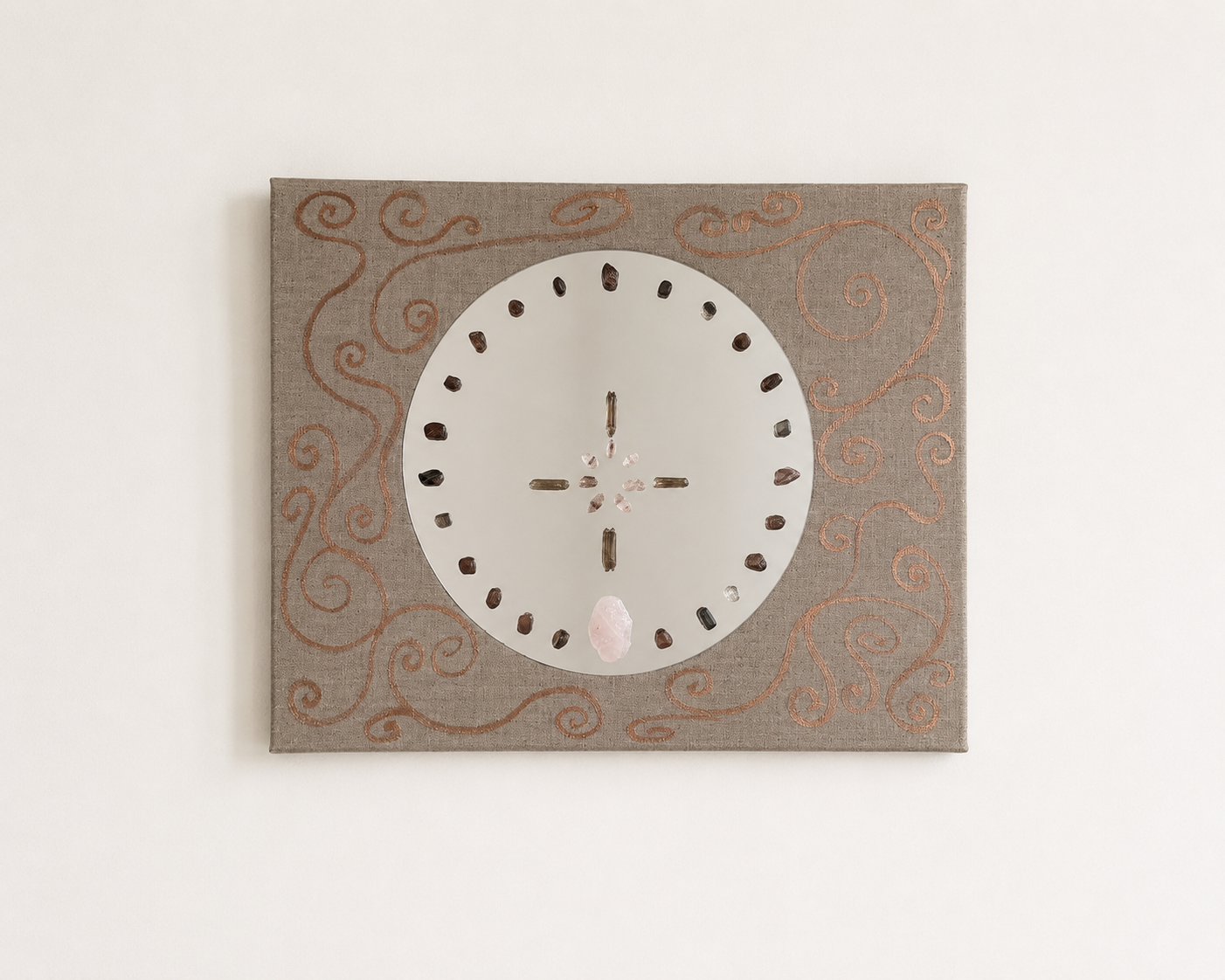
self-hypnosis and absolution, Geneva Arystan, 2026. Lodolite, brazilian super seven, smoky quartz, rose quartz, oil pastel, and mirror on linen
To explore Geneva Arystan’s practice further, visit her website.
running through an open field is featured in the online exhibition Color as Concept, on view from 5 June to 20 July.
Article by Antonio Caravella
Antonio Caravella is an Italian writer and language specialist based in Stockholm. With an academic background in literature and linguistics and professional experience in the tech industry, he draws on both worlds in his work. He has published a peer-reviewed article and co-authored a book on Swedish language and culture for Italian readers. His areas of interest include the ways in which language, visual communication and new technologies shape how people experience the world, and how cultural products engage with these changes. His writing spans literature, contemporary art, and cultural criticism across multiple languages, and includes essays published on his Substack.