
BEFRIENDING THE SUN: SAMANTHA BUCHANAN
“The work is always changing, always in flux, similar, I believe, to our environments and our perception of them.”
Have you ever tried to tame the sun? But that's rather cruel isn't it? What about befriending the sun? What about using it's beams as a tool? Samantha Buchanan builds her art around something you can’t actually touch. Using cut fiberglass mesh and negative space, her geometric pieces are never really static. They shift and react depending on where you stand and what time of day it is. We talked about the complexities of perception, the fluidity of colour, and what it actually means to collaborate with the environment.
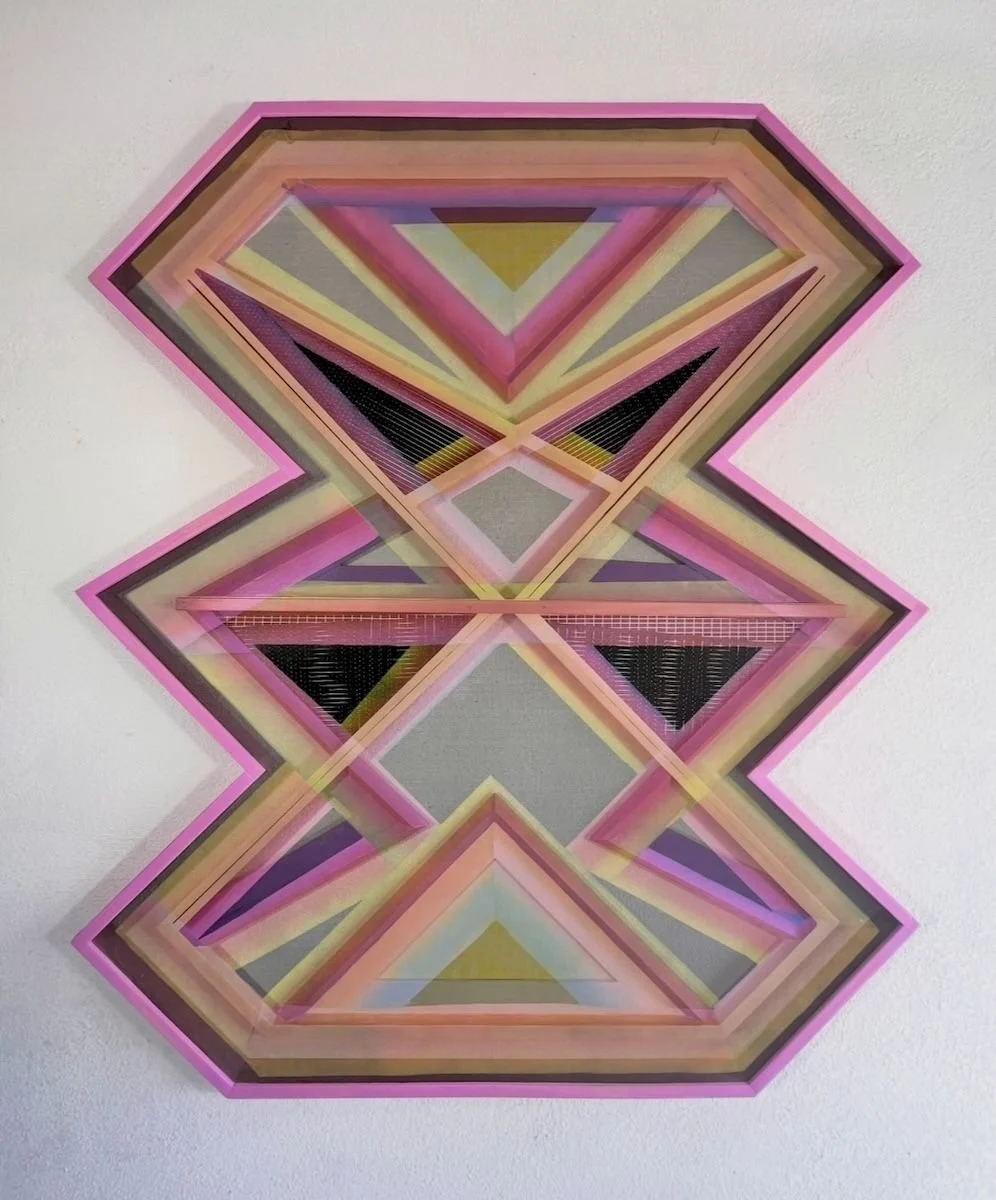
Vibrant Matter, Samantha Buchanan, 2026
First of all, can you tell us about your trip to the Arctic Circle in Norway?
For as long as I can remember, I’ve wanted to see true midnight sun, and after my partner and I spent a bit of time in Norway on a job-related trip in February of 2023, we decided that traveling to the Norwegian arctic circle during summer should be a priority. I don’t want to use the term “Bucket List” because for me, not only does that term have negative connotations, but it also suggests an experience that only happens once, and yet I cannot wait to get back to northern Norway.
Having endless daylight was such a unique experience. One of my first nights there I remember feeling hungry and thinking that it was time for dinner only to realize that it was already 10pm. I didn’t follow my traditional schedule, instead when I was tired, I would draw the shades for sleep regardless of the time, I would eat whenever I was hungry, and at one point I set out on a lengthy hike at 7pm. It was a very freeing experience. I felt much more in tune with my own body, but I was also curious about the adaptations of local animals and plants as well. For example, the birds were always chirping, do they not sleep during midnight sun? As someone who grew up in a city, I always appreciated the times that I was awake at dawn, when the city was still quiet, the light was soft, and the birds were just starting to chirp. That is what my time in the cabin in the arctic circle felt like. Aside from just the sheer beauty of both the light and the fjord landscape, what is resonating with me now, is the stillness.
I was able to spend some time in central and southern Norway as well, observing the variations in light at different latitudes. As I expected, the vibrant colors during golden hour(s) were remarkably beautiful, but what I’m finding surprising is the impact that these observations are having on my work. I expected to return to the studio with a sketchbook filled with vibrant magentas and yellows, and while that is true to some degree, what I feel most drawn to at the moment is the quieter, more tinted colors of the midnight sun sky. I’m still processing the experience, but the stillness I experienced is really sticking with me.
“I sometimes list ‘sunlight’ as part of the media in my work... but maybe more accurately I should list the sun as a collaborator, not a material.”
Traveling has been a part of your life since the beginning – your parents used to take you on road trips. Can you share a bit about your favorite trip from that time? And what place has impressed you most in your adulthood? By the way, why didn't you like those Kansas trips back in the day?
I’ve prioritized travel in my life and have been fortunate enough to visit so many wonderful locations, but the experience that was the most transformative was when I spent several weeks at sea away from the sight of land. I started my college career as a science major and had the opportunity to sail south through the Sargasso Sea on an academic research schooner. It was during this time that I began observing color in more detail and paying greater attention to my sensory experiences. It was in this ocean space, away from the sight and smell of land that I first starte thinking about the fluidity of perception and realized that I wanted to be an artist, not just as a hobby, but full-time.
Another place worth mentioning is the artist residency I attended at the Skopelos Foundation for the Arts in Skopelos, Greece which also had a rather profound effect on my creative practice. For one, the studio was lovely, overlooking wildflowers and the Aegean Sea. But additionally, my cohort of residents and the directors of the program were all so smart and creative. Their feedback and encouragement on the new experiments I was taking with color and form really influenced the direction of my work – bolder and more vibrant in color with less reliance on the traditional rectangular frame.
My recent arctic circle experiences also make the list, but as I mentioned before, I’m just starting to see the ways in which they will manifest in my work.
As for my childhood, I honestly enjoyed all the road trips that I took with my parents, so I can’t say that there is one trip that stands out the most, but I do have very strong sensory memories from certain trips. For example, I remember the first time we went to the Southwest and the way the juniper bark smelled in the arid environment. Even though I now live in a sunny climate with plenty of juniper trees, the smell of their hot bark still brings me back to that childhood trip. I also remember seeing the Pacific Ocean for the first time and being surprised by how loud the waves were. I very much loved growing up in Chicago, but I am also so grateful to my parents for introducing me to non-urban environments at a young age.
On a slightly different note, I remember that on one trip, at my request, my mom cut my hair – it did not go well and is something that we still laugh about today. (And I didn’t like the Kansas road trips because the routes we took were always flat. Flat flat flat flat, so getting from point A to B was rather boring. That’s not to say that I don’t enjoy certain areas of Kansas, I would just rather fly there)
Speaking of beginnings, do you remember your very first attempts at making art?
I always remember having a pencil or pen in my hand, even as a child (I’m grateful to my parents for this as well), though I don’t remember specifically my first artmaking attempt.
I will say that I chose to be a printmaker because of excellent guidance prior to grad school. I initially enrolled in one of Sarah Smelser’s classes because I wanted to brush up on some of my printmaking skills from undergrad, never guessing that her rigorous and rewarding curriculum would inspire me to pursue an MFA in printmaking and eventually a career as an educator.
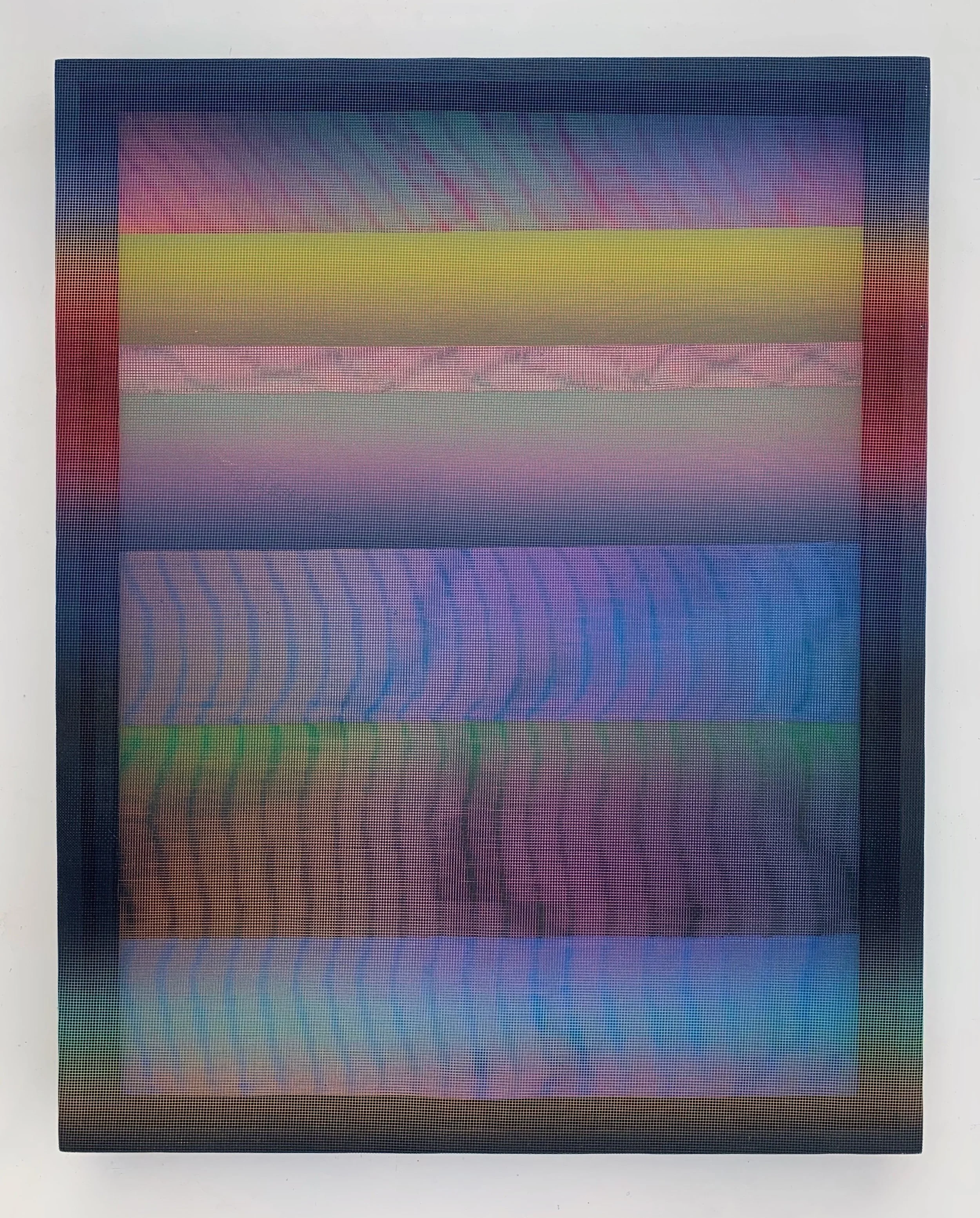
Party Animal 1, Samantha Buchanan, 2021
How would you describe your style to someone completely unfamiliar with your work? And could you tell us how Samantha Buchanan became the Samantha we know today?
At first glance, my work could be described as formal geometric abstractions that reference patterns found in architecture and nature with an emphasis on optical phenomena presented through layers of color. For me though, what I believe is at the heart of my work, is the way art can mediate our interactions with our environments – providing ways to be more connected to our lived experiences and more observant of the spaces we occupy. Sometimes this means foregrounding a place or observation, while other times allowing it to disappear entirely. This, I would say, is what I explore in my work, a mindfulness of environment and an acknowledgement of the complexities of perception.
When you were in your 20s, you read Letters to a Young Poet. I'm in my 20s right now and I find Rilke (as a poet) very difficult to understand - maybe because he is a philosopher after all. If you had to choose, what is the main point from that book that stuck with you? Also, are there any books you would recommend to our readers?
Letters to a Young Poet was given to me by a mentor when I was in my 20’s. At the time, I was struggling with indecisiveness about some significant decisions in life, so much so that it was causing a lot of self-doubt and depression. Conversations with this mentor helped me stop stressing out so much and allowed me to make some thoughtful decisions about my future. To me, Letters to a Young Poet embodies the importance of trusting one’s own instincts and finding your own individual path. I think if this book were given to me now, I might appreciate it, but it wouldn’t resonate in the same way that it did when I was in my 20’s. Readings hit differently at different times. It’s for this reason that I don’t really have any specific books that I would recommend to other readers. I will say that recently I’ve been drawn to a lot of writing from Environmental Historians exploring the connection between humans, culture, and ecology. For a slightly more art-focused approach I also really enjoy the work of Emergence Magazine.
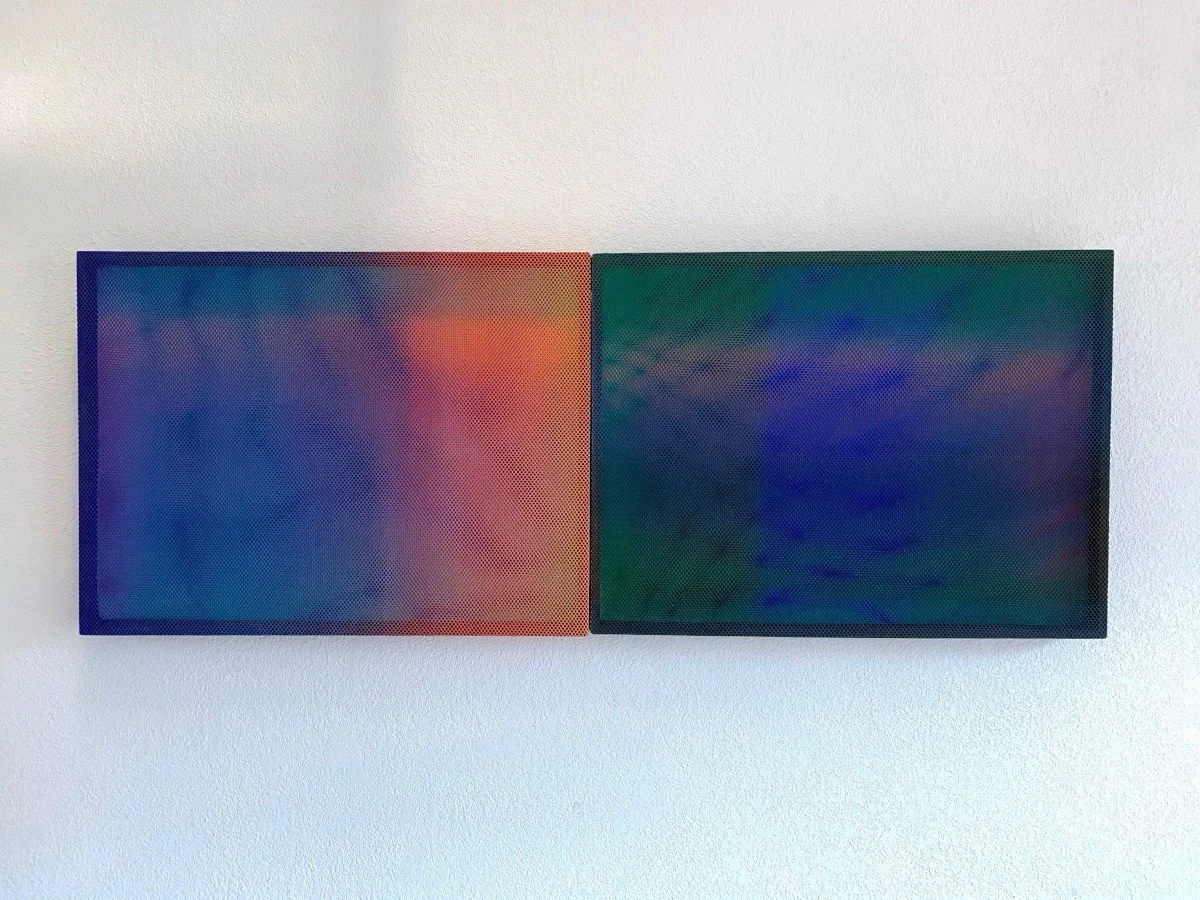
Pen/umbras, Samantha Buchanan, 2020
While submitting your work Vibrant Matter for this exhibition, you did something really interesting: you separated your piece. On one hand, we have the artwork in its normal state, but you also highlighted that this piece opens up from a different side when you let it sit under the sunlight. I noticed the sun is a sort of companion in your creative and regular life. Do you feel a particular connection between yourself and the sun?
I think so. I sometimes list “sunlight” as part of the media in my work, because it is, in part, what makes the shapes and colors so dynamic, but maybe more accurately I should list the sun as a collaborator, not a material.
I’m definitely very attuned to subtle shifts in natural light, particularly in how they affect my perception of color. On a few rare occasions, when the light has been just right, I’ve had experiences when my eyes have seemed to feel a color not just see it. These are really magical moments that I wish would happen more often. Observing changes in light, whether due to the time of day, or landscape, or weather, or the seasons, makes me feel more connected to the environment I’m in and contributes to a continued sense of wonder I feel about this world.
Can you guide us through the creative process behind Vibrant Matter?
Several years back I began a series of outdoor sited works composed of painted and cut fiberglass mesh with minimal armature. When sitting with these installations, I noticed that as the sunlight shifted, due to the time of day or presence of shadow, not only would the transparency of the material change, but the colors of the mesh often appeared to emerge out of thin air, without reliance on solid structures. Much of my work since then, including Vibrant Matter, is intended to encourage such optical phenomena, particularly those associated with light and color.
In Vibrant Matter specifically, the form is loosely inspired by the Finnish Himmeli and other geometric straw mobiles found in a variety of different cultures. The names of these straw constructions tend to have associations with nature, such as “gardens” or “sky” and historically were constructed as a way of acknowledging our reliance on the earth and promoting good fortune. I’m interested in the ways in which humans celebrate earth cycles (like solstices, for example), both mythologically and in contemporary practice and I find that not only do these geometric forms function in that way, but they also have a meditative quality, which I hope encourages the viewer to sit and observe my work longer.
Vibrant Matter’s colors and negative space are drawn from my observations of mountain light while at an artist residency in Lake Tahoe, NV. My daily routine during the residency consisted of heading to the studio in the morning, working until late afternoon, snowshoeing on one of the adjacent trails till dusk, and then heading back to the studio. While on the trails I saw such beautiful fleeting glimpses of color and light. The snow in the air would act like prisms, allowing color to hang in front of me for a moment before vanishing. Golden hour was intensified by the light reflecting off the lake or snow-covered trees. I had more time to observe all this beauty because I was moving so slowly, on foot, through the snow. At the start of the residency, when I would return to the studio at night, I was often unhappy with what I had printed earlier in the day. The grid patterns, a frequent motif in my work, felt too aggressive. I love the stability that a grid can provide, but it seemed out of place in this mountain environment. And so, inspired by the ethereal qualities of light and color that I saw while there, I began cutting out entire sections of my composition to allow for more negative space. This excising of material then gave the screens that I print on more freedom to react to shifts in ambient lighting.
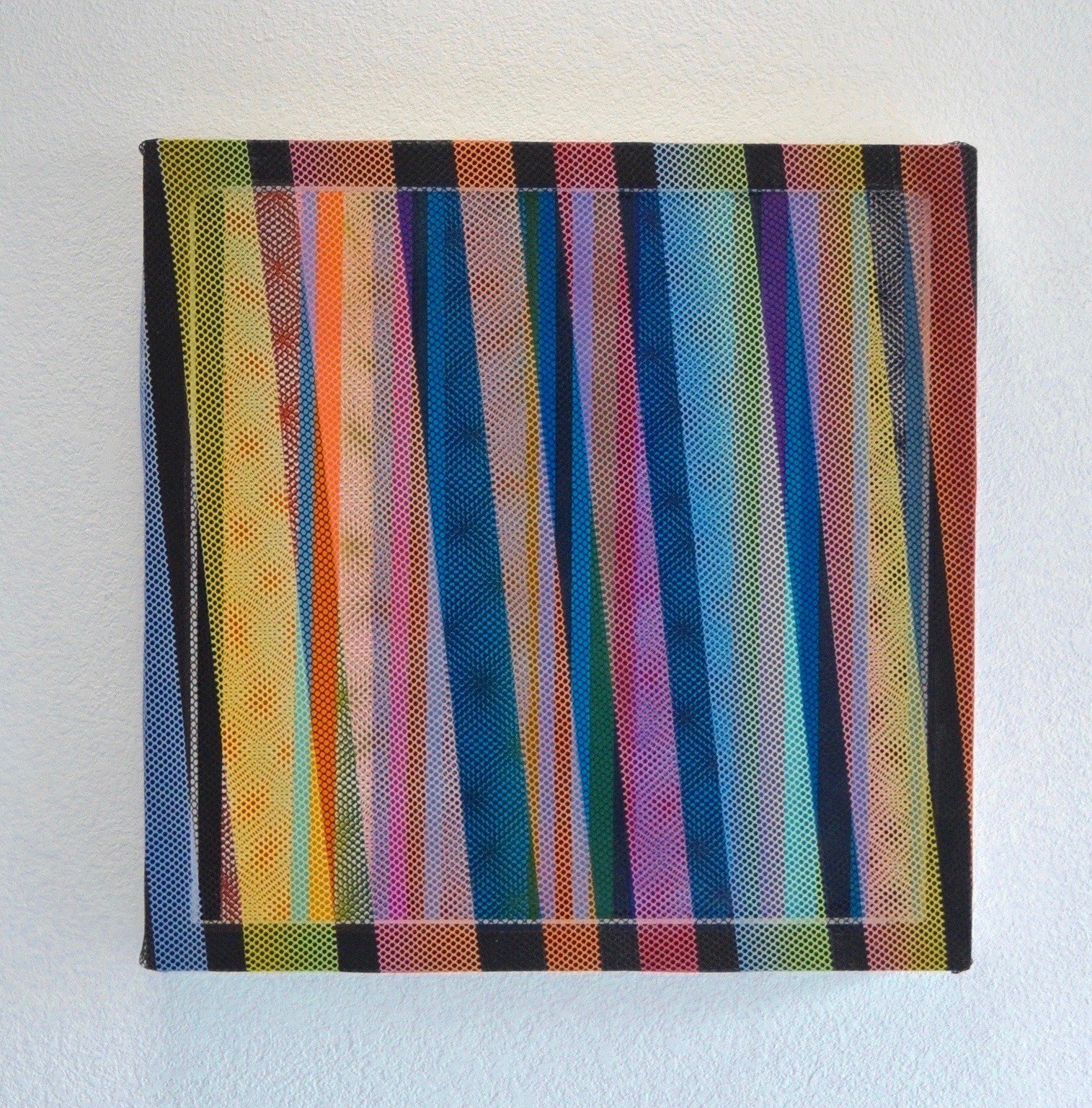
BIP 1, Samantha Buchanan, 2019
Do you have any upcoming projects that you would like to share with us?
The Holland Project, a wonderful local art space in Reno NV, is hosting a series of exhibitions highlighting new and experimental work. In late August I will be showing work from the Vibrant Matter series along with a flower installation. This will be the first time that I’ve included an olfactory component in an exhibition and I’m excited to see (and smell) the results.
What is the main message you want to convey to people looking at your work at this exhibition?
What I love about working with perforated materials – screens, essentially – is their unique ability to be either an opaque or transparent substrate depending on variations in environmental context – the angle of light for example. This physical quality allows the semitransparent mesh to materialize subtle shifts in light, shadow, and color. Therefore, the work is always changing, always in flux, similar, I believe, to our environments and our perception of them. So ultimately, I hope that Vibrant Matter encourages slow, thoughtful, observations of the fluidity of life.
The one important conclusion I made for myself out of this conversation is that we need to carry our ideas into the sun more. Let them cast a shadow. We spend a lot of time trying to lock our work into a perfect, rigid grid. But as Buchanan found out in those mountains, sometimes you just have to cut a hole in it and see what the light does.
To learn more about Samantha Buchanan’s practice, visit her website.
Article by Vasya Kavka
Based in Ukraine, Vasya Kavka is a writer working at the intersection of contemporary art and digital culture. Through his platform @ambient.delusion, he researches emerging and underground artists, publishing interviews and editorial features that move beyond aesthetics to examine context, creative process and cultural relevance. His work is driven by curiosity and a commitment to thoughtful, accessible storytelling that situates artistic practices within the broader currents shaping contemporary culture.