THE BEAUTY OF UNCERTAINTY: DELIA HOU ON PAINTING THROUGH PARADOX
In Delia Hou's practice, color becomes a site of inquiry rather than resolution. Presented in the online exhibition Color as Concept, her painting Derrumbe occupies a space where perception, sensation, and thought remain in continual flux. Drawing on a background that spans astrophysics, law, performance, and visual art, Hou approaches abstraction as a method for engaging paradox and complexity. This conversation explores the artist's concept of the "No-edge Painting," the role of ambiguity in contemporary life, and the ways color can evoke experiences that resist the certainty of language.

Derrumbe, oil on linen, Delia Hou, 2026
Origins and Influences
Your biography moves through seemingly disparate worlds - astrophysics, law, tango, performance, and painting. Do you see these disciplines as separate chapters of your life, or have they always been part of the same inquiry?
These disciplines are separate in the sense that there is no way I could have predicted in the beginning that I would end up in all these fields. On the other hand, I do feel that they are all related, with one thing leading to the next according to an internal pulsion and external luck. That internal pulsion would be a curiosity about the world and a desire to capture the sheer beauty in it in various different ways, whether it be distilling the behaviour of galaxies into scientific equations, codifying justice and human nature into law, embodying it in a fleeting experience while performing, or condensing the essence of a sensation into a visual expression. I see these as results of a single internal impulse of striving towards the perfection contained in something beautiful, the glimpse of which we can only imagine. If I follow the thread of that vague sensation in the imaginary plane in order to externalize it into concrete form in our physical plane, it comes out in all these different formats.
In your artist statement, you describe paradox as a "generative condition" rather than a problem to resolve. How does Derrumbe embody this idea of productive contradiction?
Let me clarify, firstly, that I do not mean generative in the sense of AI or art otherwise created with the use of an autonomous system. I mean to highlight the fact that paradoxes and contradictions are a rich source of inspiration, if we do not shy away from them just because it is easier to avoid the uncomfortable process of working through a cognitive dissonance. I enjoy honing in on those instances to delve into complexity and flesh out subtleties. This shows up conceptually in my performance and sculpture-based work, which allude to themes such as the exoticization of Asian women, or the monetary value of everyday objects, or the commodification of the art object and female body. In contrast, in my abstract paintings, I deliberately step away from recognizable symbols to avoid triggering the thinking game. I tap into my internal perceptual state, in the visceral realm previous to explicit language-based categorization, and register the waves of sensation colliding within myself in order to meld the paint on the canvas accordingly. The abstraction contains paradox in a perceptual, embodied way. In Derrumbe, I chose to start off with red and green, colors that are contradictory in the sense that they are hard to make work together.
“The softened edges represent a certain pleasurable indecision during moments when multiple truths are held simultaneously.”
Derrumbe is presented within the exhibition's theme of "Color as Flow," where boundaries between hues dissolve and reform. What interests you about moments of transition, and why do softened edges hold such significance in your recent paintings?
The softened edges represent a certain pleasurable indecision during moments when multiple truths are held simultaneously. Once a hard edge is included, the mind latches onto specific forms, and alternative realities are collapsed, like quantum states, into one, where the visual experience now has a starting point for the logical mind to follow a specific path to specific conclusions. I try to avoid that by making as less of a boundary as possible between colors, and distributing the colors in a way that keeps the eye moving, not allowing the viewer to settle into any overly comfortable conclusion.
I had not thought about moments of transition in particular…as opposed to moments of tranquility or stability? I suppose I have moved around so much geographically and between different activities that all moments actually feel like moments of transition. Never a dull moment when the default mode is constant expansion!
Color and the Language of Painting
The title Derrumbe translates as "collapse" or "landslide." In a painting where colors seem to merge rather than break apart, what kind of collapse are you referring to -psychological, social, bodily, or something else entirely?
Derrumbe is one of the paintings that reflect an imaginary downward pull of gravity on the colors on the canvas, in contrast to some of the other paintings that are expansive in all directions. So I was guided by collapse in a physical sense during the creation. But, instead of collapse happening in a short moment like in the physical world, the painting gives a continual sense of collapse over an extended period of time as you look at it. I stop there at that sensation, but I hope that that starting sensation guides the viewer to feel out where it leads them to, which can be personal experiences and memories, psychological pondering, association with societal collapse, among other things.
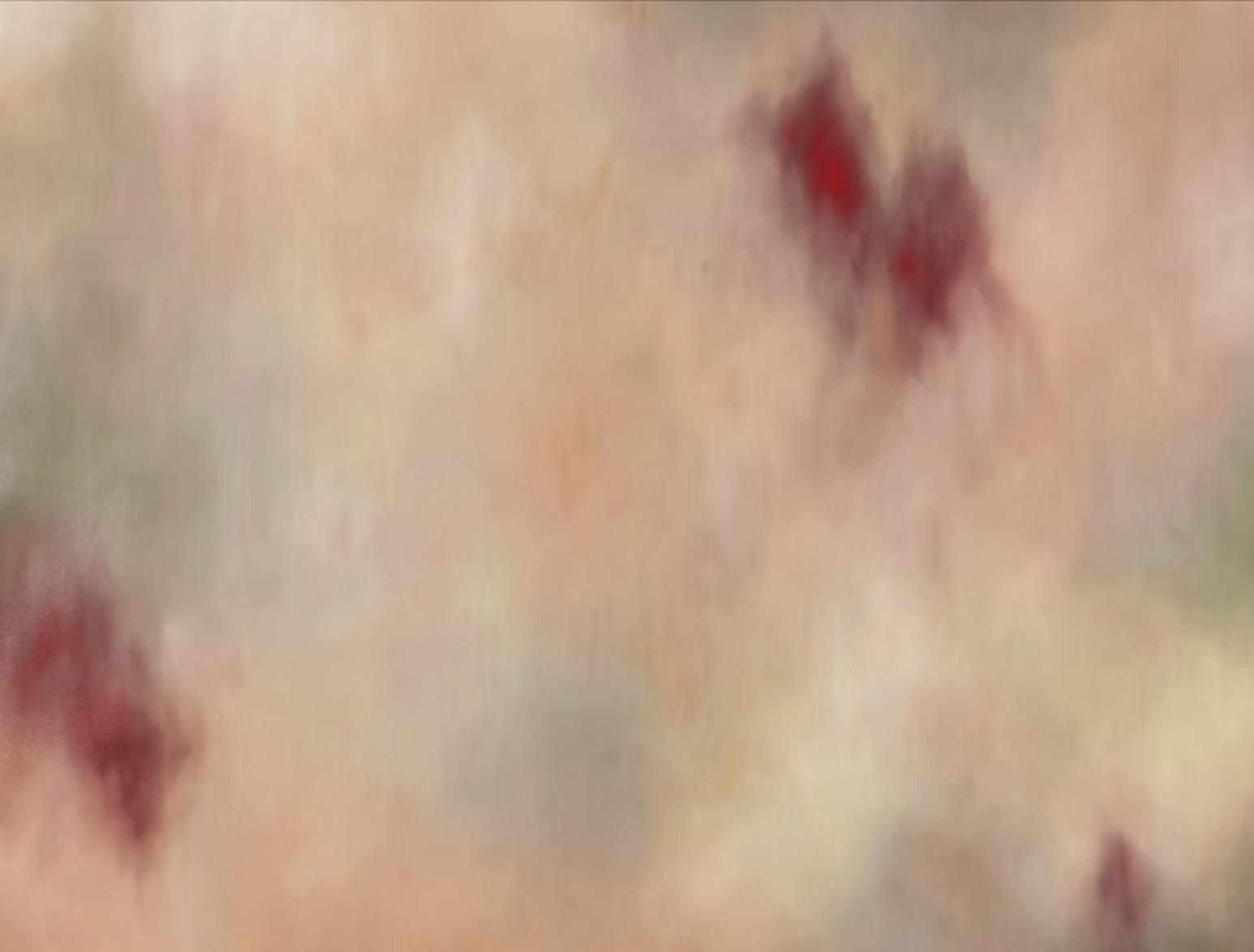
Psyop, Oil on canvas, Delia Hou, 2026
Having studied physics, you reference fields, probabilities, and relational systems in your statement. Do you see your paintings as visual analogues to scientific concepts, or are these ideas more intuitive influences?
A scientific equation captures an aspect of the physical world in a concise manner, using agreed upon mathematical concepts and conventions, and balancing one group of variables on one side of the “=” sign to the other to get to a solution. Likewise, a painting captures an aspect of our internal worlds in an expressive manner, using natural responses to visual stimuli and referencing collective symbols developed through art history. It is also a “solution” in the sense that I am working out combinations of color and form to embody a specific sensation.
In Art and Fear by David Bayles and Ted Orland, they talk about art and science, with the difference being specificity vs. generality. In science, one comes up with general principles to govern all instances of a certain aspect of physical phenomenon. In contrast, in art, each work is a very specific expression, which can not be interchanged with any other work. It made me think about how we seek to strike a note of universality in our creations, to create something that resonates universally. But it has to be specific and unique when it is an artwork, and it has to be formulated as a general principle in science. Art and science thus address aspects of universality from opposite ends of a spectrum.
In terms of whether I use specific scientific concepts as visual analogue or intuitive influence, I do often have a scientific idea present in my mind as I paint. It could be the concept of path dependency, or the birth of the universe, or the wave-particle duality, for example. However, I do not intend the painting to be a direct illustration of the idea. In fact, one thing I like about abstraction is that I feel like I can keep secrets in it.
Your paintings often privilege atmosphere over representation. Do you think abstraction can communicate emotions or experiences that figurative imagery cannot?
These abstract paintings avoid concrete form in order to prevent the mind from latching onto specific symbols of meaning. After this question made me think about atmosphere more deeply, I think we could actually describe emotions as an internal atmosphere. We use words to label our emotions, which is very useful for operating in daily life, descriptively, in order to communicate what we feel to others. But it can be prescriptive and thus limiting as well. Once you name something, you associate it with previously held associations and prejudices. The atmosphere in my paintings asks what happens when we dedicate attention, time and space to contemplate and embody sensations on a perceptual level, without labelling them. It is a more expansive way to register what we are feeling.
Figurative imagery can certainly also invoke emotions alongside the visual, aesthetic experience. And if there is a narrative within the entire painting, there is also an aspect of time and sequentiality included in the viewing experience. My other work in performance and sculpture uses these sorts of methods to address different themes, calling upon the viewer to make new associations within their past experiences and prejudices. In deliberate contrast to this, my abstract paintings try to go to the farthest opposite point of the spectrum to avoid explicit associations. I imagine these atmospheric paintings as if they were a web of strings where the strings are relaxed, and once there is something figurative, the strings become stretched taut, and we begin to use logical thinking to follow along only those limited paths. Those paths along the taut strings can certainly lead to interesting places, but different places from when you make a deliberate effort to stay in that state where the web of strings is relaxed.
Across your practice - from performance to sculpture and digital media - you often use beauty as both seduction and trap. Does color function similarly in your abstract paintings?
So much has been written on aesthetics and the role of beauty, for example by Kant, Croce, Greenberg, or Merleau-Ponty. I certainly am not able to reproduce their articulate analyses here, but my concept of beauty, in comparison to color, is that it is a human sensation that occurs inside us. It is so innate to our species and inevitable in front of certain external conditions that we can't help but experience it when we are confronted with it. In that sense, it seduces and we get trapped into those sensations (which I hope is not too fleeting when it is caused by my artwork.) I hope to trap the viewer for long enough to register and ponder the sensation so they can reach new internal destinations. On the other hand, I see color as something pertaining to the outside world that can stimulate that sensation of beauty, or lack thereof. So beauty would be an internal sensation, and color an external tool for creating that sensation.
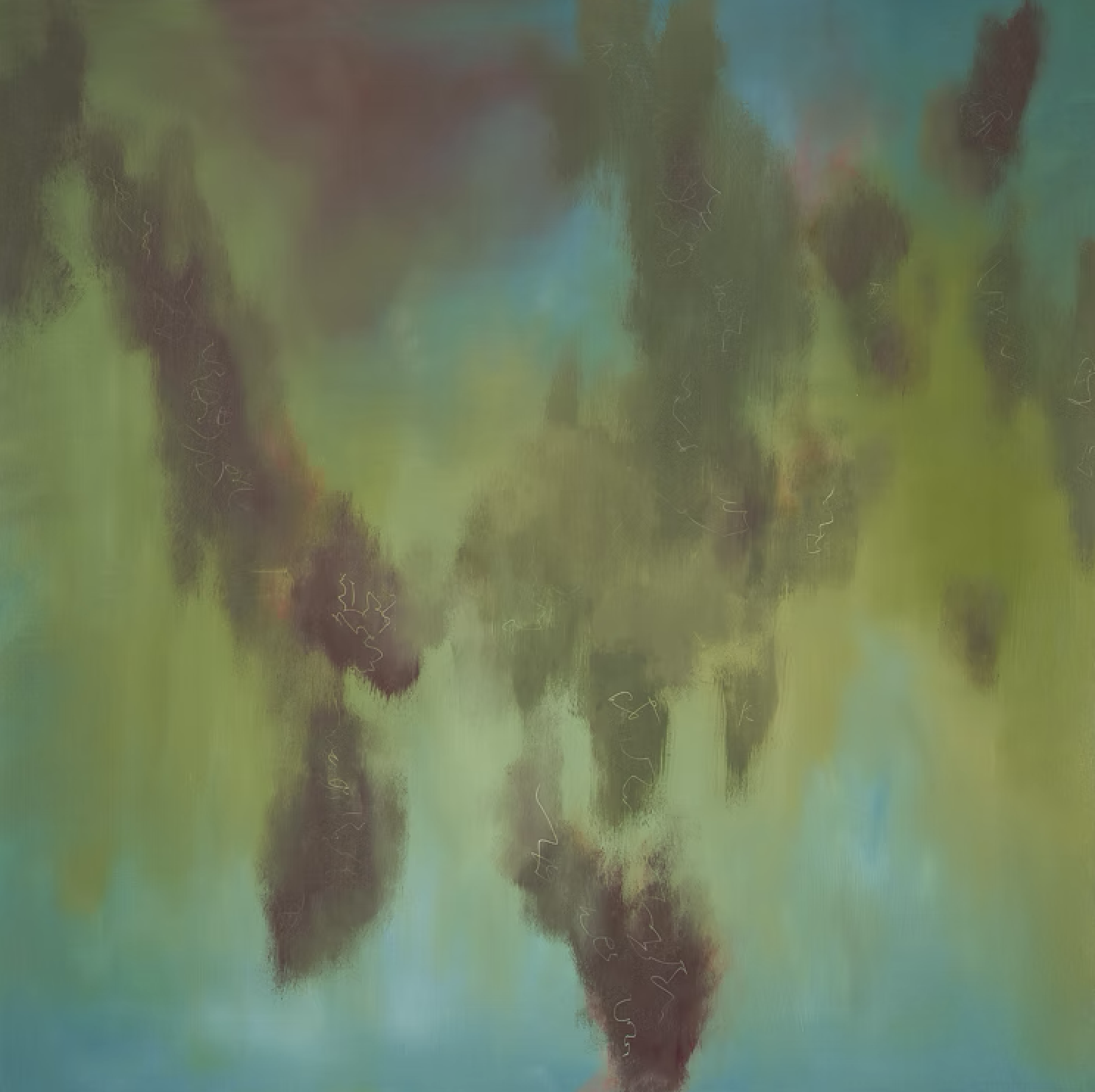
Path Dependency, Oil on linen, Delia Hou, 2025
Ambiguity, Collapse, and Contemporary Life
You have lived between Taiwan, Malaysia, the United States, and Argentina. How has migration shaped your understanding of color, atmosphere, and perception?
Each place definitely has its own color scheme, culturally as well as existing in the natural environment. Atmosphere would depend on many factors such as smell, temperature, spacing and speed. And perception involves the detection of these physical attributes of the place, but also makes me want to factor in the human and social aspects of a place, and include those subtle sensations generated by the undercurrent of social norms that govern us in each location.
Migration has shaped my awareness of these elements because I could never just assume any social convention was the established one. If you grow up in one place, you know what the social conventions are. But if you are in a new place, for example, something as simple as a meal presents a million unknown variations, from how you use utensils, to when to begin eating, to how you say hello, etc. All I can be certain of is that everything - color, atmosphere, perception - is so infinitely varied and ever-changing. Thus, it is liberating and comforting to be able to use colors moving across the surface without points to settle on. It captures traces of sensations from all these places, and retains the fluidity of those moments in life when I have to be attentive to particular social customs and be ready to adapt in real-time.
In the exhibition's curatorial statement, color is described as something that can evoke sensations that resist articulation. Are there experiences or memories in Derrumbe that you intentionally leave unresolved or beyond language?
I have had the luck to have an art teacher who emphasizes how good art leaves space for the viewer to complete the work, rather than spell everything out for them. It is up to each viewer to take the last step to figure out the meaning personally. With my background in analytical fields like physics and law, it is hard for me to turn off the constant thinking and labelling in my brain, and step away from the desire to point to specific and practical solutions. By resorting only to color, avoiding even form, I am extending the stage that exists previous to language, and leaving things unresolved. I would say it is previous to language, rather than beyond it. That is an interesting way to put it, though. What would post-language look like, as opposed to pre-language?
I do not want to mention a specific personal memory or experience because that would condition the work into too specific a meaning. It is like the observer effect in quantum mechanics where the double-slit experiment showed that the observation itself determines whether light behaves as a wave or a particle. I do not want to collapse the meaning of the painting into a single one…other than naming the painting itself “collapse”! The title is just a clue, not a conclusion.
Contemporary culture increasingly blurs boundaries - between physical and digital spaces, identities, disciplines, and geographies. Do you think your "No-edge Paintings" are responding to this historical condition, and if so, what do they reveal about how we inhabit the world today?
With the advent of globalization and internet connectivity, I think there was a sort of hope that the breaking of boundaries across the limiting factor of geography would allow humanity to reach a higher point of global harmony. Unfortunately, that has not been the only thing that has happened, with, in some senses, more division than ever. We have formed pods of like-minded people, which is of course, a natural thing to do based on our instincts of social connection, and can be a positive force by allowing us to advance deeper into whatever topic personally excites us. However, we are getting stuck in echo chambers that lead us to rigid labelling according to preconceived notions of identity and unhealthy extremes. Given this natural tendency toward ending up in extremes when we are bombarded with so much information and diatribe, these “No-edge Paintings” are an invitation to take a break from the rational thinking mind. When colors collide, they meld together to resist coalescing into rigid, articulated limitations. In some sense, they are personal attempts to short-circuit my own tendencies to overuse my thinking mind. And, at the core, they depend on my fundamental belief that we are ultimately creatures of goodness and light, if we are sufficiently open to and in touch with our innate instincts.
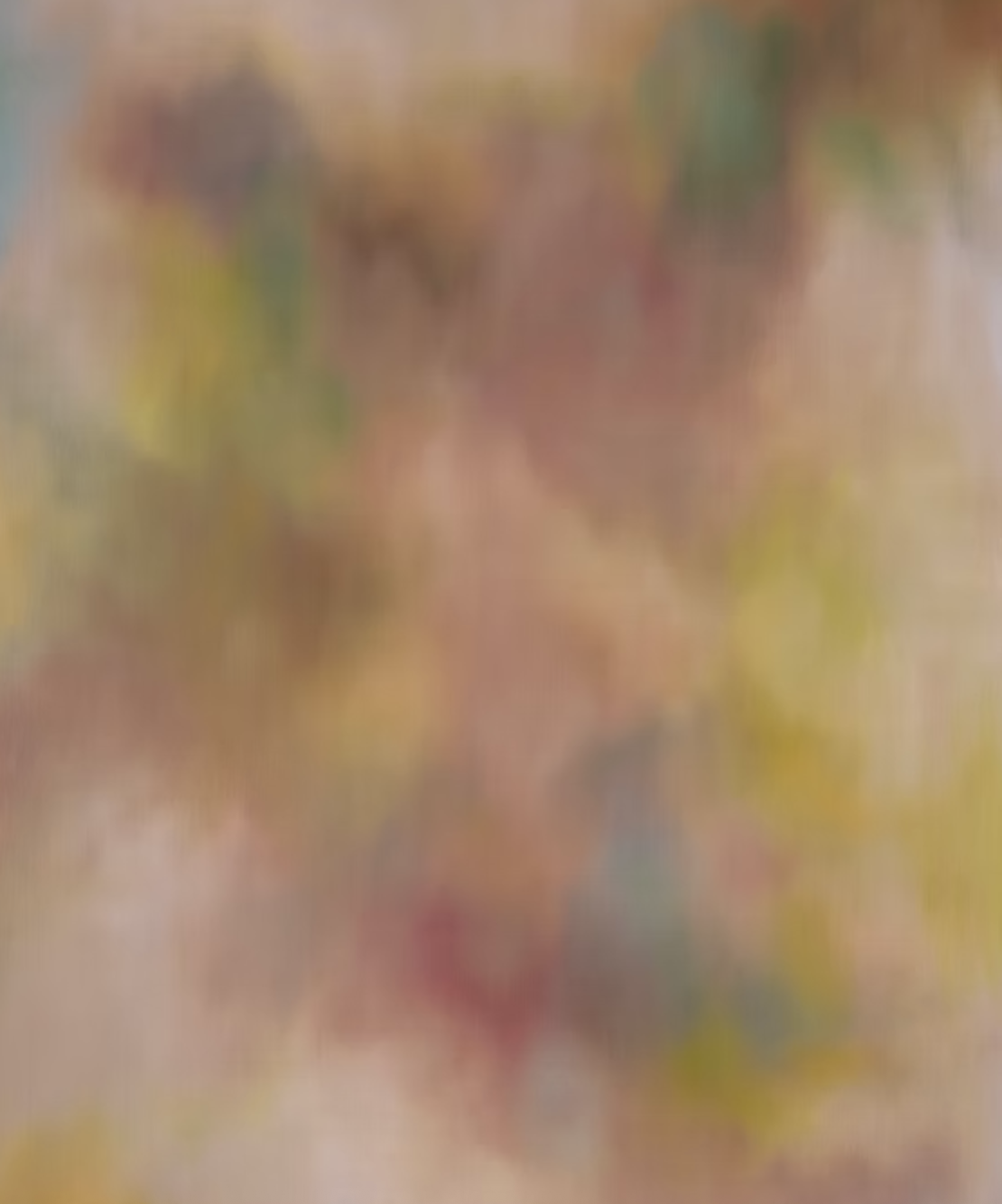
Monet II, Oil on linen, Delia Hou, 2025
To learn more about Delia Hou's practice, visit her website.
Derrumbe is featured in the online exhibition Color as Concept, on view from 5 June to 20 July 2026, and is available for acquisition through Ambrose Creatives.
Article by Alexandra Vîstraș
Alexandra Vîstraș is a Brussels-based cultural observer, policy professional and lifelong theatre enthusiast. With a background spanning cultural management, European policy and communications, she is interested in the ways art, politics and collective imagination intersect, particularly through the lenses of gender, identity and social change.