
SIMPLICITY LEADS YOU TO THE DEPTH: INTERVIEW WITH STEPHANIE SAETA
It takes only a few words to grasp the art of Stéphanie Saêta. Her painting does not lend itself to the complications of a superficial explanation; rather, it prefers to present itself with simplicity and, with that same immediacy, to explore a way of giving form to experiences still finding resolution in the artist’s life.
The first word I feel I should begin with is "escape".
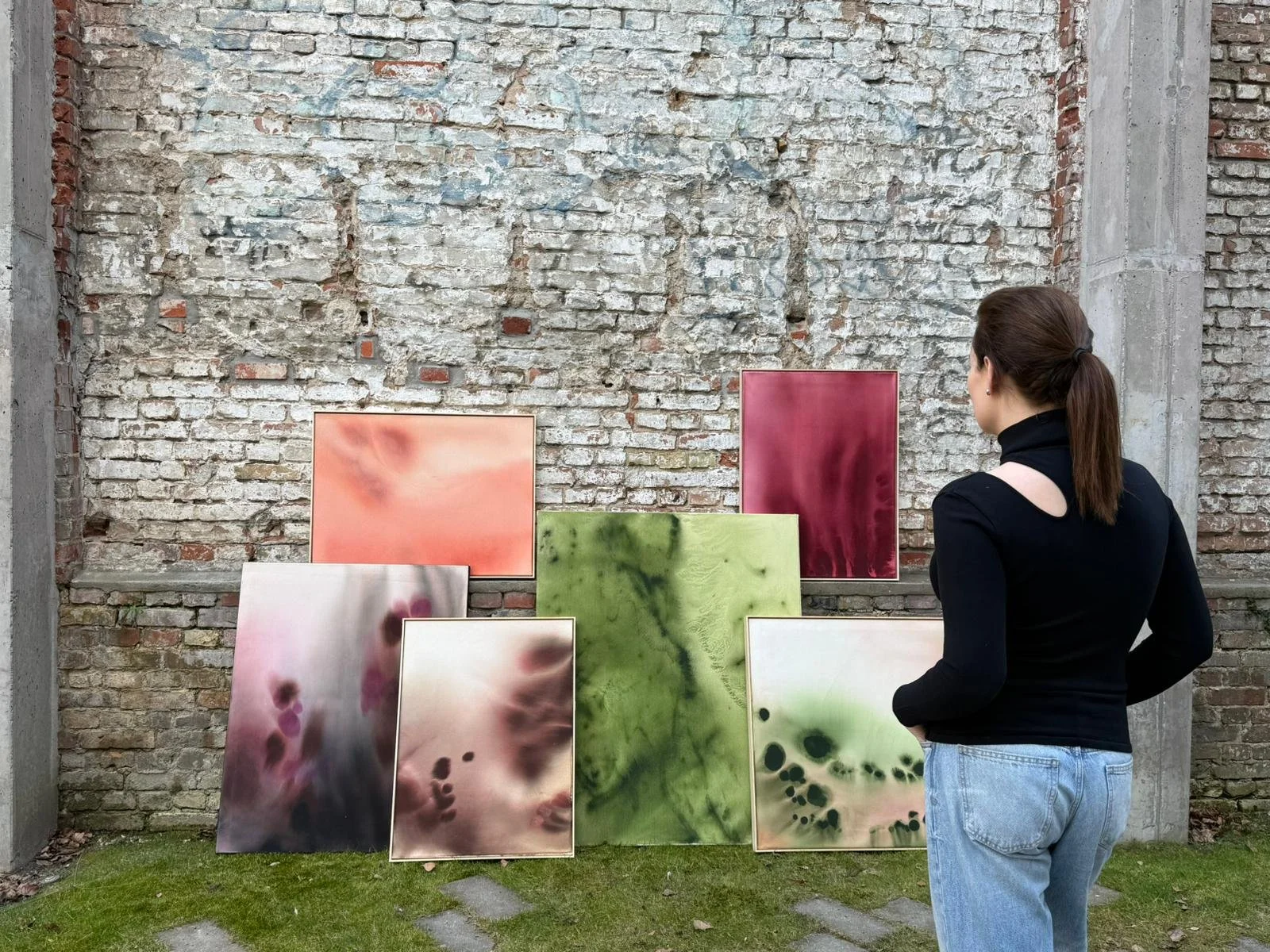
Stephanie Saeta started painting in 2020, during the pandemic. At the time she was working in the corporate world, in marketing and brand strategy, and, initially at least, she found in painting a personal space where she could distract herself from the heaviness of the period and the uncertainty of what lay ahead.
So, without a precise plan, driven solely by the instinctive need to create with her own hands, she first approached art. Over the years, this intuitive gesture has gained substance and grown much deeper, carving out a space of its own in the artist's inner world, where unresolved emotions and memories too difficult to translate into words converge and condense. It was in this space, for example, that her experience with cancer treatment, undergone years earlier, surfaced - an experience that radically changed the way she perceives human fragility.
"During treatment, I remember noticing the artworks, colours and forms in the hospital environment. In a very difficult period, they had the ability to move me somewhere else, even briefly. I think that stayed with me.”
Courtesy of Stephanie Saeta
The second word is "chance".
From the outset Stephanie Saeta was drawn to abstraction, precisely because of its ambiguity - which, in the artist's own words, is its most compelling trait, as it allows different, even opposing, interpretations to coexist, shifting attention from the obviousness of a depicted subject on the canvas to the effects the work produces on whoever contemplates it.
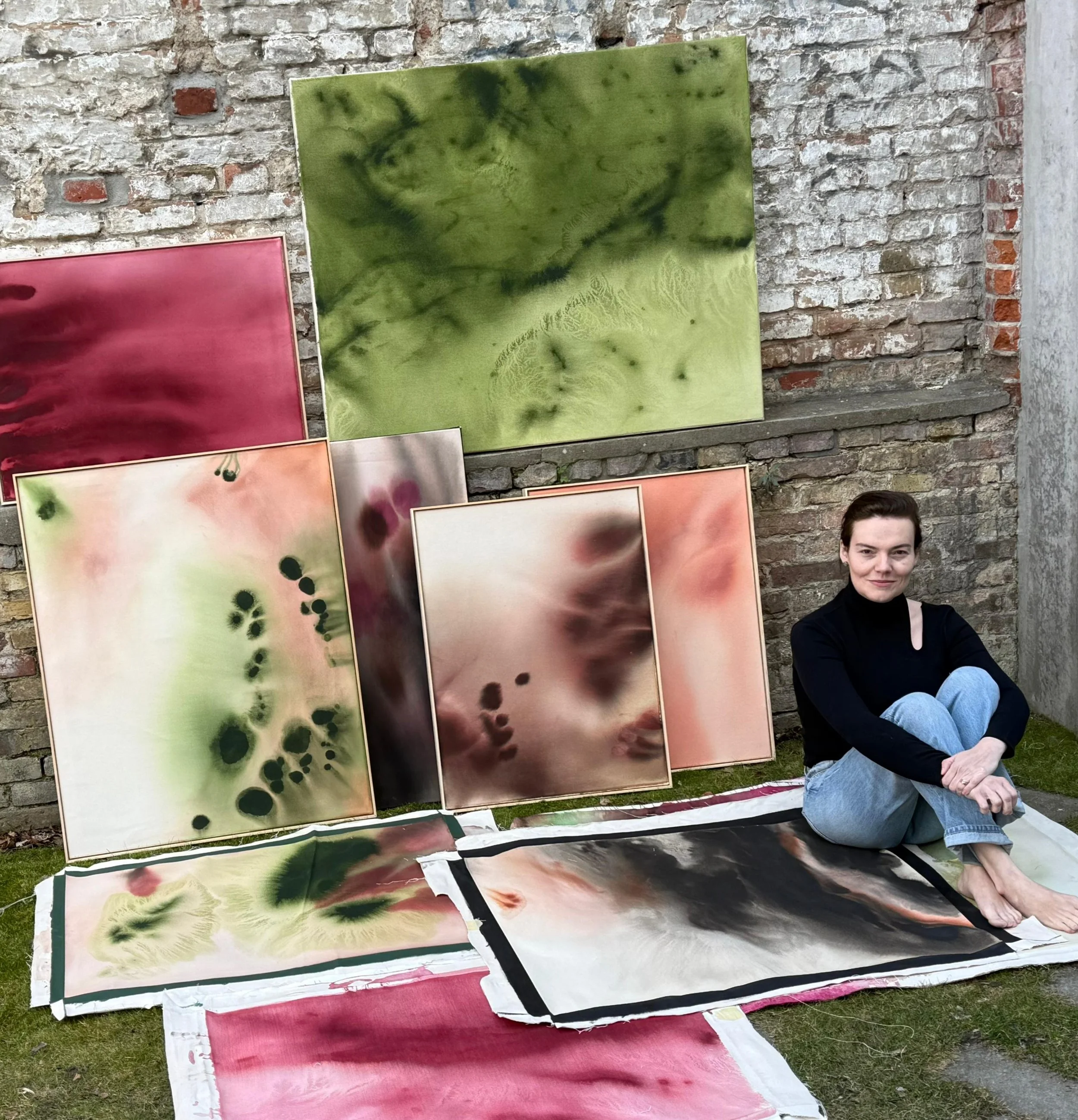
Alongside interpretive freedom, another essential aspect of the process is what the artist calls an "element of surrender": the absence of absolute control over the materials and their reactions. The artist mainly works on raw canvas with diluted acrylic paint, acrylic ink, and a great deal of water, seeking an atmospheric effect punctuated by heavy stains, soft edges, and movements that appear almost suspended.
"I like the texture of raw canvas and the way it absorbs pigment directly. It allows the color to sink into the surface rather than simply sit on top of it.”
The artist, then, can guide both the pigments and the water, but never control them completely: they keep moving and redistributing themselves as they dry, in perpetual transition, in perpetual formation.
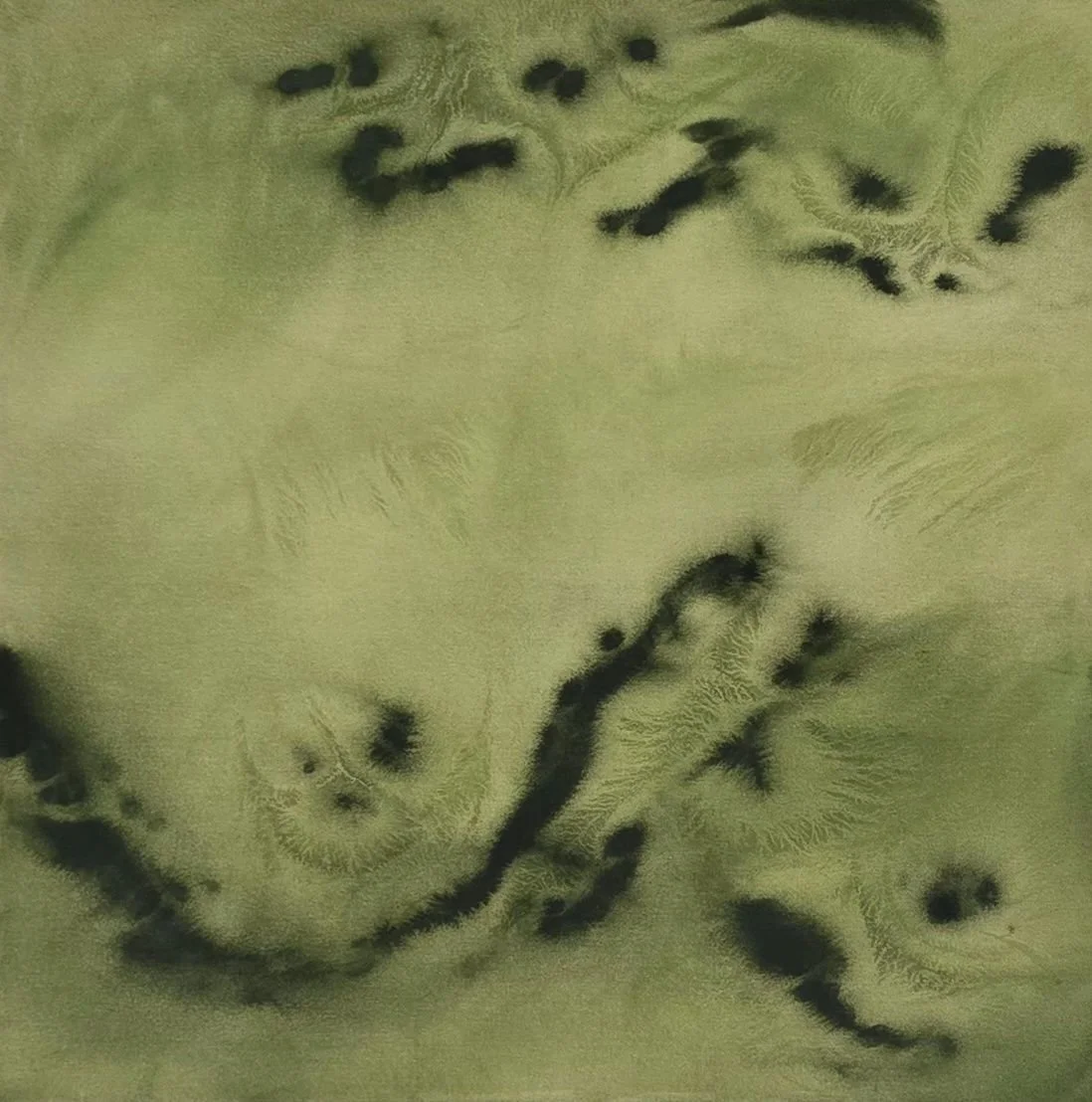
With the word "transition" we go deeper into the artist's work and introduce the series Whispers, to which the painting Green Drift belongs.
“Not the storm itself, but the moment after, when things begin to settle.”
The Whispersseries began in 2025, coinciding with Stephanie Saeta's decision to pursue a career as a full-time artist. It is the fruit of a practice that has gradually grown more substantial, one that, compared to the earlier works of the Texture series - focused on material weight and the incisiveness of gesture on the canvas - moves toward airy atmospheres. This new direction aims to render the idea of presence, just as the title evokes, in a delicate manner: a presence that spreads everywhere almost imperceptibly, with soft movements.
"Not the storm itself, but the moment after, when things begin to settle": the trace of a form, still imprecise, still suspended.
And yet certain elements enrich this notion of presence in deliberately ambiguous ways. For example the considerable size of the works give them a strong impact on the surroundings, allowing soft edges and rarefied atmospheres to expand, as if the observer were suddenly surrounded by whispers. The colours, in turn, contribute to this sense of ambiguity and unease, as we will see in the case of Green Drift.
Green Drift, Stephanie Saeta, 2026
"Drift": Let us talk about Green Drift.
It is thanks to this work that we connected. It is a painting measuring 100 × 100 × 3 cm, executed in acrylics on canvas. The green washes create an atmosphere that aims to appear organic, yet is unstable. The colour oscillates between vegetal, mineral, and aqueous associations, while darker marks disrupt the softness of the surface.
Rather than using green as a calming element, the work explores how the colour can generate, at one and the same time, a sense of familiarity and disorientation, where the natural spills over into the chemical and the industrial — into something that can feel as a growing tension. This colour would like to become a bearer of calm and hope, but is forced to contend with a drift that is innate to it. The black marks, on the other hand, testify to a fading of the suspension, and the emergence of telluric, subterranean forces that add depth, and movement to the surface.
The more one tries to define Stephanie Saeta's art, the more one loses sight of how it works. It sets the tone for a larger reflection, which is why the artist prefers to leave room for the viewer. The longer the eye lingers on the painting, the more the mind, lacking any concrete anchor to hold on to, begins to fill its voids and elaborate. And from that deliberately left darkness, monsters or paradises surface, depending on what remains unresolved within each of us.
Courtesy of Stephanie Saeta
See more of Stephanie’s work on her website.
Article by Nicolas Sartorel
Nicolas Sartorel is an Italian writer and aspiring editor. His work bridges analytical rigor and aesthetic sensitivity, with a specific focus on the structural and formal mechanisms of literacy. Currently based in Brussels, seeking opportunities in international and multicultural environments.