
ZIQI YU: UNDERSTANDING SILENCE
“Before you collide with order, you must know how order functions.”
For Ziqi Yu, the artist and creative director known as Fanfu, art is not a search for harmony – it is a study of impact. To look at his work is to witness a controlled explosion of geometry against a backdrop of absolute stillness. It is a visual language born from the friction of a life split between the ancestral weight of Guangzhou and the individualism of the American West.
In a landscape crowded with digital noise, Yu’s practice is a rare exercise in restraint. He is an artist who understands that a fracture is not just a break, but a revelation. We sat down with Ziqi to discuss the tension of living between cultures, the courage required to leave a canvas empty, and why the path to stillness often begins with a break.
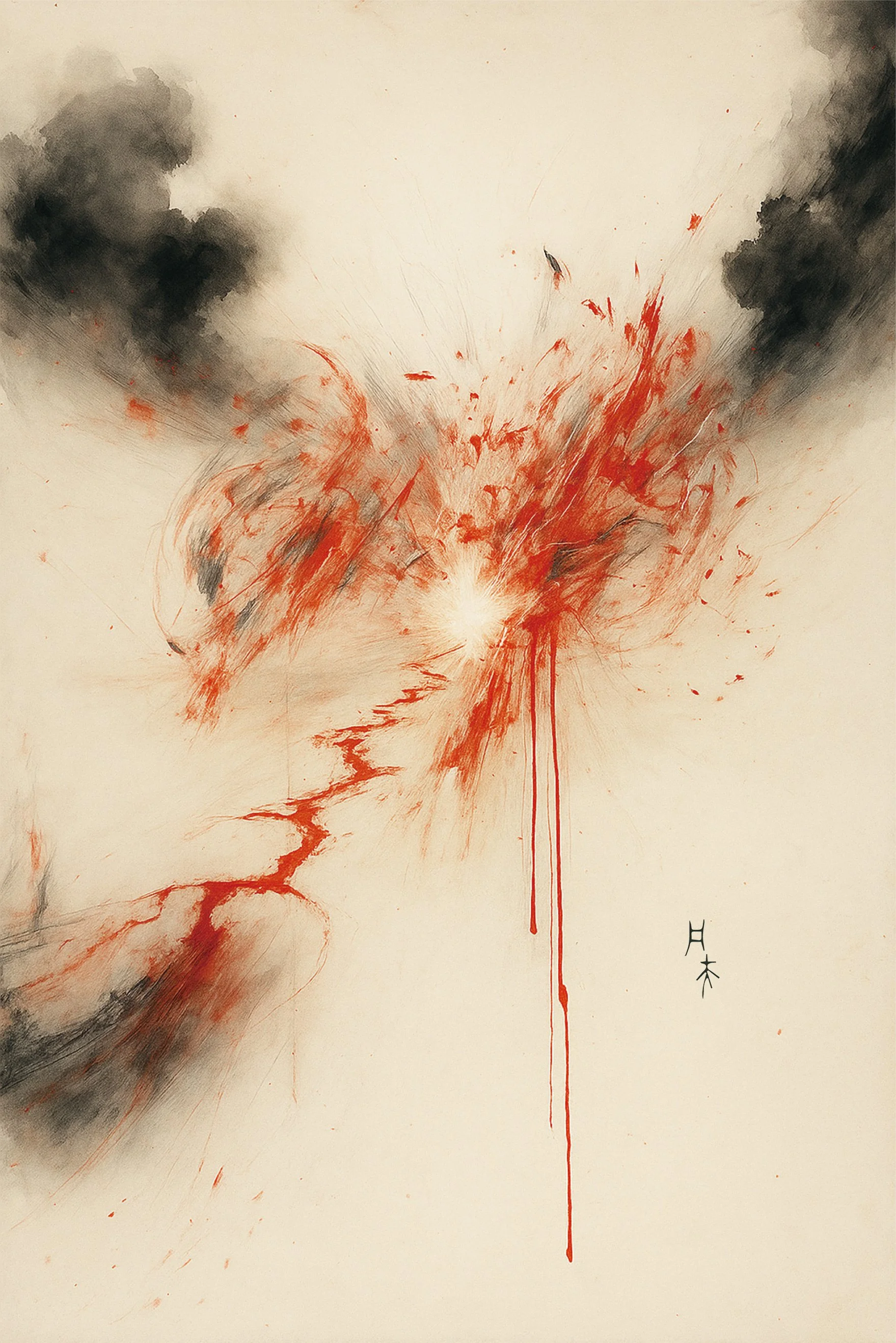
Stigmata of the Cosmos VI: The Path of Shattered Light by Ziqi Yu, 2025
You were born in Guangzhou and raised in the US. Usually, people call this a blend of cultures, but your work feels like a collision. As an artist, how does this switch between two completely different worlds affect you?
I don’t experience it as a “blend.” A blend suggests harmony. What I lived was tension.
Guangzhou gave me memories without explanation. America gave me language without roots. I grew up translating not just words, but realities. At home, history was heavy, unspoken, ancestral. Outside, identity was individual, self-constructed, forward-moving.
This wasn’t multicultural comfort – it was psychological tectonics.
That collision shaped my work. I am constantly negotiating between silence and articulation, between inherited gravity and chosen freedom. My abstraction is not stylistic; it is structural. It comes from standing between two worldviews that do not naturally reconcile.
Switching between worlds trained me to live in fracture. And in that fracture, I discovered something essential: tension creates depth.
My work is not about East or West.
It is about what happens to the human spirit when it must survive both.
Most of the artists I talk to are self-taught, and they often see art school as a “cage” that limits creativity. Since you went through the ArtCenter College of Design, what’s your take? Looking back, what were the valuable lessons you gained there?
“ Learn to create. Influence change.” That was the motto of ArtCenter College of Design.
Many artists see art school as a cage. I understand that fear. Structure can feel restrictive. But I experienced it differently. ArtCenter did not cage me – it disciplined me. It taught me that before you break structure, you must first understand it. Before you collide with order, you must know how order functions. What I gained there was not style. It was rigor. Deadlines. Critique. Precision. Accountability. Those years trained my eye, but more importantly, they trained my mind. Today, my work often speaks about tension, fracture, collision. But that collision is intentional. It is not chaos. It is controlled impact. Art school gave me order. Life between cultures gave me collision. My practice exists between the two. True freedom is not the absence of structure. It is the ability to move through structure without being defined by it. That was the real education.
“I am constantly negotiating between silence and articulation, between inherited gravity and chosen freedom.”
In your work Stigmata of the Cosmos VI : The Path of Shattered Light, you describe the red fissure as a "trace of a torn soul" and the "pain inherent in illumination". This sounds much more emotional than the typical peaceful view of Zen art. Is the path to inner stillness always a destructive process? And can you tell us about the creative process behind this piece?
Zen is often misunderstood as calmness. But stillness is not the absence of rupture. In Stigmata of the Cosmos VI: The Path of Shattered Light, the red fissure is not violence for its own sake. It is revelation. Illumination is rarely gentle. To see clearly, something in us must break. The “trace of a torn soul” refers to that moment when identity fractures – when illusion collapses but truth has not yet stabilized. The pain is not destruction; it is transition. But destruction and rebirth are not opposites. They are part of the same cosmic order. Stars collapse to become light. Galaxies fracture to create new gravity. Even supernovas are not endings – they are redistribution.
Inner stillness follows the same law. It is not achieved by avoiding intensity, but by passing through it. The path feels destructive because the ego resists dissolution. But what dissolves is not essence – it is attachment. Regarding the creative process: The work began not with an image, but with pressure. I was not composing harmony. I was witnessing impact within order. The path of shattered light is not chaos. It is the moment where destruction becomes passage – and passage becomes renewal. Stillness does not come before the break. It comes after we recognize that even rupture belongs to the cosmos.
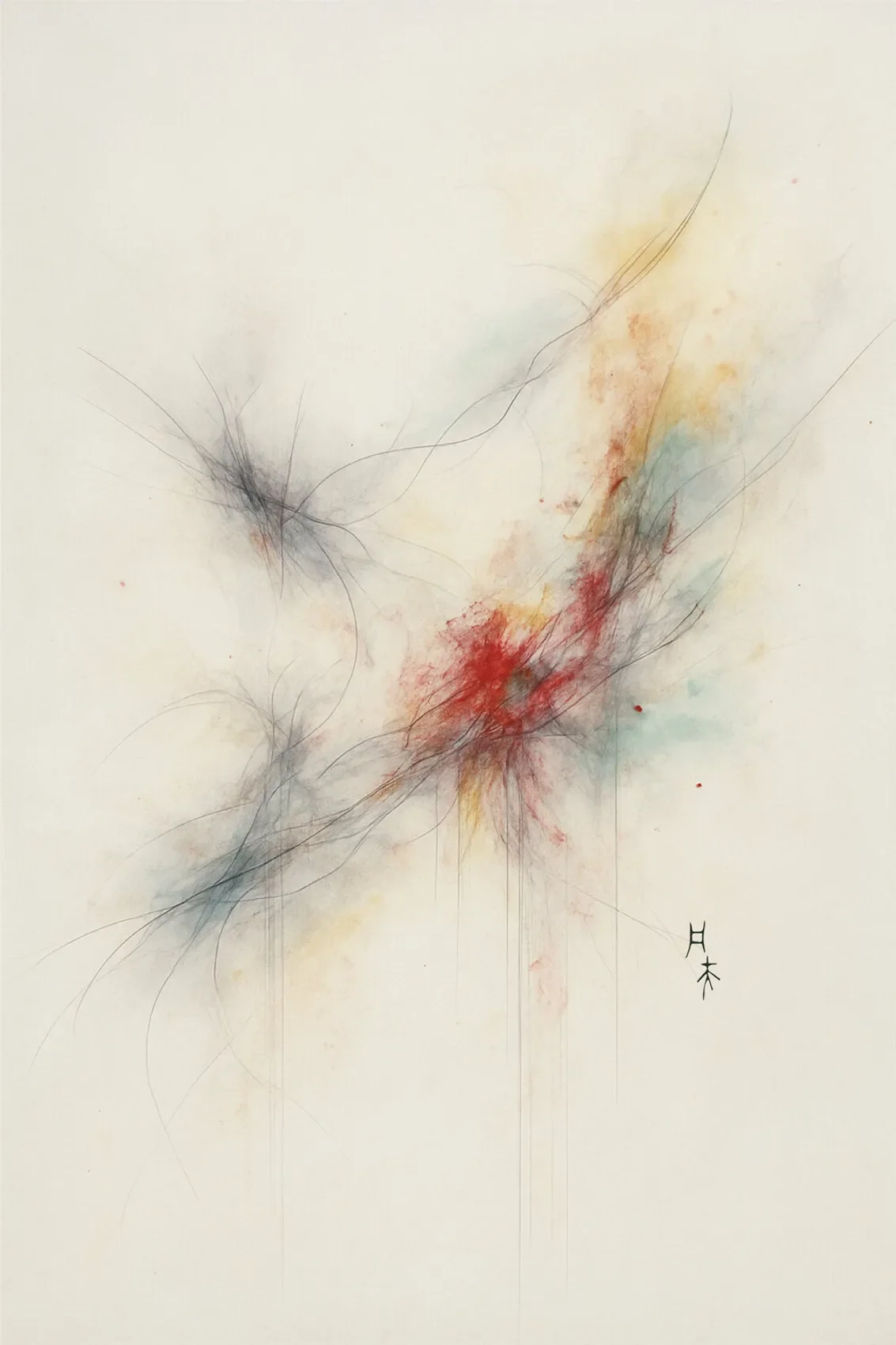
Stigmata of the Cosmos VII : The Fibers of Spirit by Ziqi Yu, 2025
You talk about wabi-sabi and the concept of liubai (emptiness). Most people are actually afraid of emptiness - that feeling of uncertainty or having no clear direction. We feel the need to fill every corner of a canvas or every second of our lives. As an artist, how do you resist the urge to fill the space? How did you manage to tame the emptiness and use it as one of your tools?I
Wabi-sabi and liubai (emptiness) are often translated as “emptiness,” but I don’t see emptiness as lack. I see it as tension held in suspension. Most people fear emptiness because it exposes them. When there is no noise, no decoration, no distraction – we meet ourselves. The urge to fill every corner of a canvas comes from the same impulse that fills every second of life – the fear of insignificance, the anxiety of silence. In my early years, I also filled space compulsively. I thought density meant intensity. But I eventually learned that restraint is more demanding than abundance. To leave space untouched requires confidence – and responsibility. Emptiness is not passive. It shapes the force around it. In my work, liubai functions like silence in music. Without silence, sound has no contour.
To “tame” emptiness was not about control. It was about trust. Trust that what is unsaid can be more powerful than what is declared. Trust that space can carry meaning without explanation. Over time, I realized emptiness is not something I add. It is something I protect. To resist filling the space is to resist fear. And once fear subsides, emptiness becomes clarity. In the end, liubai is not about absence. It is about allowing the invisible to breathe.
There is a lot of symbolism and geometry in your work. As a viewer, I feel like you are hiding a secret code that I need to crack - the thought process when looking at such a piece feels almost like a game. Are you intentionally creating a puzzle for the viewer to solve, or is this "code" just a byproduct of your own personal logic?
I am not hiding a code. But I do believe reality itself is structured like one. The geometry in my work is not a puzzle designed to exclude the viewer. It is a trace of alignment. I believe in what some call the Akashic field – a dimension of memory beyond the individual mind. I believe each of us is a receiver. But reception requires tuning. And tuning requires intention. When I work, I am not inventing symbols. I am listening.
Geometry emerges when perception aligns – like adjusting a frequency until static becomes signal. If a viewer feels there is a “secret code,” it may be because something inside them recognizes pattern before understanding it intellectually. I am not creating a game to solve. I am creating a field to enter. Moreover, here is where love matters. I believe that when one approaches a work – or life – with love and compassion, the alignment shifts. Higher insight does not come through force. It comes through openness. The “code” is not meant to be cracked. It is meant to resonate. If the viewer feels they are solving something, perhaps what they are actually doing is remembering something. In that sense, logic is personal – but it is not private. It belongs to a larger field we all participate in. Art, for me, is not encryption. It is transmission.
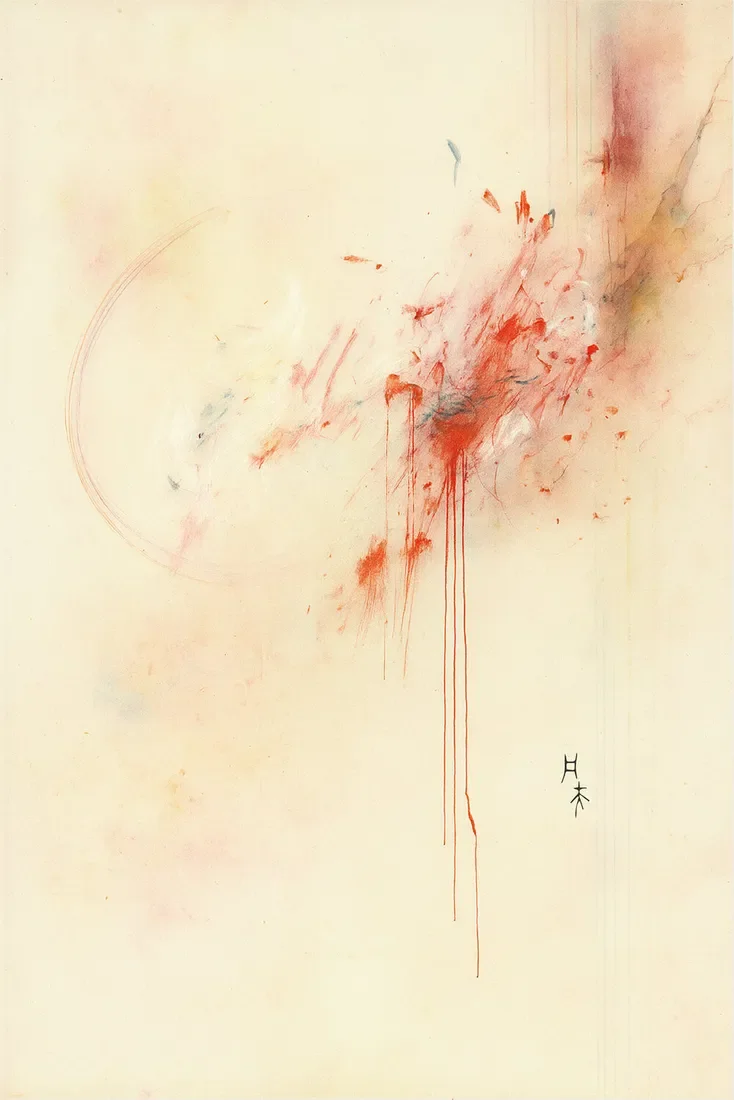
Stigmata of the Cosmos II : The Birth of Radiance by Ziqi Yu, 2025
You are always in motion - Creative Director, Graphic Design, Environmental Design, but I want to focus on the Taygeta Gallery. Most artists are happy just to be represented by others, but you’ve built your own platform. Why was it so important for you to create this specific space?
I have always moved between disciplines but Taygeta Gallery was not another project. It was a necessity. There is a Chinese aesthetic thinker who once said: “In contemporary China, illiteracy has been eliminated. But aesthetic blindness is more frightening. And technology cannot solve it.” That sentence stayed with me. We live in an age of information abundance, but aesthetic poverty. We have speed, scale, algorithms – but not necessarily depth. Technology can optimize efficiency. It cannot cultivate sensitivity.
Taygeta Gallery was born from that concern. I did not want to wait to be represented. I wanted to build a space where aesthetic dialogue could happen with intention. Representation is transactional. A platform can be transformative. Through Taygeta, I hope to transmit more than artwork. I hope to transmit love, refinement, and a deeper sense of beauty. Because aesthetic blindness is not about taste – it is about disconnection. When people lose the ability to feel beauty, they lose part of their humanity. Taygeta Gallery is my response to that fracture. It is a space where art is not decoration, but resonance. If we can restore sensitivity – even quietly – we restore dignity. That is why this space matters.
I want to ask about the name you chose - Fanfu. In a world where everyone is trying to be “extraordinary” or famous, you’ve picked a name that translates to “ordinary person” or “mortal man.” Why this specific choice?
In a world obsessed with being extraordinary, choosing the name “Fanfu” was not humility. It was clarity. “Fanfu” is often translated as “ordinary person” or “mortal man.” But I do not see it as limitation. I see it as condition. There is a saying: “Fanfu are like clouds – born of conditions, shifting endlessly.” Clouds are not inferior because they change. They are alive because they change. To truly understand the “ordinary” is not to dismiss it, but to recognize its spiritual elasticity – its infinite potential. Everyone is chasing extraordinariness as a status. But I am more interested in awareness.
When you accept that you are a “mortal,” you begin to see clearly. Ego softens. Comparison dissolves. Observation sharpens. Fanfu is not self-deprecation. It is self-location. I chose this name because I believe transcendence does not come from claiming superiority. It comes from understanding our impermanence. Clouds form, dissolve, reform. Human beings are no different. If I create anything meaningful, it is not because I am extraordinary. It is because I am receptive. Fanfu reminds me of that – every day.
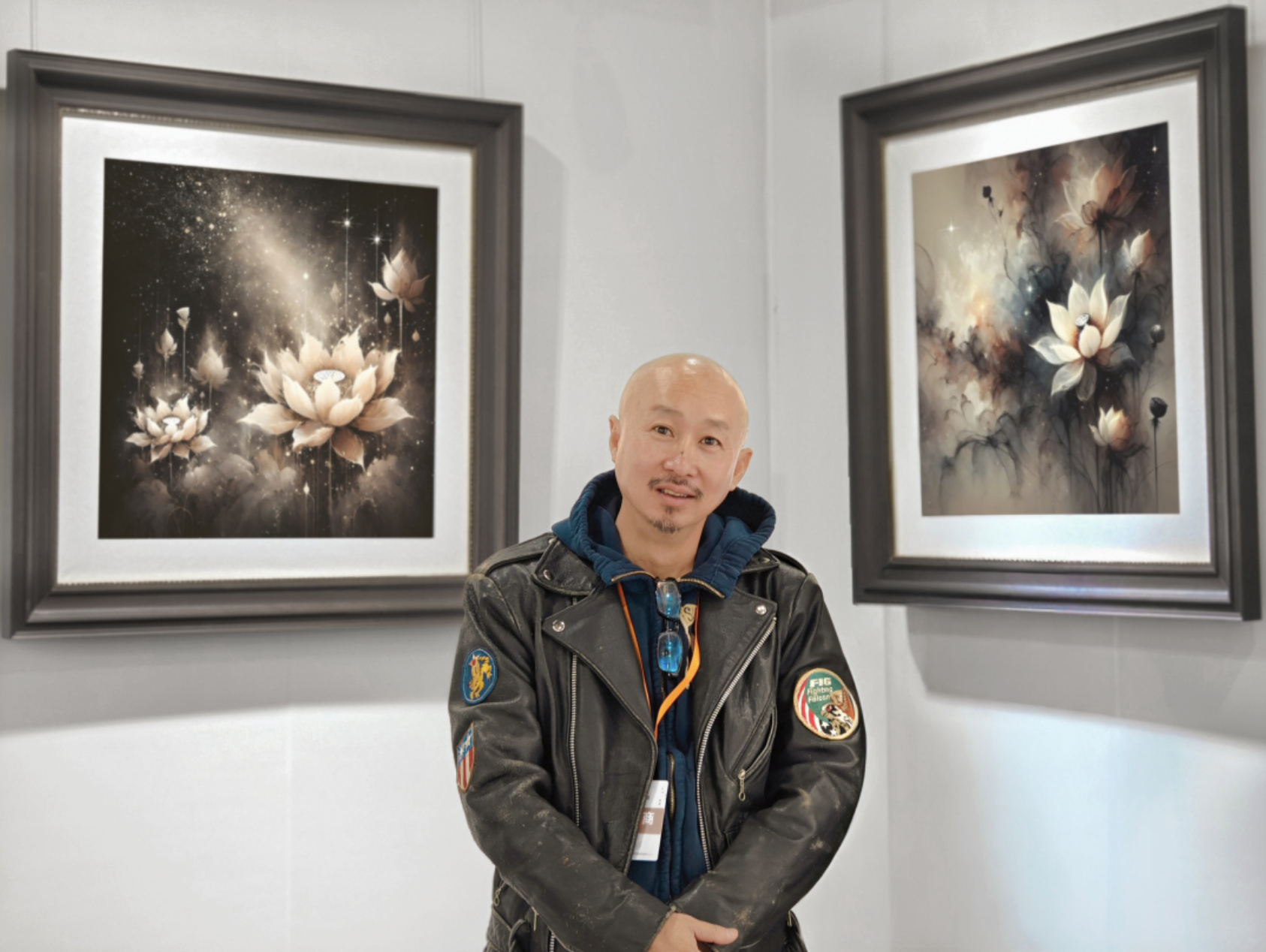
Courtesy of Taygeta Gallery and Ziqi Yu
To wrap things up: What is the main idea or the specific feeling you want people to take away from your work at this exhibition? When they walk out of the room, what is the one thing you hope stays with them?
I don’t hope to impress anyone. I hope to touch something quiet inside them. If someone walks out feeling a little softer, a little more open, a little more aware of light and silence – that is enough for me. We live in a world that constantly pulls us outward. Perhaps this exhibition gently invites people inward. Not to find answers. But to feel. If they leave with a small sense of peace, or even a fragile sense of hope, then love has done its work. That is all I wish for.
“If they leave with a small sense of peace, or even a fragile sense of hope, then love has done its work.”
Ziqi Yu shows us that true power lies in the discipline of self-control – the ability to channel radical ideas into a quiet manifest. He reminds us that emptiness isn't a void to be feared, but a companion we need to embrace. To engage with his work is to leave the noise aside and step into the unknown. It’s about breaking the cycle and facing the changes without the need for a loud ego. As he puts it, even the most violent shifts are part of a larger process: "Even supernovas are not endings – they are redistribution."
See more of Ziqi Yu’s work on Instagram.
Article by Vasya Kavka
Based in Ukraine, Vasya Kavka is a writer working at the intersection of contemporary art and digital culture. Through his platform @ambient.delusion, he researches emerging and underground artists, publishing interviews and editorial features that move beyond aesthetics to examine context, creative process and cultural relevance. His work is driven by curiosity and a commitment to thoughtful, accessible storytelling that situates artistic practices within the broader currents shaping contemporary culture.