HARRY BARTLETT FENNEY: THE PROCESS
“Out of chaos, beauty is born of itself, unaided, and without intention.”
Harry Bartlett Fenney describes the act of creating as a "natural requirement," as essential and unstoppable as any other part of life. His path has taken him from a wartime childhood in England to a renovated ruin in Brittany, where he continues to produce work driven by what he calls The Process.
From influential evening classes with Dolly Taylor and early encouragement from Bridget Riley, to a chance encounter with a girl on a train who shared the theories of Paul Klee, Harry has spent his life exploring a method of creating without intention. In this conversation, we discuss his transition from figurative landscapes to abstraction, the impact of moving to France, and that elusive "Something" in a painting that makes a viewer stop and look.
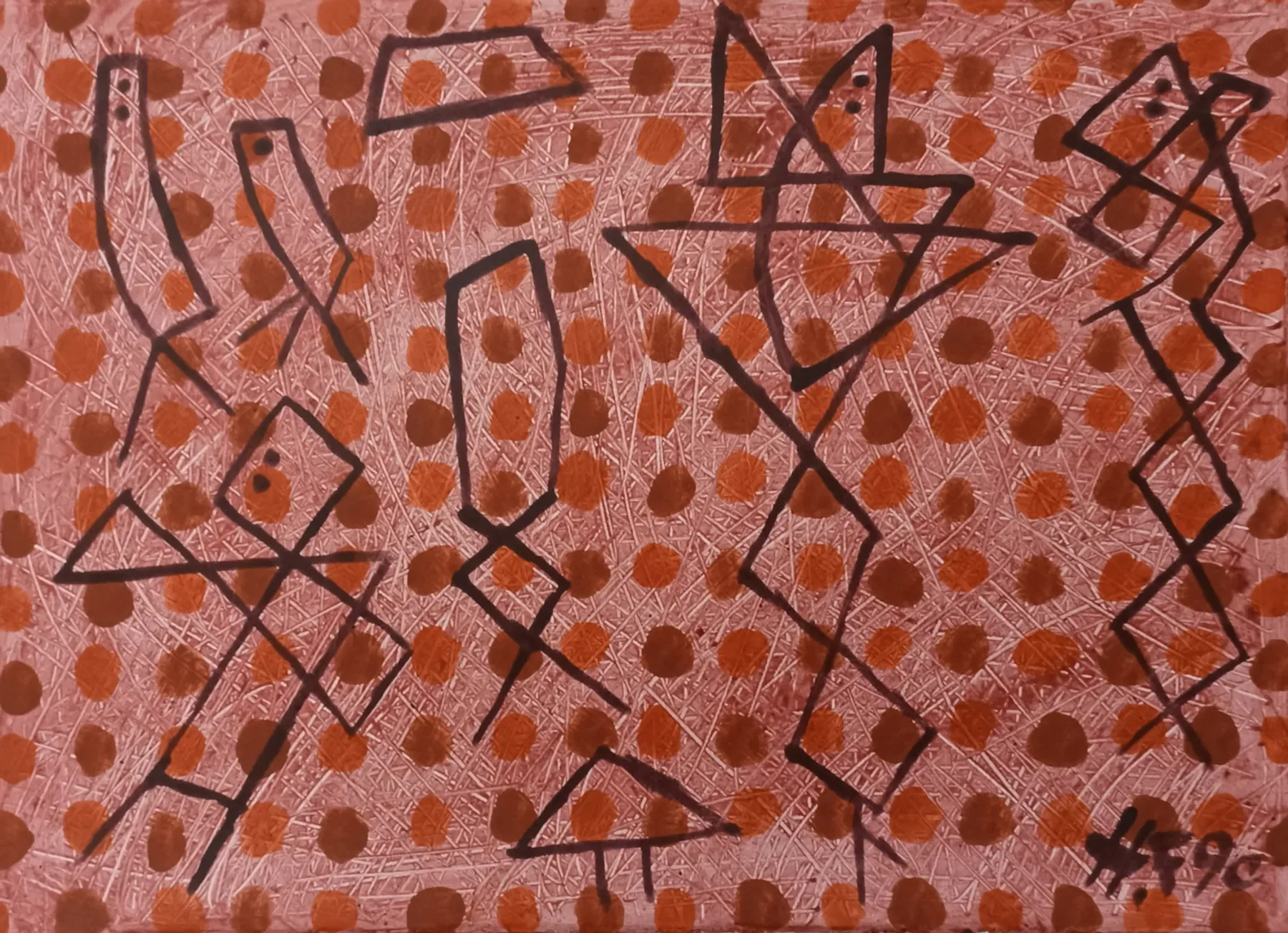
Partnered by Harry Bartlett Fenney, watercolour on paper, 1990
To start at the beginning: your childhood was affected by World War II and you grew up in a completely different era. Sadly, no lessons were learned and humanity continues to find its ways to destroy itself to this day. Could you share how that experience of war impacted you and, ultimately, your art?
Yes, a long time ago, and all I can say is that I had a very happy childhood. We lived near the railway with steam trains passing, and we collected train numbers. I had one younger brother and one sister a bit older. The war was a long way away, though there were fringe happenings which reminded us of it, like air raid sirens, the Home Guard, and an uncle who was a soldier. My dad was in the Home Guard. We had ration books and coupons for everything and listened to the wireless updates. It didn't seem important for us kids – our parents, I think, played it all down for us.
I was 7 when the war ended. I was a happy kid. I had a dog that went where I went. The village was close to the countryside, and me and my dog roamed the woods and fields all the time. Nature was my serious interest, from newts in the stream and frog spawn to collecting birds' eggs and learning all about the natural world. It was like the Song of Hiawatha – "What is that Nokomis?" It wasn't quite like that, but it was romantically similar. There were other kids to mix with, which I did, but by and large, I was a bit of a loner. Just me and my dog.
School was good and not complicated. I went through nursery, infants, and junior school, always making things in my spare time. Then came senior grammar school after an amazingly successful entrance exam. I was 12-plus then, and the grammar school was in the next town, so a bus ride was nécessaire [necessary]. A morning paper round earned me some pocket money. That's when my interest in painting and drawing started to happen.
Senior school art was not highly encouraged. It was all maths, science, language, and physics. Chemistry was my favourite subject and I was good at it. There was also an art class – almost like second-class citizenship and not quite frowned upon. It was held in the evening after school twice a week in the old unused physics lab. It was only tolerated, I believe, because the O-Level exams listed Art as a subject after all the other subjects.
But wow!! The evening class turned out to be something else! There were only a handful of participants, but the teacher was Dolly Taylor! This was the 1950s, so think of Barbara Hepworth or Ben Nicholson. I didn't know anything about those names at the time, but it sets the scenario and the flavour of Bloomsbury. […] There we were, five adolescents in the old unused physics lab being schooled by a bohemian lady in black stockings sitting on (not at) the front desk smoking cigarettes. It was unheard of at the time!
As I remember, we were given bits of paper about A3 size and access to various colours of schoolroom powder paints, brushes, and a jar of water. Dolly would set a subject and we all sloshed the colours around in the hope to meet the requirements in our own ways. It was ecstatic in the extreme!! Mme [Mrs.] Taylor interrogated each work in turn during or at the end of the session to give judgement and criticism. I remember getting enormous encouragement for the first time ever. I will never forget Dolly Taylor.
“Creating and making is what I do and have always done. It’s like any other natural requirement - impossible to stop, has no start, it’s just there.”
On your Artprice bio, you stated: "When one finally realizes one is an artist and gives into this and accepts the fact, then from thereon, every mark made on paper, canvas or panel... is a work of art, by definition and indisputable!" At what moment in your life did you realize you were an artist and fully accepted that fact?
The Songbird Alights. The songbird alights and continues to sing, but now he knows it is what he is supposed to do. All wonderings, all doubting, all guilty feelings, and all uncertainty are gone – he's singing!! Perhaps when I first made a drawing of this is when it happened to me.
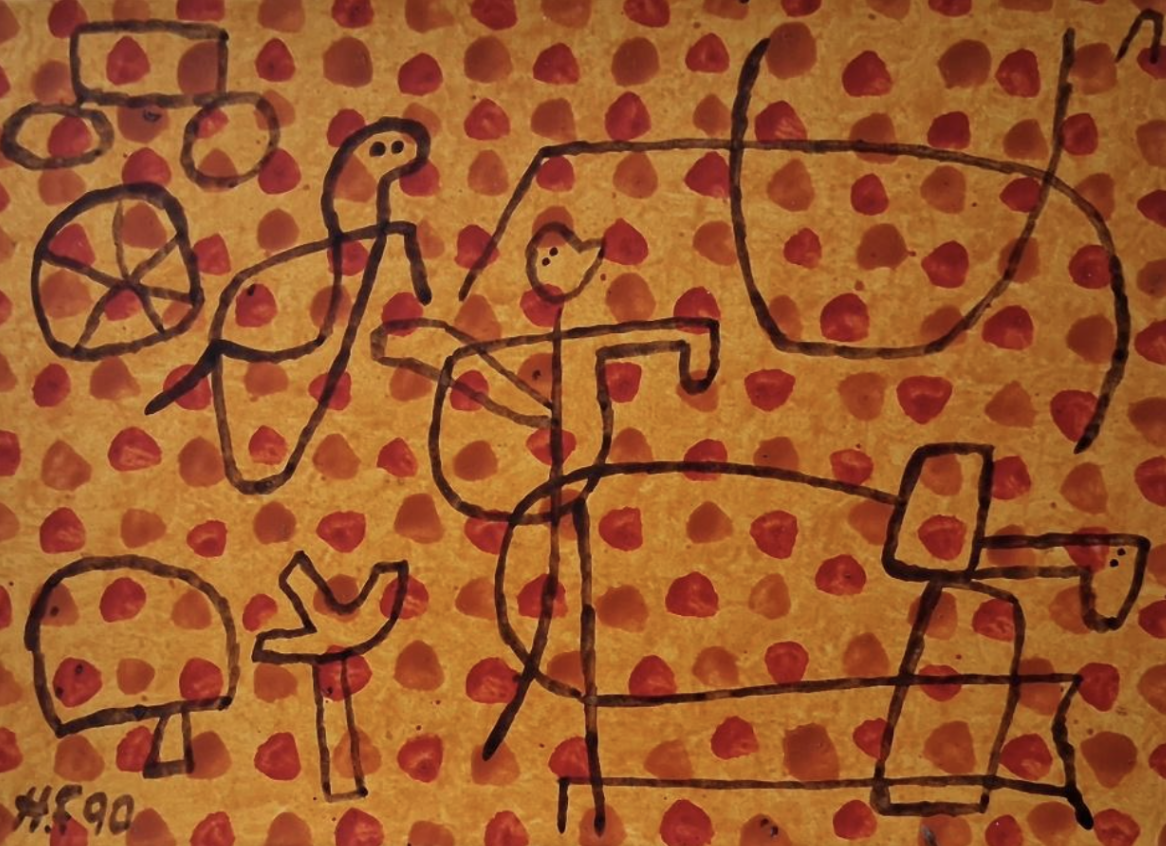
Songbird Alights by Harry Bartlett Fenney, watercolour on paper, 1990
Let's say that people are born with the formulas of what they are. Let's say that the guy who cuts your grass is born to be a gardener. He is happy in his work because now he has arrived, alighted, after years of doing this and that but wanting to be a gardener at the same time. But also let's say that many people born to do things haven't got there yet and are still searching. Gradually one's house and one's life gets filled up with actual tableaux [scenes], drawings, incubation, and productions. Even though one's everyday job is being, say, a plumber – is that when it occurs to you that you are not a plumber, you are an artist, where you are at ease?
Space that we're in, people that we see, even food that we eat - has an influence on us. You moved from England to France a long time ago. Can you tell us what effect this change had on your art? And can you share what thing about France you like the most?
Zen is Yes, in about 1998 I bought a ruin in Brittany, France, which I renovated. That included the fabric of the building and all services like electrics, plumbing, and so on. This gave me a comfortable living space and a place to paint – a studio.
This change from England had profound effects on my way of life and artwork production. In the beginning, I was still employed in London, so commuting was a big part of it. I was self-employed for contracts, then at the age of 65 I became full-time in France with a UK state pension. I sold up the English property so I have no ties to England.
France was good and still is, and my artwork production line became my main function in life. Also, je construire [I built] another house starting on a green field site tous seule [all alone]. […] Yes, I found France good. The people are very friendly, and the cost of living and climate are good, though it's cold in winter and hot in summer.
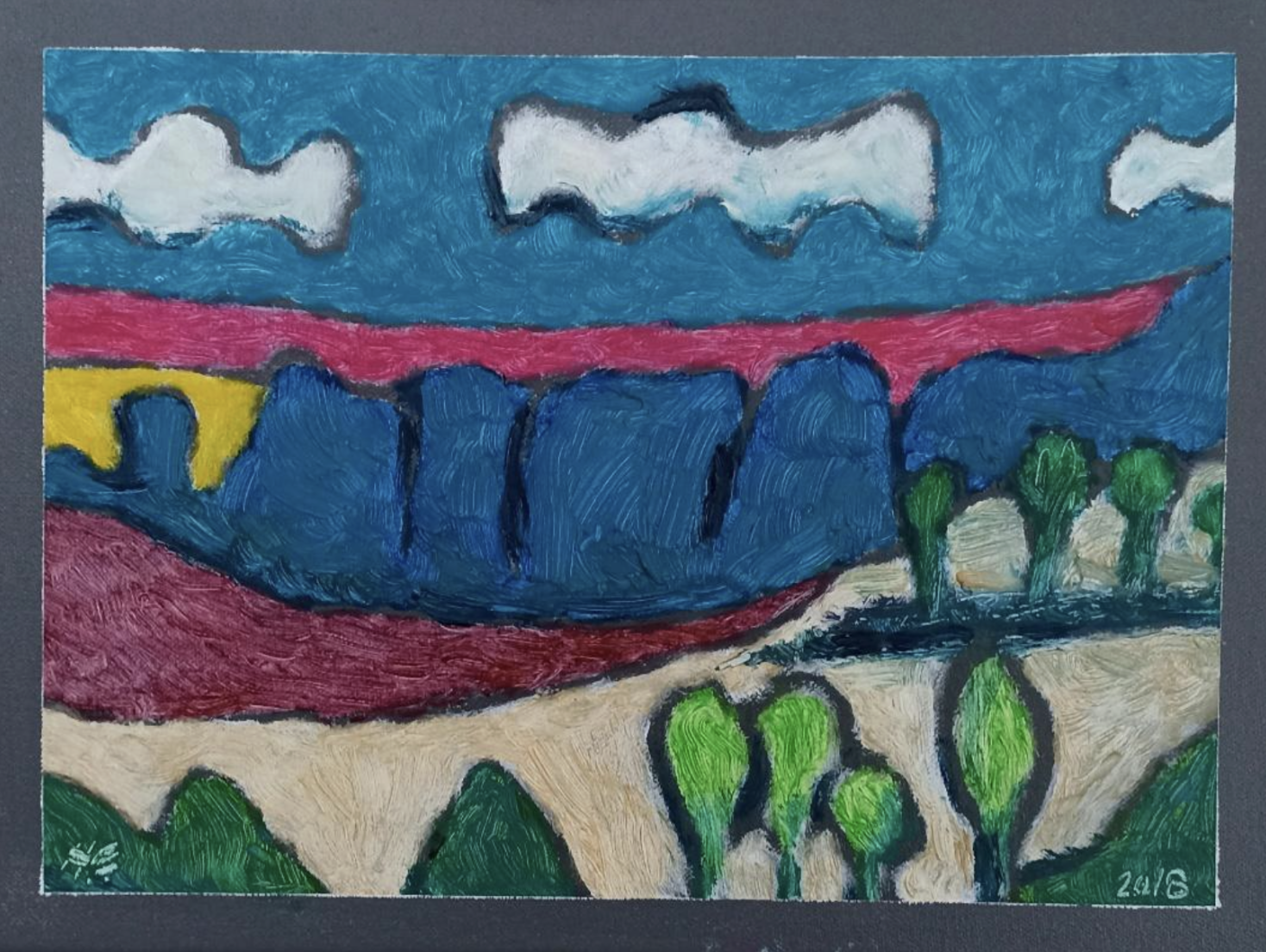
Près d’ici by Harry Bartlett Fenney, acrylique on canvas, 2018.
You have mentioned that abstract art is a form that "makes the process of subconscious creation possible." For those who might find abstraction difficult to grasp, how do you personally tap into that subconscious space?
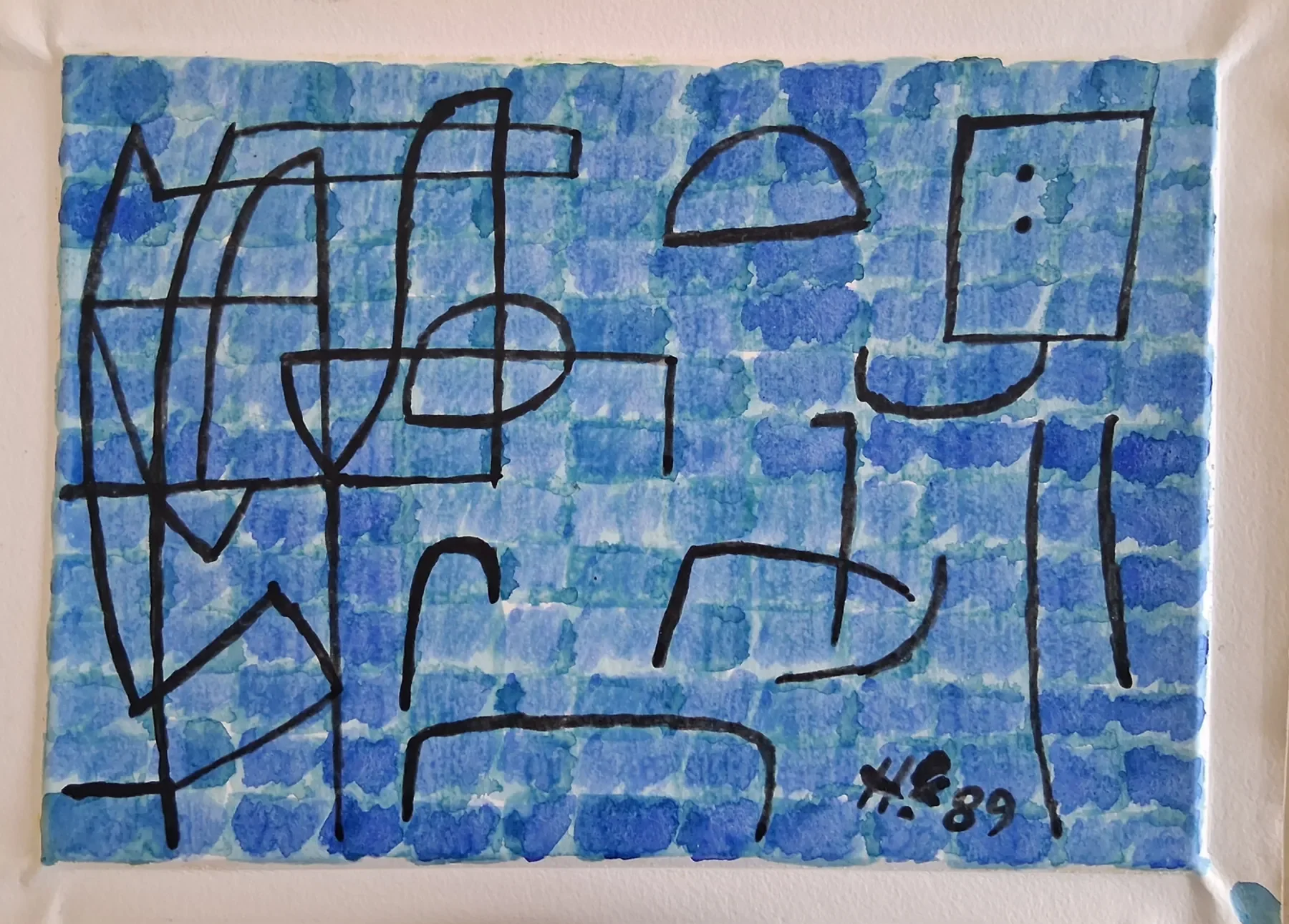
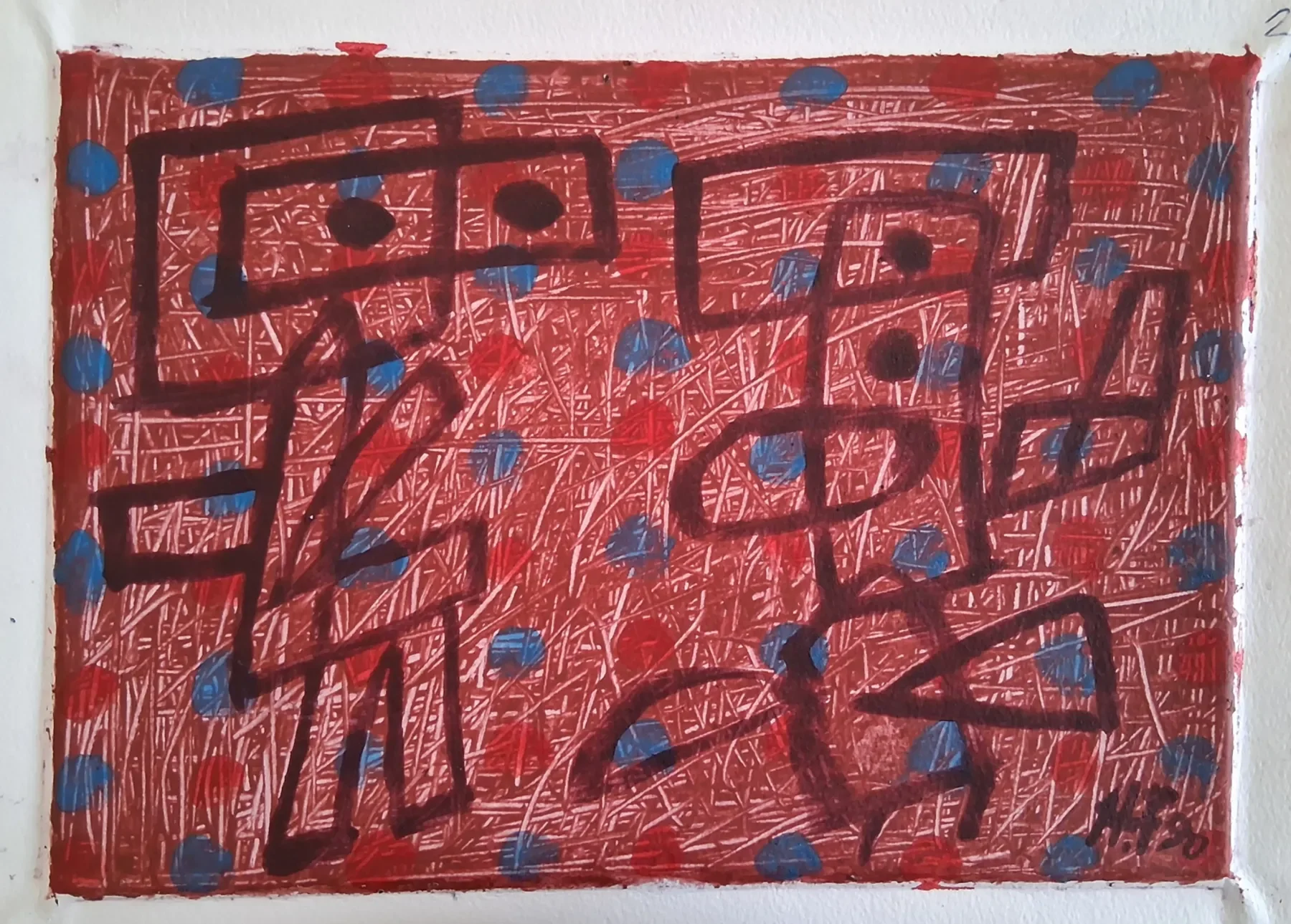
The abstraction and process pictures I was doing in the 80's and 90's – and there are dozens, if not hundreds in my stockage [storage], and "Partnered" is one of them – were all done in the "without intention" mode. We call it: Process.
Why there are so many is that up until the 80's my style of working was changing from figurative. By that, I mean viewing a model to produce the picture – landscapes from real life, you know, sitting out there in the fields or woodland painting the scenery – to a startling new modus operandi [way of operating]!!
But having said that, it's worth noting that the pictures formulated from the old ways were still exceptional. […] For that time, my studies of the works of Turner gave me an unusual style and taught me the beautiful difference between modelling and carving. One would take reminder sketches or partly completed landscapes from the outside scenario and bring it all back to the studio environment to create the finished work. So I was now out of the wind and rain and working inside. I had learned the imperative use of good quality materials such as heavy acid-free paper and high-grade colours. While I was solely using water colours at this time, I learned to wet and stretch the paper on suitably sized frames which I made using plywood.
Then the carving as against modelling became plus facile [easier]. I had more than one stretching frame which allowed me to have a production line to work on several in sequence. […] For dramatic skies, par exemple [for example], you put on the colour and let it dry, then you carve into it with a wet brush, scrubbing to effect and sculpting out the clouds, buildings, and so on. You rinse it off in the bathtub as you go. This may have been a well-known idea, but for me it was a revolution when I stumbled onto it single-handed. I was now automatically moving away from the figurative and into the abstract without noticing it until another breakthrough: the Process!
Within the chaos, the picture is there already, and my work is to bring it to the surface. You know instinctively when it is finished so you move onto the next one in the production line. […]
Simply the Process: Chaos – Beauty – Contemplation - Title. Out of chaos, beauty is born of itself, unaided, and without intention. What it is – the title – comes later after contemplation, which is the last part of the Process. After two years or more of making purely abstracts, my work progress shows me moving into a realm of more conceptual artworks, but with obvious lingering to the subconscious.
“Simply the Process: Chaos – Beauty – Contemplation – Title.”
I’d love to talk about your piece, Partnered. You’ve described it as a "dreamlike dance of lines and dots" intended to evoke deep, intangible feelings. Could you walk us through the inspiration behind this work? Was there a specific "metaphysical" moment or emotion that triggered its creation?
Much later came the advent of computers, which I quickly saw would be an enormously useful aid in all facets of art production. I quickly got the hang of it. I first wondered if my previous work with abstraction and process would work digitally – and sure enough it did. I have numerous examples of the results. Also, the use of the digital medium was good for figurative and abstract pictures, and again, there are numerous examples of these.
All this digital stuff was done round about the turn of the century in 2000 or before when I was in France. There are countless images in my old computer from that time which I still have to extract from the hard drive. […] With digital, paint brushes are replaced by helpful software and drawing tablets like Wacom. It is a very enjoyable way to produce works of art.
Going back to your question, there are no specific metaphysical moments or emotions that triggered any of the abstraction process pictures. As I said before, those works were all done and happened without intention, as were most of my works previous and after, even life studies. Intention to me is when a person gets out their paint box on Saturday morning and says: "What shall I paint today? I know! I'll paint a dog." It probably ends up with a nice picture of a dog, but is it art? There is an enormous difference between craft and works of art. Many pictures you see are very clever and nice to look at, works of craft, but in no way are they works of art. There is a difference.
As mentioned before, the title and description is what comes after the work is completed. In the case of "Partnered," it was generated by a fresh source, the Singulart AI, which went along with my own would-be description tweaked to play down the "first person" aspect. It's a good description with which I agree entirely, like it's from a knowing and bright, independent observer. The incubating of ideas and past things seen plays a big part in evoking an artwork. First there is the "crush" you have for something seen or imagined which jolts you into action, or perhaps the "crush" happens when you look at the completed work in retrospect. The word "crush" is something I read recently by another professor – it's not my invention, but it sums up neatly the moving force to put crayon to canvas.
1989 3 by Harry Bartlett Fenney, watercolor on paper, 1989
Every creator is shaped by those who came before them. Throughout your extensive career, figures like Paul Klee, Fernand Léger, and Ezra Pound have influenced your style. My question is: is there someone among contemporary artists today who inspires you or whose work you find particularly resonant?
At the end of my car factory apprenticeship in my late teens, I applied for and was offered a job in London as a designer by a firm of Consulting Engineers in Victoria SW1. This gave me a drawing board long before the debut of computers, and the feeling of being closer to creativity while always in my spare time I was painting, making, and incubating ideas. My village was some 30 miles (50 km) from the city of London, but there was a train station nearby with direct lines to St Pancras. So I became a commuter.
There was a girl on the route and we became friends. Amazingly, she showed interest in my chat about art and I wasn't showing off. In retrospect, I think she thought me naive. Anyway, one day she gave me a small book by the author Paul Klee, illustrating and explaining all his theories on colour, line, and so on. WOW! It was like a foreign language. What a revelation, and so amazingly different to my knowledge so far. It wasn't easy to read, but it started me on a road of intensive study. I wondered: "Was there more to art than I thought?!"
This new-found study of intensive research filled every spare minute. I got a copy of The Thinking Eye to keep, and it led me to many other creators like Picasso, Leger, all the Impressionists, Braque, Juan Gris. Also, I found and read all of Ezra Pound's works, essays, translations, and Cantos avidly. They weren't political – I was amazed to read later of him being incarcerated for treason in Italy, because there was nothing like that in any of his poetry. That girl on the train changed my life enormously, though I can't now remember her name. C'est la vie [That's life].
Later when I moved to Surrey in the early 60s while still working in engineering, I enrolled into an evening life drawing class at Croydon Tech. The teacher was one Bridget Riley. After a few evening sessions, she kind of took me to one side and dragged me into the library and said: "Read it all, find what suits you." This was true encouragement which went on for a few weeks until the end of term. I never went back, and don't ask me why – my life drawing I know was something else, and she had seen this but with no compliments or comments.
She persisted in furthering my studies and I added many more heroes to my list: Giacometti, Dubuffet, Henry Moore, and others. I was learning and changing. After that, I was always a big fan of Bridget Riley's work and proud when she became world-famous. She lives in France somewhere now. She was nice to me.
As to other contemporary names whose work stands out, like Andy Warhol, Tom Wesselman, and Dubuffet, I never copy but I see these and others have obviously been down the same routes of my own thinking. […]
Exhibitions are familiar territory for you now, but can you share what it felt like to show your work to the world for the very first time? Looking back, how did that first interaction with the public affect your desire to keep creating?
The desire to keep on creating was never in question. Ever. Desire or wanting is no part of it. Creating and making is what I do and have always done. It's like any other natural requirement – impossible to stop, has no start, it's just there.
The need to show one's work is a part of the process. It's not for asking: "What do you think of that?" - no, but it's a real part of the way of the artist (the warrior), much like how the farmer makes his produce available. […]
The first time I took some works to a local gallery, the man helped me and said: "Get it framed." That was a good lesson for me because the difference a frame makes is extraordinary. I had a couple of pictures framed and they hung in the gallery – they are probably still there from the 1950s. This also told me that the gallery business is another discipline, and it's available for somebody else to do, not the artist. Following this, I exposé-d [exhibited] at other places, but it seemed like standing at a market stall showing your produce. It didn't seem all that worthwhile. It's better to let professional show-persons do that.
Then the internet arrived, which was much better to fulfil the need. It's better than humping boxes of stuff up and down the marketplace hoping to be accepted. More recently we have Singulart, which is brilliant. Every facet of the showing process is fulfilled, telling you what to do at every stage. It occurs to me that creating and public showing are two separate actions needing two lots of artisans. Always, if a company or person wants to take my works and show them in a physical environment, it's no problem. I would always happily go along with that.
1989 4 by Harry Bartlett Fenney, watercolor on paper, 1989
For my final question: What is the primary feeling or message you hope people take away from your work at this specific exhibition?
Recently a friend visited my studio – he often drops by and lives in the next village. He's a fellow painter and usually raves about my works in progress. […] At the time I happened to be looking at one of my works and wondering, so I said: "What do you think of this one, George?" He said: "Hmm, no it doesn't do anything for me." When he'd gone, it made me think: “Doesn't do anything?.. Doesn't do anything?.. It's a painting, what's it supposed to do?!”
Now think of this: What are paintings supposed to do, or rather what do they do? That's a good question. For instance, when I am scrolling down the entries in one of those internet minus 30% sales with 180 tableaux [paintings] per page - one catches your eye and you pause. You scroll back for another look. There you have it – this one did something!! Scrolling on, it suddenly happens again and another did something. They did something that none of the others do. My first reaction is that the stoppers, to me, are truly works of art. Invariably I notice they are offered for bon prix [a good price] where most of the non-stoppers are up in the thousands, but you are not looking at price when scrolling, you are looking at the picture. So price has nothing to do with it. What does, though? There is definitely something.
Consider this: when working on a piece, one knows instinctively when it is finished. You know when to stop and when you can't add or take away anything else. It's finished. Any further work would spoil it, and when you look at it, your brain says yes, it's what I had in mind. Perhaps this is the moment the picture is saying, leave me alone. Is this the birth of the Something which will stop a looker? Is this the Something!? (Spooky). Here is another example: when you are confronted by a Van Gogh, a Kandinsky, a Paul Klee drawing, or a Picasso you haven't seen before, there is an immediate something. One is overwhelmed with feelings you can't describe – a silent awe, a presence. (Spooky). It is so true. The picture has done something for you, even for George. It is like when you experience "eye contact" with another being, especially male to female. There is an exchange of energy, it does something.
And when I look at a recently finished work, I'm saying to myself: “Yes, it's what I had in mind. Yes, it has been done in accordance. There's a little bit of renovation needed on that line that didn't come out right” and so on… You are not seeing the Something yet. It is only when perhaps you are searching through old stock and something catches your eye and you say: “Yes, that one has something special!” Perhaps it's when all the heartache of the producing is forgotten. But this still hasn't defined what the Something is – will it ever?
But returning to the original question: What is it I hope people will take away from seeing my work at this exhibition? Is it too much to ask that my works touch the Something indefinable in others as it has already done to me?
“You know when to stop when you can’t add or take away anything else. It’s finished.”
What I liked the most is that talking with Harry is less like a formal interview and more like being led on an adventure through time. His answers don't just provide information, they build a whole world. There is a rare, poetic warmth in the way he speaks, a wisdom that only comes from a life fully lived and deeply observed.
Reading his words feels like stepping into one of his own "process" pieces: you start in the chaos of history and memory, and you end in a place of quiet contemplation and answer. It is the power of a human who has seen the world change and yet remained steadfast in his pursuit to create. This conversation, is one of those that will linger in my head for a long time.
As Harry continues his work in the stillness of Brittany, he leaves us with a profound reminder: that art isn't just something we look at, but something that does something to us. It’s about that sudden, indefinable exchange of energy – the Something that impressed him decades ago and, to this day, still manages to make him wonder. The mystery of a lifetime.
See more of Harry’s work on Instagram.
Article by Vasya Kavka
Based in Ukraine, Vasya Kavka is a writer working at the intersection of contemporary art and digital culture. Through his platform @ambient.delusion, he researches emerging and underground artists, publishing interviews and editorial features that move beyond aesthetics to examine context, creative process and cultural relevance. His work is driven by curiosity and a commitment to thoughtful, accessible storytelling that situates artistic practices within the broader currents shaping contemporary culture.