
TANJA HOFFMANN: DELIBERATIONS OF COLOUR AS AN ENTITY AND A MIRROR OF THE SELF
German artist Tanja Hoffmann creates impossible places on her canvases through her experiments with colour; not “impossible” because they are unrealistic, but because they are built with the most intangible bricks: our consciousness.
These places are made of quasi-organic forms blooming from meticulous layering of vibrant colours. Hoffman insists upon the idea of “meditation” through her Zenpolychromos series, and conveys a fundamental aspect of human experience - the connection or lack thereof between what’s viewed and what’s seen - by inviting the observer to reflect on their own sensory experiences. By creating that which is physically contained yet somehow expands, the spaces Hoffmann paints are boundless sources of deeper awareness of being in space and being-in-within.
We had a conversation with the artist to better understand how she sees the inner presence she seeks to evoke and how it arises during her creative process.
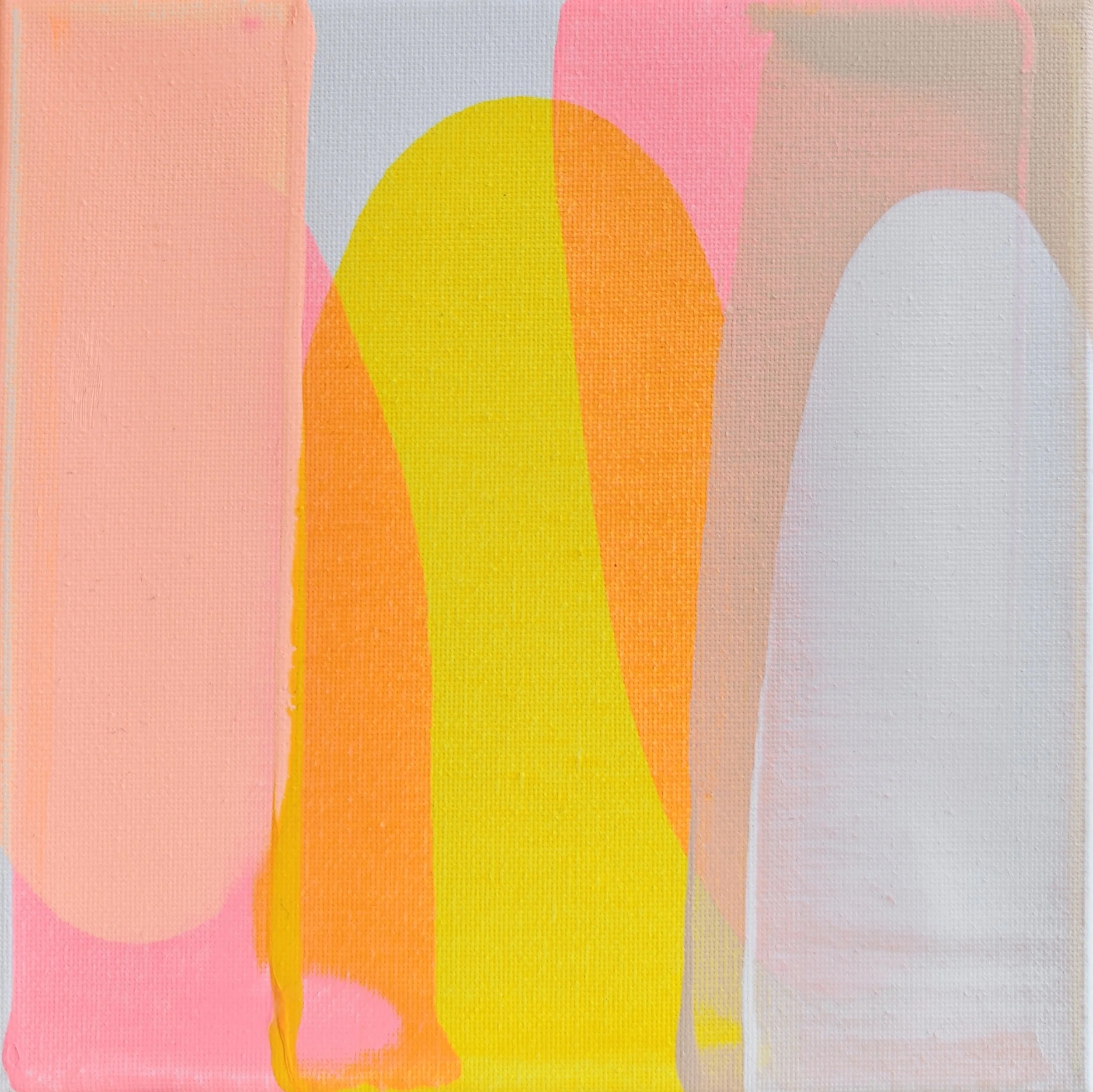
Zenpolychromo Mini 223 , Tanja Hoffmann
All of your paintings show a diligent construction of texture and depth. What first attracted you to creating abstract art, and how did the process of finding the right technique happen?
My point of departure has always been a fascination with colour and light as autonomous phenomena. Abstract painting offered me the possibility to approach colour as a conceptual field of research.
My work can be understood as a continuous investigation of colour perception, transparency, and depth. The technique evolved over many years through systematic experimentation. A central element of my process is the squeegee technique, in which from 30 to 90 percent of the paint is removed from the surface. What remains is an extremely thin layer of colour that does not block light, but carries it.
Through layering, new colour values emerge that develop from interaction rather than from individual pigments. Colour is given space to unfold, both within the pictorial surface and beyond it. The works often extend past the image plane, creating a spatially expansive atmosphere that understands the painting as an open field.
The process is further shaped by extended drying phases. This temporal delay is an integral part of the work, as colour, tonal values, and transparency stabilize only through rest and duration.
A meditative attitude consistently accompanies this process. Elements of Zen practiceare an integral part of the working environment. They support a state of focused presence, structuring the rhythm of work without directing it, and allow colour and light to be attentively accompanied rather than controlled.
Depth, in this sense, does not arise from material density, but from reduction, layering, and the interaction with light.
You describe your work as an “exploration of colour as an energy field”. Do you have any specific creative rituals you follow to channel this? What do these rituals help you achieve?
I begin my work with colour tests. I select up to 3 colours and expand them through mixing until their spectrum multiplies. This phase sharpens my focus on nuances and transitions and forms the foundation for the subsequent work on the pictorial surface.
I work exclusively in natural light and never under artificial lighting, as colour perception, transparency, and tonal values can only be reliably assessed under these conditions. Daylight becomes an integral component of the work and informs every decision.
The working process is shaped by repetition, pauses, and attention. Applying, removing, and waiting establishes a steady rhythm that slows decision-making and heightens sensitivity to minimal shifts within the colour. Colour is not approached symbolically, but as a physical and energetic phenomenon that unfolds through the process.
A meditative attitude consistently accompanies this work, in a highly focused working phase that reduces external stimuli and allows colour to be explored as an open, evolving field rather than something to be controlled.
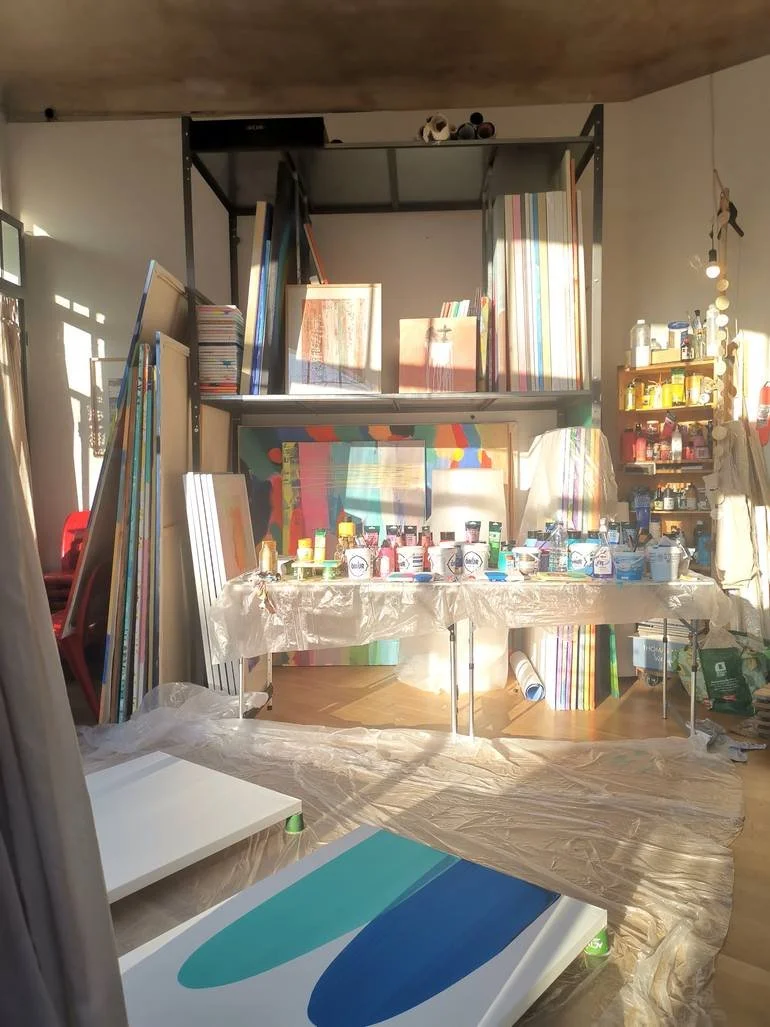
In Tanja Hoffmann’s studio, courtesy of Tanja Hoffmann
You also create collages, some of which are composed over these color-field backgrounds. What are the similarities and differences you find between the processes of creating something more figurative versus creating something abstract?
Both abstract painting and collage in my work are grounded in the principle of layering. The key differences lie in readability and in how content is articulated.
Collages tend to be more immediately legible for the viewer. In non-representational painting, by contrast, I avoid clear references and instead open a perceptual space in which meaning emerges through resonance rather than narration.
The two approaches complement each other. While the abstract works condense emotional states, collage allows for a more differentiated engagement with complex subjects that can be articulated more precisely through figuration. When combined, they create a heightened intensity. This interweaving of abstraction and figuration is a direction I intend to pursue more strongly in the future.
The fragmentation you do with the pictoric in your collages ruptures images, identities, words, and then creates new worlds for them to occupy. This fracturing opens up a lot of room for self-reflection prompted by outward perception. However, your Zenpolychromos conveys a very strong sense of a more harmonious, deep space for thought that’s independent of external influences. How would you describe the emotions you believe your abstract pieces, specifically, cause in an observer?
Within the Zenpolychromos, an atmosphere of calm, concentration, and inward focus emerges that operates independently of external stimuli. The works open a space in which perception slows down, and attention turns inward.
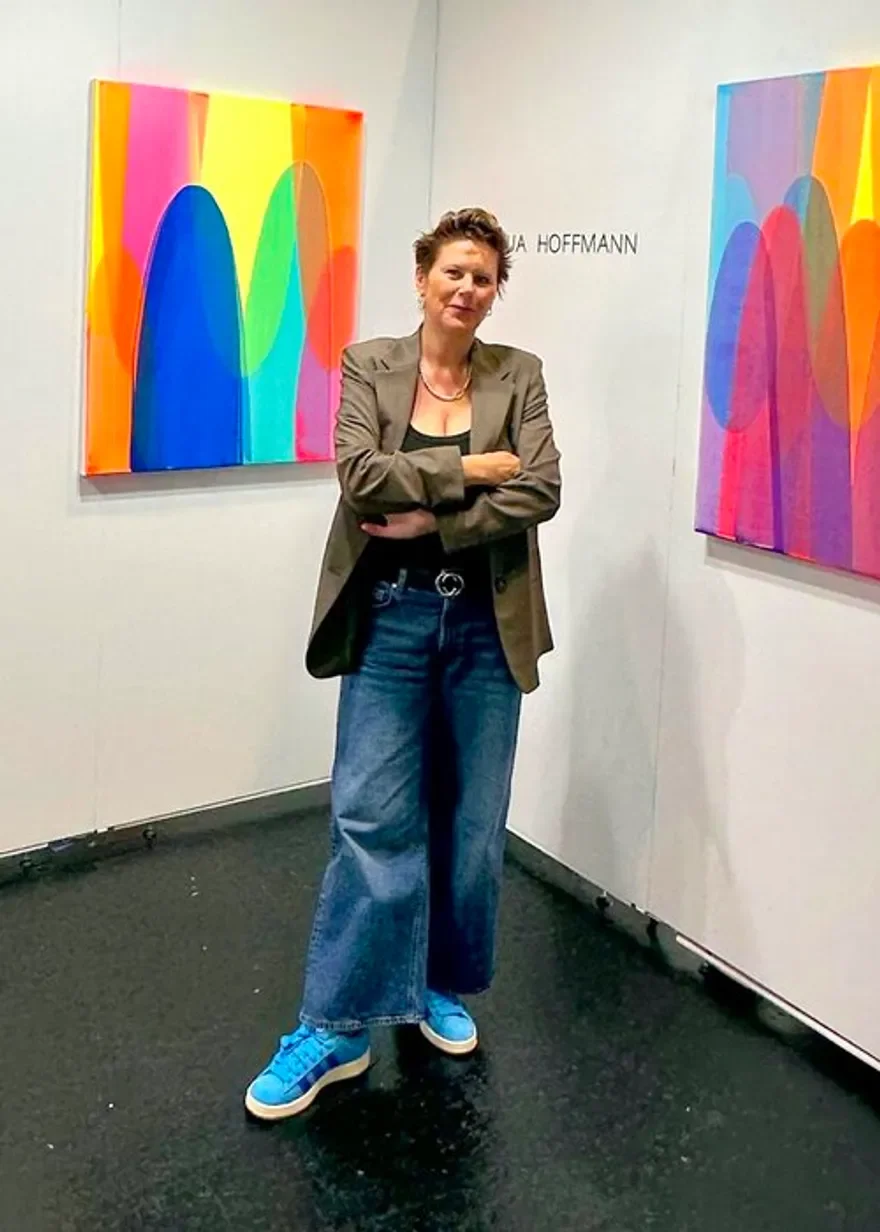
Especially in dialogue with one another, the Zenpolychromos develop an experiential colour space. Through their collective presence, relationships form between individual colour fields that extend beyond the single image. In contrast to the collages, the abstract works are less confrontational. They offer no narrative entry point, but rather an open structure that invites lingering. Emotions arise here not through content, but through colour spaces, the interaction with light, and temporal depth.
Many viewers describe a sense of clarity, inner spaciousness, or meditative presence. The works create a space for experience and thought that is not oriented toward self-analysis, but toward quiet perception. In this sense, I understand the Zenpolychromos less as expressions of a state than as invitations into a state.
“In non-representational painting, I avoid clear references and instead open a perceptual space in which meaning emerges through resonance rather than narration.”
Finally, the idea of “inner presence”, introspection, and meditation are very present in your work. I’m interested in hearing about your personal headspace while you’re working on a piece and how it influences the results. When looking at the Zenpolychromos as a series, there’s an incredible variation of colors and compositions; do you choose the colors, or do the colors choose you? How would you describe the way your art comes into being?
My state of mind while working is shaped by presence and openness. I try to step back from control and allow decisions to emerge from attentive engagement with the process itself. In this sense, working is less about executing a predefined outcome and more about entering a continuously shifting state.
The process can be described through the image of a river - one that you step into again and again. Even though the movement may feel familiar, it is never the same. Each work arises from new conditions, new experiences, and altered inner and outer circumstances. This openness to change fundamentally informs the way the work develops.
Within the Zenpolychromos series, this results in a wide range of colours and compositions. The colours are not determined in advance; they evolve through dialogue with previous layers, light conditions, drying phases, and perception. In this sense, I do not simply choose the colours - the colours emerge through the process. The series is less a closed system than an ongoing experience, in which each work represents a new moment within the same flow.
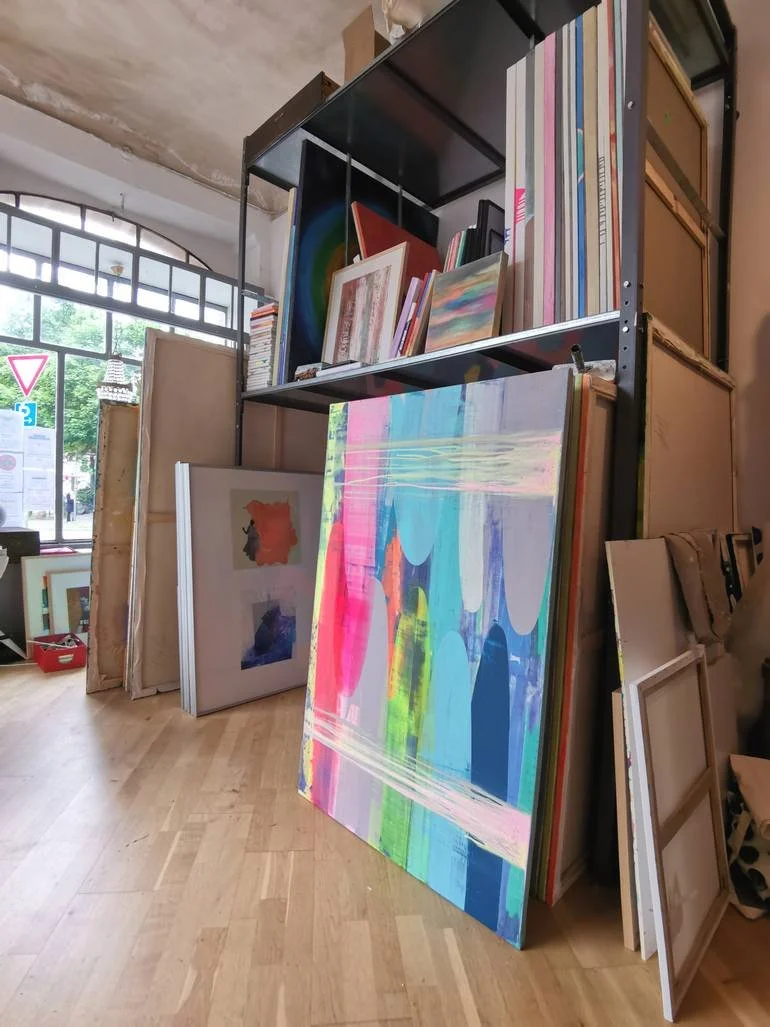
In Tanja Hoffman’s studio, courtesy of Tanja Hoffman
Tanja Hoffman’s invitations to soften the rhythm of life and ponder are irresistible, zen and Walden-like. Her infinite layerings, scraping, drying, and letting light in seem to work perfectly as an analogy to the composition and evolution of the unexplainable, immaterial presence we understand as the “I”. Looking at a canvas, indeed, can be one of the most powerful ways to see ourselves.
See more of Hoffmann’s work on her website.
Article by Ananda Muylaert
A Paris-based multidisciplinary artist and researcher on the phenomenology of painting, she has produced an extensive body of work in art, music, and poetry. Her artworks and published research on philosophy, essays and poetry have been presented and published in four languages across two continents.
Her artistic practice revolves around the search for rationality in animality (and vice versa) and an infatuation with organic texture, both inside and outside the flesh. More so, there's a desire to portray the relationship of the urban Self with the world around it truthfully, through the worst transgressions and most devastating desertions caused by the domestication of the Human species.
Her previous work experience includes working at the Musée Grand Palais, in Paris, and the Federal Cultural Center of Heritage Paço Imperial in Rio de Janeiro, Brazil, where she worked closely with prestigious institutions such as the Institut Goethe, the Instituto Moreira Salles, and the embassies of France, Japan, and China.