SYDNEY CROSKERY ON HOPE, POLITICS, AI, AND UGLY DUCKLINGS
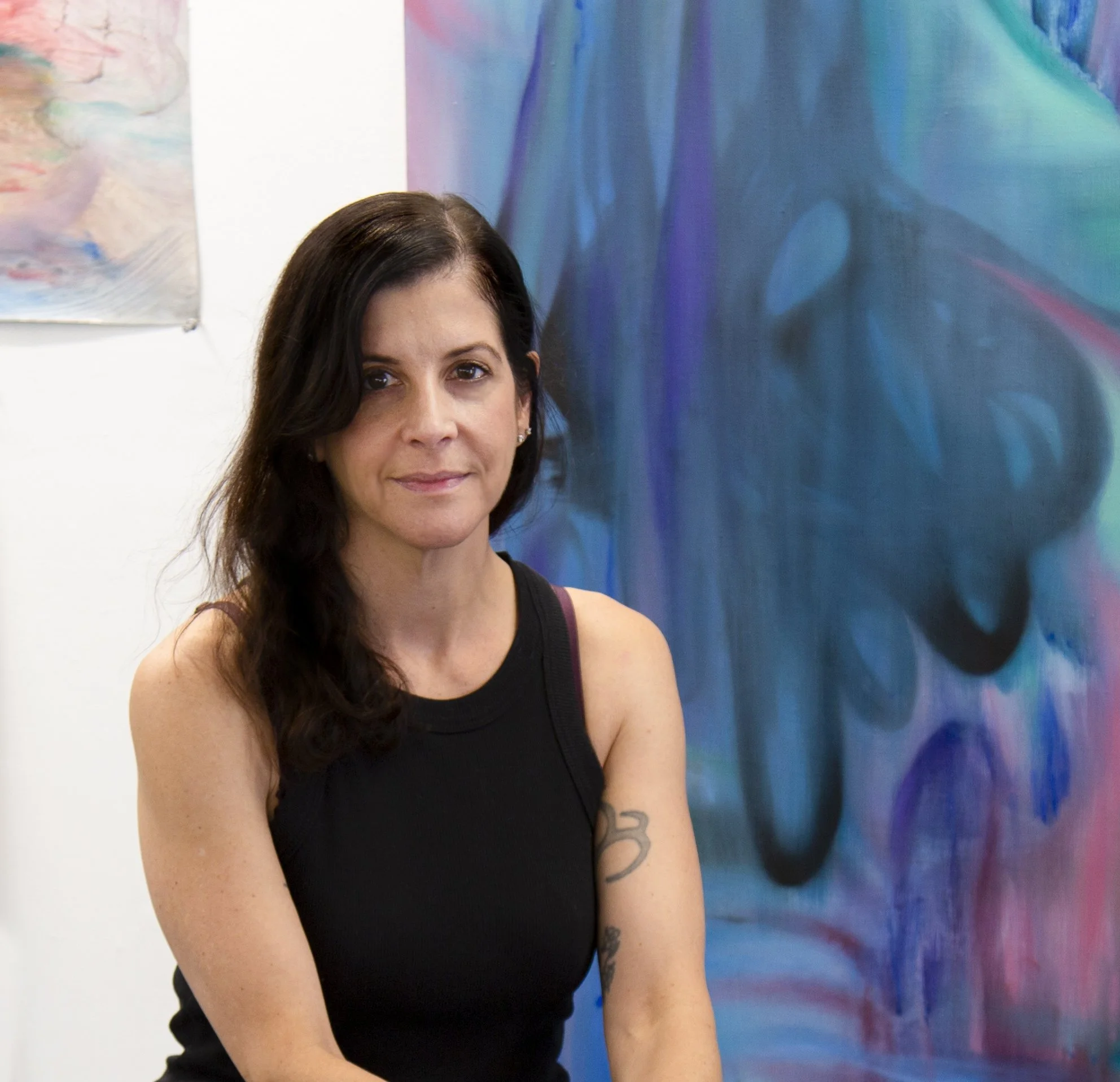
Sydney Croskery
In the description you wrote of your work for this exhibition, you describe the “brushstrokes, movements, and colors” as metaphors for the world at large. When you're in the act of painting, are you consciously constructing those metaphors, or do you discover them afterward or meanwhile?
Meanwhile and afterward. Meanwhile, because when I start my paintings, I really try to start with a blank slate and not think much. It sometimes gets in my own way when I try to move towards something specific in abstraction. In my older work, I had clearer ideas, but I also think that specificity can stunt the work. So I start almost blind, just moving the paint around. And truly, you don't know what it's gonna look like. So you let it dry, then you come back the next day, put it on the wall, and now there is something to start with. The ways in which the paint is moving, the thoughts I’m having while I’m painting, and what’s going on in the world at large start bouncing around in my mind while painting. The work for me is connecting the visuals with the ideas I’m thinking about. That's how I figure out what the work is about.
Sometimes having a dream, an endpoint, or a goal to work toward can also be limiting, right? So in this sense, you say that it's more of the process itself that makes you come up with meaning for the work?
Yes. Part of my process is also in the naming. I feel like a painting isn't really done until it's named, so to name a piece, I start to write about the visuals and the ideas they conjure up in my mind. In that text, a phrase usually emerges that is beautiful or unique, and much more interesting than any title I try to come up with outright. The naming of a painting is similar in process, as well as dependent on, my process of making a painting.
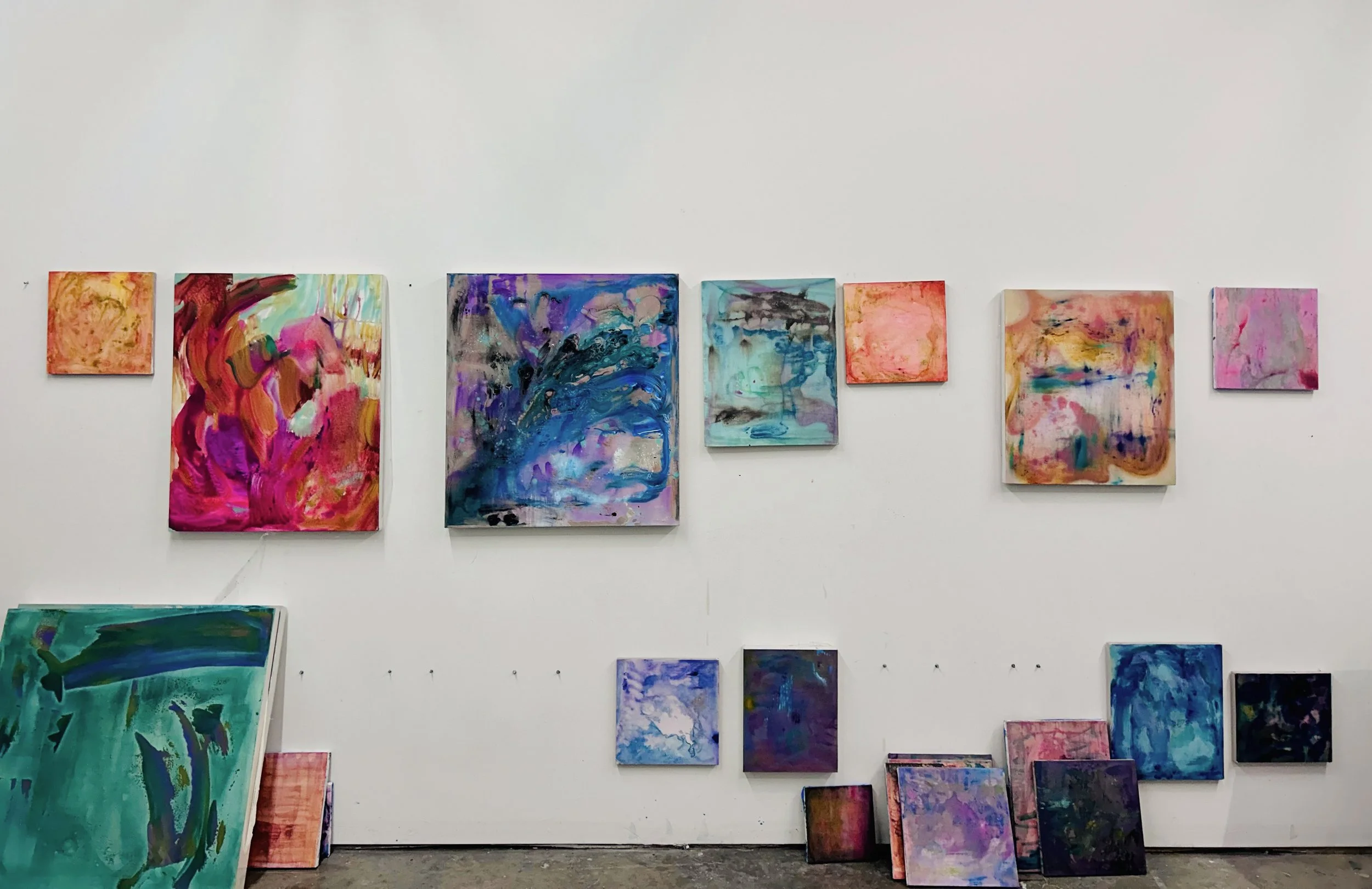
Studio of Sydney Croskery, courtesy of the artist
At the American pavilion at the Venice Biennale this year, every artwork was marked “Not yet titled”. What do you think of these types of titles or “non-titles”?
Interesting question. There was such a big controversy with Alma Allen’s show; I was only moderately engaged in the discussion. I like the works. I think a lot of the criticism was that the content was light for such a huge representation of American art. He didn’t seem to communicate any larger ideas of what his work was about, and I guess the not-yet-titled works didn’t help. Normally, I do not like untitled works; I think it’s a missed opportunity. “Not Yet Titled” is interesting in this context; I myself will post something on Instagram as not yet titled, because I haven’t totally resolved the piece yet. I think Alma Allen’s title “not titled yet” is part of the theory of his work, letting the piece evolve as the viewer sees it. He doesn’t prescribe the meaning for them, and the “yet” implies the piece is still being created. There’s something really beautiful about that. It feels very different from Untitled, which to me feels like the conversation is shut down, like the work is not about anything and therefore there is no conversation. In terms of my work, I relate to his idea of an openness in the work, that it’s not one idea and that the ideas are still evolving. Letting the viewer add to his ideas allows for the connection to happen. I think I like it in this case!
On the topic of titles, there's one that definitely struck me there: “Ugly Duckling”. I think it's a great title, and I have a few questions about it. In light of your transition toward abstraction, how would you situate this tension between the ugly and the beautiful in art?
I feel like we all experience ugliness in some way, personally and societally. But I also think this connects to some of your other questions about making beautiful things in a difficult world. I think my paintings are really hopeful even though they carry a lot of heavy weight. So I think the beautiful and ugly forces are both visual and emotional. I'm a very optimistic person. I laugh all day, and I can be stupid and goofy, but there's also a lot of heavy issues that weigh on my heart. I don't think just making a hollow but beautiful painting is enough. It's definitely not enough for me.
I've always found that my best paintings kind of start ugly. I then try to pull the beauty out of them. A great painting is like beauty coming out of the ashes of ugly.
“Ugly Duckling” was mostly blue and green movements when I started; there was way too much of it, so it wasn’t succeeding as a painting. The terracotta was introduced because it needed contrast, some respite from those colors. Having ugly aspects as a base is like a question or a challenge, asking to be transformed; it allows you to respond. A beautiful base of a painting asks you to leave it alone, even though it is not fully realized.
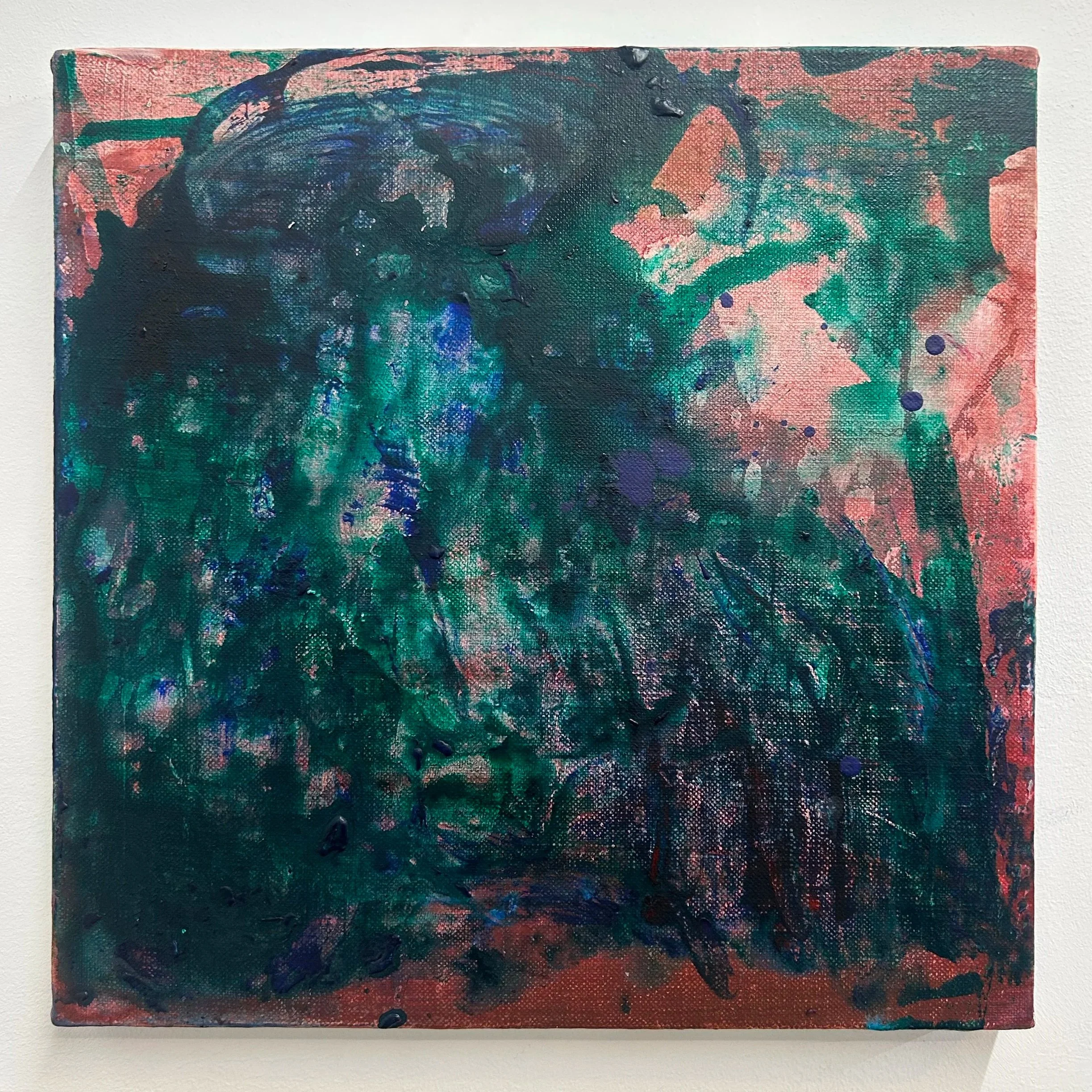
The beginning of Ugly Duckling
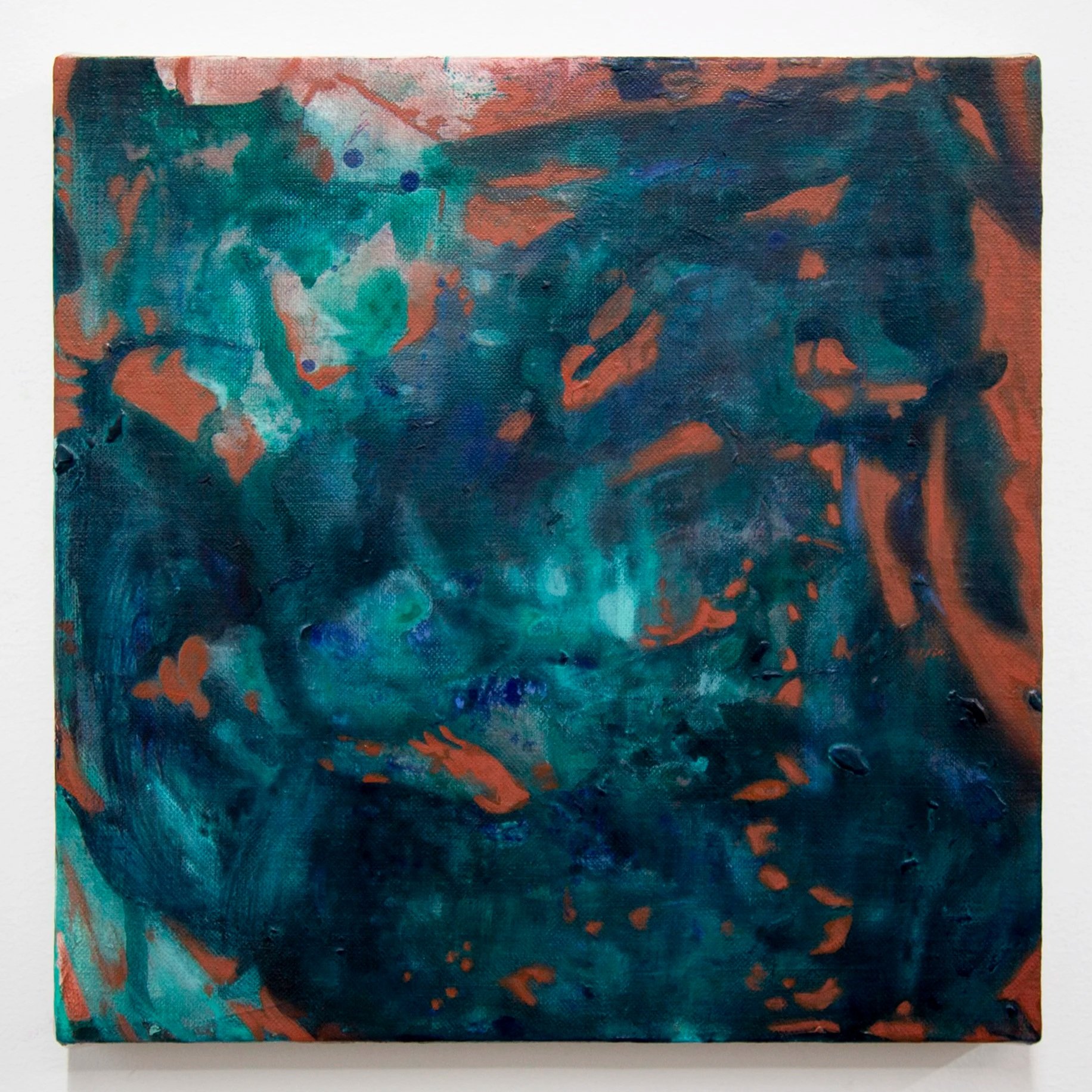
Ugly Duckling, 2026, Sydney Croskery
This makes me think of a tweet featuring a Nano Banana AI-generated image that looks especially “realistic,” with the quote: “The chopped and disgraced shall inherit this world.” In an age where perfection and sanitization are cheaper and easier to access than ever, do you think the ugly shall inherit the earth?
Yes, though I'd call it balance more than ugliness. Beauty with ugliness, like a garden: even the most perfectly manicured garden has dead elements in it somewhere. It’s just the balance of life. Or with food, if you want richness, you need a bit of acid or citrus for contrast. I have a painting referring to salt in recipes of cookies, because “A Touch of Salt Brings out the Sweet.” I think it's the same with artwork: you need balance and contrast. That's part of the problem with AI-generated work, or anything purely technology-based. It feels uniform; it lacks contrast. As we become more technologically advanced, I personally want things that are homemade. The majority of objects in the world are fully mass-produced; I prefer things with a bit of quirk that show the hand that made them.
“Having ugly aspects as a base is like a question or a challenge, asking to be transformed; it allows you to respond.”
AI art evolves quickly, but its lack of lived balance makes the “difference” fascinating to explore. On a similar note: How does the current state of the world, or your country, affect your work directly?
Right now, in my country and probably the world, things feel very chaotic, compounded by having phones on us all the time, constantly informing us of the chaos. I see that in my work right now: it's chaotic, and I'm trying to bring in a little serenity. That's part of what “Ugly Duckling” is about. I started with green and blue, a lot of chaos. I then chose terracotta for serenity. Not surprisingly, it's a color that exists in the natural world, and it brought calm to the piece.
So it's partly a way of coping too, perhaps? When you can't beautify reality itself, you can still do it within the painting. Does practicing art bring you peace, given the state of the world?
Definitely, my painting practice is like meditation. I'm quiet, working for hours, and my brain is working very slow; it's a way just to work gradually and not have to talk. I work part-time at a restaurant where I have to think quickly and basically talk the whole time. Going into the studio, being alone and quiet, becomes a real coping mechanism. No matter their life’s circumstances, I think studio practice is that for a lot of artists.
A nice contrast to your restaurant job: one is all communication, the other all introspection. I wanted to continue here about your shift from figurative to abstract work. Abstract paintings don't always illustrate politics the way figurative work can. What was behind that transition for you?
It was a lot of things. My earlier work wasn't strictly figurative, but it had aspects of realism in it. Looking back, I can see I'd actually been moving toward abstraction for about a decade. It felt like a sudden shift at the time, but it was really a slow evolution. The real turning point happened during the COVID lockdown. I was in the studio seven days a week, and at some point something in my brain broke, and realism left. My older work was more socially and politically focused, not straight politics, but society, culture, what was going on in the world. I was making the work about something specific. Now I figure out what the paintings are about as I go. Sometimes it's political, sometimes it's about humanity broadly, sometimes it's personal.
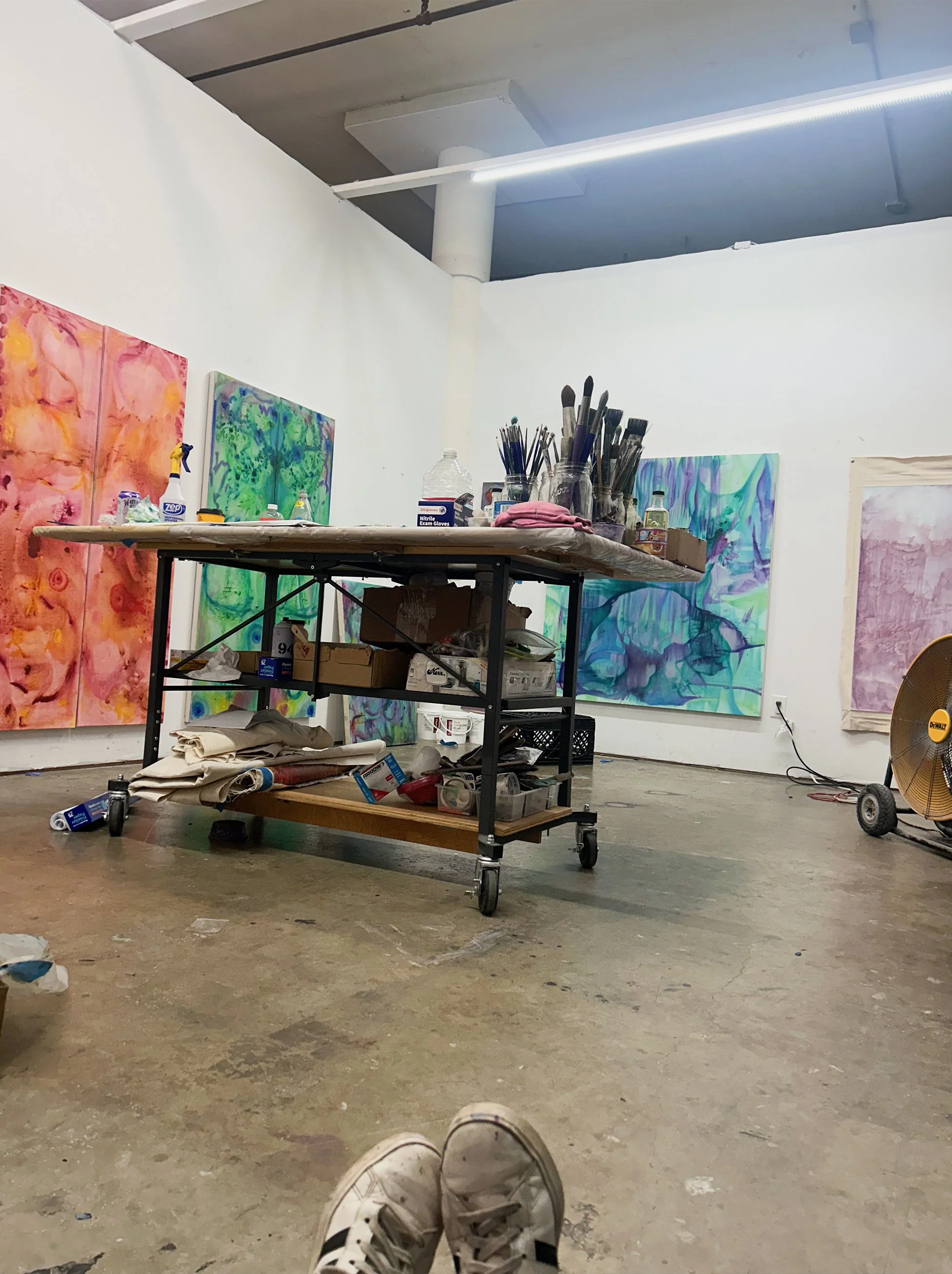
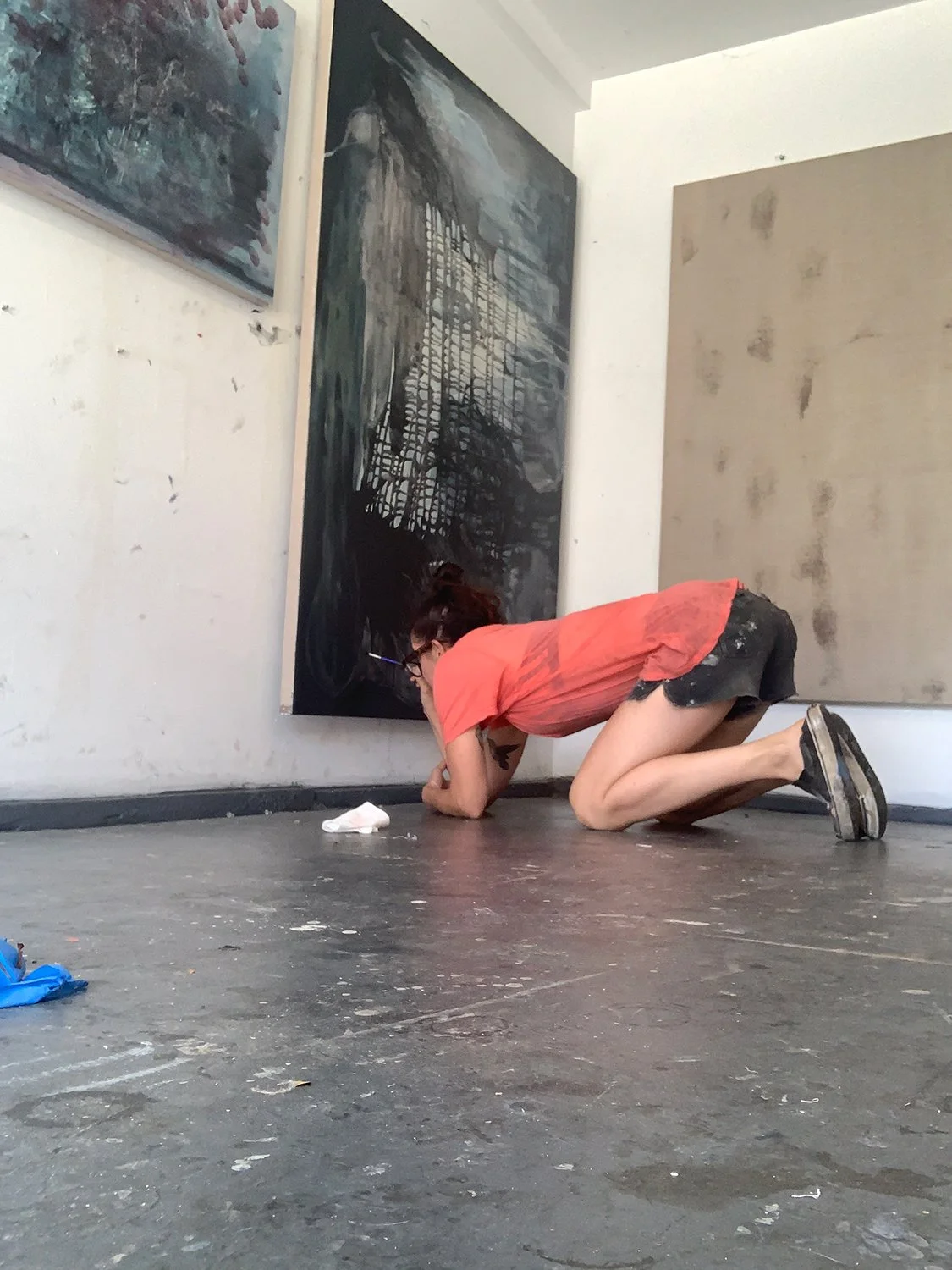
Studio of Sydney Croskery, courtesy of the artist
Do you think art is inherently political?
I do. I think good art is inherently social, political, and/or personal, and that anyone talking about their experience in the world is great for humanity. I prefer to use abstraction to explore multiple perspectives rather than present a single, didactic viewpoint. I mean, that’s what abstraction is: looking and seeing in a different way, so I think at its core, abstraction is political. I am very clear on my opinions, but I make great efforts to try to consider the alternative side. I don't think any of us are right 100% of the time. My paintings stand on their own visually, and if a viewer doesn't care what they’re about, that's fine too.
There were a couple of shows. I won't be specific, but I really, really loved them, and then I read two different art critic reviews, like: “The artist says it's about this... But I don't see that in the paintings”. I thought it was so funny; art supposedly has no boundaries, but here were two art critics who were advocating for a very conservative outlook on art.
Maybe let me get to the last question, then, on the topic of hope. How can you – or how can we – envision hope through art?
I think a beautiful artwork in its best moment can make us reconsider even just one of our deeply rooted ideas. And if we can do that for an artwork, maybe we can do it in other ways we connect to each other and to the world. I think the only way we can move forward is by listening to one another. That is hope to me. That is optimism.
Article by Atakan Temizkan
A graduate in Political Science (BA) and Urban Planning (MSc) from the University of Amsterdam, I work at the intersection of cities, politics, and art. Between Paris, Istanbul, and Amsterdam, I explore questions of justice, ecology, and accessibility in urban environments. Alongside my academic work, I am active in the cultural field, with experience in scenography assistance and art analysis. This informs my view of cities as cultural and political landscapes. My latest publication, for “Non-Boring Mobility Innovations,” examines bike-sharing culture in Istanbul.