
What does it mean to remain curious and embrace whimsy in a world full of danger and uncertainty? Art has long explored the complexities of human experience, giving space for the imaginary to become an escape route from the harsh realities of everyday life. But what if imagination and whimsy could be more than an escape from the real world, becoming a means of rediscovering the magic within it?
Daisy Sheff is a California-based artist whose work is defined by its colourful, whimsical visual language that defies linear visual narration, stirs the imagination and invites curiosity. And yet her work does not promise an uncomplicated world. Danger and a sense of the unknown remain present beneath the surface, adding depth to the lightness of her work.
“Sheff’s work suggests that re-enchanting the world is not a matter of escapism but rather a means of encountering its darkness differently.”
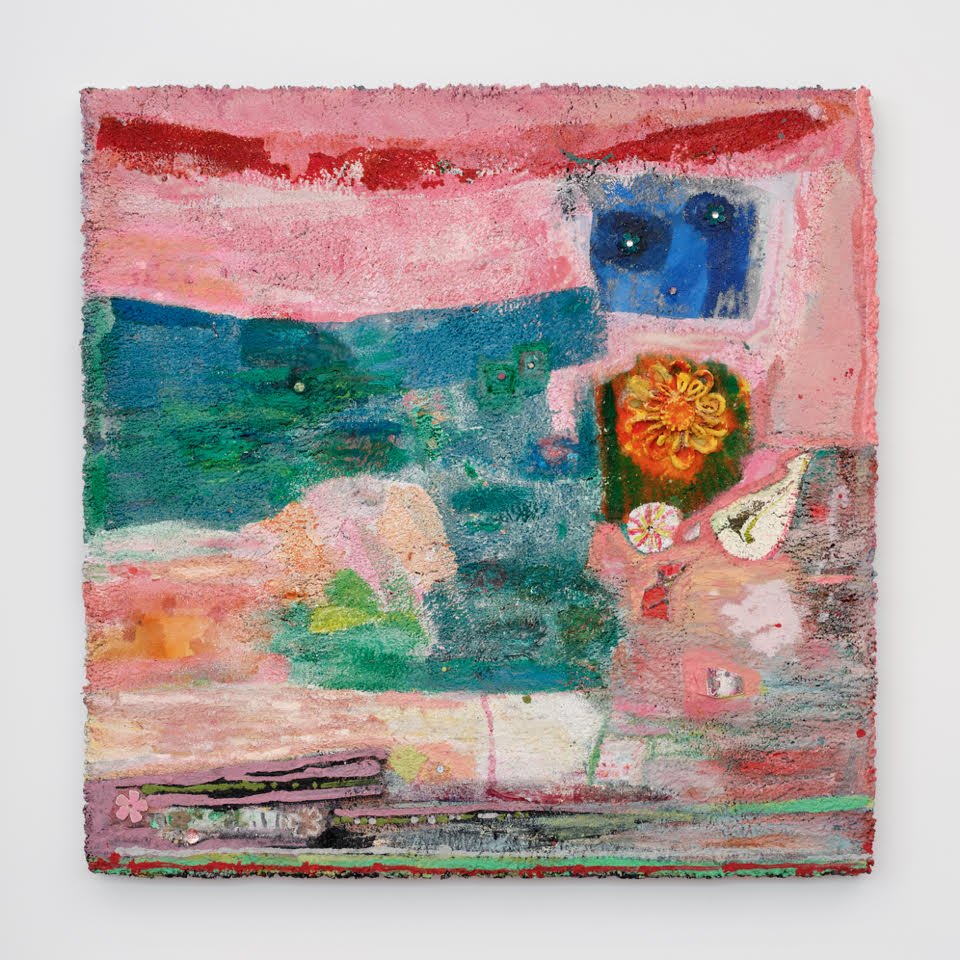
Earthy Nostrils, 2025, Daisy Sheff
Oil, enamel, leather, acrylic, rope, glitter, sand, flocking, and beads on rug mounted on wood panel; 36 1/2 x 36 1/2 inches (93 x 93 cm)
Image courtesy of Parker Gallery, Los Angeles
Are there particular experiences or memories that shaped the way you make art?
“I might be a bit biased, but my mom, Karen Barbour, is one of my favourite artists. She really treats it like a nine-to-five job: she wakes up really early, goes to the studio, and works all day until the evening. That’s what she’s done for my entire life. I grew up in a kind of hippie, tiny town where we did a lot of art. We made papier-mâché, together-drawings, ceramics, and collages. I was lucky enough to be born into a family where people were like, “Yeah, artists are real.” I always wanted to be an artist, and I always felt like I was an artist. It felt like what we all did together was part of my life since the beginning.”
Your paintings often feel like fragments of a larger fairytale. What comes first for you: the image, the story, or the material?
“It’s kind of simultaneous, but with the physical objects, it’s definitely the materials first. I’m a big reader and a collector of images online and in books and magazines. I’m doing a lot of what I hate to call ‘research’: a lot of novel reading, embroidery, and illustration sourcing.
A lot of times, I’ll be rotating the surfaces, and even if I don’t feel very inspired, I might have a new technique I want to try or have found a new colour hanging around the studio. So I’m just trying to get something on which to jump off of.”
An important aspect of Daisy Sheff’s artistic practice is her connection to tangible objects and handmade materials. While working on her pieces, she focuses on the physical aspects of the work, building up surfaces, rotating them, and allowing them to take form and shape.
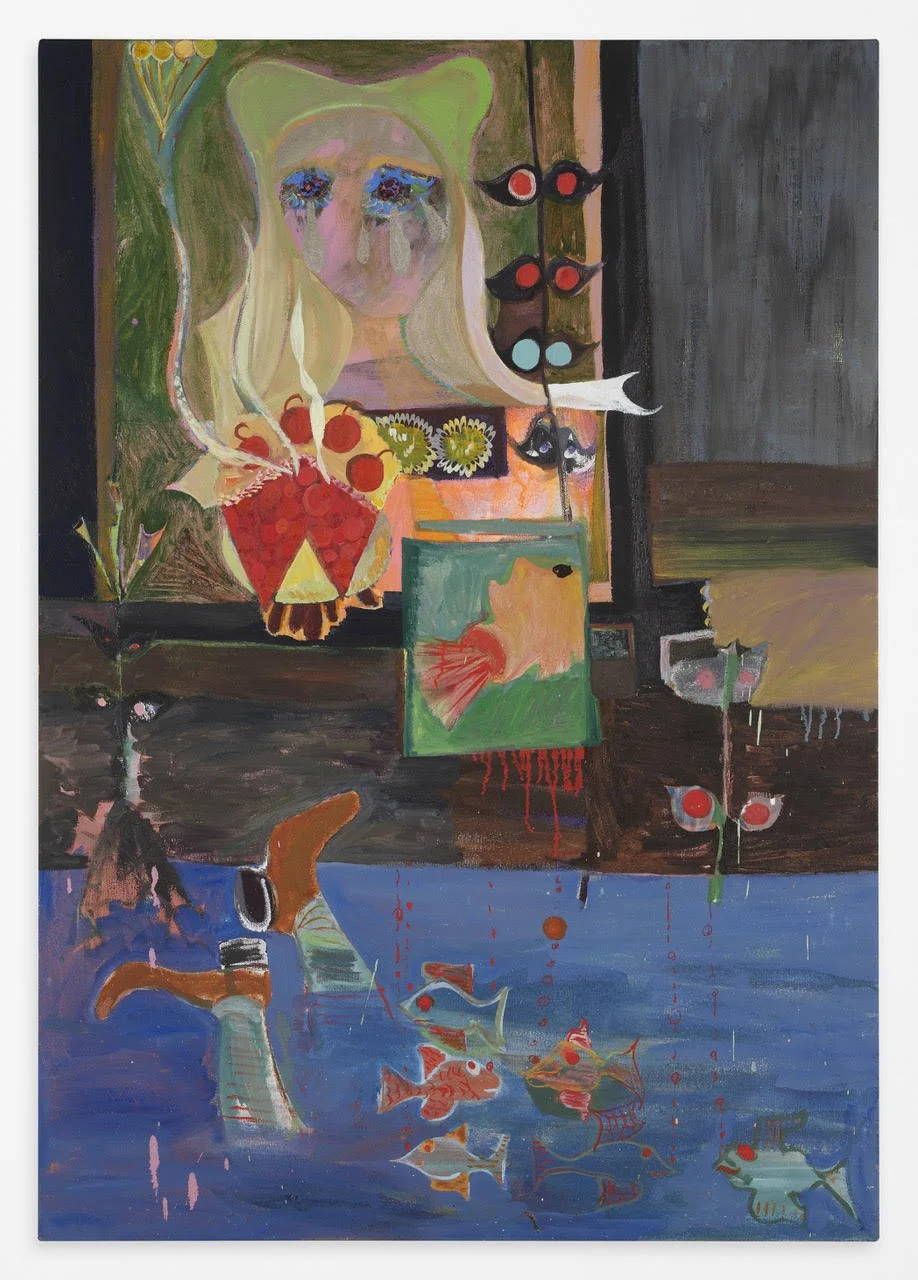
Crying Princess With Bloodthirsty Literature, 2023
Oil on canvas 46 x 32 inches (117 x 81,5 cm)
Image courtesy of C L E A R I N G
Your pieces bring together various materials like fabrics, beads, glitter, and everyday objects. What attracts you to materials that have such a tactile quality?
“I think I just got used to using whatever we had on hand, whether it be super formal art materials or not. I’m also really attracted to these objects. So I want them to be part of the work. I guess it’s just another tool of disruption for the surface, to make it stranger and weirder and sometimes even surprising to me.
I can’t really claim credit for collecting all these small things because I come from a long line of hoarders. My family never threw anything away, and my mom, being an artist who also had small children, had shells and glitter and clay, paper, and magazines. I just got used to working by being able to reach out and grab something strange and unexpected. I think I learned that from my mom, who has always worked this way. I also really like reuse stores. They’re kind of like thrift stores, but with art materials. I get a lot of great stuff from different ones in different cities.”
In Sheff’s work, materials become more than a vehicle for an already existing idea; they actively participate in developing the work. Her use of collected and found objects challenges the boundaries between what qualifies as artistic and non-artistic. In her work, ordinary objects become pieces of the artwork and give space for new interpretations to form. At the same time, colour also appears to be an element that refuses to abide by conventional colour composition rules, rendering the familiar strange and allowing fragments of an imaginary world to take shape. Every aspect of her work embraces the unknown, allowing materials and colours to playfully guide the process of making.
You use greens, browns, pinks and almost fluorescent, vibrant and one could say “unruly” colours. Do you think of colour as something that can behave unpredictably and lead the painting somewhere unexpected?
“I definitely feel like colours have a life of their own. I love pink and yellow, pastel colours, and more typical colour combinations that look really good. And yet, if you look at my paintings, there are a lot of swampy colours, browns, and strange yellowy browns – colours that I don’t know if I even like. It’s strange because I’m not really able to control it. I love all colours, but they do take on a life of their own.
When the colours start to relate to each other, it’s an intuitive thing for me. I’m like, ‘Okay, this needs to go there.’ I also like collecting and looking at fabrics and wallpaper designs, and a lot of them use just two or three colours that really vibrate. But whenever I try that, I just can’t control it. The colours go where they need to go, so they definitely always surprise me.”
For Sheff, colours cannot be entirely tamed. Although she might initially imagine a palette, the relationships between colours have a way of developing intuitively, giving the impression that this is more than a stylistic observation. The way colours behave seem to reflect a wider characteristic of her artistic practice, namely her willingness to allow the work to exceed her original intentions.
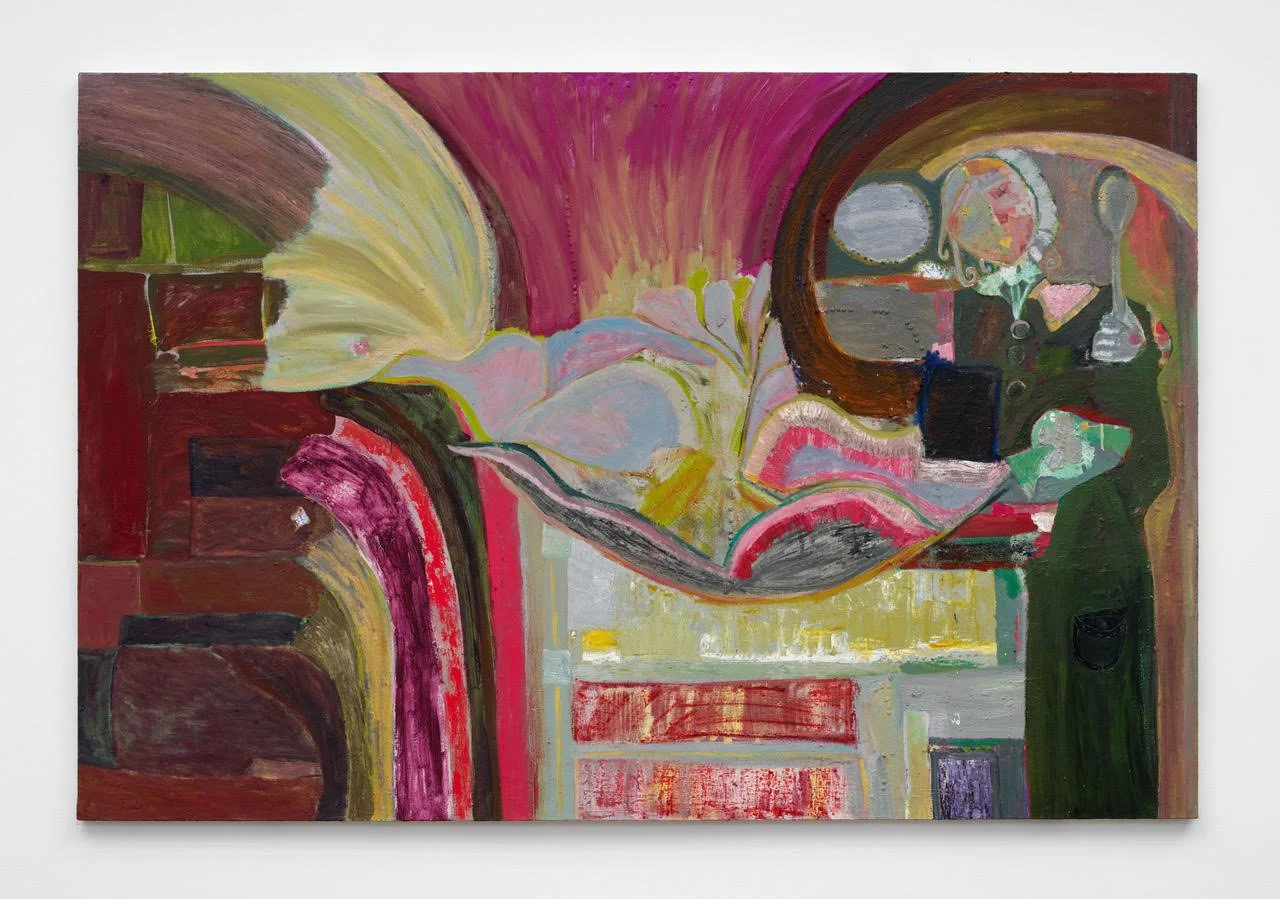
Cauldron Explosion, 2025
Oil and beads on canvas; 44 x 66 inches (112 x 168 cm)
Image courtesy of Parker Gallery, Los Angeles
In her exhibition “All This Splish and Splash”, Sheff uses colour as a means of transforming the familiar into something strange and unpredictable, bringing together folkloric figures, everyday objects, and animals in an imaginative world that resists a fixed narrative. Her art combines pastel and luminous shades that mingle with browns, greens and fluorescent flashes of colours, while layered paint and use of various materials such as glitter and beads give the surface a tactile quality. Additionally, water and mythological creatures associated with it appear to be a significant element of the exhibition, revealing the duality of being in the ocean. These elements reflect both the thrill and boundlessness of the experience and the simultaneous acknowledging of what is hidden underneath the surface.
Do you see art as an escape from reality, or as a way of making reality feel magical again?
“I identify with all of that, actually. It does feel like an escape and, simultaneously, makes my reality feel more magical. Making art feels like a very positive action, but that doesn’t really make any sense within the world or within what’s going on; at the same time, it feels like what makes life worth living. Unfortunately, it’s not part of our values to look at nature, experience nature, and see the magic that is there. We do not bring in all these enchanted things that we may have learned when we were younger.”
While negotiating re-enchantment, Sheff’s art invites the viewer to reconsider the magic that still exists in the world and resist the social expectations that adulthood imposes on our imagination and sense of wonder. While art can offer an escape from an over-rationalised reality, it can also help us recover the lost sense of magic that we may have experienced as children. By incorporating animals, bright colours, found objects and folkloric creatures into her work, Sheff challenges what distances us from nature and whimsy and returns the viewers’ attention to things that are often dismissed as childish or frivolous. By embracing intuition, material experimentation, and the imaginary, she challenges the limitations on how the world should be perceived. She also invites us to understand wonder and fear as not mutually exclusive.
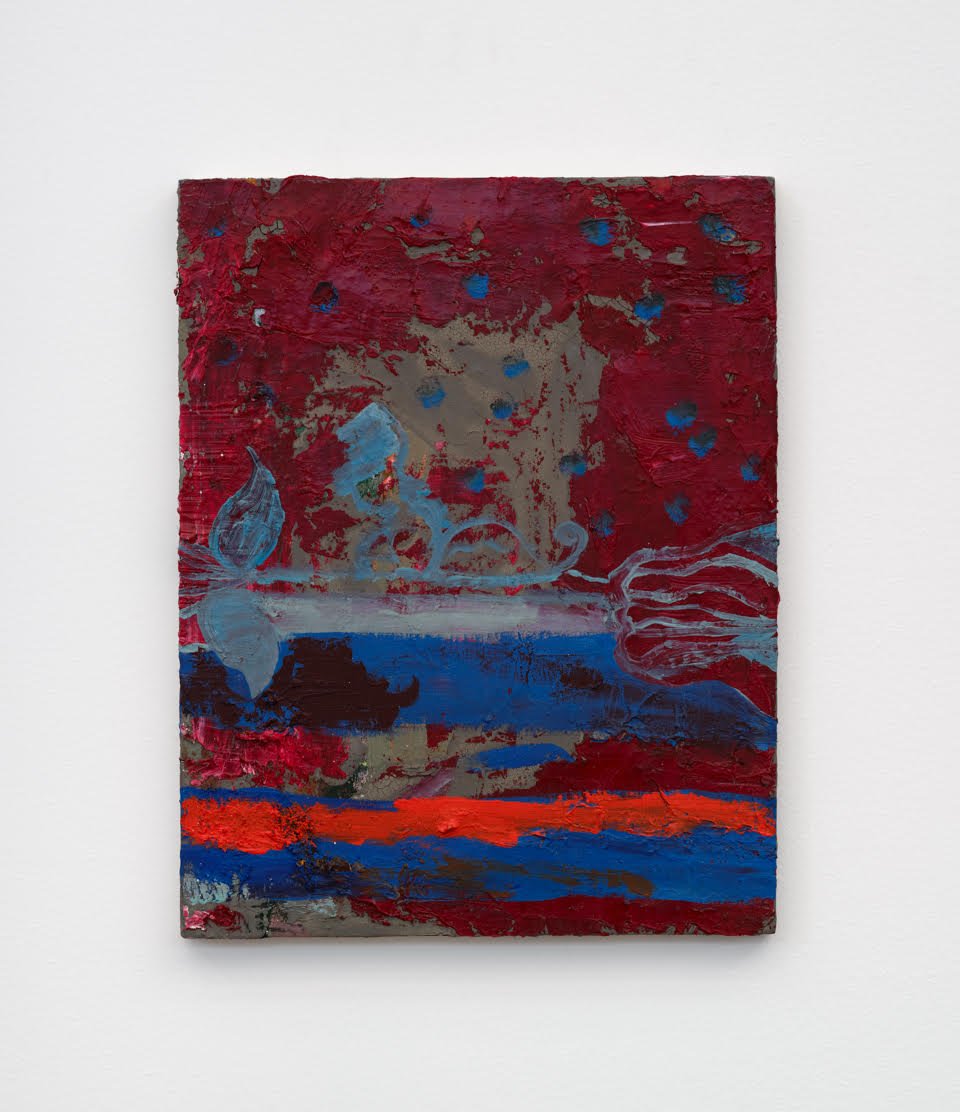
Chipmunk on a Broomstick, 2023, Daisy Sheff
Oil on panel; 14 x 11 inches (36 x 28 cm)
Image courtesy of Parker Gallery, Los Angeles
Do you think about whimsy as something purely joyful, or can it also be a way of dealing with darker or more complicated aspects of life?
“I think the whimsical aspect is also about negotiating darker and more complicated aspects of life. Within the work, there are a lot of things that are bright, maybe cute, and funny, but there is also evil there, and there’s danger and a nightmarish sense for sure. I guess if it’s my imaginary world, which is kind of what I feel is happening in the work in some ways, there is also a lot of fear that I have. There’s the sense of trying not to feel afraid within all these really terrifying things, both inside and outside of being a human being.
Even when I think about surfing, which I love and consider one of the best things about being alive, it’s also scary. You’re in the water with a bunch of men, sometimes aggressive, sometimes not. I’m not afraid of the water, but I am afraid when I think about what’s underwater, about eels, certain crabs, great white sharks, and all these things. I think it’s all there. Even among the most positive and best things, there’s violence, loss, sadness, and all the things we all experience. It does feel like I’m dealing with it, trying to see it, and trying to feel like it makes a little bit more sense.”
By acknowledging the darker aspects of life, she allows whimsy and imagination to become tools of confronting fear. Danger and violence can coexist in a world of beauty and wonder. Her paintings explore the interplay between playfulness and unsettling atmosphere, giving physical form to the complexities of human experience and allowing the viewers to better understand their fears.
Why are animals such an important part of the worlds you create? Are there particular animals that you feel especially connected to?
“I love animals; I’m kind of an animal-obsessed person. Where I’m from, there are a lot of farms, so I would see horses, cows, etc. There’s also a ton of wildlife: foxes, coyotes, bobcats, and all sorts of stuff.
I actually make a lot of work about my dog. He’s giant; he’s 115 pounds and golden and glorious. I think of him as my magic familiar. But another thing I like about working with animals is that they often show up in pattern design, cartoons, old paintings, etc. There are so many ways people have synthesised animals into design, and I’m interested in their figuration in that sense.”
Animals occupy a significant place in Daisy Sheff’s personal life and artistic practice. Reflecting on her childhood, she recalls being surrounded by farm animals and wildlife. Those experiences appear to create an enduring attachment to animals and more particularly to her dog Blinky, whom she describes as her familiar, referencing the idea of an animal companion from folkloric stories. Beyond her personal connection to animals, animals also appear to be a recurring element in her work. For Sheff, animals are not merely subjects of representation but rather the connecting point to nature, the imaginary and personal affection. Her work explores how our relationships with animals can offer a way to be in touch with the natural world.
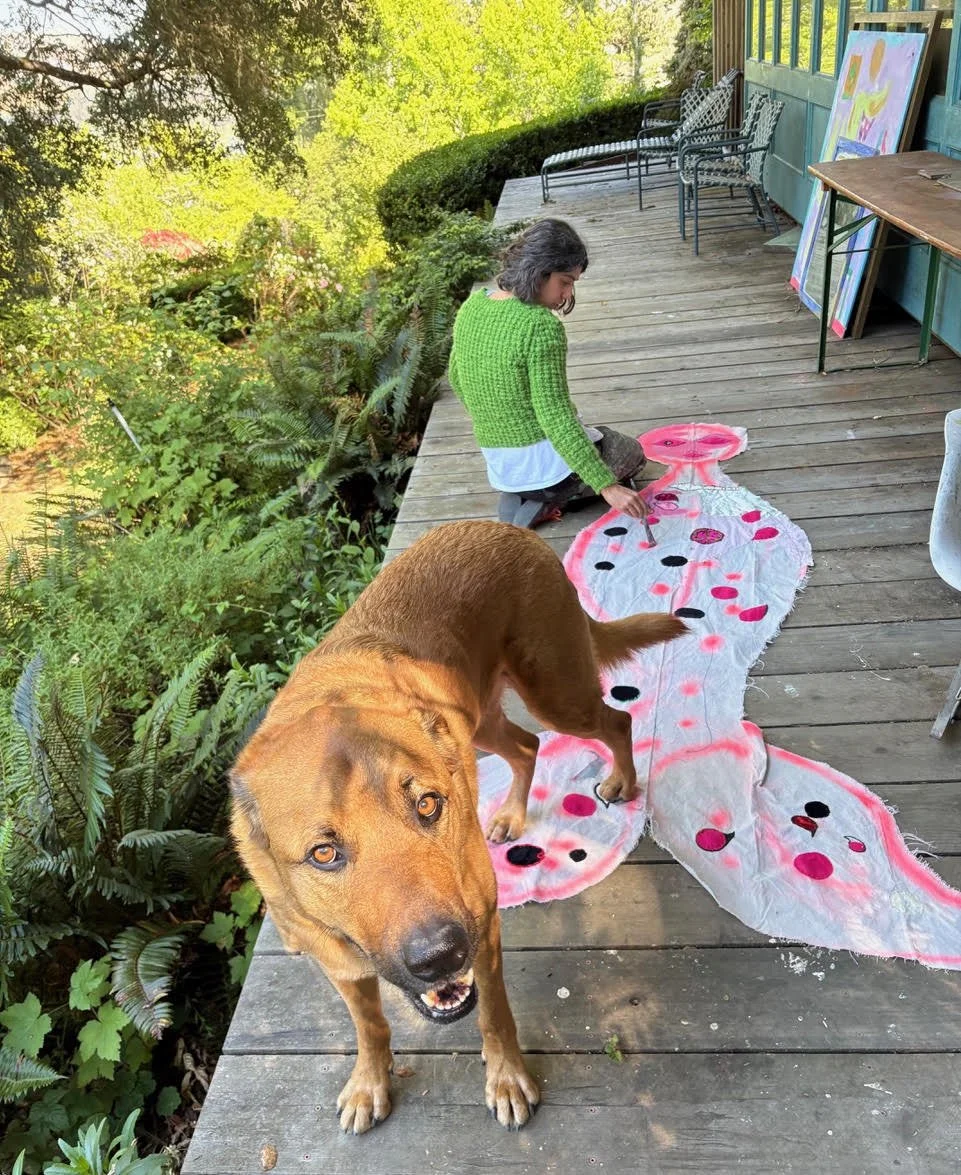
Daisy Sheff and Blinky
Image courtesy of Daisy Sheff
How important is it to you that viewers understand the stories or meanings behind your paintings?
“The work isn’t particularly legible in terms of a clear story arc. To me, it’s more important that viewers absorb the mystery that might be there and approach it with whatever they want to add themselves. I work pretty hard on the titles. Through them, I try to add another little snippet of information, or another gesture within the scene that could add meaning, a feeling, or something else. It’s a starting point, and from there, viewers can take it in their own direction.
I like when people bring their own meanings to the work. It would be impossible to translate everything that’s going on in it because I see a ton of different things all the time. Sometimes people see something that makes me think, “Whoa, I didn’t see that at all,” but then I realize that it’s there too. I like that the work perhaps encourages people to put together something of their own from the fragments that are there.”
Sheff’s narration techniques extend beyond the imagery to the titles of her work.
She describes titles as additional gestures within the scene and not a fixed interpretation of the work. Instead, the titles are introductions of possible associations and moods, providing the viewer with a starting point from which they can draw on their own memories, experiences, and associations.
Re-enchantment is not necessarily a return to an innocent or entirely harmonious world. It is an ongoing attempt to remain curious about the aspects of human existence that cannot be fully understood or controlled. Sheff’s work does not abide by conventional forms of narration nor promises a world without fear. Instead, it creates space for the familiar and uncertain, and the joyful and frightening to coexist. Essentially, she reminds us that re-enchantment does not mean the absence of danger or fear but rather the willingness to remain open to the unknown and to rediscover our capacity for wonder and curiosity.
See more of Daisy Sheff’s art on her Instagram or at the Ludovico Corsini gallery, where her exhibition runs until November 7.
Article by Christina Anagnostoudi
Christina Anagnostoudi is a cultural anthropologist and researcher based in Brussels. Her academic background spans cultural research and gender studies, with a particular interest in ethnography and socially engaged art practices. Her current work explores contemporary artistic practices, cultural participation and how art institutions can foster more inclusive and meaningful encounters between art and audiences.