KRISTOF SANTY ON REPETITION, RHYTHM AND THE LIFE OF THINGS
For Kristof Santy, an egg, a bicycle or a piece of furniture can become something larger than itself. Working between observation and abstraction, the Belgian painter transforms familiar fragments of everyday life into images that feel at once immediate and strangely timeless. Largely self-taught, Santy developed his practice alongside factory work before his paintings came to wider attention in 2021. Now, on the occasion of the BOLERO exhibition at Sorry We’re Closed in Brussels, he reflects on repetition, folk traditions, the rhythms of Ravel, and his recent move into copper — exploring how an image can accumulate meaning while resisting a single story.
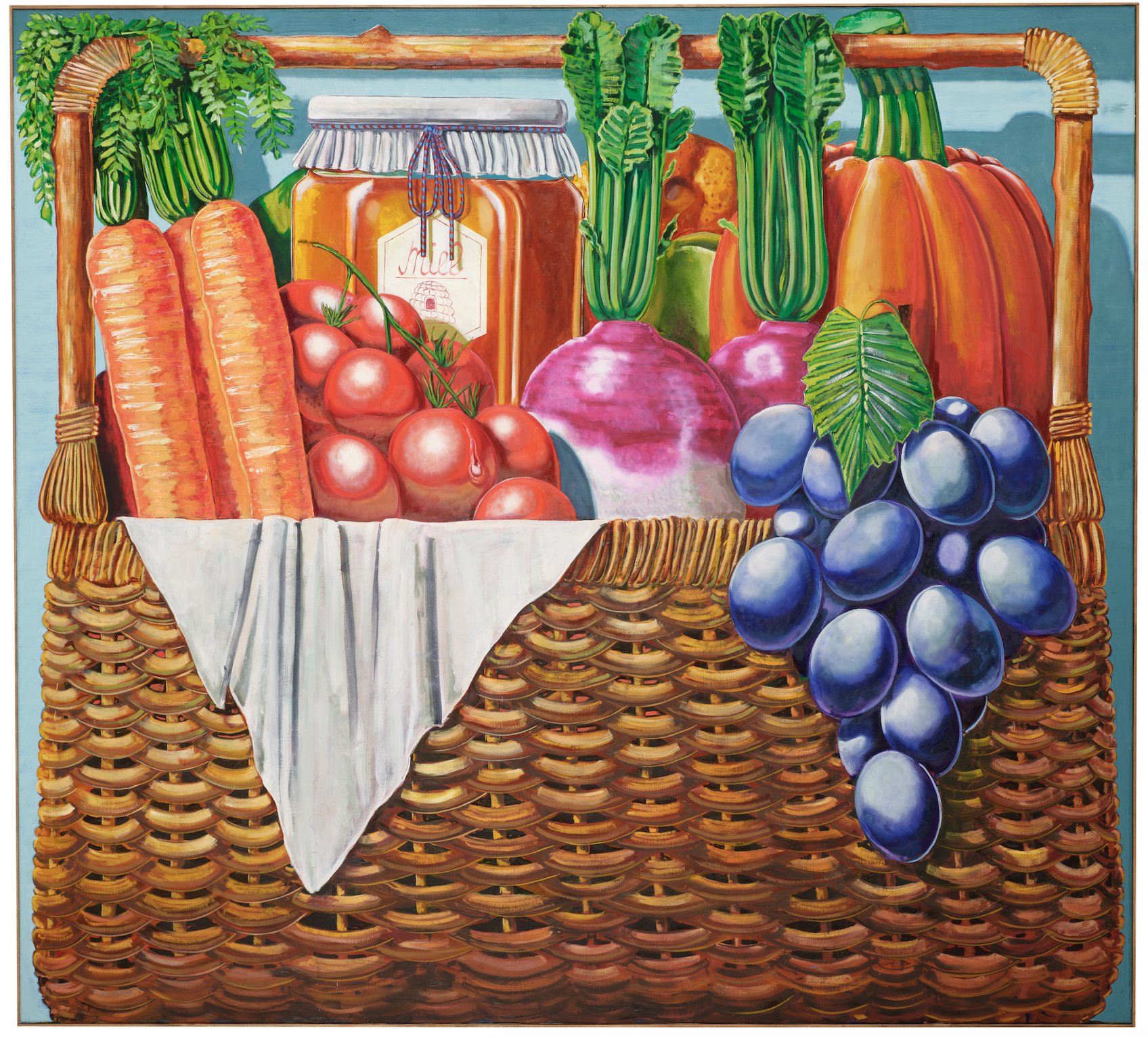
Kristof Santy, Winkelmand, 2026
Before dedicating yourself fully to painting, you worked in a factory and developed your practice largely through self-study. How did that experience shape your understanding of artistic labour—and did remaining outside formal art education allow you to develop a visual language less constrained by what contemporary painting was “supposed” to be?
It is difficult for me today to fully put myself in the position of the person I was back then. I can say that I have changed a lot as a person. I am no longer the same person I was when I worked in the factory. Over the past few years, I have spent a lot of time on introspection, and because of that I also look at that period differently.
During my working life, there was actually a good rhythm between heavy physical work and painting, which in its own way was also a form of work, but more mental. The main difference today is perhaps simply that one of those two elements has disappeared. This gives me more time to think about my work and about the choices I make within it.
I don't really see the fact that I did not receive a formal art education as a conscious choice or as a rejection of it. It was simply the path I followed. In the end, perhaps with some delay, I arrived at a place where I was able to learn a great deal without that traditional education.
I also want to be honest about something: at different moments in my life, I met the right people. People who gave me exactly the knowledge or insights I needed at that particular moment. I am very grateful for that. So my development is certainly not only a story of being self-taught. It is also a story of people crossing my path at the right time.
Your transition from painting in relative obscurity to exhibiting internationally happened remarkably quickly after your work was discovered in 2021. How have you protected the intuitive or private qualities of your practice while adapting to the expectations, rhythms and visibility of the international art world?
I think that change in a person's life always requires some form of adjustment. Sometimes that happens quickly, and sometimes it takes more time.
In the beginning, I did not always find the new situation easy. I did not always know exactly what was expected of me or what the expectations of the outside world were. Over time, I started to look at that differently. I now try to take those expectations with a grain of salt and return mainly to introspection.
In the end, I think many of those expectations also come from within yourself. To a large extent, you determine how you relate to the outside world. And if you are constantly trying to meet other people's expectations, I think it becomes difficult to continue following your own path as an artist.
So I mainly try to keep looking at what is important to me and at what is happening within my own work. That is probably the best way for me to deal with this changed environment.

Kristof Santy, Fauteuil, 2025, Oil on canvas 150 x 120 cm. Courtesy Sorry We're Closed, Brussels
You have described your paintings as “snapshots from everyday life,” often focusing on food, tools, furniture and other seemingly modest objects. What makes a particular object demand your attention—and at what point does observation give way to invention?
It happens largely intuitively. Sometimes an image simply appears and I have the feeling that it gives me something. Some images have such a strong presence that they remain in my mind for a certain period of time. Those are the images that eventually find their way into my paintings.
At first sight, they may be simple or everyday things, but by enlarging and monumentalising them, they can suddenly take on a different meaning. They become almost universal and timeless.
An image that does not interest me will probably not be painted. I often notice that the images that do not appeal to me are precisely the ones that feel very artificial and strongly tied to a particular period of time. They are connected to a certain way of life, but for me they have no life of their own outside that context. They may exist today, but I do not feel that they necessarily have a place in my universe beyond that.
Your paintings are immediately legible yet strangely resistant to narrative: familiar objects become flattened, enlarged and almost monumental. Are you interested in allowing an image to exist autonomously, beyond what it depicts, or does something of the object’s social and personal history always remain?
That extra layer, the history or possible symbolism of an object, is something I like to play with. I can depict an object in such a way that, as a viewer, you almost automatically feel that it is loaded with meaning or that there is a story behind it, while objectively the object itself may not mean anything special at all.
An egg is ultimately just an egg. But in a painting it can almost become a mantra. An egg is an egg is an egg. That also made me think of Gertrude Stein and the way she worked with repetition and meaning.
The possible narrative then perhaps arises mainly with the viewer. That is what I find interesting. A painting does not necessarily have to tell one fixed story. Everyone brings their own experiences and memories to an image.
For me, that is also one of the beautiful things about painting: that it can evoke emotions without you necessarily being able to fully explain them. Whether that emotion is positive or negative is less important to me. It is a very personal journey for the viewer.
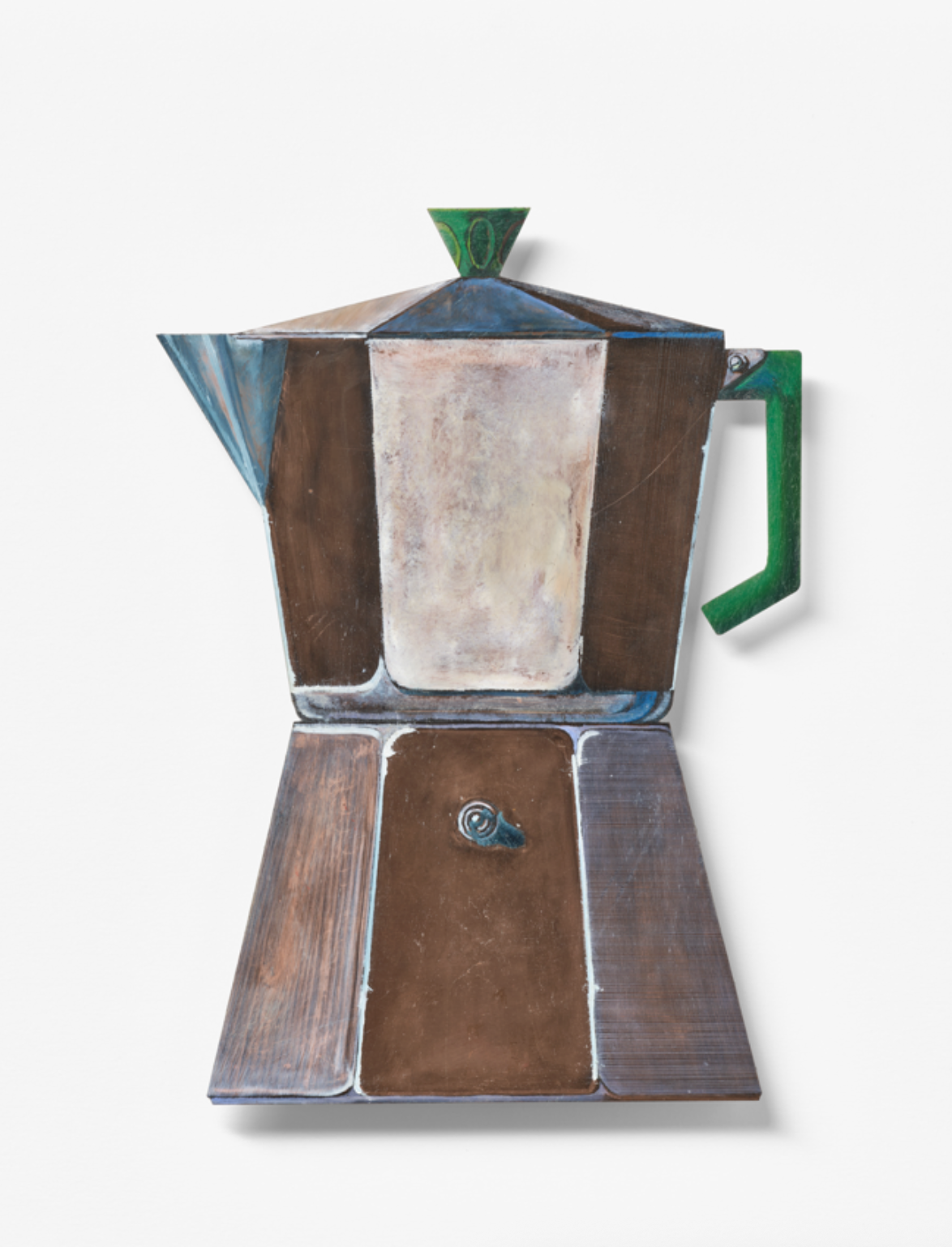
Kristof Santy, Koffiezet, 2026, copper plate
Folk traditions, anonymous popular painting and Belgian modernism frequently appear in discussions of your work. How do you approach these visual histories without turning them into exercises in nostalgia—and what does it mean to you to make distinctly Belgian paintings today?
Those comparisons probably also come from the question of what my sources are. Folk art and modernism are certainly part of those sources. But if I am completely honest, I make so many associations that it is almost impossible to sum up all those sources in a short list.
When I am working on a particular subject, I often think about artists I admire. Then I also became curious about the artists and images that their work came from. In that way, you are constantly looking for another source. One source leads you to another.
I experience that way of thinking as a kind of mechanical continuity. It also connects to how I see my own work: as something that keeps moving forward and develops from what already exists.
I find it a very fascinating world. There is so much information, so much history and so much work to look at. Having the possibility today to dig into all of that at my own pace is something I see as a privilege. I try to make as much use of that as I can.
Your exhibition at Sorry We’re Closed Gallery in Brussels takes its title, BOLERO, from Maurice Ravel’s composition, whose structure grows through repetition, accumulation and variation. How did you translate that musical principle into visual terms, and how will the exhibition unfold rhythmically across the gallery’s three floors?
In the previous question, I talked about that mechanical continuation of searching for sources. I recognize the same kind of continuity in Ravel's work.
For me, Boléro is actually a very abstract piece of music. I mainly experience it as something about rhythm, colour and form. It starts very simply, and through repetition and addition it slowly grows towards a climax.
I recognise that process in my paintings as well. I often start with a simple basic form and then gradually add colour and other elements until the image becomes a complete whole in its own right.
So I am not trying to literally translate the piece of music into a painting. It is more the way it is constructed that interests me.
That said, I believe putting together an exhibition is more of a form of collective work. I receive help from the people at the gallery, and I think that is important.
For me, the work of a painter happens primarily in the studio. That is where my language lies. Installing an exhibition is actually a different language. It is about space, rhythm, proportions and the way different works relate to one another.
For that, I need other people as well. I don't feel the need to pretend that I have to determine or control everything myself. It is actually interesting when different people look at the work from the perspective of their own expertise.

Kristof Santy, Cours de Dessin #198, 2026 ,Pencil and wax on 130 gram simili japon paper 56 x 38 cm. Courtesy Sorry We're Closed, Brussels
BOLERO brings paintings and drawings into dialogue with your first three-dimensional works on copper plates. What led you towards this new material and spatial territory, and does working beyond the conventional surface of paper or canvas alter the way you think about an image?
I see the works on copper as a next step from my work on paper. On paper, I first create a form. I then have that form cut out of a copper plate.
For me, there is an important difference between this and a painting. A painting can carry several forms on one surface. Take a bicycle, for example: the bicycle is one form, but behind it there is also the form of the shadow. That shadow creates an almost additional, illusionistic layer.
With the copper plates, the shape of the object becomes the edge of the work itself. The shadow is still there, but in a natural way. Because the copper plate hangs away from the wall, a shadow is created behind the work that changes throughout the day.
I have always had a strong fascination with images and objects, from religious sculptures to simple fragments of stone. When you look at such an object throughout the day, it constantly changes because of the light. The sun moves, and with it the shadow changes. So you experience the same object differently each time.
That principle also interests me in the copper plates. The foreground remains flat and the form remains intact, but the shadow behind it keeps changing with the natural light. The work is therefore never quite the same.
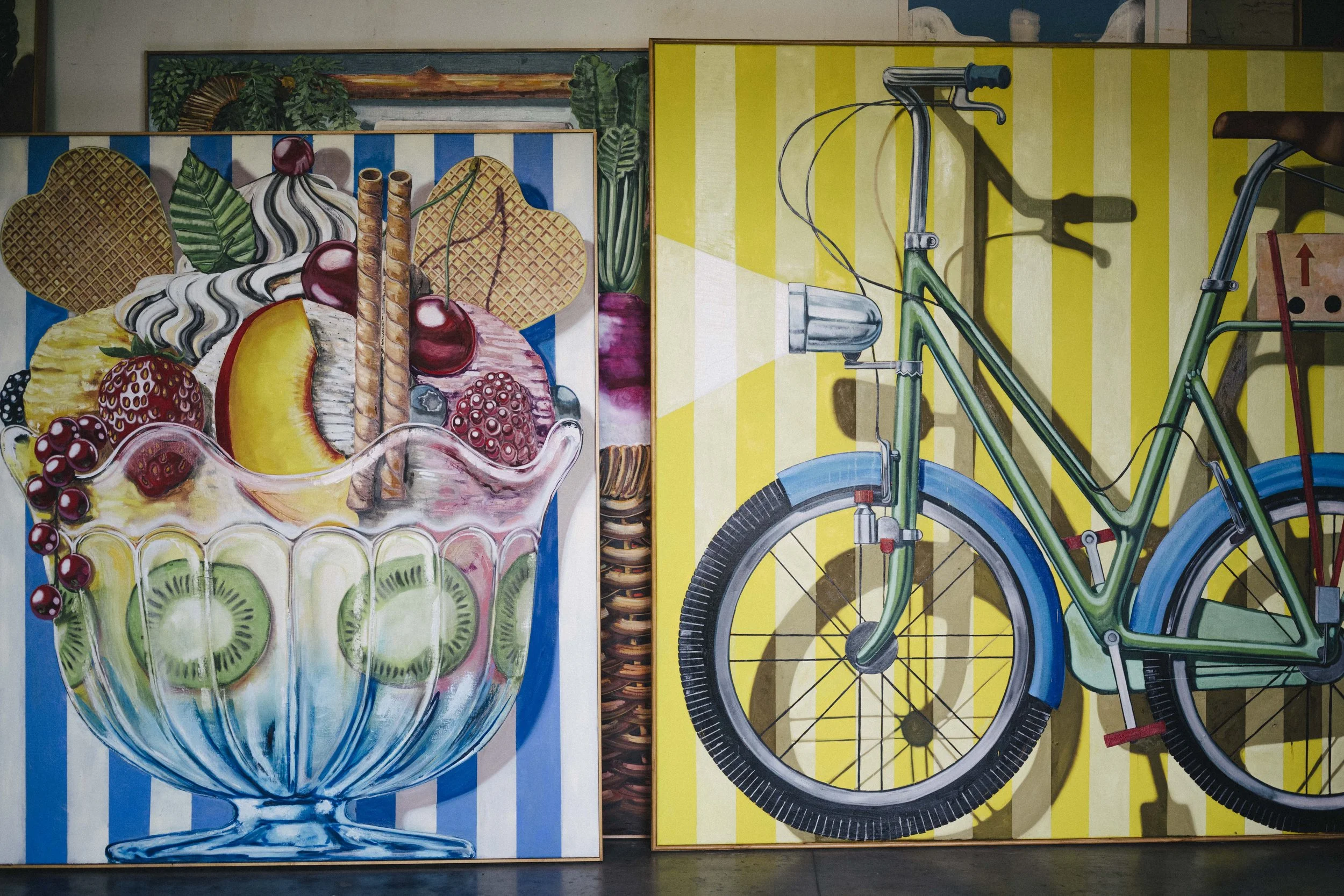
Kristof Santy studio, photo credits Alexander Dhiet
Your work has often found intensity in repetition, routine and sustained attention to overlooked things. As BOLERO marks both a return to Sorry We’re Closed Gallery and a new stage in your practice, what possibilities do you now want painting to open up—for yourself and for the viewer?
I can say that the way I look at my own work today, but also at the world in general, has changed a lot compared with three years ago.
My view of life has become lighter and more relaxed. Objectivity has become much more important to me. I also increasingly see neutrality as a quality.
As people, we can easily become bitter, angry or disappointed. Perhaps that is also a logical development in a world that is constantly becoming faster and more complex. But I think that, as human beings, we cannot always keep up with that speed.
That is why I increasingly believe in the importance of looking at things more objectively. Some things do not need to be judged immediately. And sometimes it is also good to simply let something pass when we do not know enough about it. I think that can ultimately make us calmer.
I am also trying to apply that way of looking more and more to my own work. Perhaps that is ultimately what painting can mean for me: a way of looking again, without everything immediately needing a judgement or an explanation.
I believe art remains a way of arriving at new insights. It has always been that way, and I think it always will be. I find that thought hopeful in itself.
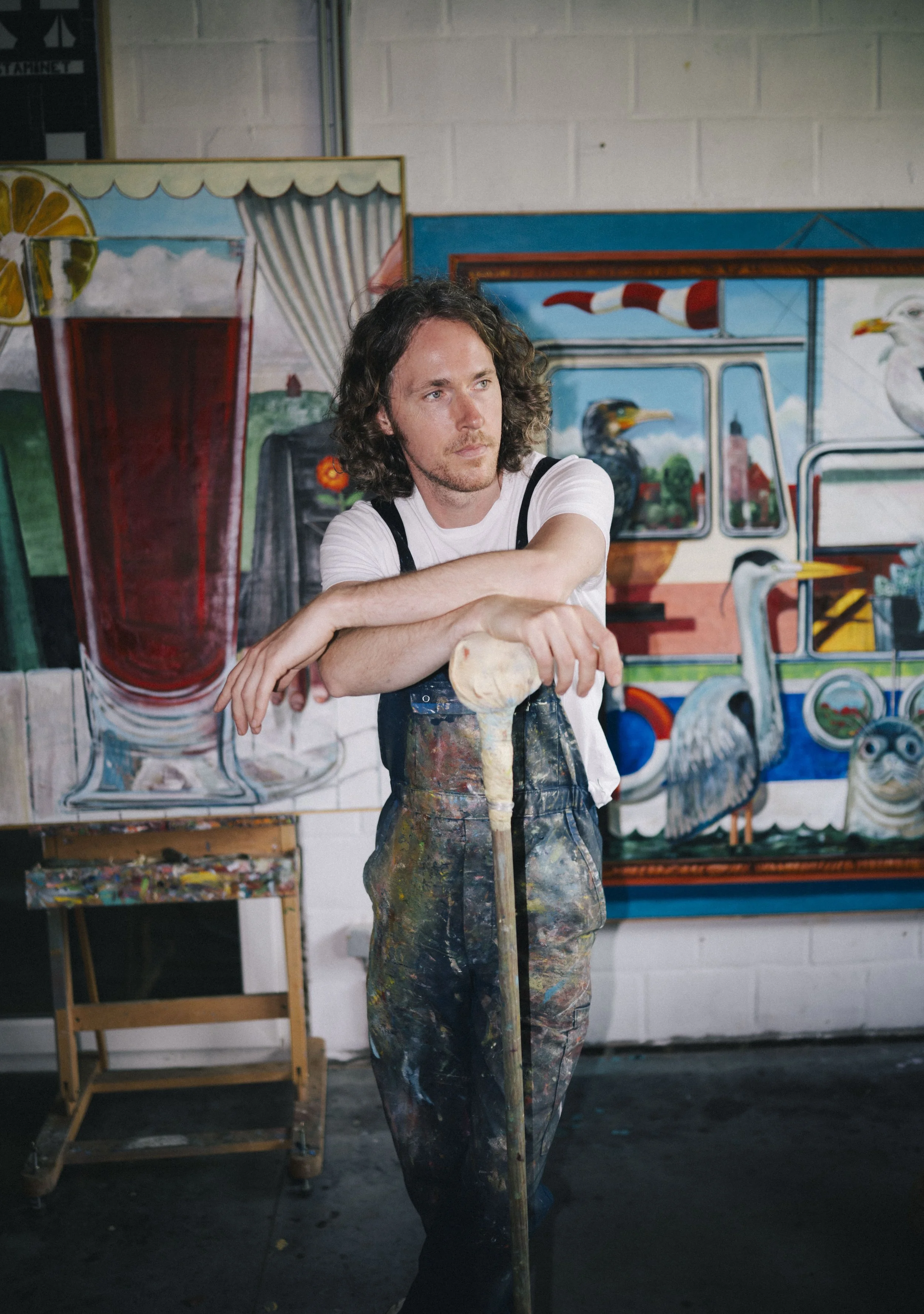
Kristof Santy in studio, photo credits Alexander Dhiet
To further explore Kristof Santy’s work, visit his website and follow him on Instagram. The artist is represented by Sorry We’re Closed Gallery Brussels.
Article by Alexandra Vîstraș
Alexandra Vîstraș is a Brussels-based cultural observer, policy professional and lifelong theatre enthusiast. With a background spanning cultural management, European policy and communications, she is interested in the ways art, politics and collective imagination intersect, particularly through the lenses of gender, identity and social change.