PHIL BRIADE: WHEN LIFE IS IN-BETWEEN
“What if perfection is not where everybody thinks it is? What if perfection exists between two things?”
Phil Briade is an artist who searches for the liminal, for the in-between, perhaps because it is there that meaning can emerge - where matter is not fully fixed and spirit becomes more accessible to us. It is this mystery, this sensation of seeing something that both is and is not, that captivates us through his black-and-white charcoal drawings: a tree that could be a woman, a bird that could become an entire landscape.
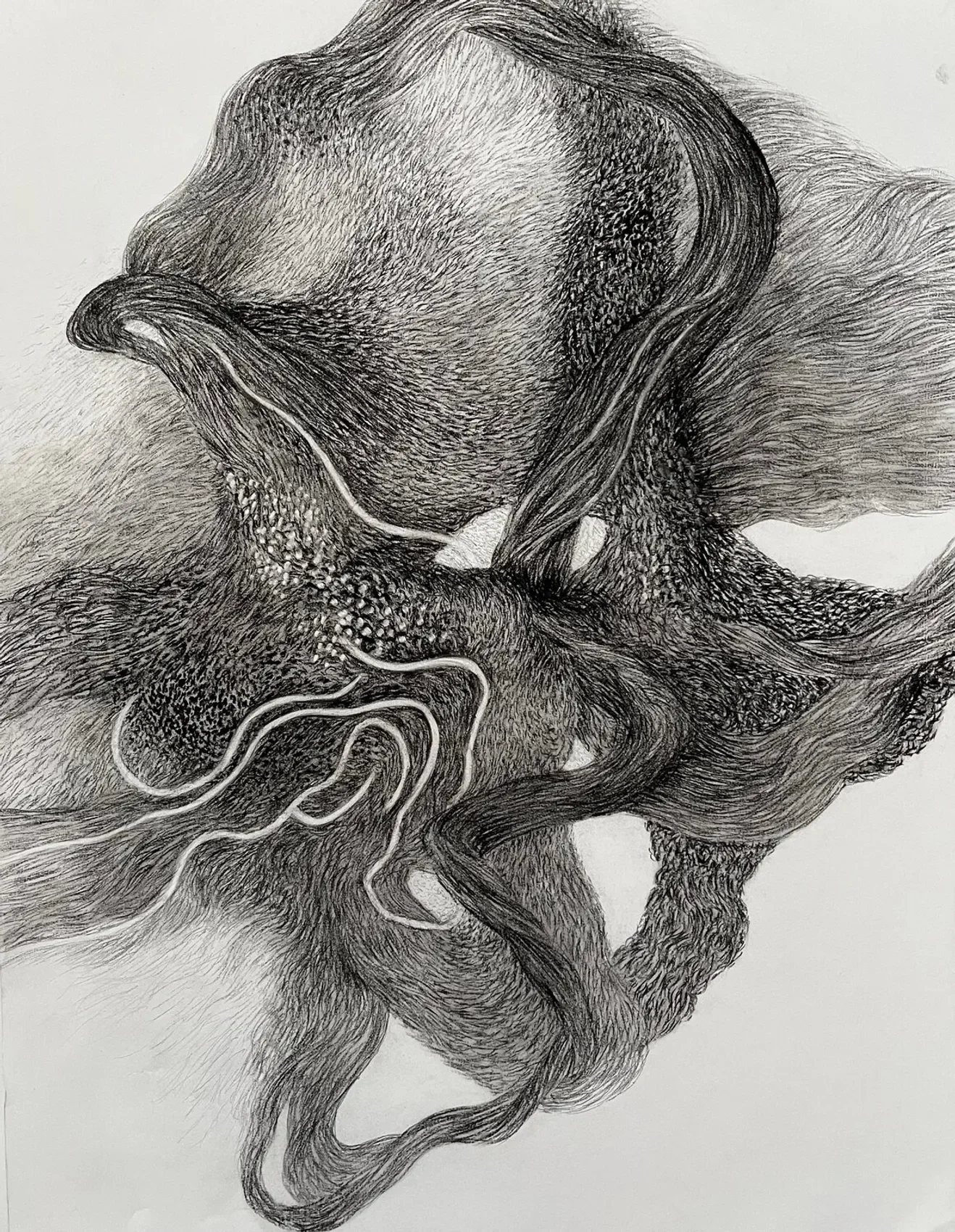
Lines of Becoming by Phil Briade, 2026
I have seen that you passed through many different facets as an artist before arriving at this type of drawing. I read that one of the things that inspired you toward this path was the modelling sketches you used to make in art school, and that in some way you try to preserve this feeling of the “sketch” in your work.
I did life drawing for eight years and it’s something I have ‘mastered’ in some way. The models were moving, so you had no time. It was not a fixed pose. And at the beginning I thought: how can I draw someone moving? Even if the movement is slow, it feels impossible. And my teacher said: ‘If you draw people on a terrace, you’re not going to ask them to stop moving.’ You have to accept movement. Things move. So what do you draw? You capture moments. You remember what you saw. And then maybe the body becomes hybrid. Maybe there are three arms. It doesn’t matter. That freedom was very important for me.
Imagine you are taking a photograph of moving people. The image becomes blurred. Is it less real because it’s blurred? No. It’s simply that the camera couldn’t freeze the movement: there’s another reality there. And I think that this new paradigm is very interesting to explore. What if perfection is not where everybody thinks it is? What if perfection exists between two things?
You can look at cars, or you can look at the spaces between the cars. You can look at the shadow instead of the building. You try to see what people usually don’t notice first. Second-degree, third-degree perception: different ways of reading reality. Animals don’t see the world like we do, and I like that idea. What happens if I try to focus on things people don’t usually focus on?
“Once you find your direction, you can’t betray it anymore.”
This reminds me of an experiment with kittens done by neuroscientists David Hubel and Torsten Wiesel in the 60s and 70s. They were raised only seeing vertical lines, and later, when they entered the real world, they couldn’t recognize objects properly because their brains had adapted only to those lines. So I guess we are very conditioned in the way we learn to see.
I think the job of an artist is to look where things are less obvious. To discover hybrid things, mutating things: they are not completely one thing or the other. Some people look at my work and say: ‘I feel uncomfortable.’ ‘It’s bizarre.’ I definitely don’t do it to disturb people, but I guess it can happen. Most of the time I’m trying to create a warm feeling, something like a nest. And some people think it’s dark because everybody brings their own past into what they see. It’s true that it’s mysterious, though. One person once said: ‘I see somebody watching me through a crack between two doors.’ And I said: ‘Where?!’ I hadn’t seen that at all, but for them it was real. So you realize people project their own stories into the work.
I imagine that the subconscious mind can project itself onto abstraction because nothing is completely clear. I guess it can trigger memories or beliefs that come from somewhere deeper, and I think that is also a beautiful thing, because the artwork becomes much more personal and can reveal deeper truths. Do you try to create a specific feeling for the spectator when you create?
Well, I assume that if I’m impressed by what I’ve done, other people will be too. And of course I’m trying to create images that stay in your retina, in your memory. But the fact that the image is not clearly identifiable is important: the idea is that the viewer doesn’t feel too comfortable. If an image is too easy to decode, people just look at it and move on. But if there is mystery, if there is a question, then people can return to the image many times. When I buy artwork, I like something that still contains mystery. ‘What did he mean? What was that?’ That interests me.
It is similar to improvisation, but within a certain field. Sometimes I go outside that field and it surprises me, but sometimes it doesn’t work - it’s always a risk. The way water creates its path is also the way I draw: water creates pathways as it moves (and we know everything comes from water), going in many directions and expanding through different branches - which is kind of funny because they are very similar to the structure of lungs, or to forms found in nature. I try to figure out how to make my way through the drawing and find directions; sometimes I rotate the paper to see what it evokes in me. If I’m not convinced, I change direction as I draw. I’m not really looking for meaning, but I guide myself through other sensations (for example, I know when something feels too heavy or too light), and I try to find a precise balance between textures and flow.
I compare my drawings to birds moving through the sky in groups: they have a kind of consistency, they look like something you could grab, and at the same time they suddenly fade away. And when I’m drawing, I have a bit of that feeling. I’m not planning the work. I’m improvising. There’s a moment when I say: yes, it’s there. I try to finish it while capturing something that could fade away or suddenly explode. I try to keep it at its highest point before it collapses.
It’s curious that you say you improvise because when I think about improvisation, I always relate it more to dance or performances. I am wondering how this process unfolds while drawing.
I think it is a bit like walking through a forest and taking a path without knowing exactly where it is leading you. Then you look around and discover things while walking. I don’t really have a fixed direction. I know when it will be time to finish the work, and I know when that moment is near or not, but I’m completely open to what is happening. It’s like: ‘Oh, look there… oh, look at that.’ That’s exactly it. Where is this going to take me? What connection will it create? What is going to happen?
I’m very intuitive. I don’t know exactly what’s going to come out. Of course, some shapes are immediately recognizable, so I try to break them. So it’s possible that it is that thing, but also possible that it is not. And I want to keep it open. If it becomes too precise, if it immediately means something, I try to escape from that. ‘Oh, it looks like a mountain.’ No, I don’t want a mountain. But it could be a mountain and a body. So a body-mountain, okay.
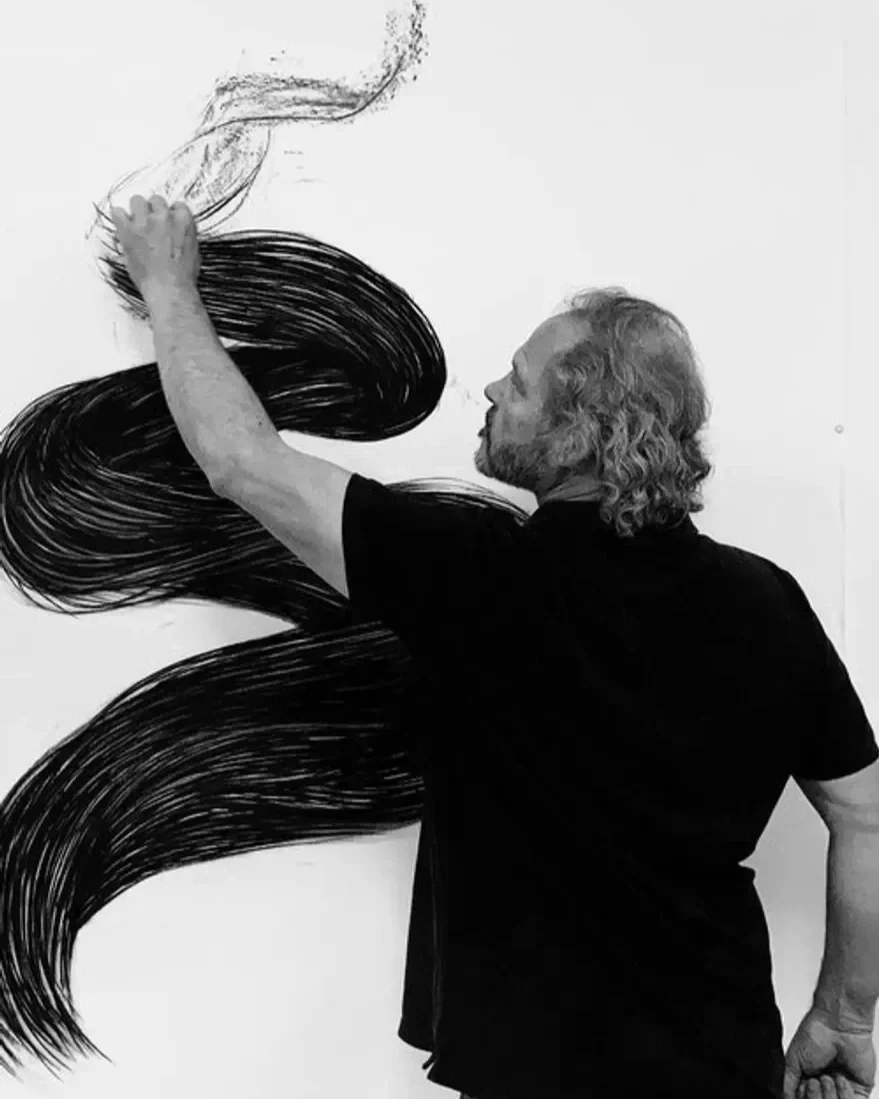
Courtesy of Phil Briade
You also write, and I imagine that has inspired your art as well. What other forms of art are you interested in, and have they changed the way you draw today?
“I started making sculpture recently because I was interested in discovering what it could bring to my work. Through drawing, I’m trying to convey the idea of touch and three-dimensionality. I wondered: what if I worked directly in 3D? Maybe I could discover something there and bring it back into my drawings, since drawing is already a way for me to express the idea of matter in a strong way. That question is one of the reasons why I’ve continued exploring this art form.
The idea that we are matter - something we can touch - and at the same time spirit, are the two things I want to express in my drawings. That is why I’m interested in what is alive, in whatever form this could be: wood, grass, hair, skin, the inside of us. Everything that carries life.”
“We think our lives are disconnected pieces, but, in fact, one day you realize everything connects.”
You created your own school in Brussels, and it seems that your artistic direction is very defined and clear now. How did you find your path among so many possible directions?
At some point I realized: I don’t make art, I express myself. Drawing and painting are only tools, and what it really matters is what you need to say through them. Once you find it, everything becomes clear.
People say: ‘You should make more colorful work.’ ‘It would sell better.’ But once you find your direction, you can’t betray it anymore. You stop asking: ‘Will this make me famous?’ ‘Will this make me money?’ And instead you say: ‘This is what I have to do.’
I think everybody has that hidden door. Not only artists. And once you cross it, things become obvious. You meet yourself. We think our lives are disconnected pieces, but, in fact, one day you realize everything connects. Every experience becomes useful later, like a puzzle: we are made from many stones, many stories, and somehow all those fragments become us.
I also like to think that sometimes what we consider a failure becomes a beautiful human moment for others. That vulnerability matters: it’s not only about the artwork. It’s also about the person behind it - or better said, the person and it’s vulnerability are definately a part of the artwork.
See more of Phil’s work on his Instagram.
Article by Sofia Alonso Wilson
Sofia Alonso Wilson is a Spanish-Catalan-English writer currently based between Brussels and Barcelona. She works at Time Out Barcelona and has a multidisciplinary background spanning writing, music, and contemporary dance. Alongside her professional practice, she is studying music and previously completed a BA semester in Contemporary Dance at Pera GAU University in Cyprus. She graduated in Journalism with a Humanities mention from Universitat Pompeu Fabra (Barcelona), one of Europe’s leading universities and ranked among the top 100 in Europe according to the QS Europe Rankings 2026. Her practice is informed by a strong interest in the arts, combining critical thinking, creativity, and cultural awareness through ongoing engagement with contemporary performance and artistic scenes.