
OKSANA ALEKHINA: THE ART OF SEEING WITH EYES SEALED SHUT
What do we see when we cover our eyes from what the world wants us to see?
Throughout her colorful, collage-like artwork, Oksana Alekhina explores what it’s like to perceive life with feeling and intuition rather than what’s tangible. Her vivid, dream-inspired compositions provide viewers with a shelter from the noise of reality, where they can lean more into their inner balance.
Drawing on many years of experience in interior design, she creates expressive visual accents that bring color, harmony, and emotional depth into contemporary spaces.
In this interview, Oksana Alekhina talks to us about intuition, imagination, and the inner worlds that shape her distinctive visual language.
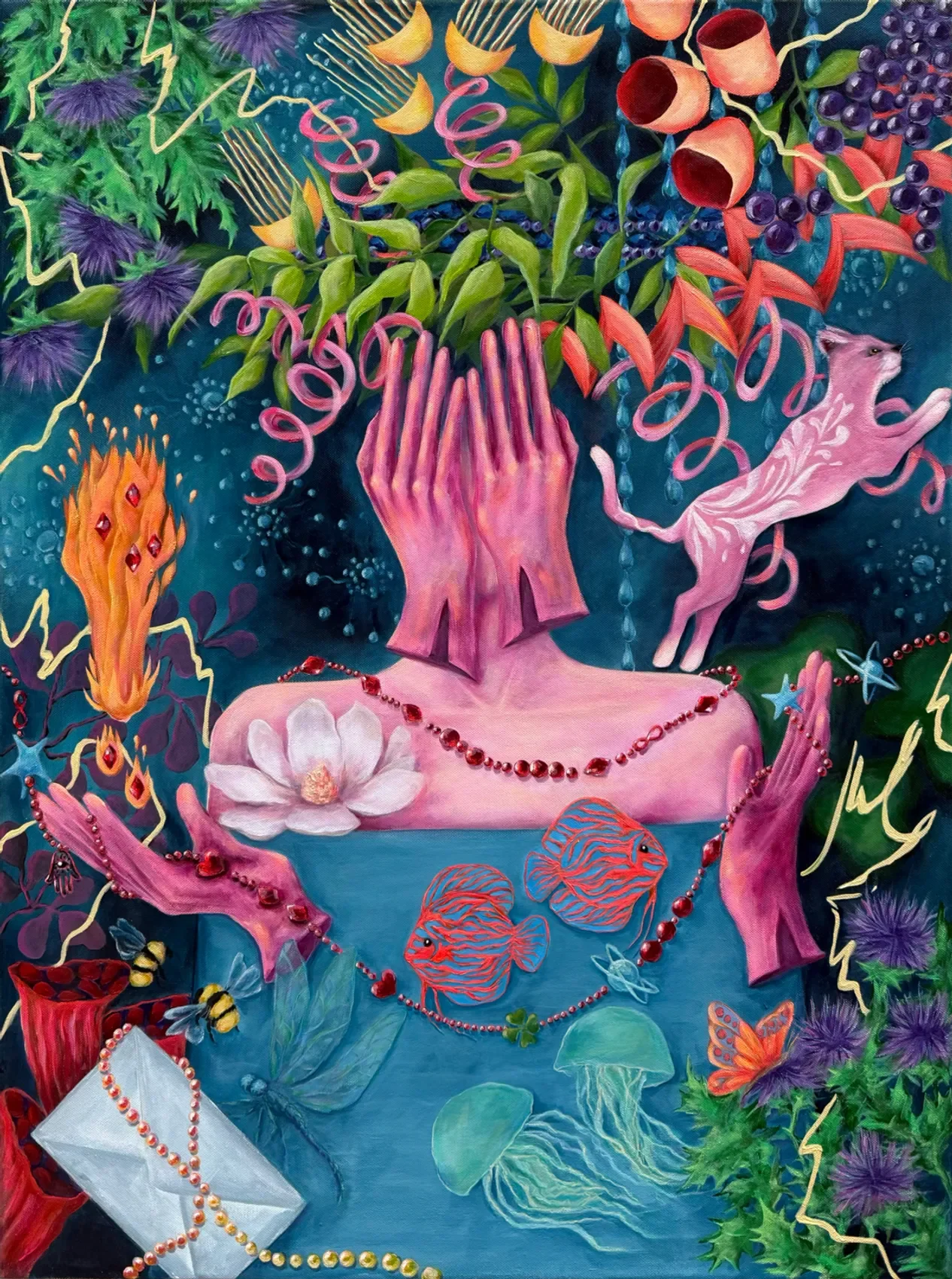
Decode, Oksana Alekhina, 2026
Your artwork consistently features figures with their eyes covered. Why is this such a fundamental component of your art? What does it represent to you?
Figures with closed eyes first appeared in my work as a symbol of refusing to accept the aggression and pressure of the outside world as absolute reality. It’s not a form of escape, but rather a way of turning inward - toward one’s own feelings, intuition, and inner freedom, beyond imposed expectations and stereotypes.
Closed eyes allow the figure depicted to exist in a state of inner autonomy. It is neither disconnected from the world nor fully controlled by it. This creates a sense of harmony and self-preservation.
My goal is always to create works that combine decorative expressiveness with a meaningful narrative. The brightness draws attention, but there is always a deeper symbolic layer beneath it.
It’s important to me that my paintings can exist naturally in contemporary spaces while maintaining their autonomy - as objects that not only interact with the space, but also create their own emotional reality.
I don’t want my works to have a fixed meaning, but to remain open to personal interpretation.
“Covered eyes are a symbol refusing to accept the aggression and pressure of the outside world as absolute reality - not as an escape but a way of turning inward.”
How does your relationship to a piece of art change between its creation and its exhibition?
During the creative process, I’m always in harmony with the work. At that moment, I fully immerse myself in its internal logic and trust it.
My favorite stage is when the composition has already taken shape, and I begin working on the details. In this moment, the structure of the work is already clear, and I can begin refining the color, texture, and symbolic elements. It’s the most interesting and meditative part of the process. I can spend a long time working on these details, because this is where emotion and layered meaning emerge.
For me, this is when the work truly becomes alive and almost done - but once it’s selected for an exhibition, something shifts, and I often feel the urge to rethink or refine certain elements.
When preparing a piece for exhibition, my perception changes. It begins to exist not only in my world, but also in the outside world and within the context of the exhibition. A sense of distance appears, and I begin to see it more objectively, noticing details I hadn’t seen in the same way before.
Sometimes, before or after an exhibition, I return to the work and make small changes. For me, this is part of the process.
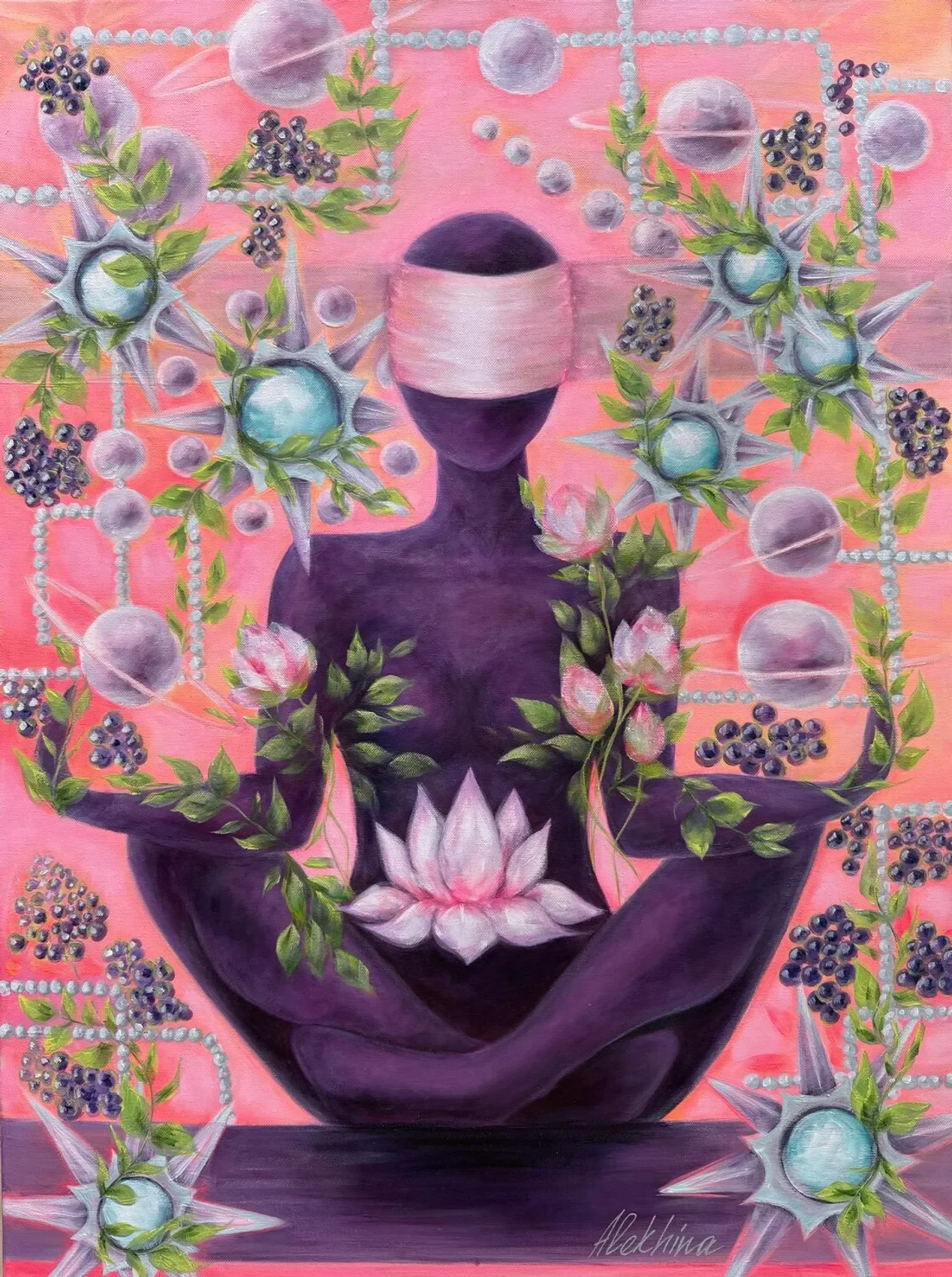
Energy of the Elements, Oksana Alekhina, 2022
Do your pieces ever resist the original idea of what they’re supposed to be and transform into something else entirely?
This is exactly how Decode (the piece exhibited at UNFIXED) came about. At first, the composition already existed in my head, and I had started painting it according to that initial vision. But at some point, something stopped feeling right.
One morning, I began changing it spontaneously, and the original concept shifted completely. The colors changed, the main figure changed, and the symbolic elements changed. There wasn’t a clear decision - it simply unfolded in the flow of one morning.
This rarely happens, because I usually build the composition in advance and refine it through details. But with Decode, the painting seemed to decide its final form on its own. It reminded me that the artistic process remains open - and doesn’t always follow the first plan I had in mind.
It also became the starting point for a new series and an important turning point in my work, as it explores the relationship between an inner state and the external world, and how external forces influence the way we perceive ourselves.
This work is connected to the idea of looking inward - an attempt to understand one’s place in a constantly changing world. We are influenced by cycles, environment, information, and technologies we cannot fully control.
The title itself reflects the need to interpret the signals we receive from within ourselves and from the outside world. For me, this work is a search for harmony through understanding my connection to the world around me.
It doesn’t offer a final answer, but captures a moment of inner balance and becoming.
Decode is a piece depicting a silhouette caught between nature and artifice. What would you say is the main message behind this artwork?
The central idea of all my work is staying connected to your inner voice, despite external pressure and the constant noise of the world around us. I’m passionate about that moment when someone chooses to rely on their own intuition rather than imposed expectations or external definitions.
My works explore the pursuit of harmony as a conscious choice. It’s a way to find inner stability and clarity. Decode is directly connected to this idea. It reflects an inner process - learning to hear and understand yourself beyond the external noise.
“It’s important to me that my work maintains an inner direction - a search for harmony between the world and my understanding of myself.”
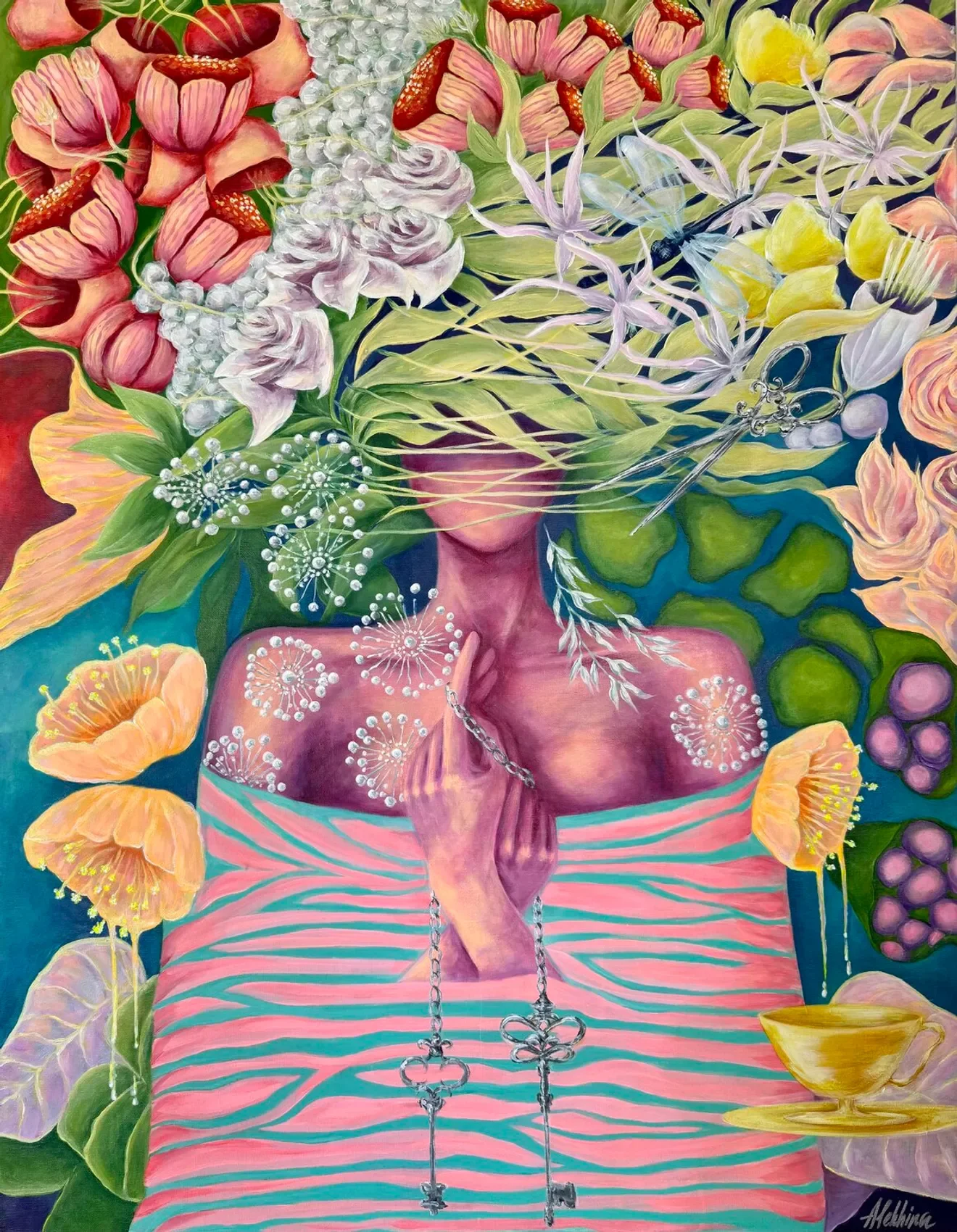
Keys to Harmony, Oksana Alekhina, 2025
How does exhibiting Decode within this particular conceptual framework influence how you see your own work?
I see this piece as part of a broader process rather than an isolated object. It became a transition point for me, encouraging me to continue this visual and conceptual direction in new works.
This experience reinforced my sense that my work is part of an ongoing process, not a final point. I have already begun a series of works that grew out of this painting.
Do you think your paintings behave differently when placed alongside other artists’ works?
Yes, definitely. The context of an exhibition allows me to see my work differently than I do in the isolation of the studio. When my works are placed alongside those of other artists, they enter into a visual and conceptual dialogue, which opens new ways of seeing them.
An exhibition also allows me to see my work more honestly. It becomes an important moment of reflection and reevaluation. I realize that the work exists beyond my personal space and begins to interact with a broader artistic context.
This experience helps me better understand the direction of my work and becomes part of my growth as an artist.
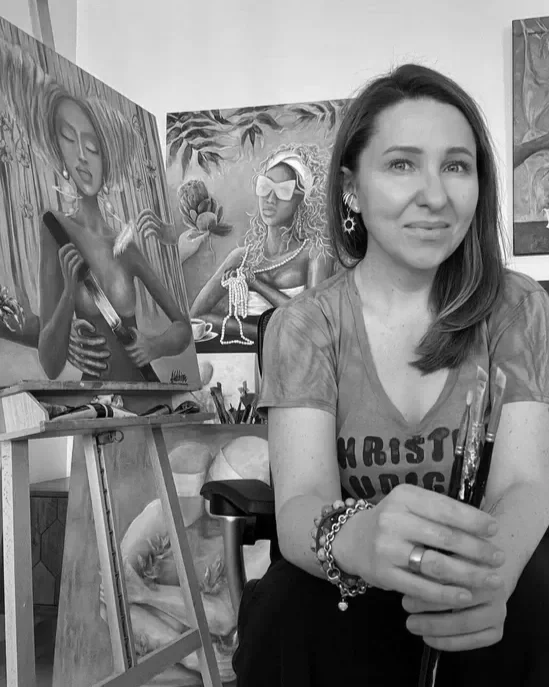
Courtesy of Oksana Alekhina
How do you, as an artist, perceive the difference between physical and digital exhibitions? Do you prefer one form over another?
Physical exhibitions create a unique experience of seeing the work in real space. The ability to experience its scale, texture, and observe the immediate response is very important to me.
At the same time, digital exhibitions create a different kind of interaction - more intimate and calm. This feels more comfortable for me, as direct interaction with the audience can be stressful. Online exhibitions allow the work to exist in a quieter, more controlled environment, where the viewer’s attention is focused directly on the image itself, rather than on my ability to explain it in words.
I value both formats because each reveals the work in its own way and allows me to experience it differently as an artist.
If meaning is not fixed, is there anything you hope remains constant in your work? If so, what would it be?
It’s important to me that my work maintains an inner direction - a search for harmony between the world and my understanding of myself.
Inner harmony and staying attentive to my feelings and desires despite external pressure and constant change are essential to me.
I hope this search for balance will continue - not as a fixed form, but as a direction I continue to follow in my work.
See more of Oksana Alekhina’s art on her website.
Article by Dominika Głowa
Based in Krakow, Poland, but often on the road, Dominika Glowa is a writer, translator, and traveler - fascinated with what lies between visual arts and textual interpretation. In her writing, she seeks to uncover the narratives that emerge when art and language collide, trying to provide fresh perspectives on contemporary creative practices. Drawing on her linguistic education, she’s particularly interested in exploring how language shapes perception, and how meaning shifts as it moves across cultural, literary, and artistic contexts.