JOANNA KOZIEJ: BETWEEN THE ABSTRACT AND THE MUNDANITY OF MOVING LIFE
Disrupting poetics and spaces, bridging nature and the urban landscape, combining geometric structures with surreal imagery.
Joanna Koziej, a visual artist from Poland, is a master of redefining spaces she draws inspiration from without violating or appropriating their quiet identity. She’s known for her unique style of work that features surreal paintings on ceramic tiles installed in public places across the world, which she discovers while working nomadically from a self-built van studio.
Moving between wilderness and city streets, Joanna manages to create pieces that balance expressive gesture with the delightfully delicate mystery of a simple, everyday life.
Her work is a dialogue of spontaneity and structure, inviting viewers to look closer and discover layered visual narratives that surround us. In this conversation, Joanna Koziej reflects on her process, inspirations, and the fluid idea of what it means for art - and life - to remain unfixed.
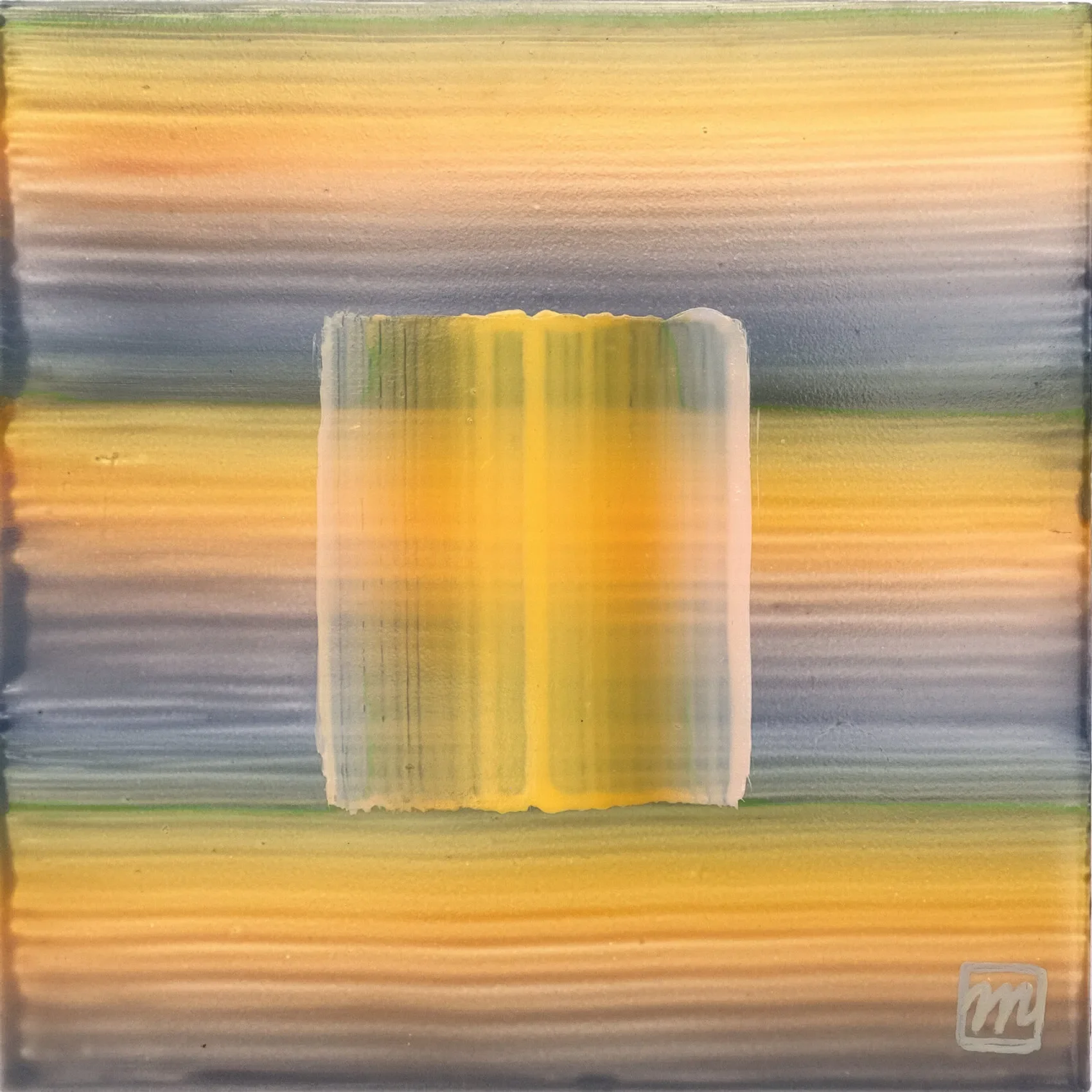
Et La Mer Avait Embrasée Moi, Joanna Koziej, 2024
If you could describe the art that you create in three words, what would they be?
The first words that come to my mind are: visual sensitivity, exploration, and poetry. At the heart of my work is the fascination with capturing the essence of an experience or phenomenon and retelling it with my own visual language of gesture, colour, or even rhythm.
I suppose it's my way of witnessing something deeper and then sharing the uniqueness of it with others. My style combines painterly, vibrant brushwork with geometric structure. I often mix soft, calligraphic gradients juxtaposed with sharp shapes, grids, and patterns.
I enjoy creating small visual tensions; like placing a blurred, out-of-focus stroke in front of a crisp form or building layers - a peculiar trompe-l’oeil - that feel spatially impossible (although that may have something to do with my myopia).
This interplay of fluid gesture and precise construction is a characteristic of my visual art.
“It’s not as much of a message as it is an invitation to look closer - like a riddle to solve, something interesting to discover in the commonness of the world.”
One of your signature visual languages includes creating paintings on ceramic tiles that later become an inherent part of the landscape that inspired them. Do they always carry a message?
It’s not as much of a message as it is an invitation to look closer - like a riddle to solve, something interesting to discover in the commonness of the world.
You travel the world in a self-built van that’s also a working studio, living a nomadic lifestyle that allows you to create art without the confines of one place. How has that affected your creative process?
Living and creating nomadically from my self-built van-studio influences my art and how I feel about it very strongly, allowing me to spend a lot of time surrounded by nature, in the wilderness, by moving water.
This environment has, of course, affected me in numerous ways.
For example, it inspired me to incorporate the image of a mythical river entity into my pieces. For me, the creative process is a dialogue above all else, but it’s also a journey, like setting off to a previously chosen destination only to discover and confront myself with what is beyond my control.
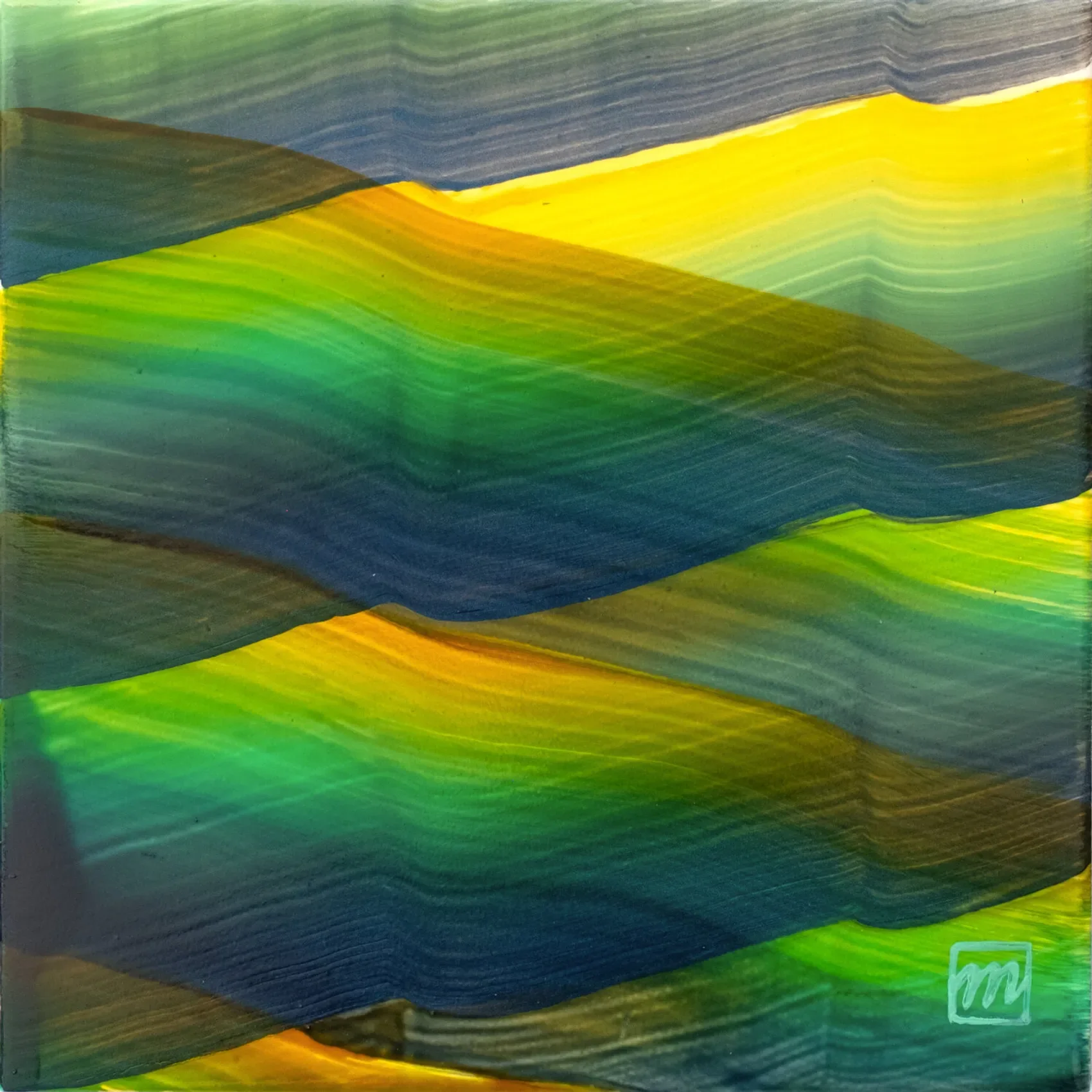
Possessing And Caressing Me, Joanna Koziej, 2024
Which part of your creative process do you enjoy the most?
I actually love experimenting with the medium and truly being in the process, as though I’m in a conversation or dancing with a partner.
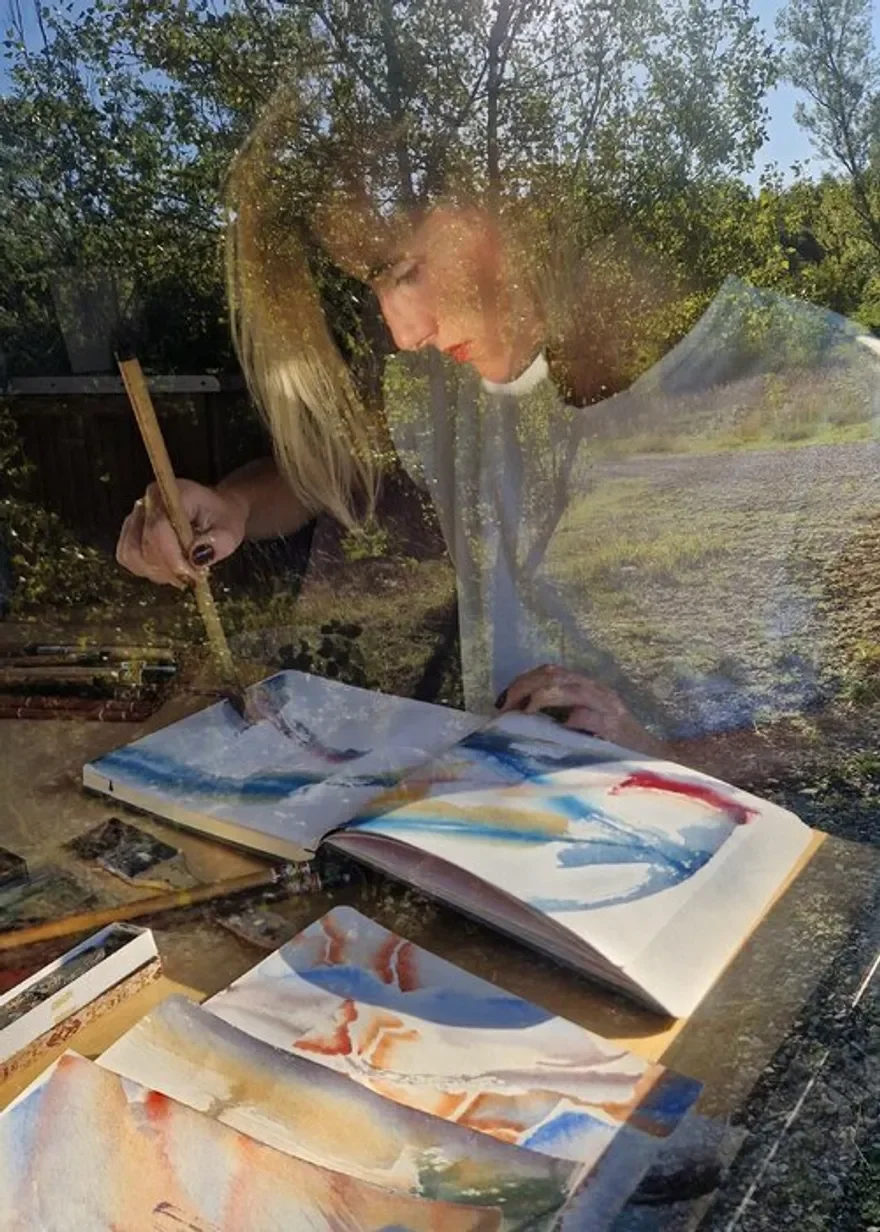
I’m making decisions while simultaneously responding to where the process or medium takes me. I work mainly with gesture and colour, using a mix of expressive and contemplative mark-making. My paintings often start with an intentionally set brushstroke and develop into what I might compare to elusive portraits of places, moods, or phenomena I’ve experienced.
Recently, I’ve been using mostly watercolour on paper and enamel paint on ceramic tiles, and I like how differently those mediums behave - watercolour is soft and fluid, while paint on ceramic has a more physical, textural presence. I pay a lot of attention to how the materials and substances interact with each other.
What is the first creative moment that you remember? Does it have a connection to the art that you create now?
It’s a beautiful question and one I don’t think I’ve heard before. What springs to mind instantly is the memory of a 4-year-old me, in the woods, picking up scones, straws, pieces of moss, and using them to build tiny home layouts. I feel like it has a connection to the art I create now - collecting unique elements of the surrounding reality to express my inner world with them.
One of the most intriguing pieces you’ve ever created, Malarka, is being showcased at our upcoming virtual art exhibition. Can you tell us more about what it means to you and what the process behind it was? Why Malarka?
Malarka (Paintress in Polish*) is probably the most important part of my artistic practice - serving me as a personal art project and alias.
I have a background in graphic arts, as I’m a graduate of the Academy of Fine Arts in Warsaw, where I mastered painting, printmaking, and visual communication. I’m also very fond of the Polish School of Poster, and Malarka’s early roots - especially the ceramic tiles placed in public space - draw from this tradition of entering public space with metaphoric imagery.
This way of working with distilled visual narratives continues to shape how I approach painting today, and the artwork I’m presenting at the exhibition is part of Malarka, only this time taking up more space than a single ceramic tile.
*The name came to me as a feminist answer to “the controversy” of using feminatives in Polish - since I am a woman who paints, while also taking a stance on the visibility of women in the arts. I designed a stylized “m” signet and decided to use it as my signature for the ceramic tile paintings that I later pasted up directly on walls as street art.
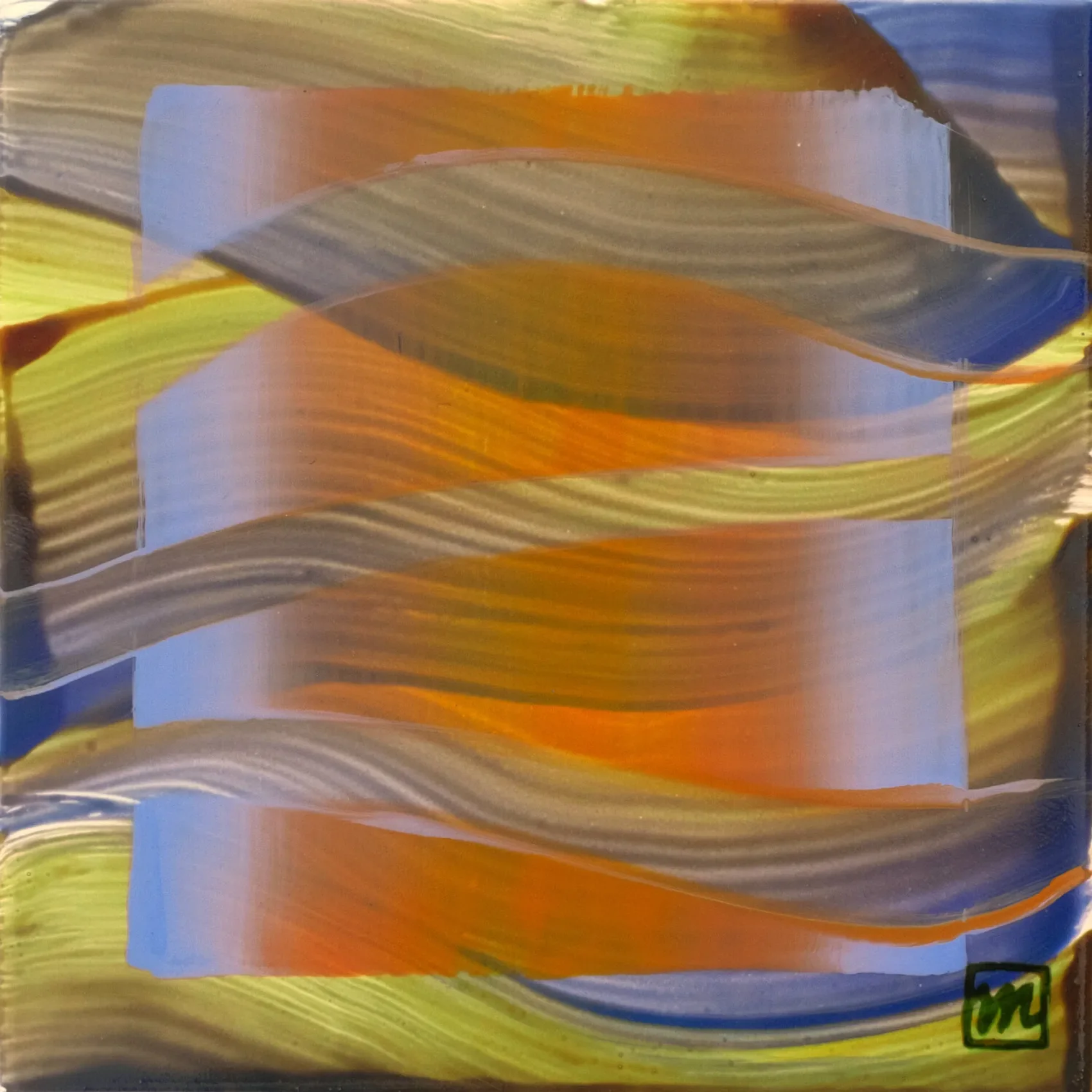
The Meaning Hasn’t Come Up Yet It’s Still Under The Surface, Joanna Koziej, 2024
Malarka began as street art. How does the shift from street to gallery transform the way you perceive it? What about the audience?
It’s true that Malarka has changed throughout the years. What began as a way for me to “just get out there” from my studio later transformed into a more versatile and mature artistic practice.
Upon discovering the Malarka project, one of my friends called it "a poetic vandalism,” and that name really resonated with me. It’s also how I feel about it. I saw this piece of art as a sort of ephemeral exhibition that I’d hoped people would just stumble upon. I didn’t create it with any particular audience in mind; it could have been anyone, as long as they were observant enough to see this tiny installation of mine.
But as soon as I published the work, it honestly felt like for me, it’d already served its purpose.
Even though I keep a track of all Malarka’s paste-ups on a world map (you can find it on my website with exact coordinates), I am at peace with these artworks being stolen, taken down, or destroyed, which would actually give me a great incentive to simply create new work and have a reason to travel more.
Now that Malarka is a part of an exhibition, do you think it will “behave” differently when placed alongside other artists’ works?
Absolutely. Like most artists, I’d love for my art to stand out and have a unique feeling to anyone who’s consuming it, but I also hope that Malarka will resonate with its neighbouring pieces.
I’m actually very curious to see this exhibition for myself - after all, the curation and placement can really change the context and the way we perceive art. It will also bring a new audience who will have a fresh look at it.
Because at the end of the day, the artwork changes with what each visitor brings.
Courtesy of Joanna Koziej
What does UNFIXED mean to you?
It means fluid, ever-changing, living.
Which resonates very well with the state I’m currently in - no fixed address nor schedule, free but also a little unsure. My way of living is very exciting and without many constrains but that means challenging as well. For example, this winter’s storms came with a lot of destruction in Portugal, where I’m currently stationed. The hectic weather caused damage in all of Southern Europe, even destroying an iconic tourist destination, the Italian rock structure called “Lovers’ Arch.”
Goes to show that nothing is permanent, nothing is fixed. But that’s exactly what makes it precious.
See more of Joanna Koziej’s art on her website.
Article by Dominika Głowa
Based in Krakow, Poland, but often on the road, Dominika Glowa is a writer, translator, and traveler - fascinated with what lies between visual arts and textual interpretation. In her writing, she seeks to uncover the narratives that emerge when art and language collide, trying to provide fresh perspectives on contemporary creative practices. Drawing on her linguistic education, she’s particularly interested in exploring how language shapes perception, and how meaning shifts as it moves across cultural, literary, and artistic contexts.