THE RIGHT TO DREAM: JULIEN ABSTRAIT
“I create from my dreams, from the pulse of my emotions”
The importance of listening to yourself and the necessity of understanding your own internal landscape cannot be overstated. It is sad that many have been taught to build defensive mechanisms – to see feeling as something weak rather than a vital source of power. But these suppressed dreams and desires are, in fact, the only crucial instruments for truly understanding this world.
If you haven't cried, it’s hard to say you’ve truly lived; if you haven’t even tried to reach for what haunts your imagination, was the path ever really worth the walk? In his work, Julien Abstrait uses emotion as a storytelling tool – a hand that leads the viewer through the labyrinth of his ideas. His journey from feeling like he is gated from his own dreams to breaking that barrier and embracing his true calling is etched into every textured layer of his canvas. We sat down with Julien to discuss the transition from the industrial to the astral, and the profound physical sensation of "letting go".
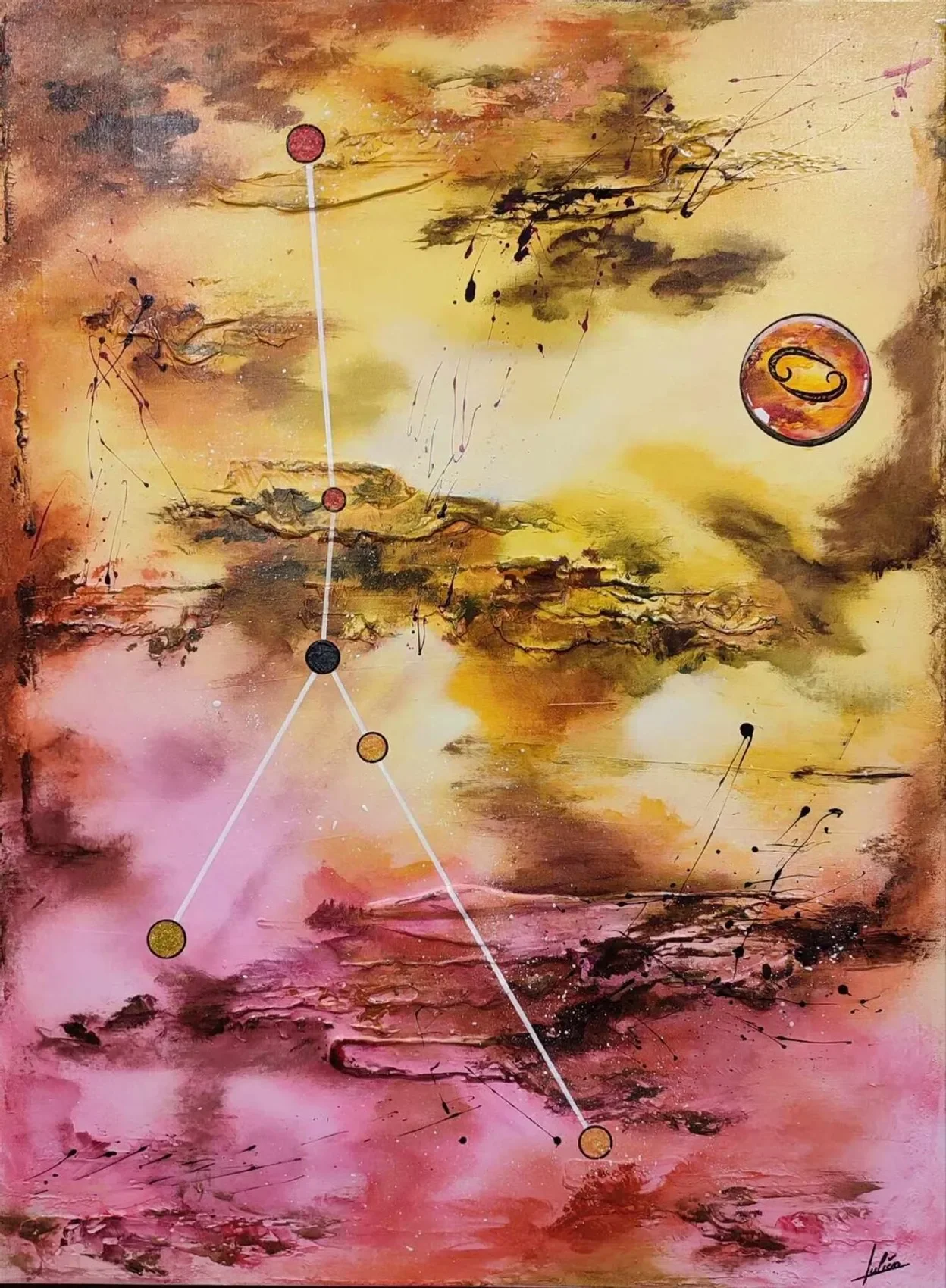
Cancer 1, Julien Abstrait, 2024
In your biography, there is a powerful mention of growing up in an environment where "being an artist wasn't a job" and feeling as though there was "no right to dream." Instead of just a "safe space" would painting be described as a form of rebellion against that industrial, disciplined past?
It wasn’t a rebellion, but a quiet awakening, like learning to see in a new light. I began to listen inward, and what I found slowly took shape on the canvas. With each brushstroke, I gave form to something long unspoken, allowing my deeper desires to emerge in color, texture, and space.
Being a self-taught artist gives the work a raw, unfiltered sincerity. Have you ever felt the desire to study art formally at a university, or did you consciously choose the path of free experimentation?
I have immense respect for formal training in graphic arts, but my heart has always led me to explore this path on my own. That freedom is everything, it lets me follow my imagination wherever it wants to go. I create from my dreams, from the pulse of my emotions, letting each brushstroke carry a piece of my inner world onto the canvas.
“To me, abstraction is pure freedom - a journey of the mind and the heart.”
A key part of your identity is the name "Abstrait" (Abstract). Why do you feel you found your place specifically in this genre? What does "abstraction" mean to you?
To me, abstraction is pure freedom – a journey of the mind and the heart. It is the act of stepping away from the concrete, peeling back layers to touch the essence beneath, to reveal the idea, the hidden structure, the silent rhythm that shapes everything.
Can you recall your first exhibitions? What was the feeling when your works, were seen by strangers for the first time? Was it a feeling of vulnerability, or a sense of satisfaction?
This memory is incredibly dear to me. I value spontaneity above all, and witnessing the raw, unguarded reactions of the audience is profoundly rewarding. In that moment, nothing can be feigned, the emotions that stir in those who encounter my work, the quiet sensitivity woven into each piece, become a deeply fulfilling affirmation of what I create.
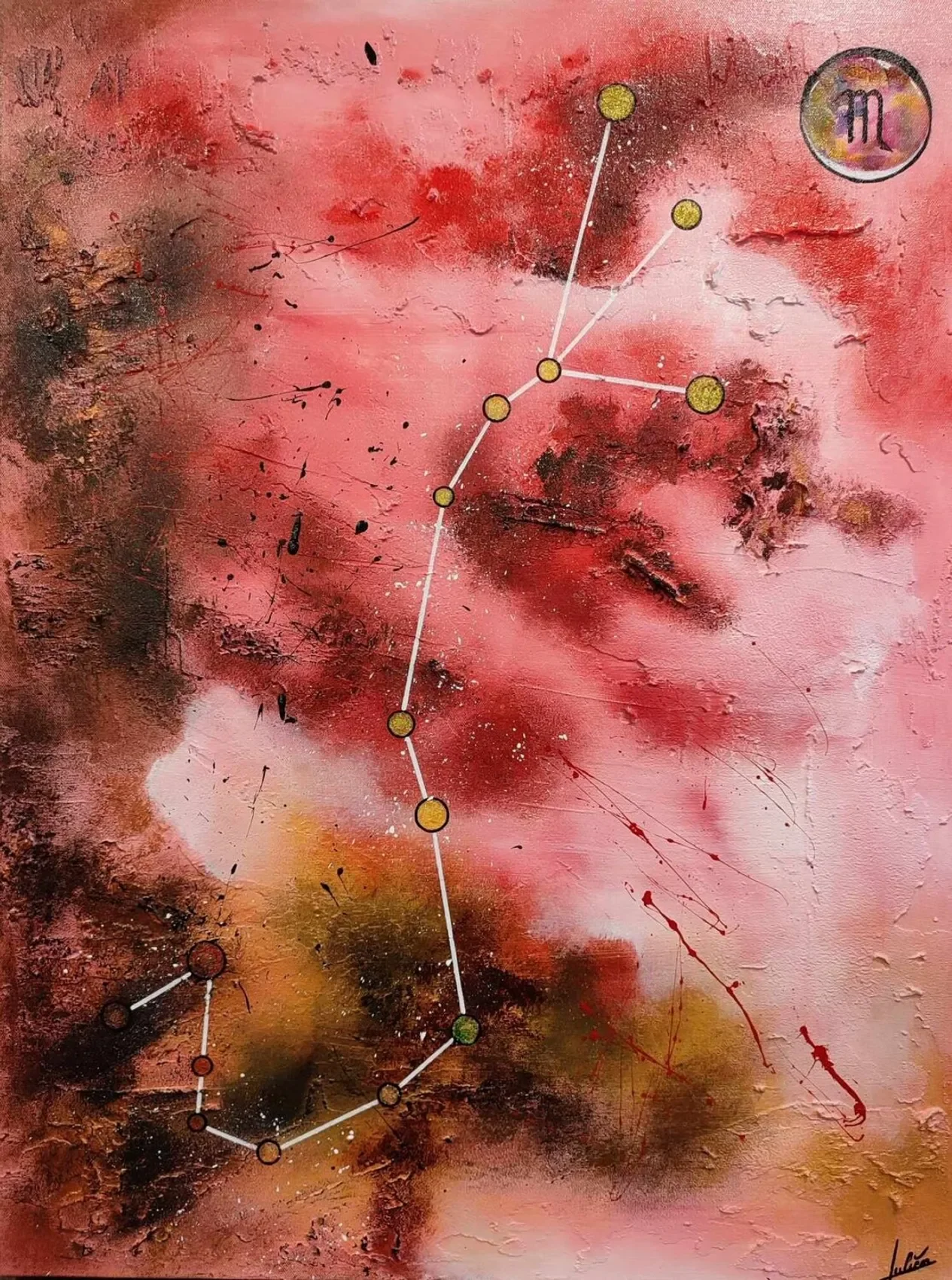
Scorpio 1, Julien Abstrait, 2024
You mentioned that modern design is a major inspiration. Could you expand on that? Are there specific designers or artists whose work makes you look at shape and space in a different way?
I don’t draw inspiration from any particular person. I appreciate the work of many artists (their original ideas, the precision and rigor with which they create...) but I strive to be open and attentive to my own perceptions. I follow my senses and let my feelings guide me, creating from what comes naturally rather than copying what’s already out there.
When did you first feel validated as an artist? Was it the moment you sold your first piece, a specific review, or an internal realization?
It’s always nice to know your work connects with someone. But the real turning point came when I started trusting my own choices and creating for myself, not for others. And when people responded in ways I hadn’t expected, it was a wonderful reminder that my work could reach beyond me.
For you the act of painting is a sensation of "letting go." How would you describe that feeling physically? What is your ritual for achieving that state of flow?
For me, it’s all about peace of mind and music. Music opens the door to my own little imaginative world, where limits just fade away. Once emotions take over, anything feels possible.
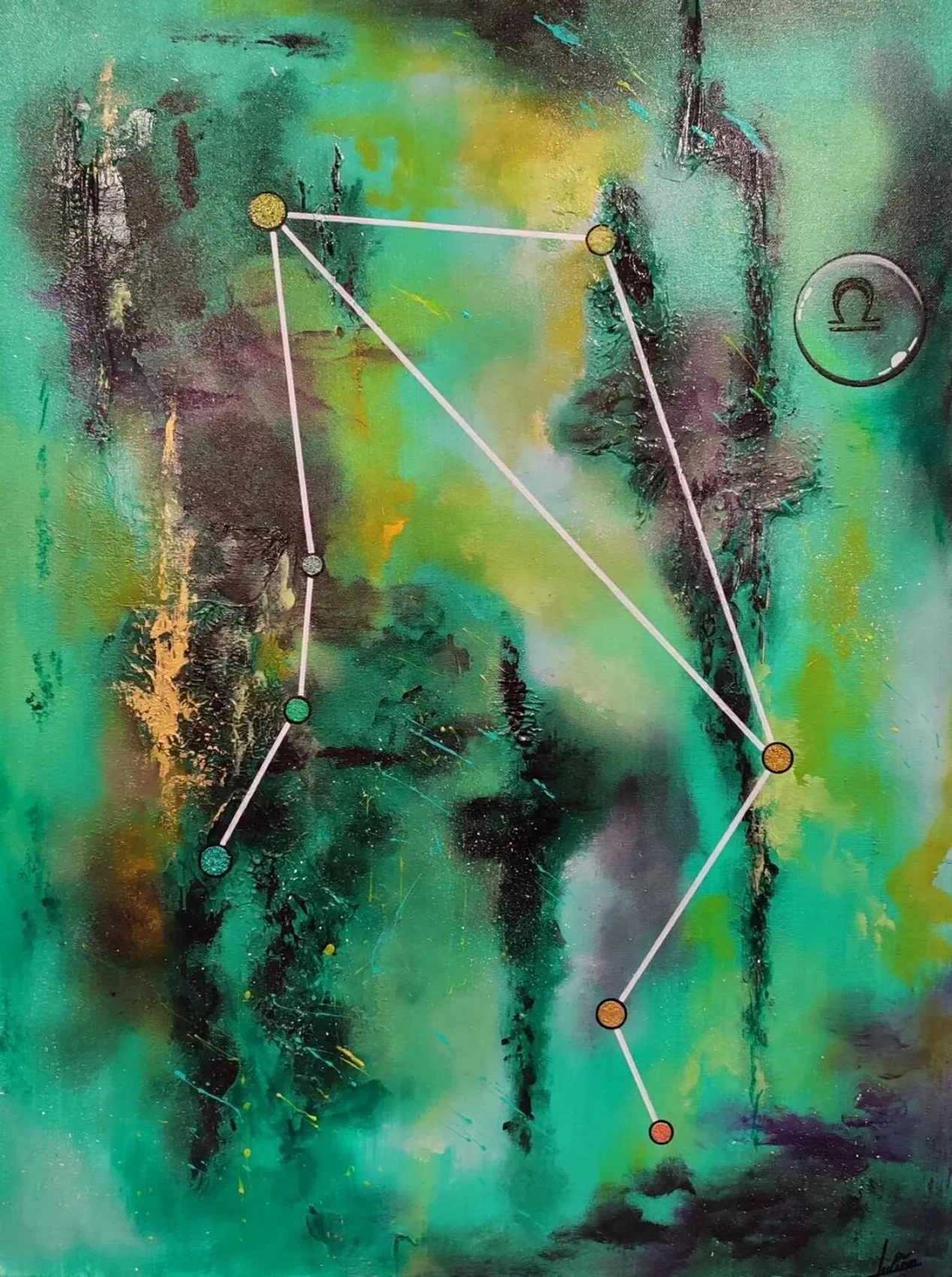
Libra 1, Julien Abstrait, 2025
You are undoubtedly a "color enjoyer." Your canvases are an explosion of pigment. How do you choose your palette? Is it a rational choice based on color theory, or an intuitive reaction to what you are feeling the second you face the canvas?
I really love working with colors, and I usually go about it in two ways: sometimes I follow a clear idea I’ve been thinking about, even using specific color codes, and other times I just let myself improvise.
I try not to set limits, but occasionally I give myself little challenges, like choosing certain colors, shapes, or materials to push my work in new directions and see where it takes me.
The Astro Paintings series feels like an attempt to find order within the chaos of the universe. What was the exact moment the decision was made to start this series? Additionally, is there a personal belief in the power of Zodiac signs, or is the fascination purely with the visual and symbolic structure they provide?
The Astro Paintings didn’t start at a single moment – it grew from a phase where I felt scattered and wanted to bring some order to the formless. Astrology offered a ready-made language of cycles, grids, and correspondences, which I used to give shape to the elusive.
I’m not focused on literal belief in the Zodiac; what fascinates me is their rich symbolic and visual structure. They become a tool to explore rhythm, tension, and the balance between order and chaos, leaving plenty of room for intuition and chance.
Last but not least: What is the main feeling or core idea intended for people to carry away from your work?
What I hope people take away isn’t a fixed message, but a feeling – a sense of the fragile balance between chaos and order. My work doesn’t aim to dictate interpretation; it’s a space where everyone can bring their own perspective and questions.
If there’s a central idea, it’s this: even in apparent chaos, there’s hidden structure, rhythm, and connection, while what seems ordered is never entirely stable. I hope viewers leave with a renewed awareness of these tensions between control and letting go, system and intuition, and a greater sensitivity to the complexity and beauty of the world.
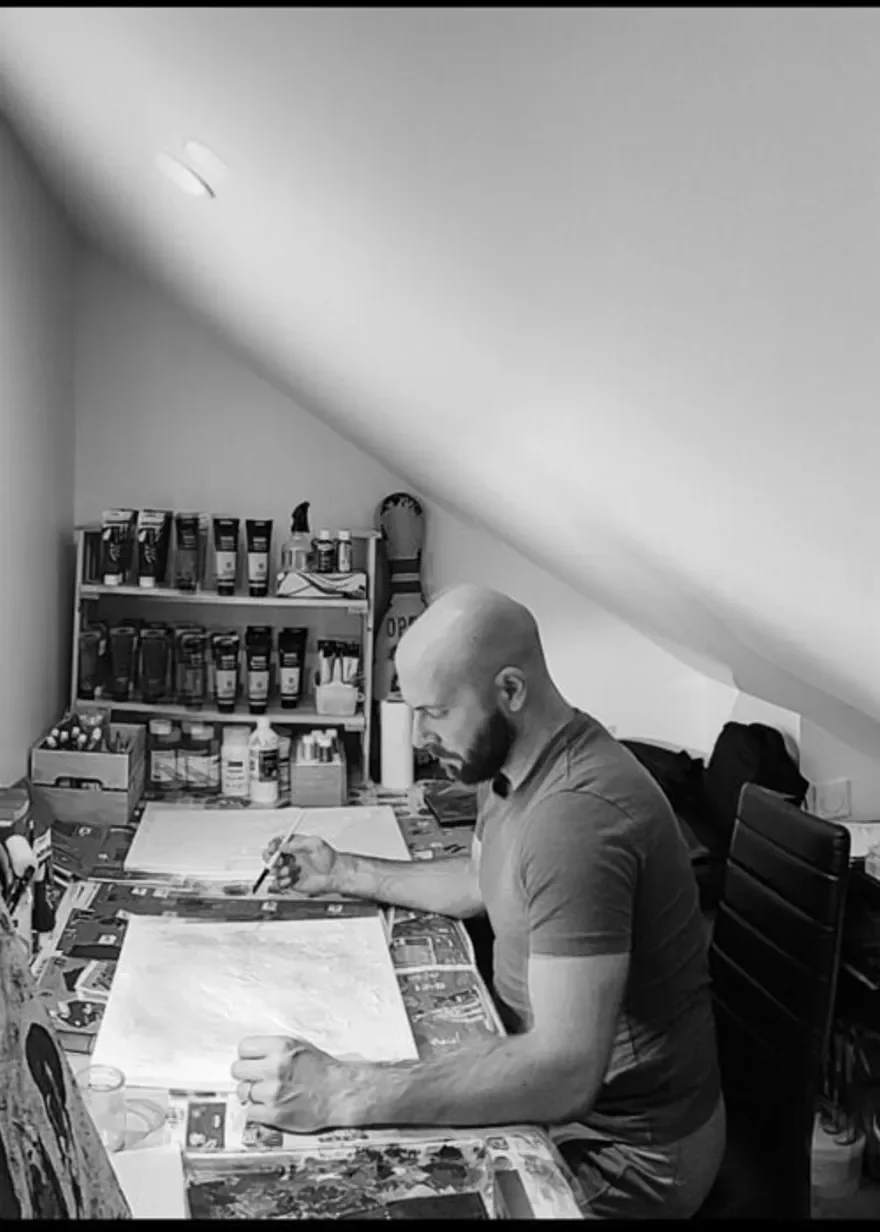
Courtesy of Julien Abstrait
If the internal landscape is the most crucial instrument for understanding this world, then Julien’s work is a map of that territory. His journey is a proof that the path was indeed worth the walk. By choosing the "quiet awakening" over the well-mapped route, he has traded a life of moving straight ahead for one that explores the hidden structures beneath the surface. The "letting go" that Julien describes is not a loss of control, but a gain in sensitivity. He doesn't offer a fixed message, but rather the one that mirrors our own lives. For those who are against their own emotions, his canvases serve as a reminder: there is a silent rhythm and a deeper connection waiting to be discovered, even in the apparent chaos. To stand before his work is to finally give oneself the permission to dream –not as an escape, but as a way to truly live.
See more of Julien’s work on his website.
Article by Vasya Kavka
Based in Ukraine, Vasya Kavka is a writer working at the intersection of contemporary art and digital culture. Through his platform @ambient.delusion, he researches emerging and underground artists, publishing interviews and editorial features that move beyond aesthetics to examine context, creative process and cultural relevance. His work is driven by curiosity and a commitment to thoughtful, accessible storytelling that situates artistic practices within the broader currents shaping contemporary culture.