
In the work of Mario Schifano, multiple expressive languages converge, reflecting a practice that spans painting, text, photography, and film. His universe is made of visual codes, often rooted in Pop, that overlap and resonate with one another, taking shape across different media and resulting in a body of work of remarkable visual strength.
Today, a significant and representative portion of this practice is on view in the exhibition Mario Schifano at Palazzo delle Esposizioni in Rome. Curated by Daniela Lancioni and open until July 12, the exhibition offers a comprehensive and nuanced overview of the artist’s career, tracing its development from his early works to his later, more mature phases.
But who was Mario Schifano, beyond being one of the most influential voices of post-war Italian Pop Art? How much more lies behind this name?
His biography unfolds in close dialogue with his work. Schifano was born on 20 September 1934 in Homs, Libya, where his family had settled due to his father’s work as an archaeologist. This early immersion in the material traces of the past cultivated a way of seeing the world that would later inform his artistic language, filtered through a distinctly personal and contemporary sensibility.
In 1941, he returned to Rome, the city in which both his artistic and personal identity would take shape. In the years that followed, he met a rapidly evolving cultural environment. His work was first exhibited publicly in 1954, marking the beginning of a trajectory that would soon intersect with some of the most vital artistic circles in the city. In 1960, alongside Franco Angeli, Tano Festa, and Giuseppe Uncini, he participated in the group exhibition 5 pittori. Roma 60, a moment that positioned him within a new generation of artists redefining the Italian visual landscape. The following year, he held his first solo exhibition at Galleria La Tartaruga. The 1960s marked the beginning of his career within a city experiencing a period of intense artistic vitality, an energy that provided the conditions in which Schifano’s restless, instinctive approach could fully emerge.
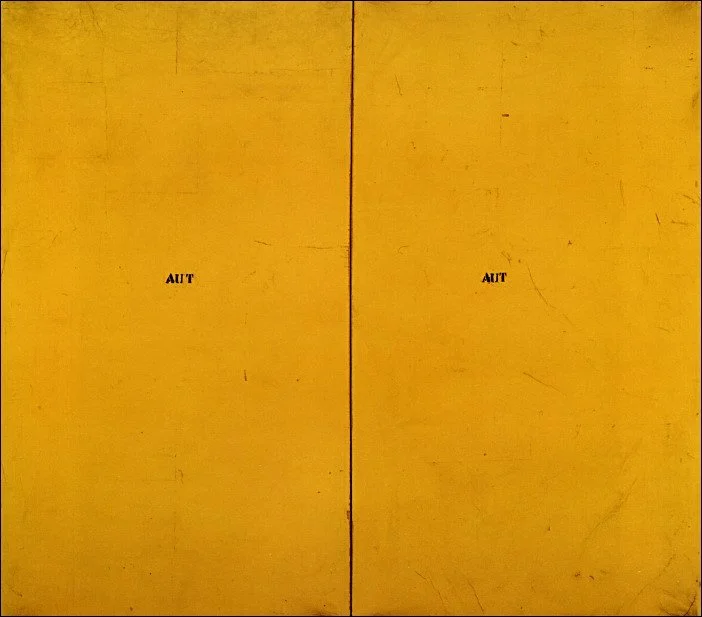
As Daniela Lancioni notes, the exhibition follows a chronological structure, guiding visitors through the successive phases of the artist’s practice. The starting point is the monochromes of the early 1960s: surfaces dominated by colour, almost screen-like, onto which elements such as letters and numbers are gradually introduced. One example is Aut-Aut (1960), in which colour symmetrically frames the two words.
Mario Schifano
Aut Aut, 1960
Enamel on paper mounted on canvas, 150 × 170.5 cm
Galassi Ferrari Collection
Photo: Giorgio Benni
© Mario Schifano, by SIAE © Archivio Mario Schifano
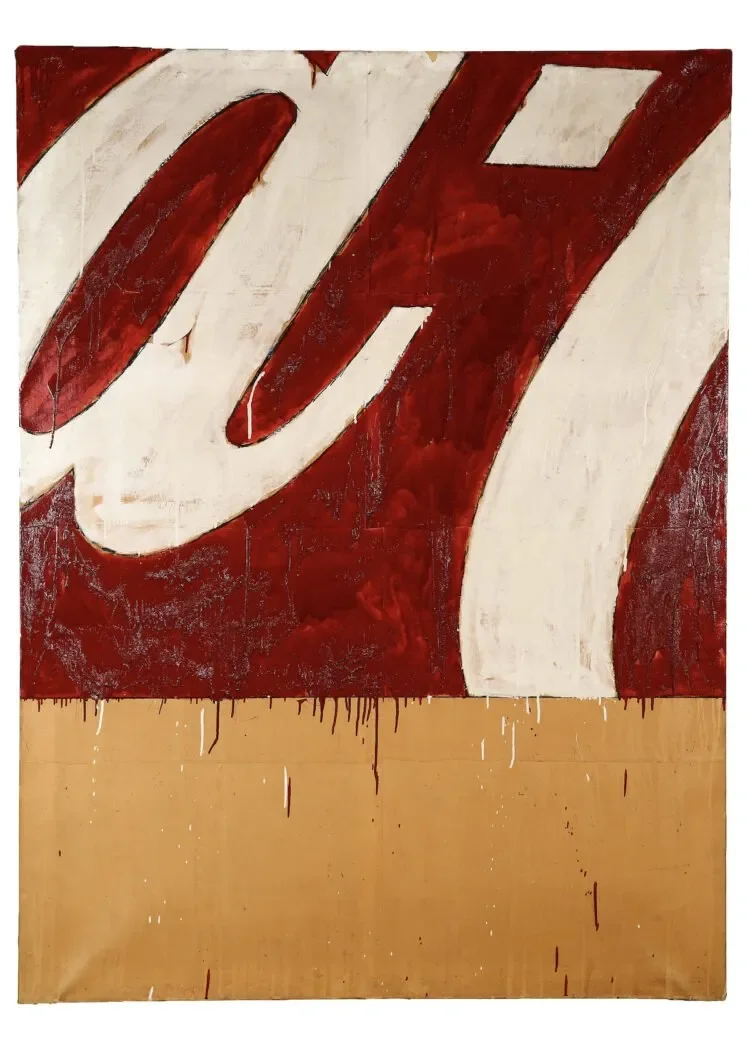
From the apparent stillness of the monochrome, the exhibition moves into the next phase of Mario Schifano’s work: a distinctly Pop language that appropriates, extracts, and reinterprets the imagery of contemporary culture. It is no coincidence that between 1963 and 1964 the artist moved to New York City, absorbing new visual influences, including that of Andy Warhol, with whom he shared a relationship of mutual respect. On display is Grande particolare di propaganda (1962), where a fragment of the Coca-Cola logo emerges, isolated and enlarged, transforming a familiar commercial sign into a powerful and ambiguous pictorial element.
Mario Schifano
Grande particolare di propaganda, 1962
Enamel and graphite on paper mounted on canvas, 189 × 150 cm
Private collection
© Mario Schifano, by SIAE © Archivio Mario Schifano
The exhibition then shifts to later developments, when Schifano began engaging more directly with political themes, using artistic experimentation as a means of exploring them. His curiosity towards the external world, and the evolution of his visual language, led to an increasing focus on the screen and the television image, observing closely the processes through which images are constructed.
These phases anticipate a return to painting that is not a simple revisiting of earlier approaches, but rather a reinvention of the painterly gesture. In the 1980s, Schifano’s work becomes more immediate and energetic, characterised by a renewed intensity of colour. Colour takes centre stage, though in a freer and more instinctive manner, as if translating a continuous flow of images and impressions onto the canvas.
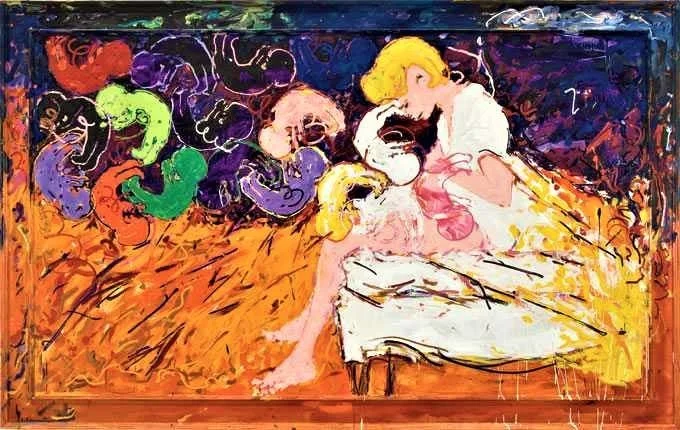
One of the most compelling works in the exhibition is Il parto numeroso della moglie del collezionista (1984), in which the dynamism and immediacy of the brushwork are charged with a strong internal tension. The movement suggested by the “numerous birth” of the female figure generates a vibrant pictorial energy, with form and colour expanding into space and conveying a sense of constant transformation.
Mario Schifano
Il parto numeroso della moglie del collezionista, 1984
Enamel and acrylic on canvas and frame, 235 × 375 cm
Valsecchi Collection
Photo: Giorgio Benni
© Mario Schifano, by SIAE © Archivio Mario Schifano
The different phases of Schifano’s life are thus mirrored in a continuous artistic output, shaped by its own rhythms and impulses. They reflect a life that was rich and complex, marked by contradictions, excesses, and moments of crisis, but also driven throughout by experimentation and curiosity.
Schifano died in Rome in 1998, following a severe cardiac event. The exhibition at the Palazzo delle Esposizioni, bringing together works from both institutional and private collections, symbolically returns him to the city that shaped and ultimately recognised him.
“Forse per me l’infanzia non è mai finita, neppure ora che sono piuttosto avanti con gli anni. Non vorrei apparire presuntuoso, ma per infanzia intendo la possibilità di continuare a osservare il mondo con uno sguardo… magico”.
“Perhaps childhood has never really ended for me, not even now that I am rather advanced in years. I would not wish to sound presumptuous, but by childhood I mean the ability to continue observing the world with a… magical gaze.”
(Mario Schifano, interview with Costanzo Costantini, Il Messaggero,1991)
It is precisely this shifting, dreamlike yet persistent gaze that defines the intensity of Schifano’s work. His practice stands as one of the most distinctive voices in the history of modern art, continuously reconfiguring itself in response to the images, tensions, and transformations of its time.
The final room of the exhibition, a striking installation, brings together the works created by Schifano for the dining room of Casa Agnelli, recontextualised within the exhibition space. This gesture, while bringing the exhibition to a close, also seems to reopen it, extending its narrative and once again drawing the viewer into his world.
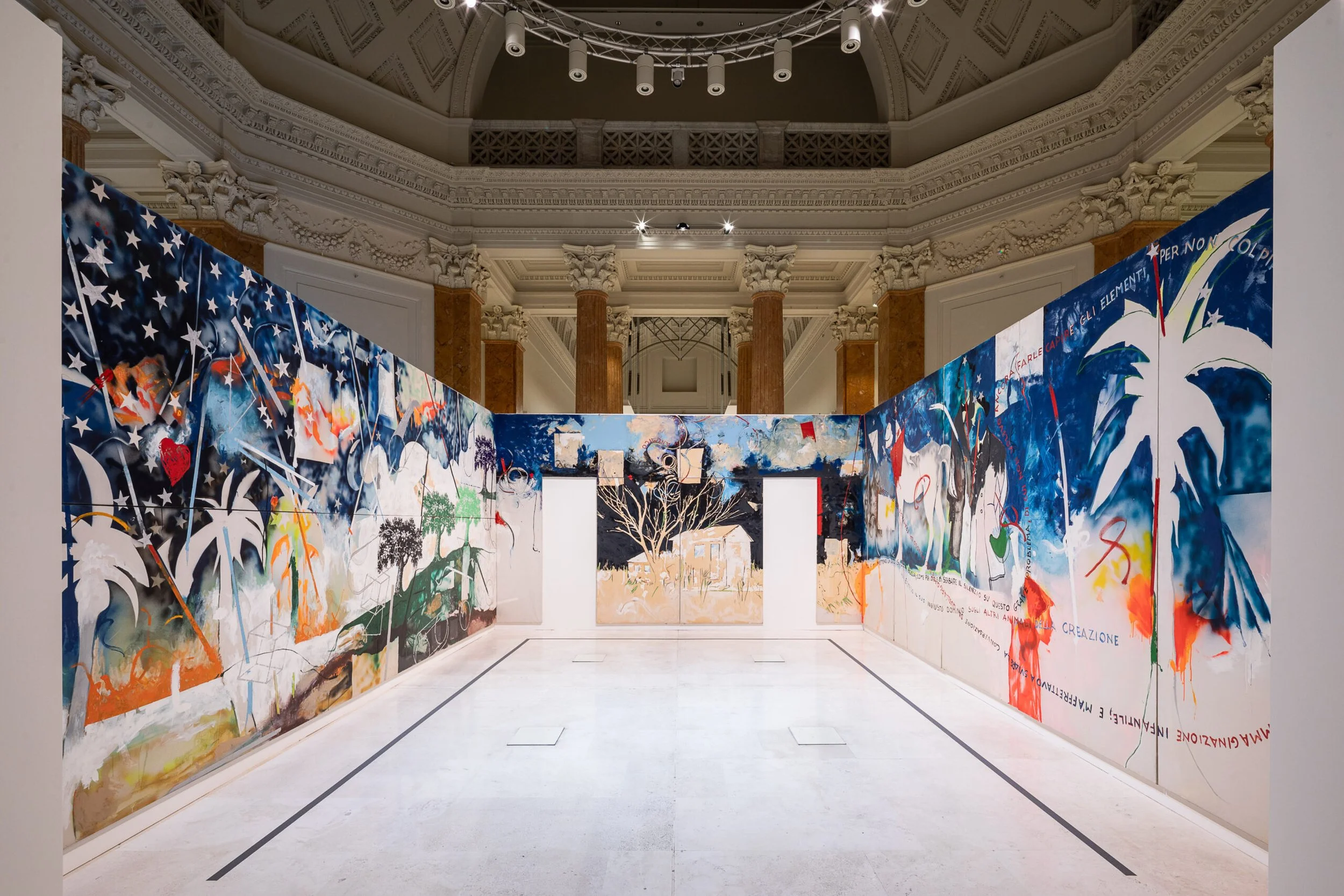
Photo: Alberto Novelli © Azienda Speciale Palaexpo
Article by Desideria Manzini
Working between Italy and France, Desideria Manzini specializes in cultural management, strategy, and communication. She has worked and collaborated with private art institutions, contributing to the development and positioning of cultural projects within an international context. Alongside her strategic practice, writing plays a central role in her work: a tool for analysis, critical reflection, and cultural interpretation. Through her texts, she explores the intersections between art, heritage, and contemporary discourse.