MORNING DEW: NATALIIA KRYKUN
“At a certain point, silence became more uncomfortable than exposure.”
I find this perspective incredibly honest. The art has to breathe! Think about the things you keep hidden. We often convince ourselves that our most profound thoughts are safer in the dark, tucked away where no one can touch or judge them. But what happens to a person when they stay silent for too long? The interior weight grows until it becomes unbearable. We are taught that exposure is a vulnerability, a weakness – but what if it is the only way to finally breathe? To speak is to exist. To express is to leave a mark on a map that others can finally follow.
Why do we share our souls with strangers? Because a dialogue is the only thing that validates the journey. Nataliia’s work is about the courage to turn the lights on in a room that has been dark for a long time. To embrace other opinions, no matter how difficult it is at times. In this interview, we dive into the "lakes" of Nataliia Krykun – a place where memory, home, and the urgent reality of the present moment collide.
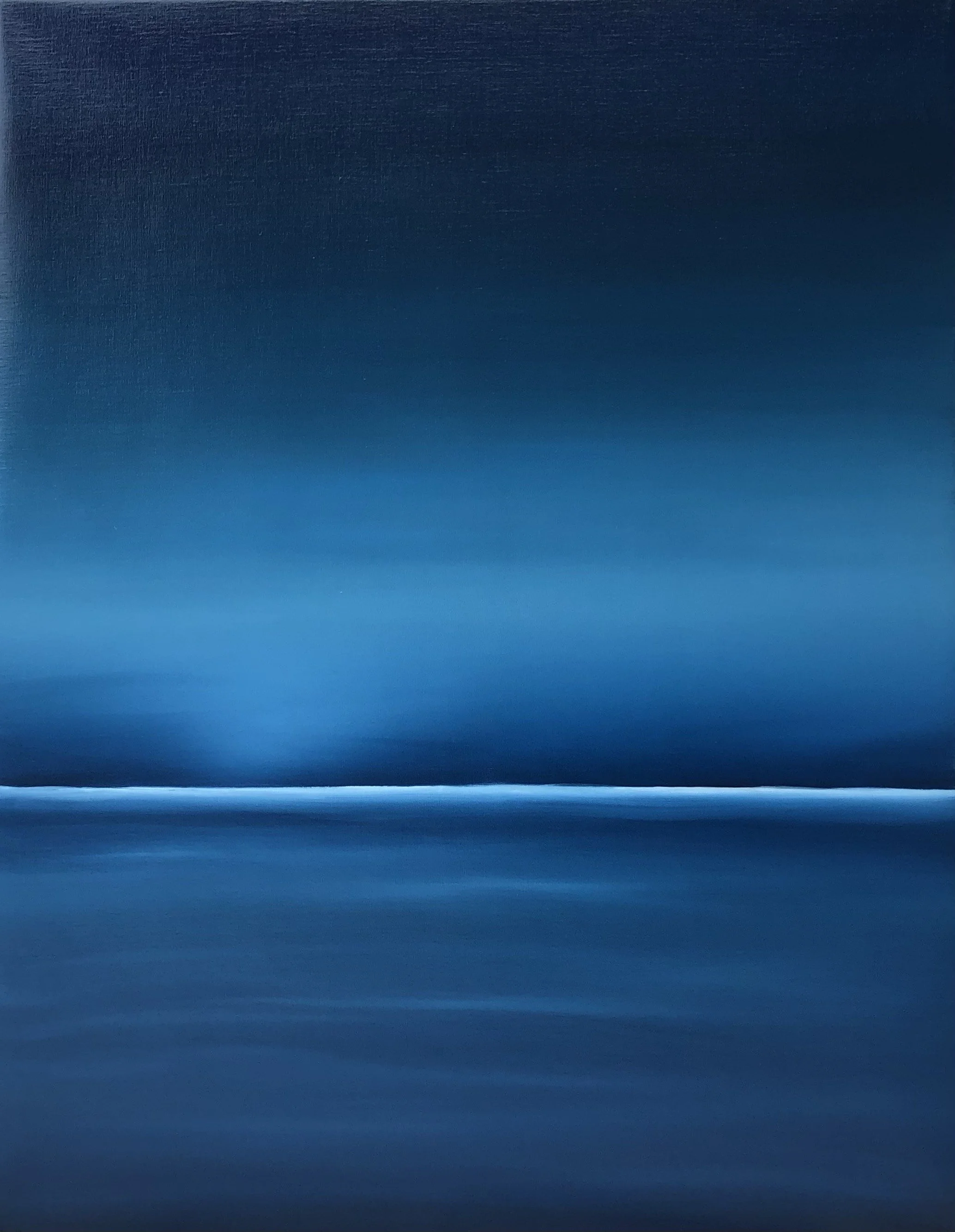
Night lake in Ukraine, Nataliia Krykun, 2026
In your words, art was "somewhere inside" you for a long time before it became a public act. What was the catalyst that finally pushed you to bring it out into the world?
For a long time, art existed for me as an internal necessity rather than a public act. It was a private language, something I carried without fully articulating. The catalyst was not a single dramatic event, but a gradual accumulation of urgency. At a certain point, silence became more uncomfortable than exposure. I realized that keeping the work hidden was, in a way, limiting its existence. Art only fully comes into being when it enters a space of dialogue – when it is seen, interpreted, even misunderstood. That shift – from containment to communication – was decisive.
After developing your own unique style independently, what pushed you to transition into formal education at a private art school and later an art academy? Was there something specific you felt you could only find within the walls of an institution?
I have been autodidactic from the very beginning and do not have a completed formal degree. My decision to enter an art academy was driven by curiosity rather than necessity – I was interested in testing my practice within an institutional framework. However, due to personal life circumstances, I chose to leave and continue developing independently.
In retrospect, this path was essential for me. While an academy can offer structure, discourse, and context, I realized that my work requires a certain autonomy. My visual language evolved outside of academic constraints, and maintaining that independence allowed me to stay closer to my intuition and inner process.
You’ve mentioned that your work is influenced by the greats: Picasso, Warhol, Rothko, Klimt, and Malevich. How do you balance the bold "pop" energy of Warhol with the deep, meditative stillness of someone like Rothko?
I don’t see these influences as contradictions that need resolution. Instead, I treat them as coexisting forces within a single visual language. Warhol’s immediacy and surface intensity intersect with Rothko’s introspective depth. The tension between these poles – between noise and silence, saturation and void – is where my work operates. Rather than balancing them, I allow them to collide. That collision produces a space that is both visually assertive and emotionally absorptive.
“Art only fully comes into being when it enters a space of dialogue – when it is seen, interpreted, even misunderstood.”
Did you find yourself in abstraction from the very beginning, or did you experiment with more traditional genres (like realism or portraiture) before realizing that symbols and emotions were your true language?
Abstraction was not an initial choice but an evolution. I began with more representational approaches, exploring form, proportion, and figure. However, these frameworks quickly felt restrictive, as if they were filtering or delaying the immediacy of expression. Over time, I moved toward a visual language that could bypass literal depiction and access something more direct – something closer to sensation and memory. Abstraction allowed me to work with ambiguity, which I consider more truthful than fixed imagery.
Your work is a playground of textures – from "drip painting" to "cascading layers". What provokes these changes in your technique?
Technique, in my practice, is not predefined. It emerges as a response to the internal logic of each work. Different emotional states and conceptual impulses demand different material behaviors. Sometimes the gesture needs to be abrupt and uncontrolled; at other times, it requires slow accumulation and layering. The surface becomes a record of decisions, interruptions, and shifts. Texture is not decorative – it is structural, almost like a topography of the process itself.
Could it be that this changes in technique are influenced purely by emotion of the moment, or does the subject itself dictate the texture?
Emotion is the initial trigger, but it does not operate in isolation. As the work develops, it begins to assert its own direction. There is a point where the painting resists or redirects my intentions. In that sense, the “subject”, even in abstraction, emerges through the process and begins to dictate the material language. It becomes a negotiation between impulse and response, rather than a one-sided expression.
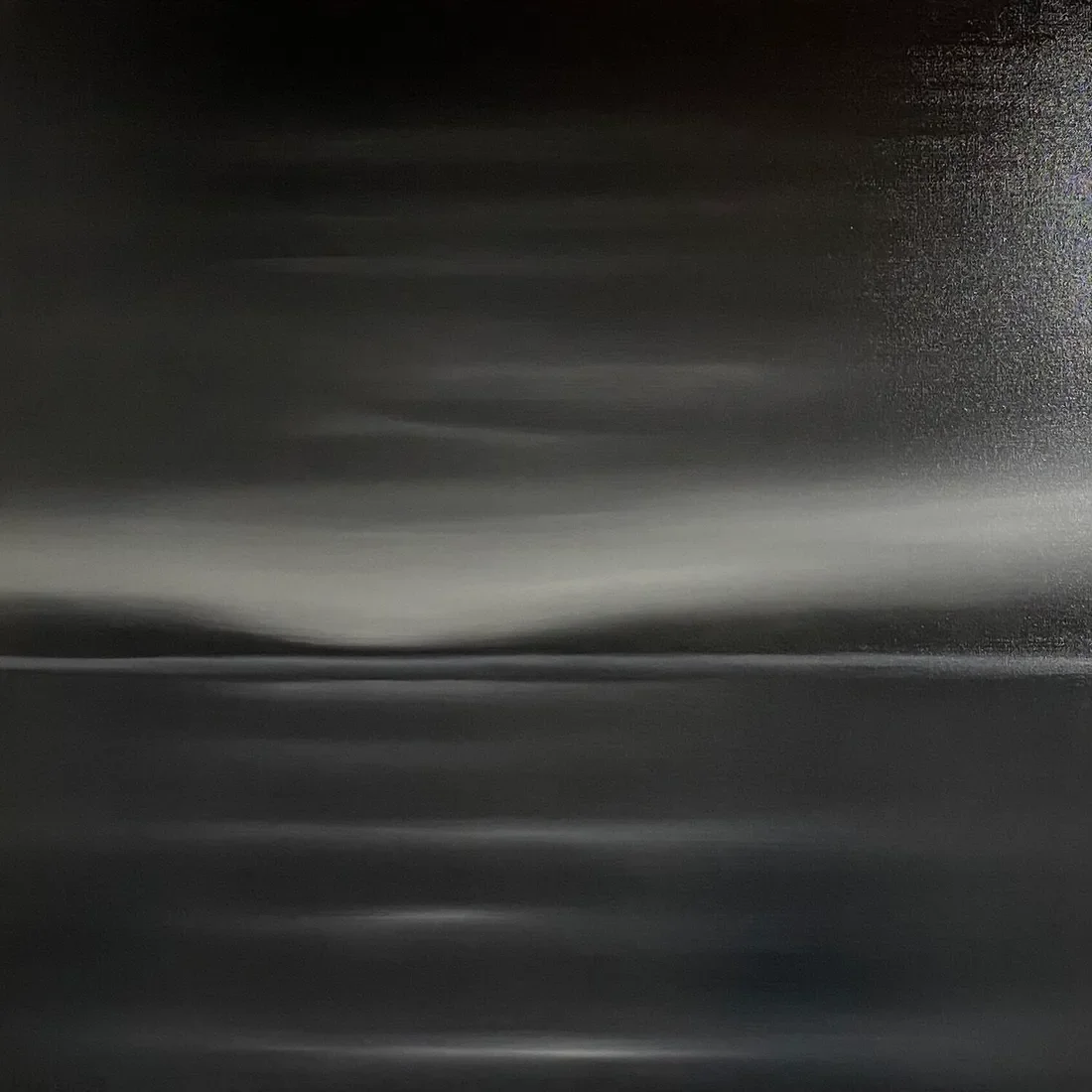
Sunset Dark, Nataliia Krykun, 2022
Thinking back to your very first solo exhibition – where did it took place, and what was the feeling of seeing your work hanging on a wall for strangers to see?
Yes, I remember my first solo exhibition very clearly. It took place in 2012 at the Kremenets Regional History Museum in Ukraine (Кременецький краєзнавчий музей). At that moment, seeing my work installed on the walls, in a public and institutional space, felt both unfamiliar and inevitable.
There was a strong sense of exposure, almost a physical vulnerability, because the works were no longer protected by the privacy of the studio. At the same time, it was a moment of confirmation. The paintings began to exist independently, entering into a dialogue with viewers I did not know and could not control. That shift – from something deeply personal to something publicly experienced – was both unsettling and essential for my development as an artist.
The first criticism I received during that exhibition was direct and, at times, difficult to accept. Some viewers perceived the work as too emotional, too raw, and not aligned with more traditional expectations of composition or narrative clarity. There were also questions about ambiguity – people were unsure how to “read” the paintings.
At that stage, this kind of feedback was both destabilizing and necessary. It forced me to confront the gap between intention and perception. Rather than discouraging me, it clarified something important: my work does not aim to be immediately understood or comfortable. The early criticism helped me recognize that tension, uncertainty, and even resistance from the viewer are not weaknesses, but integral elements of my practice.
You’ve described your paintings as a "map of your life." As for the series "Night Lake in Ukraine," what specific "coordinates" or moments in your life are we seeing?
The Night Lake in Ukraine series operates on both a collective and a deeply personal level. On one hand, it reflects a broader atmosphere – night as a space of uncertainty, silence, and psychological depth that resonates with the current condition of Ukraine. On the other hand, it carries very specific personal coordinates connected to a Ternopil Pond/ Ternopil lake in Ternopil, a place embedded in my memory.
This location is not depicted literally, but it informs the emotional structure of the works: the stillness of water, the density of darkness, and the sense of suspended time. The lake becomes a point of return, both physical and internal, where memory and present experience overlap. These intimate “coordinates” are translated into a wider dialogue, inviting viewers to navigate their own associations within the work.
The world has changed significantly for Ukrainians since 2022. How has the war impacted you, your art, and your creative rhythm?
The war has inevitably reshaped both my inner landscape and my artistic practice. It disrupted any sense of continuity and introduced a constant awareness of instability. At the same time, it clarified the role of art in my life.
During this period, art has become a form of cultural diplomacy. It is not only a personal language anymore, but also a way to represent, communicate, and preserve a cultural identity under pressure. I found myself working more intensively on an international level, participating in exhibitions and dialogues beyond Ukraine.
This shift has influenced my creative rhythm – it is less predictable, often more urgent, but also more focused. The work carries a different weight now. It is no longer only about internal expression, but also about connection, visibility, and presence within a broader global context.
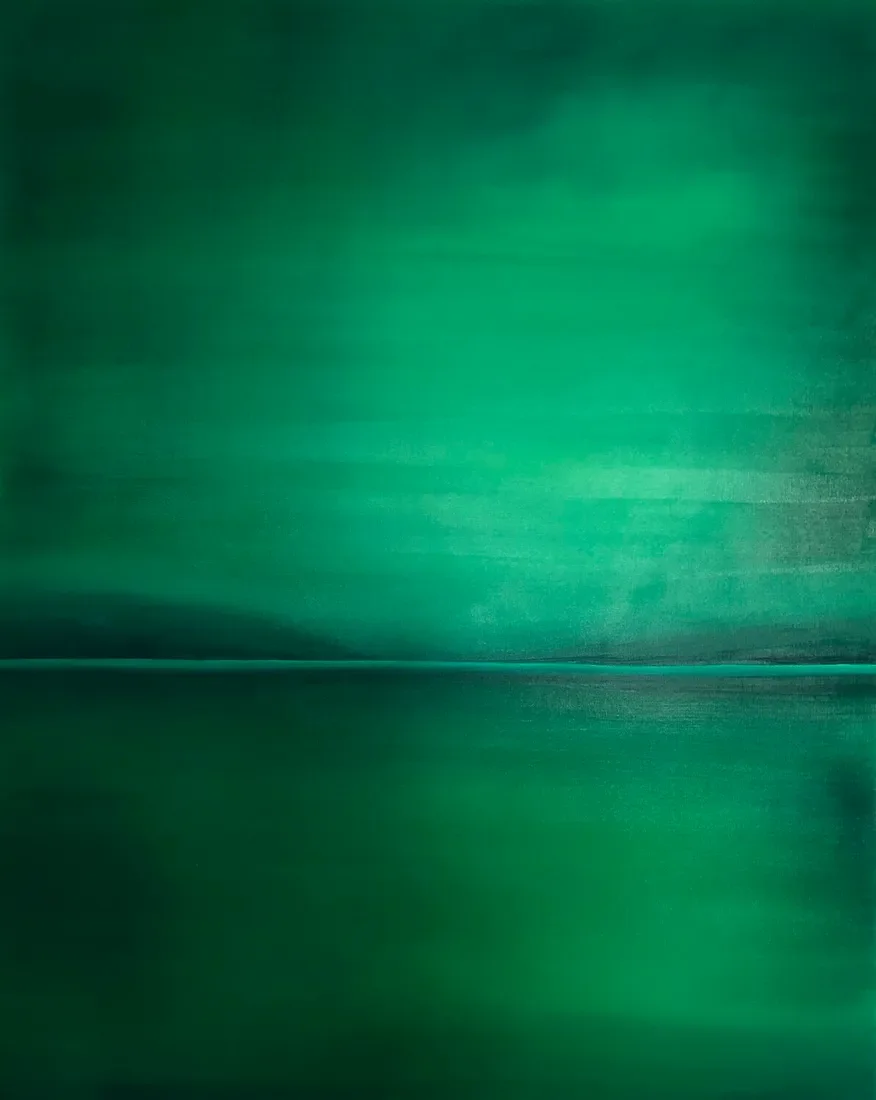
Green Landscape in Summer, Nataliia Krykun, 2020
For my last question: What do you want people to feel or take away when they stand in front of your work at this exhibition?
When viewers stand in front of the paintings from the Night Lake in Ukraine series, I am not aiming to deliver a fixed interpretation or a single emotional response. What matters to me is that they enter a state of reflection – perhaps a moment of stillness, or even a quiet tension that is difficult to immediately define.
These works are built around the idea of depth – both visual and psychological. The surface may appear minimal or restrained, but it holds layers of memory, distance, and unresolved feeling. I would like the viewer to slow down, to remain with the work long enough for something subtle to emerge – something personal rather than prescribed.
At the same time, this series carries a broader resonance. It speaks about fragility, about the shifting meaning of place, and about the experience of holding onto something that is no longer physically accessible. The lake becomes a space of projection, where individual memory and collective reality intersect.
The lake holds what cannot be spoken easily. It reflects what we can no longer touch.
The paintings ask: what remains when everything external becomes unstable? What is home when it becomes a memory, a responsibility, or a promise?
My motto remains: “No matter how dark and long the night is, a bright morning always comes after it.”
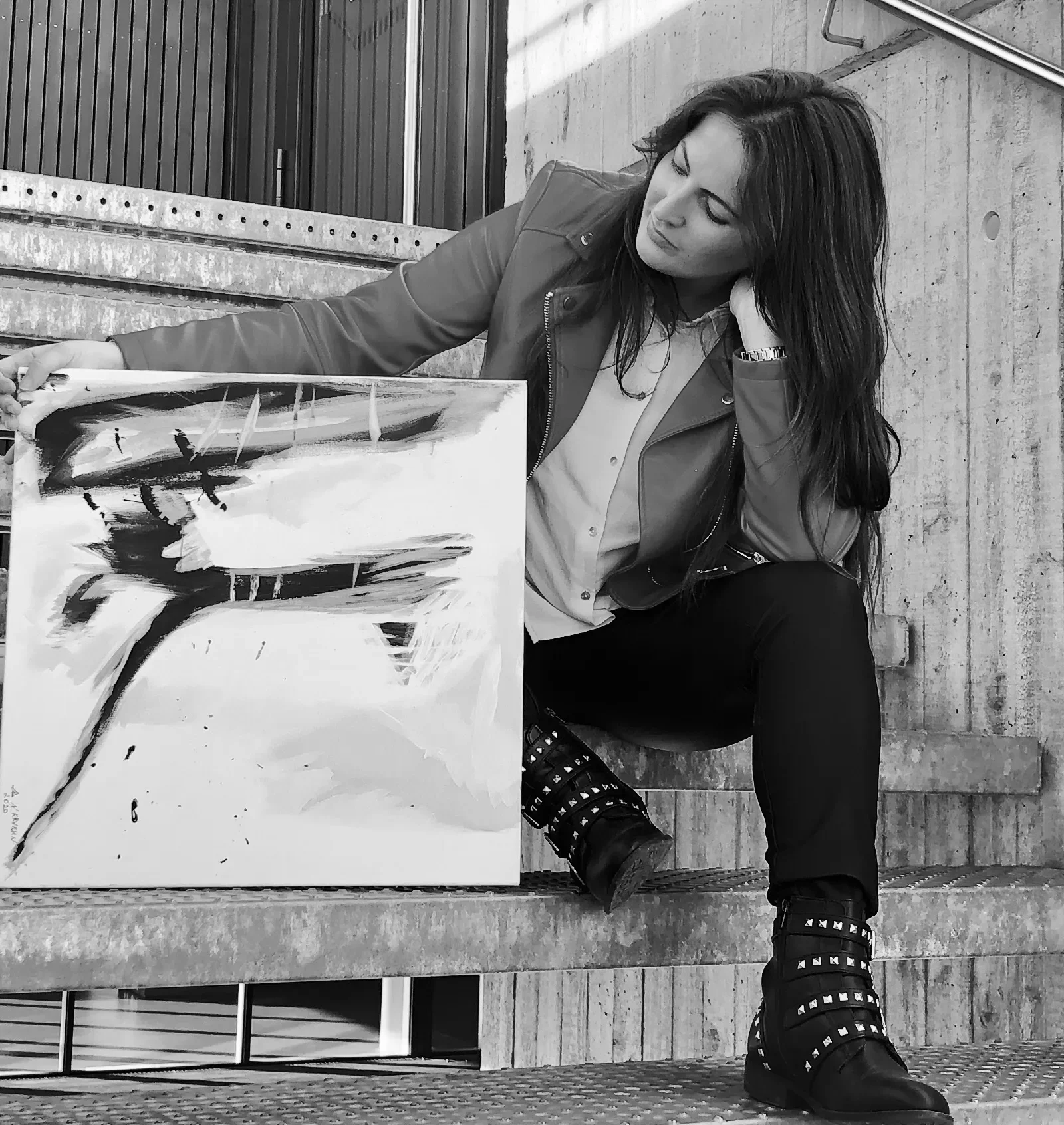
Courtesy of Nataliia Krykun
There is a specific kind of silence that only exists just before dawn. It’s a moment where the shadows are at their heaviest, but the air feels different – it’s expectant. In the intro, I talked about the weight of silence and the necessity of exposure. If the night was about containment, then the morning is about the release. Nataliia’s journey says that home isn't just a place we left behind in the dark, it is the light we choose to bring with us into the new day.
Night can be long, but it never lasts forever.
See more of Nataliia’s work on Instagram.
Article by Vasya Kavka
Based in Ukraine, Vasya Kavka is a writer working at the intersection of contemporary art and digital culture. Through his platform @ambient.delusion, he researches emerging and underground artists, publishing interviews and editorial features that move beyond aesthetics to examine context, creative process and cultural relevance. His work is driven by curiosity and a commitment to thoughtful, accessible storytelling that situates artistic practices within the broader currents shaping contemporary culture.