
"BUONA LA PRIMA": A CONVERSATION ON INSTINCT, COLOR, AND CHANNELING
Benedetta Manzino works fast and doesn't look back. Working under the name bm.artstudio from the privacy of her own studio, she builds each canvas from four joined panels of cardboard, fusing them into a single surface while deliberately leaving the seams visible, as though the work wanted to remember how it was made. The oil itself refuses to behave: in one passage it thins into something like watercolor, translucent and drifting; in the next it dries into a chalky, matte density, closer to pigment than paint. Nothing here is revised. Each canvas is completed in a single, unbroken pass, no second attempt, no returning to fix what's already down. Geometric seals, gates, and keys recur across her canvases like a private alphabet, and the colors she chooses, iridescent and vibrating, are selected less for how they look than for what she believes they do to the body and the mind standing in front of them.
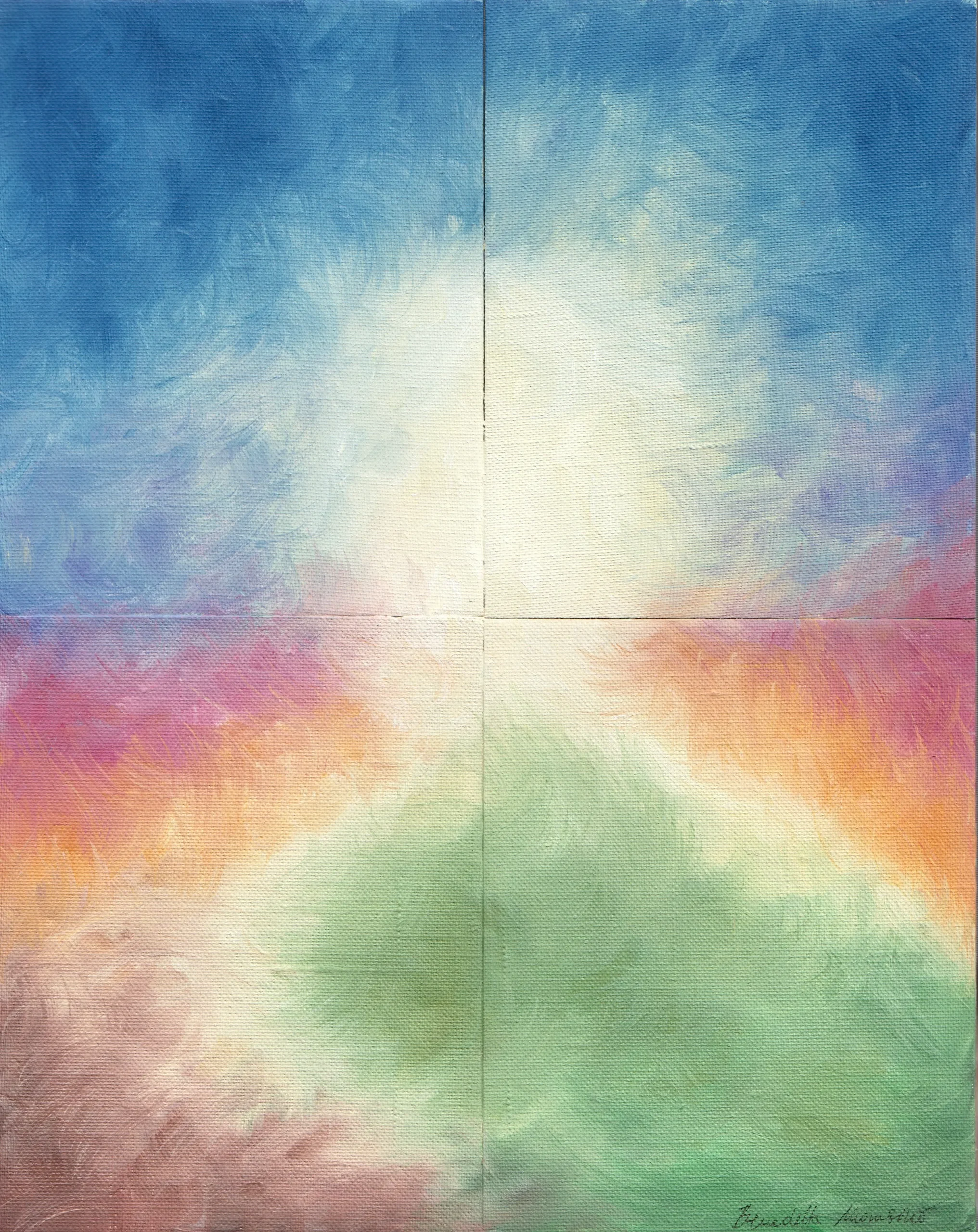
Heaven, 2022, Oil on canvas board, Benedetta Manzino
Born in Mortara, Italy, Manzino trained first at the Liceo Artistico's multimedia track before completing a degree in Modern Literature at the University of Eastern Piedmont in Vercelli, with a curriculum concentrated in Cultural Heritage. That literary formation never really left her practice; if anything, it gave her mysticism a vocabulary. She counts Mark Rothko, Fra Angelico, Hilma af Klint, Agnes Martin, Georgia O'Keeffe, Agnes Pelton, and Raphael among the influences she paints within, spanning Renaissance devotion, American transcendentalism, and early spiritual abstraction. That lineage was recognized formally in 2023, when her painting Morpheus Gate was selected for Spirit Worlds, the sixth volume of TASCHEN's Library of Esoterica, a 520-page survey of visionary art edited by Jessica Hundley, where it now sits in dialogue with works by Agnes Pelton, Rothko and af Klint.
Manzino describes her canvases as portals to be crossed, "Air Portals," in her words: openings through which a person might slip out of ordinary perception and into something more contemplative, more attuned. We spoke with her about where that language comes from, how a painting actually gets made in her hands, and what she hopes is waiting on the other side of the threshold for anyone willing to step through.
How did mysticism become a main theme in your art?
In these past years I've done an immersive journey into the world of meditation to guide my brave soul towards enlightenment; I‘ve always been a “weird” girl for the people that surrounded me, I've always seen behind the veils, the lies and through people’s heart, but this gift of mine was always so close to my heart that didn’t felt like a “gift”, I was absorbing it and making it mine, like a flaw that you want to shush. Growing in my boots has given me the opportunity to refine this ability of mine; what better way to channel the divine connection and mysticism inside my veins than with my art. I tend to reflect this transcendent path by making my art ethereal and magical; it’s a work of spiritual channeling.
Since you studied literature, do you believe there's a connection between literature and mysticism?
Absolutely, I think it’s another way to channel the divine creativity and flow of ideas that come from the ethereal realm of the Cosmos.
I think “nothing is truly original CAUSE everything is simply, gradually, remembered!” We, as humans, are in a constant flow of discovering, of becoming, and remembering what we really are, what we can do with our minds and free will, with our hearts.
Let’s cite a few examples of literature that comes to my mind and that are in line with what I do are: Hildegard von Bingen, writer, composer, philosopher and mystic visionary; Saint Caterina of Siena (as Italian, I might cite her) with her quest around the theological reflections and her political rebukes directed to the people in power of that time; Emily Dickinson with her quest for what lies behind the physical world, the nature of the soul and death as a passage, not an ending; other ones are William Blake and my all time fave Rainer Maria Rilke with his metaphysical poetry of the invisible dimensions, his works reached me as a whisper, one day, while I was painting in my studio (chills downs my spine).
For concluding: Carl Jung, I know it’s not in the literature field, but his works and writings are iconic, groundbreaking, and visionary; a real channeler.
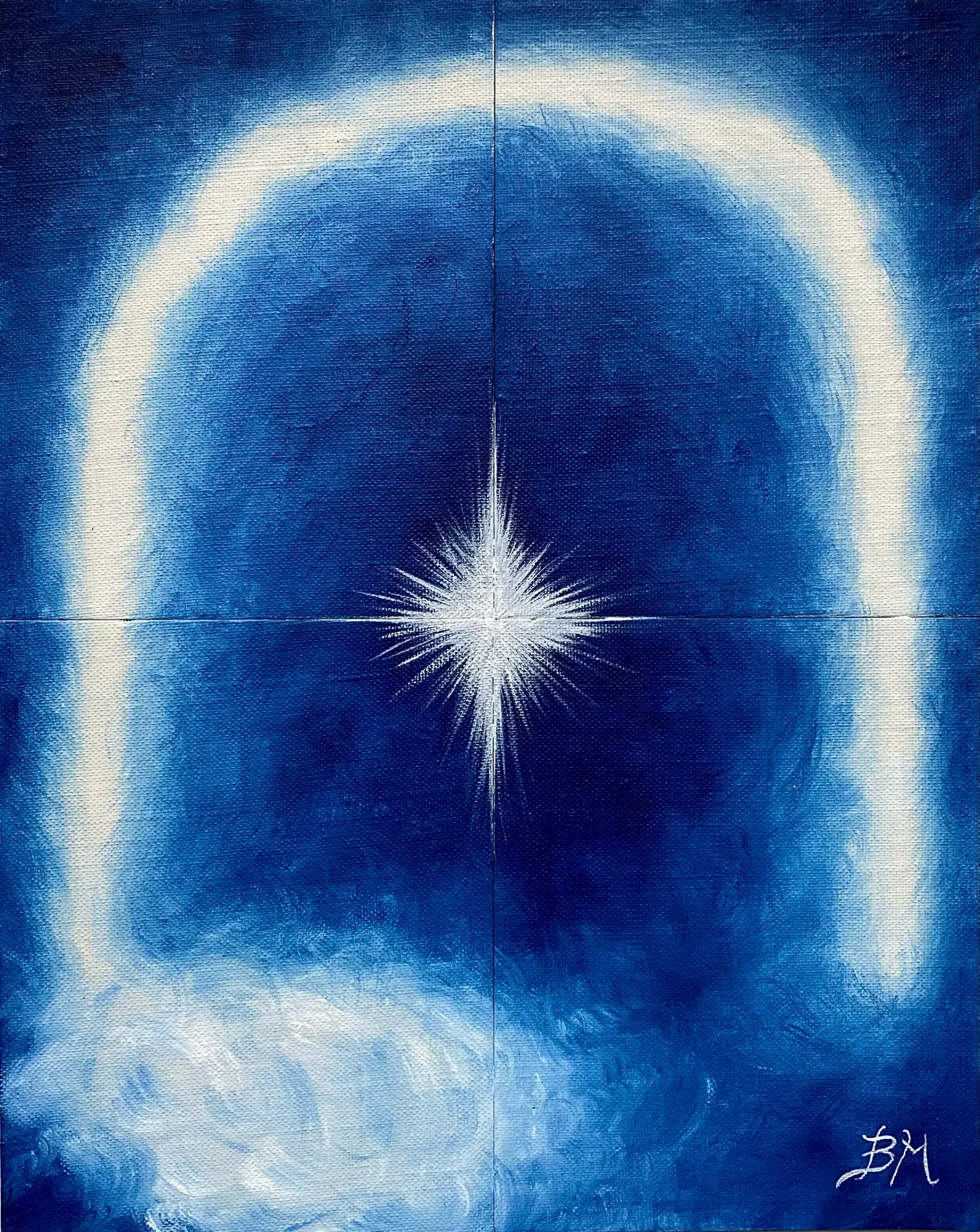
Morpheus Gate, 2023, Oil on canvas board, Benedetta Manzino
Can you walk us through what a typical painting session actually looks like, from the moment you sit down with a blank canvas to when you know you're finished?
This is a secret; I do not kiss and tell!
I can only say my paintings are like Paganini’s works: they do not repeat themselves.
In Italy we say “buona la prima”, and that's my work ethic; I never repaint.
Where does your inspiration come from, and how does the process of starting a new piece typically begin?
I simply channel my visions and put them onto paper as a sketch, then I put myself onto the canvas & the job is done!
You use oil paint in very unconventional ways, sometimes like watercolor, sometimes like chalk. How do you achieve that range?
I can feel the need for the painting to be handled like a real oil paint or more of an ethereal creature coming out of the fog. They speak to me, and I have a good intuition or ear to catch that sound. The variety of my works also comes from the specific use of colors and brushes, I have tons of brushes, from the micro ones to the big, puffy, and fluffy ones.
“I aim to create works capable of entering into dialogue with an interior dimension, evoking contemplative states and perceptual openings through geometric structures and transforming chromatic fields.”
You call the canvas an "Air Portal." What do you want it to open up for someone standing in front of it?
I aim to create works capable of entering into dialogue with an interior dimension, evoking contemplative states and perceptual openings through geometric structures and transforming chromatic fields. My paintings are created with a predilection for iridescent and vibrant colors, used not only for aesthetic purposes, but as true tools of perceptual stimulation and neuro-emotional stimulation: they serve to bring out latent emotions, to welcome them and transform them. My signature: the pictorial support consists of a combination of four canvases of cardboard; this technique allows me to join the four into one unit, while keeping the mosaic visible. With this method of canvas processing, the surface transforms into an AIR PORTAL, helping the viewer open that door to other worlds of awareness and reflection of the spirit, bringing to the surface the internal dialogue; our true divine voice.
In your portfolio, there's a quote by Richie Norton: "Wherever I go, the grass grows greener." How do you relate this to your artwork and artistic process?
It really is like this, but this quote is first more about me and what I do, after what I want to do in my life and artistic process. I know I have a key role in this society, and my art is the best medium that everybody can experience. For the rest, who know me personally, even the ones who never understood me, they know my energy is different, and when I transit into their life, some things become brighter (that’s why sometimes they're mad) and greener (that’s why sometimes they do not want to let me go).
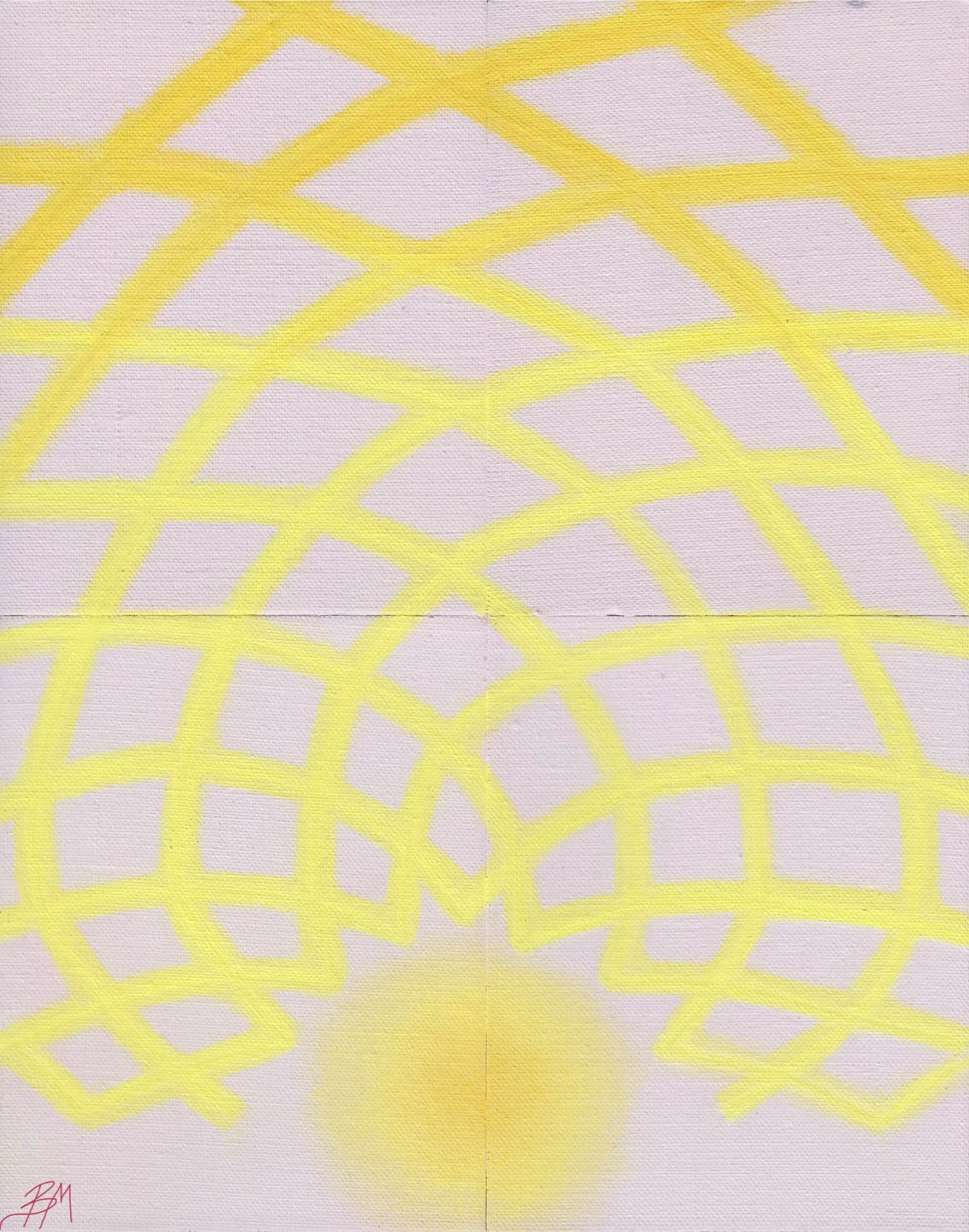
Ancestors, 2024, Oil on canvas board, Benedetta Manzino
You describe the paintings "Heaven" and "Healing Nature, Grounding Exercise" as "brothers" that can't be separated. What would be lost if they were shown individually rather than together?
To be honest, all of my paintings are brothers and sisters. I do not want to sell them, for now, cause they need to STAY together. They can tho be shown separately, but why limit the beauty that someone can experience?
Let’s expand and let’s show them all together: like a family reunion! Everyone (paintings) can show up and have something different to say, cause each one of them is unique!
When someone stands in front of one of your paintings for the first time, what's the first thing you'd want them to notice?
The love that I have for this world and the devotion that I have for the other “invisible” world, for my artistic practice.
Love is the answer.
If you could only pass on one thing you've learned through this journey, as an artist or as a person on this meditative path, what would it be?
I might say: this path is not for the faint of heart, but what a joy and grace to be this attuned and cared for by the Great Cosmic Mother in the sky.
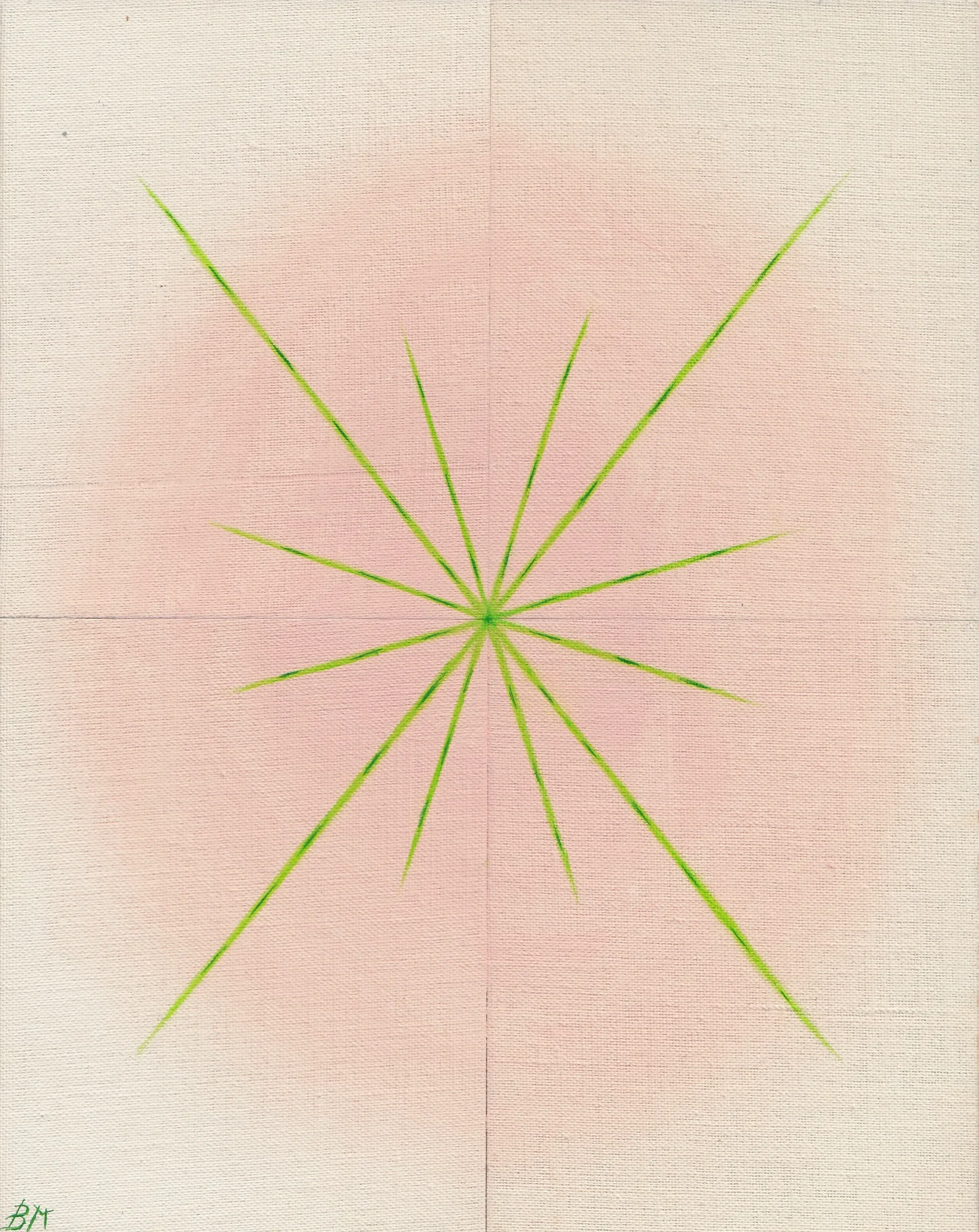
My most purest form: Love, 2024, Oil on canvas board, Benedetta Manzino
Talking with Manzino, it's hard to separate the artist from the cosmology she describes; the paintings read less like statements than like transmissions, each one a portal she's simply agreed to hold open. Rilke, one of the poets she cites as an influence, wrote in Letters to a Young Poet that works of art are profoundly solitary, and that nothing reaches them less than criticism; only love, he argued, can truly hold a work of art and do it justice. Manzino gets at the same idea in her own words: love, she says, is the answer, the thing she wants a viewer to feel first. The paintings make their own case: built from four joined panels, layer by layer, out of what she calls channeling, and what Rilke might have simply called love.
Article by Ana Gabriela Batista
Ana Gabriela Batista is a translator, writer, and editor. Trained in literature and translation studies in Brazil and Italy, she moves between translating and writing with the same attentiveness: to the shifting contours of meaning across languages, and to the rhythm, structure, and weight each word is asked to carry.