THE PERFECT LINE: CORINNE PAGÈS
Life is motion. Going along the way, discovering, exploring where it may take you. Searching for that perfect line that will tell you a story of the landscape, the story of a body. Each and every curve is a word, and, once combined, becomes a poem. The one about humanity and nature. The poem of life. Life is motion.
Corinne Pagès is an observer, she’s not intervening. She lets the material dictate its own path. Her work is an agreement between the artist's hand and the canvas. For Pagès, the creative process is a journey through an undefined nomadland where the goal isn't just to reach a destination, but to remain in the balance of the moment. In this conversation, we delve into her beginnings, the territories she has crossed, and the lines that map her world.
Could you take us back to the dawn of your artistic journey? Is there a specific first creation or a vivid childhood memory that stands as the starting point for the work you do today?
The paintings of Pierre Bonnard, his ability to transcribe colored sensations has profoundly fascinated me from the very beginning. One canvas from 1913 in particular, titled "Dining Room in the Country" translate, in my opinion, with great subtlety the luminous fragility of the moment and remains at the origin of my unconditional love for painting.
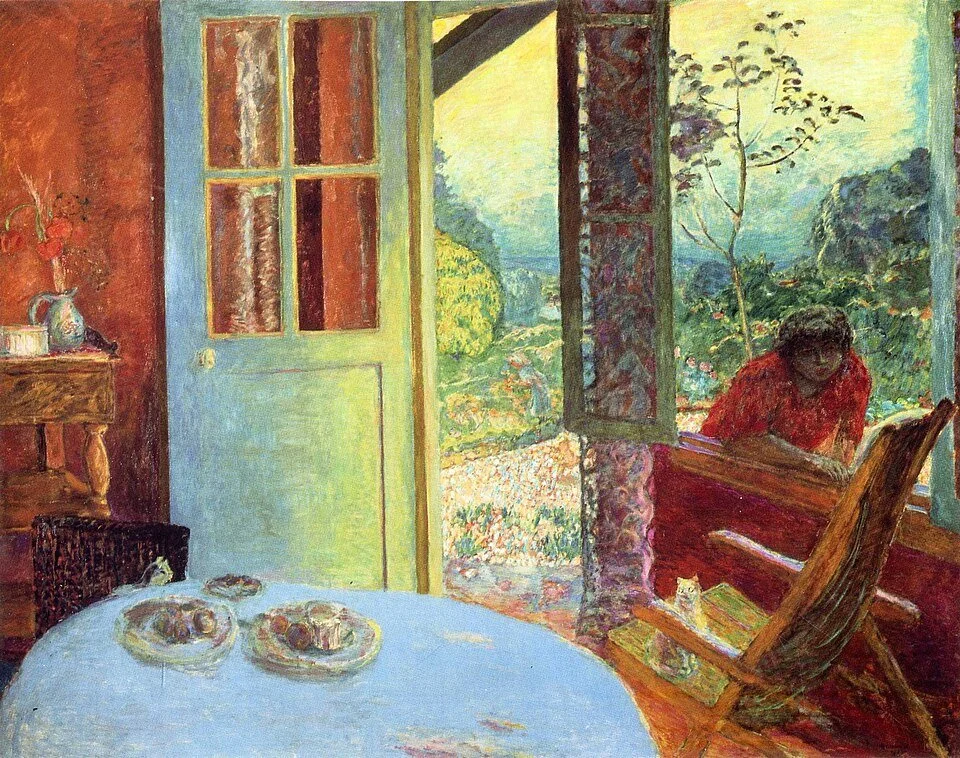
Dining Room in the Country, Pierre Bonnard, 1913
Are there any particular artists or movements that you feel a strong connection to, or that helped you figure out your own style?
Abstract art is the one that for me, through the possibility of the choice of forms, lines and color, speaks the most to the imaginary. Artists like Joan Mitchell and Zao Wou-Ki express a lyrical abstract art to which my own style identifies.
As an abstract artist, what does the act of creation feel like for you? In your view, what does abstraction means?
I feel a sensation of extreme freedom and unspeakable joy in a relationship to time that dissolves, as well as a form of challenge since one is never completely sure of the final result, always approaching the creative process with a great patience and much humility.
“Before all beginning, the canvas already vibrates with a kind of organized chaos to come.”
You’ve spent years drawing nudes in charcoal, focusing on the tension and gravity of the human form. Have you ever considered merging the human body and the abstract landscapes? Or are must remain separate worlds?
Yes, I have several times considered the relationship between the nude and the landscape. For the two, the search for the line must be for the perfect line, sober, concise, concentrating and synthesizing the essential message in a few fragments of line. This is what will underpin the truthfulness and the suggestive power of the drawing.
In your 2021 feature for Maison & Jardin journal, you mentioned that traveling is essential to you. Where does this urge for movement come from? Of all the territories you’ve crossed which one left the deepest imprint on you?
In its total mineral power, the Hautes-Alpes made me feel in the harshness sometimes of this nature, the rightful place of man. And on the high plateaus of Cantal, in wider horizons, I rediscover this feeling of solitude and infinity, the same as one feels facing the immensity of the ocean. These 3 territories are landscapes dear to my heart.
One of the descriptions you used for your work is "organized chaos" and based on that I wanted to ask you this kind of a philosophical question: When facing a blank canvas, do you see it as organized because of its absolute whiteness and potential, or is it already chaos because of the storm of thoughts trying to find a way onto the surface?
It may seem that before all beginning the canvas already vibrates with a kind of organized chaos to come and it could well be that it alone knows what will become of it... Its size, its relationship to the height and to the width are going to indirectly influence my artistic intentions and this beyond my own pictorial desires. This is similar to an amicable agreement between the support and myself.
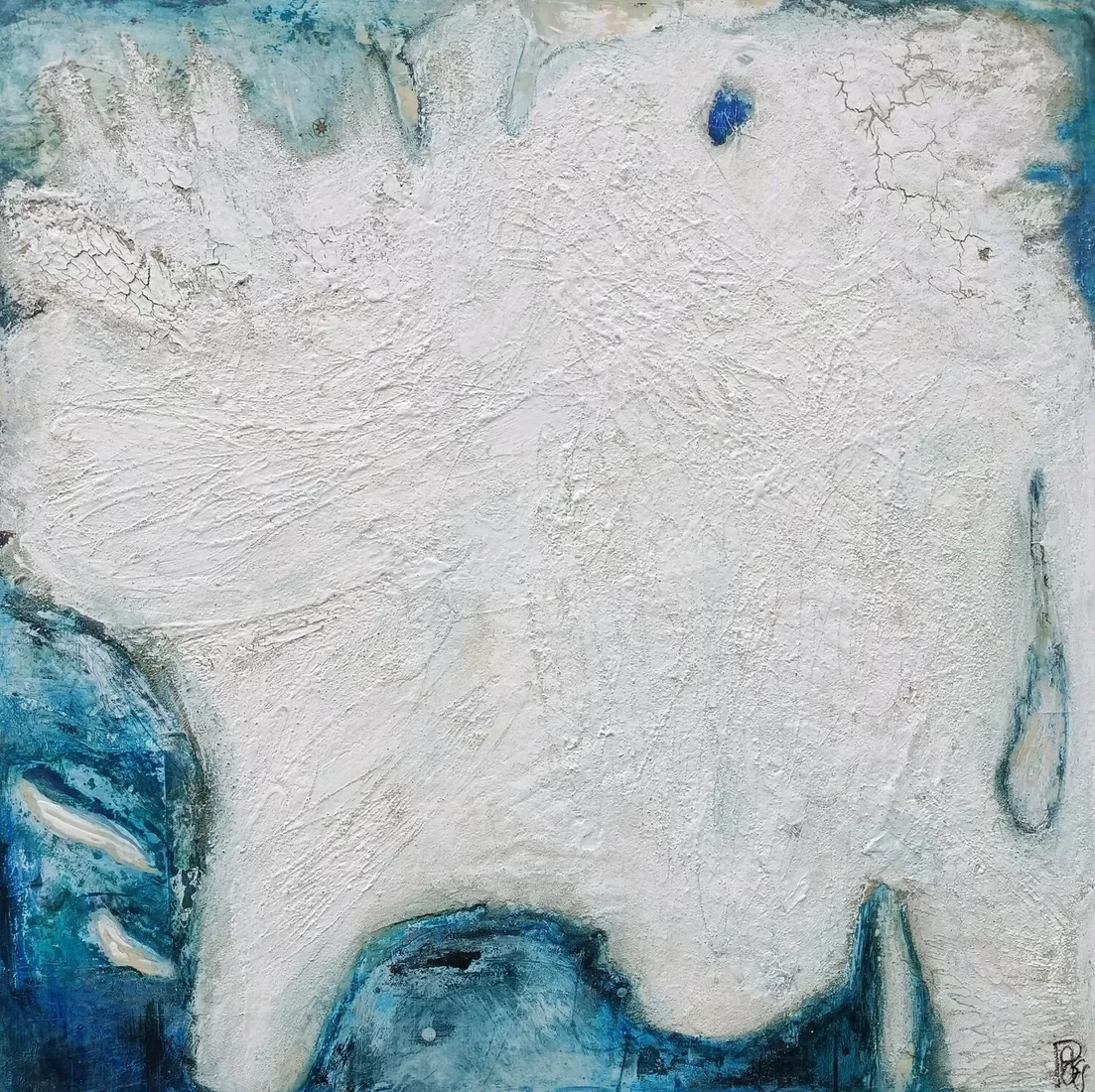
Ilandsis I, Corinne Pages, 2025
While talking about your painting Ilandsis I you said: "The winter season is a bit like a kind of iceberg, those thick glaciers of the high latitudes that we will have to cross to find, later and further away, the lights of spring. " Would you say that the creative process itself is a kind of an inner crossing? And can you share a bit about the creation of this specific piece?
Yes, the trajectory which goes from the beginning to the finality of a canvas passes through a sort of undefined nomadland which little by little takes form.
For "Ilandsis I", the banks of mist which accompanied the process of creation seemed to blur the work in progress, namely this sensation of non-finished that lingers... Much time was needed before finalizing the canvas. It is a moment that remains in balance, that of deciding whether or not the work is finished, because the time of the realization and the time of the observation between each of the stages will have been intrinsically linked all along the path.
Finally, when a viewer stands in front of your work, what is the one emotion or idea you hope they take away with them?
… that they travel !!!
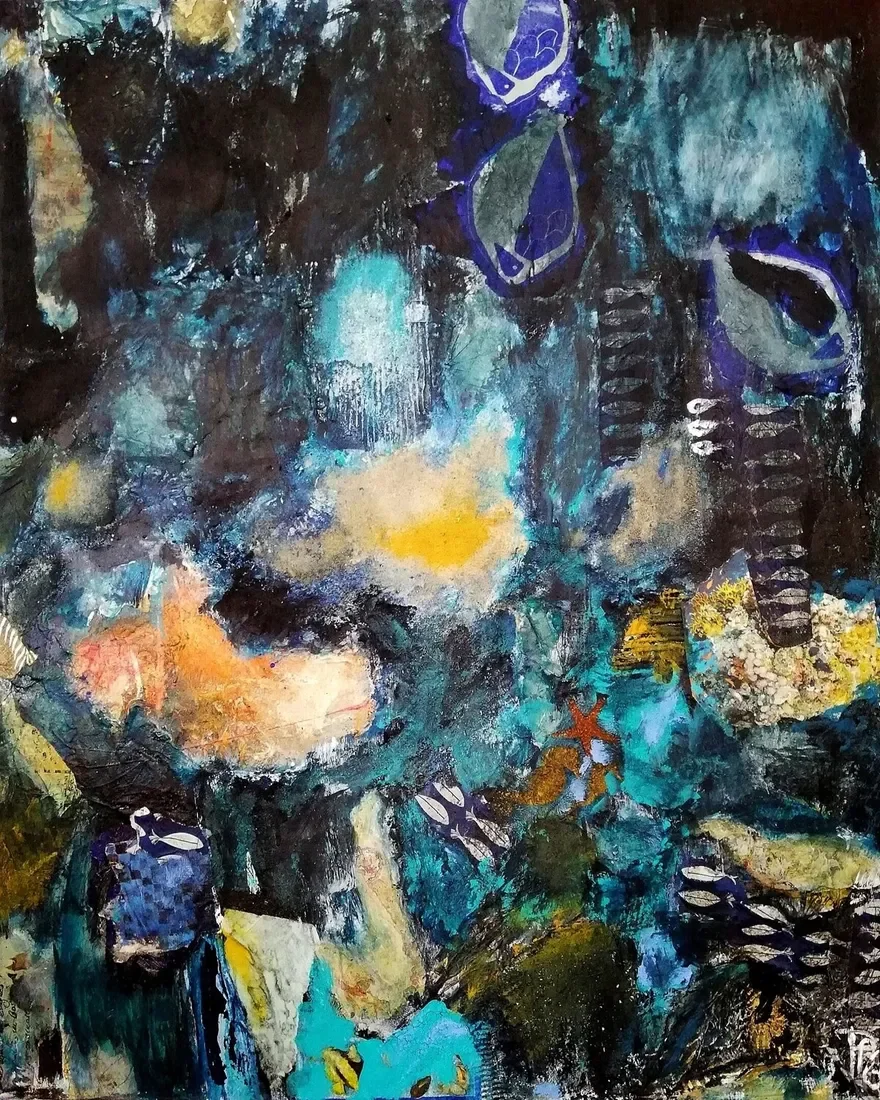
Aquarium, Corinne Pages, 2022
"Voyage!!!" Corinne says.
The motion doesn't stop at the edge of the canvas, it continues through the eyes of the viewer. She asks us to travel and explore every corner of the work – where each and every detail is a word waiting to be found. But the path is rarely a straight line.
A crossroad is not always about a choice or a direction, sometimes, the journey leads you to a place where you simply stop. You take a deep breath and let the chaos settle. You find that the ultimate motion isn't just moving forward – it is the ability to just be.
In the end, there is no rush, the poem is already written. All that is left is to step inside.
See more of Corinne’s work on her website.
Article by Vasya Kavka
Based in Ukraine, Vasya Kavka is a writer working at the intersection of contemporary art and digital culture. Through his platform @ambient.delusion, he researches emerging and underground artists, publishing interviews and editorial features that move beyond aesthetics to examine context, creative process and cultural relevance. His work is driven by curiosity and a commitment to thoughtful, accessible storytelling that situates artistic practices within the broader currents shaping contemporary culture.