THE BEAUTY OF THE UNEXPECTED: INSIDE JEANNE MAZE’S COLOURFUL WORLD
Jeanne Maze Churchill, an Anglo-French artist born and raised in London, now lives in the southwest of France, where she devotes herself to working in pastel, oil, and gouache. Her artistic vision has been deeply shaped by the legacy of her grandfather, the Post-Impressionist painter Paul Maze. It is, in fact, his grandfather pastels (carefully preserved since his passing) that Jeanne still uses today to bring her luminous scenes to life.
In the landscape of contemporary art, Jeanne invites us to rediscover a gaze that is simple and unguarded, far from strict realism, yet vibrant with the colours of the world around us, and above all, with the living essence of nature.
Engaging directly with Jeanne Maze allows us the rare privilege of delving into the evolution of her pictorial practice, uncovering her artistic intentions, technical decisions, and thoughtful reflections on today’s art landscape.
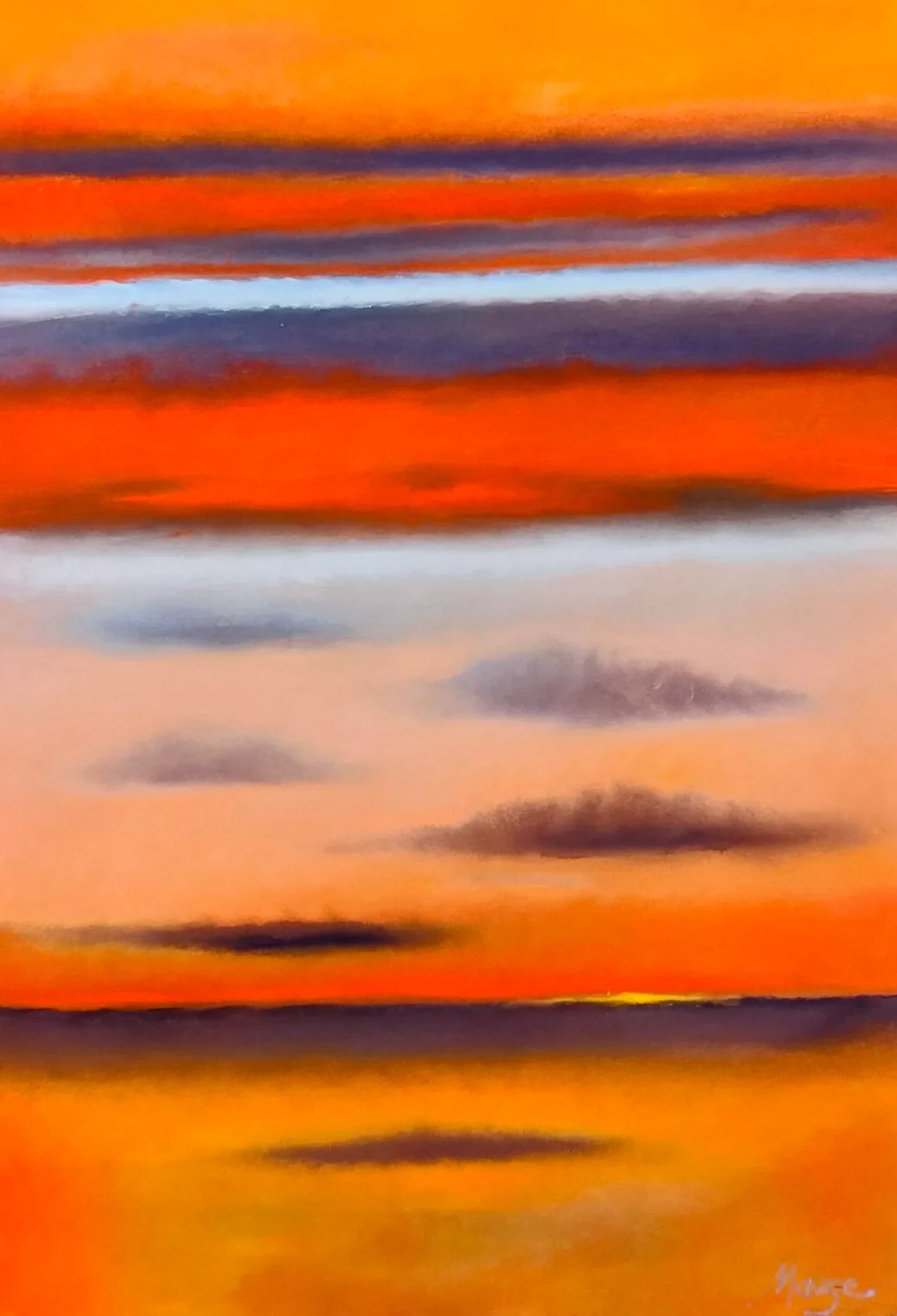
Spectrum N. 16, Jeanne Maze
Has your art changed throughout the different phases of your life?
I was just thinking about that before I spoke to you. I was reflecting on how liberating it is to reach my age and be able to release what I would like to paint without worrying about learning a technique or proving how technically correct I can be as a painter. Now I know that my technique is at a level where I don’t need to think about that anymore.
Could you walk us through your painting process; are there specific materials that guide you while creating a work?
Yes, I’ve been spoiled by understanding that if you use quality materials, your work becomes more capable of developing a natural energy; if you use lower-quality materials, you end up having to force the result. […]. So lately I’ve been using these fantastic pastels to develop and push the ideas of the Spectrum series as far as I can. Through this process, I’m obviously learning how far I can go. It’s very exciting, because it’s not something I’ve ever done before, and I never anticipated doing it. One day I created a large picture inspired by the sky in pastels, and it worked for me and for everyone else. I’ve been painting them for several months now, and I’m going to continue exploring this direction for quite some time.
When you begin a new piece, do you start with preparatory studies or sketches, or do you prefer to work directly on the canvas?
Basically, I prepare the paper. I choose the colour scheme and lay out the main colours I’m going to use. I establish the initial skeleton of proportions, and then I begin building it up. […]. I place the first strokes of soft colour onto the paper to find the equilibrium of how I’m going to approach it. After that, I stop worrying about what I’m doing and simply let it unfold. It becomes a kind of discovery as I work.
That’s why I called this series Spectrum: colours overlap like in a rainbow; they are not separate from one another. The effect I try to achieve is for the colour to emerge from the paper rather than sit on it, so that you feel the energy of the colour. When the painting is hung, there is a living vibrancy that stops it from being just a dull colour scheme: it becomes a living thing.
“It’s about discovery, about the humility of letting it happen instead of trying to force it. I’m never 100% sure what the final result will be. Throughout the journey from beginning to end, there’s an enormous amount that I’m not in control of, but it just happens.”
Which part of this creative process do you enjoy the most and why?
I think I love the unexpected result. Sometimes it’s dreadful and I feel I’ve failed, but most of the time it’s wonderful, because it’s never exactly what I initially set out to do, it’s always slightly different from what I imagined. It’s about discovery, about the humility of letting it happen instead of trying to force it. I’m never 100% sure what the final result will be. Throughout the journey from beginning to end, there’s an enormous amount that I’m not in control of, but it just happens. I love that because I have faith in it. If you fail, you fail; but if it works, it feels like an unexplained kind of magic. After years and hours of drawing and painting, you begin to understand how far you can push something without overdoing it. The subtlety of pastel, combined with years of accumulated knowledge, makes it possible for a painting to develop its own individual style.
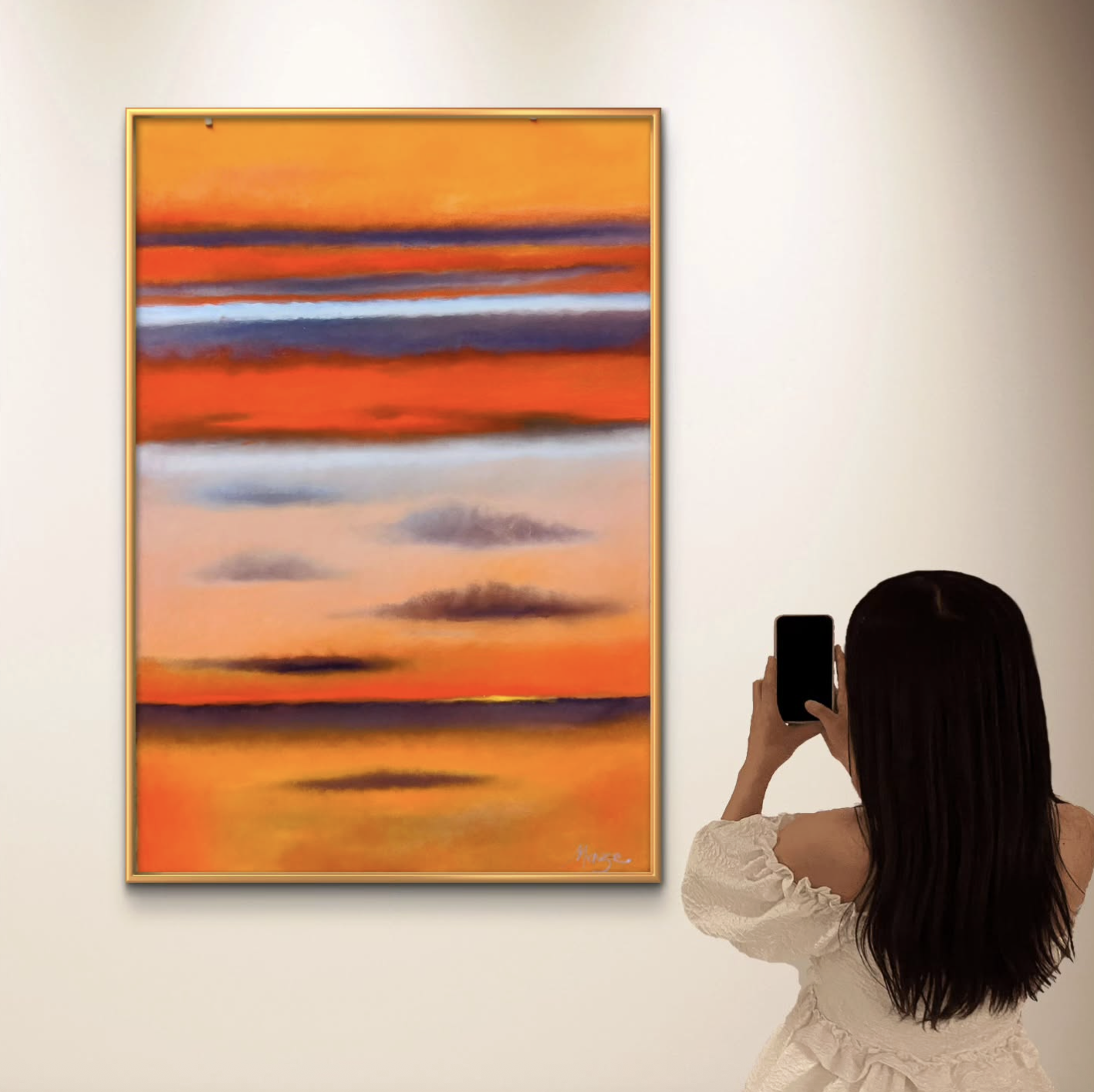
Courtesy of Jeanne Maze
Nature appears as a recurring subject in your work. I was wondering what are you trying to capture in nature?
I’ve always worked with enormous respect for nature, because it’s something I truly stand in awe of. I’m constantly amazed by the colours in nature, the shapes, the changing light, everything that happens within it. Early on, I realized I was always trying to capture the natural essence of something. When I paint a landscape, a bunch of flowers, or any object people can recognize and say, “That’s what that is,” I focus more on the colour and the feeling than on the precise depiction. I’m not interested in realism. I’m trying to capture the emotion of what I’m painting. Even if it’s a wooden spoon, I want to convey its character, that’s what interests me. I’m not concerned with the grain of the wood or the shadow; I’m interested in the feeling of that wooden spoon. I believe the emotion of something is the vibrancy people seek in a painting. If there’s genuine feeling in it, like the first daffodils you pick in spring, with their sense of newness, that’s what matters. I try to capture that feeling of newness rather than just paint a pretty daffodil. In a way, I suppose I’m trying to capture the mood of what I’m painting rather than perfection.
Growing up within an important artistic tradition, especially with the influence of your grandfather Paul Maze, how has this shaped your view of contemporary art today? What do you see as its main challenges today?
At the moment, the market is saturated with paintings that are trying to sell, largely because of the rise of the internet. Before the internet, selling required bringing a painting to a gallery or having someone visit a studio, it was a physical experience.
Now there are digital exhibitions, and it’s possible to buy a painting in Paris while sitting in South Africa, seeing it perfectly on a screen. There’s an enormous saturation of artistic information overwhelming the internet. I think people almost become frightened or bored because there’s simply too much. […].
It’s like going to a restaurant and being served 24 courses, you can’t enjoy them all. I think people will slow down. They still love going to galleries and exhibitions and looking at art in person. I believe people will begin to collect for their homes in a different, more thoughtful way.
Thousands, even millions of people have seen the Monna Lisa, but not one person has seen it in exactly the same way. That individuality is incredibly valuable now. Ultimately, I think it’s the personal emotion you experience from a painting you love that will drive people to buy it.
And quality matters, real quality of workmanship that has taken time to develop, rather than something produced too quickly. I think that will be admired and respected.
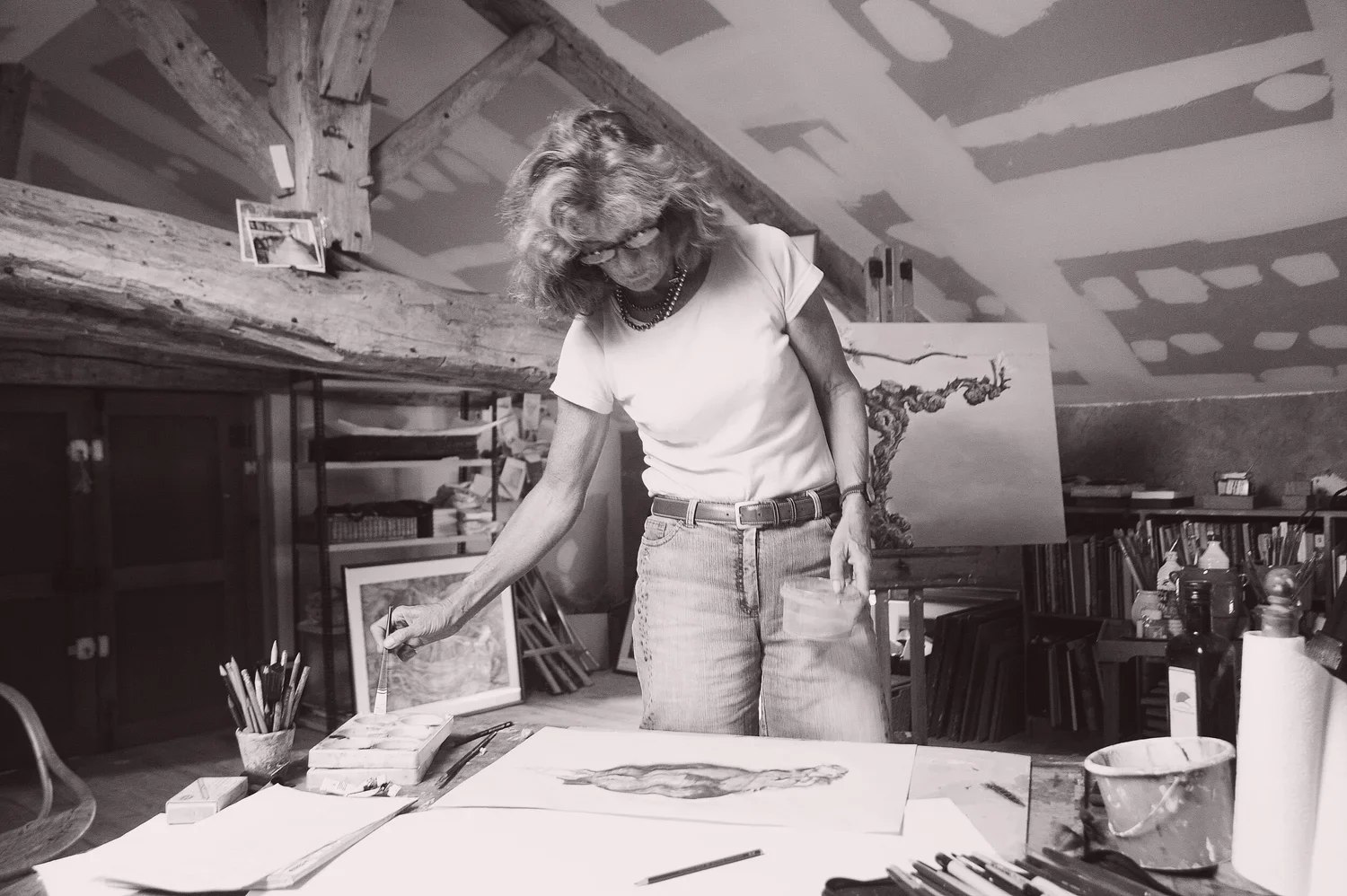
Courtesy of Jeanne Maze
“Even if it’s a wooden spoon, I want to convey its character, that’s what interests me. I’m not concerned with the grain of the wood or the shadow; I’m interested in the feeling of that wooden spoon.”
How do you balance intuition and technique in your work?
One cannot override the other. Intuition isn’t learned, while technique is the result of years of hard work. Technique is something you develop over time. For example, I painted a vine (since I live on a vineyard) and I spent three years drawing vines to truly understand them and how they grow. Only then did I sit down to create a painting of a vine. I’ve spent many years learning techniques across different media and scales, while intuition is what comes naturally to the artist. Everything else is simply years of hard work.
What do you ultimately hope viewers feel or understand when they meet your work?
I would love for people to see and absorb the colour for what it is. In the past, my paintings contained a lot of colour, but these latest works are literally constructed out of colour. There are no defined shapes or linear designs. The colours vibrate against one another and merge into each other. That creates the story, it creates the strength and the softness and establishes an equilibrium that carries emotion. Many people come through my studio to see what I’m doing, and often they say, “Oh wow, that’s terrific.” I ask, “Why in particular?” and they reply, “I don’t know. I just love it.” I think it’s because the colours tell the story, and viewers form their own interpretation. They create their own story through it.
See more of Jeanne’s work on Instagram.
Article by Desideria Manzini
Working between Italy and France, Desideria Manzini specializes in cultural management, strategy, and communication. She has worked and collaborated with private art institutions, contributing to the development and positioning of cultural projects within an international context. Alongside her strategic practice, writing plays a central role in her work: a tool for analysis, critical reflection, and cultural interpretation. Through her texts, she explores the intersections between art, heritage, and contemporary discourse.