THE BEAUTY OF IMPERMANENCE: INEZ FROEHLICH
“Art is not a monologue. It lives through exchange.”
Inez Froehlich builds atmospheres by layer, using sand, stone, and marble powder to reconstruct the history of abandoned walls and the specific tension of lost places. She understands that a location is more than its coordinates - it’s a physical archive of everything that has happened there. In her studio, surrounded by her dogs Klaus, Fanny, and Hermann, Inez practices an art of reduction - stripping away the literal until only the "truth of a moment" remains.
We sat down with Inez to discuss her path toward abstraction and why her work is never truly finished until someone else stands in front of it.
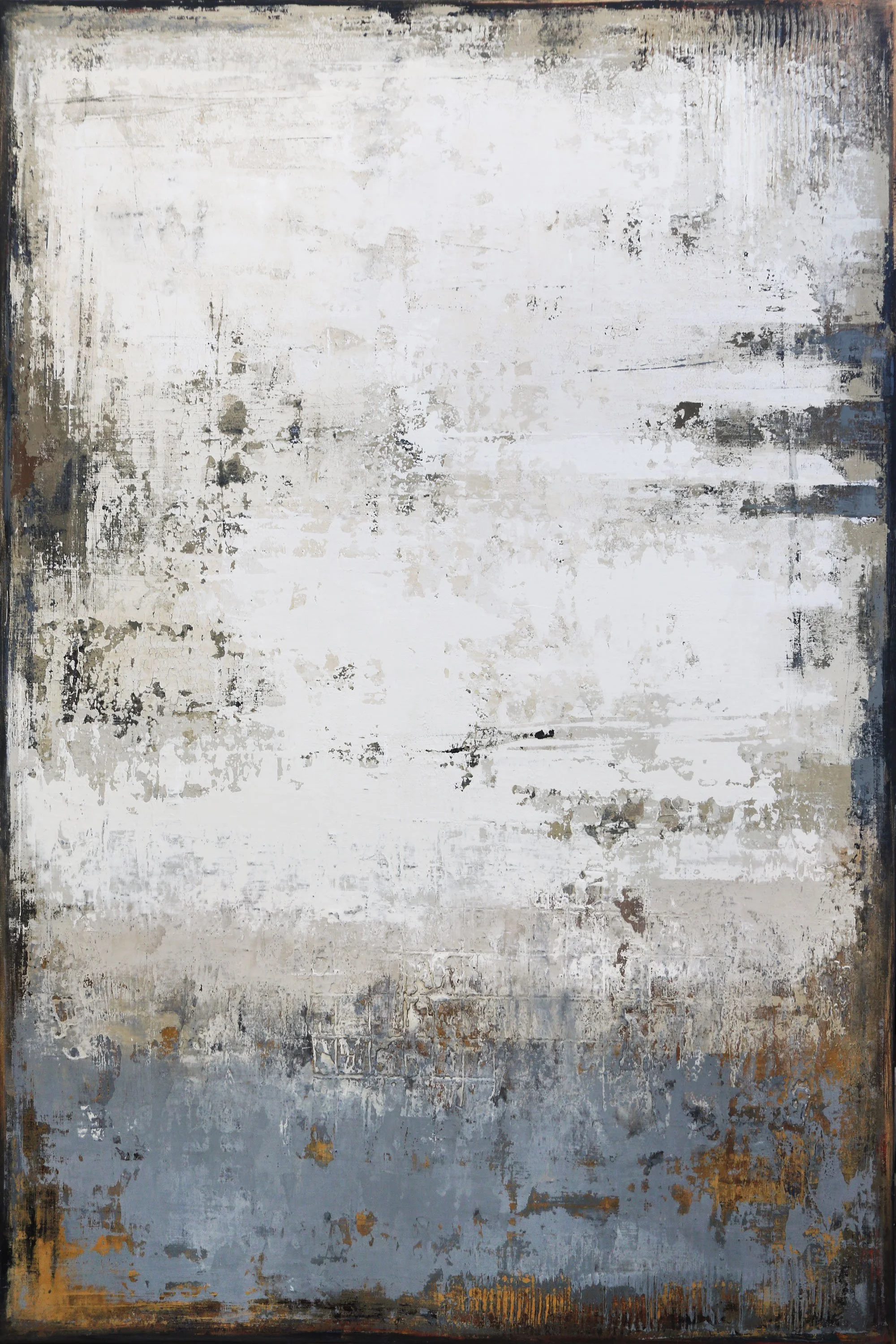
Dusty Roads, Inez Froehlich, 2026
I like to start from the very beginning. Looking back, where do the origins of your style lie? Was this something you were already experimenting with in your childhood or did this specific visual voice only emerge much later in your career?
Looking back, I would say the roots of my work were planted very early – not as a defined style, but as a way of seeing. Even as a child, I was fascinated by surfaces: peeling paint, weathered wood, walls marked by time. I was less interested in drawing objects and more drawn to textures and traces. My current visual language, however, developed much later. It took experience, detours, and the courage to reduce rather than add. What I do today is the result of a gradual process of clarity. The style did not appear overnight – it matured with me.
Who or what influences you and your work? I’m curious if there are specific artists you look up to, or if it's more about things like music, books, or a certain philosophy that gets you in the zone?
I am less influenced by specific artists and more by atmospheres and places. Lost spaces, abandoned buildings, old fences, industrial structures where time has visibly left its mark – these quiet environments carry a presence that deeply resonates with me. Music is important in the studio; it creates an inner rhythm. Books and philosophical reflections on memory, transience, and identity also shape my thinking. Ultimately, my work is a dialogue between material reality and inner perception.
You made a big move in 2003 to go full freelance artist. Was there one specific moment that made you say "that's it, I'm done," and how did you feel the day you finally made that decision? Was it scary or just a relief?
The decision to become fully self-employed in 2003 was not a dramatic break, but a conscious step. There was no single explosive moment – rather a growing certainty that I needed to give my artistic work the space it required. Of course, there was respect for the risk. But stronger than fear was a sense of clarity. The day I made the decision, I felt calm. It wasn’t a leap into the unknown; it felt like stepping into alignment with myself.
“An abstract work is not a finished statement; it is an invitation. It becomes complete only through the perception and experience of the person standing in front of it.”
You’ve mentioned being inspired by "lost places and the traces of time on walls and fences." When you’re standing in front of a canvas, are you trying to paint a memory of a real place you saw, or are you just trying to capture that feeling of a space?
I never aim to document a specific place. Real locations often serve as a starting point, but I am not interested in depiction. What I try to capture is the feeling of a space – its silence, its tension, its history. I am drawn to that subtle moment between visibility and disappearance. The canvas becomes a field where memory, imagination, and material meet.
I wanted to ask you about your piece Dusty Roads. The name itself is such a thought-provoker – it really makes you feel the vibe of an abandoned place. Can you share a bit about the story or the process behind creating that specific piece?
Dusty Roads emerged from the idea of a long, seemingly endless path – not necessarily geographical, but internal. It reflects the experience of journeys taken, decisions made, and the traces they leave behind. The process involved working in layers – applying, removing, revealing. Some areas were intentionally reduced again, others left untouched. Like a dusty road, not everything can be wiped away. The piece exists in the tension between movement and stillness.
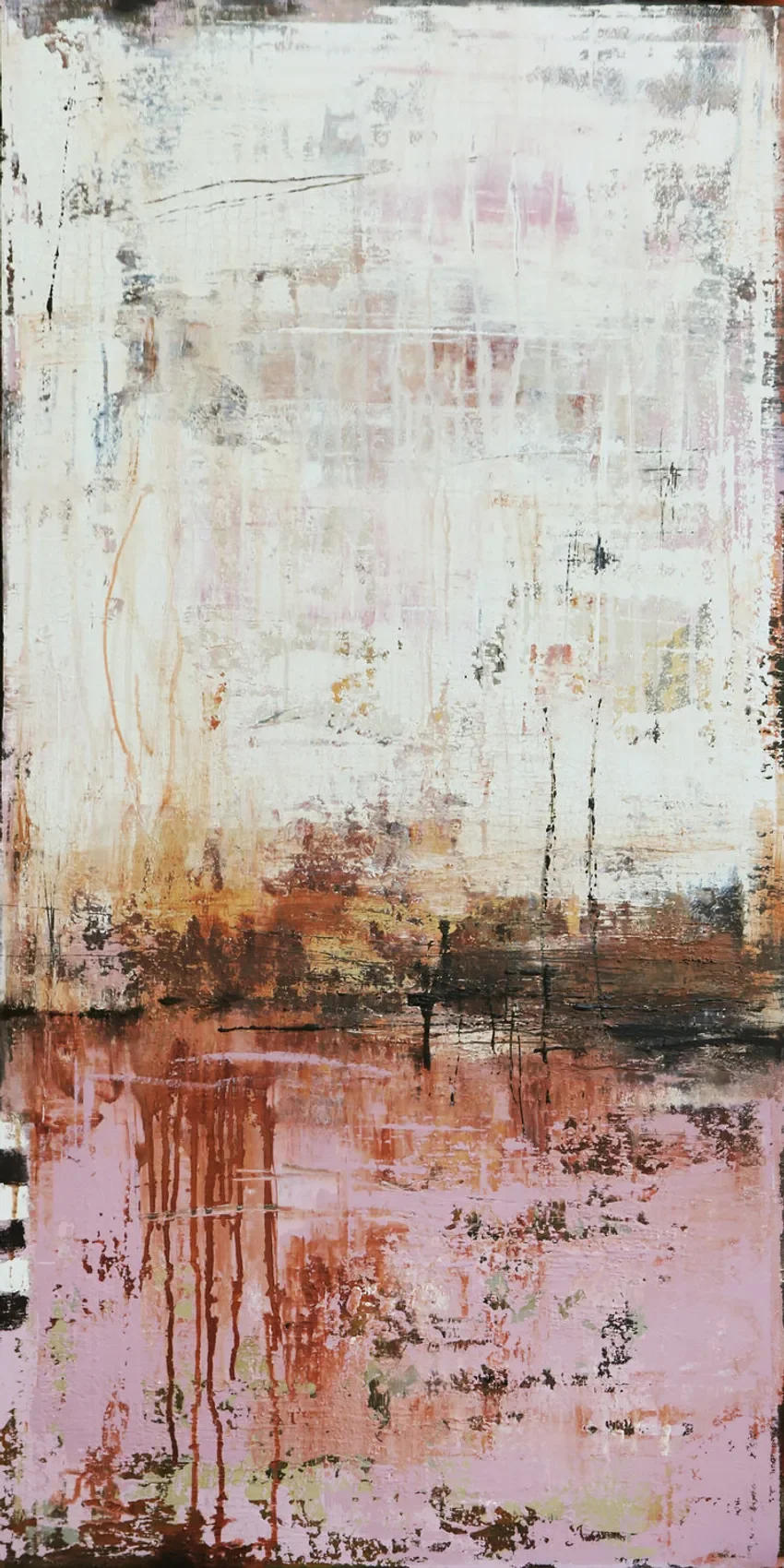
Dusty Rose, Inez Froehlich, 2025
Out of all the different ways to create art, why did you choose abstraction as your main style? What was it about this specific direction that felt like the right fit for you? And what is abstraction means to you?
Abstraction was not a strategic choice; it felt inevitable. Representation would have limited what I wanted to express. I am not interested in explaining – I am interested in opening space. For me, abstraction means freedom. Freedom in the process, and freedom for the viewer. An abstract work is not a finished statement; it is an invitation. It becomes complete only through the perception and experience of the person standing in front of it.
Could you tell us about your first exhibitions? What was it like seeing your work on a gallery wall for the first time, and how did your perspective on your own art change once you started getting feedback from the public?
Seeing my work on a gallery wall for the first time was a defining moment. Suddenly the paintings no longer belonged only to me – they entered a public dialogue. The feedback changed my perspective. Viewers often discovered elements and meanings that I had not consciously formulated. That experience deepened my understanding that art is not a monologue. It lives through exchange.
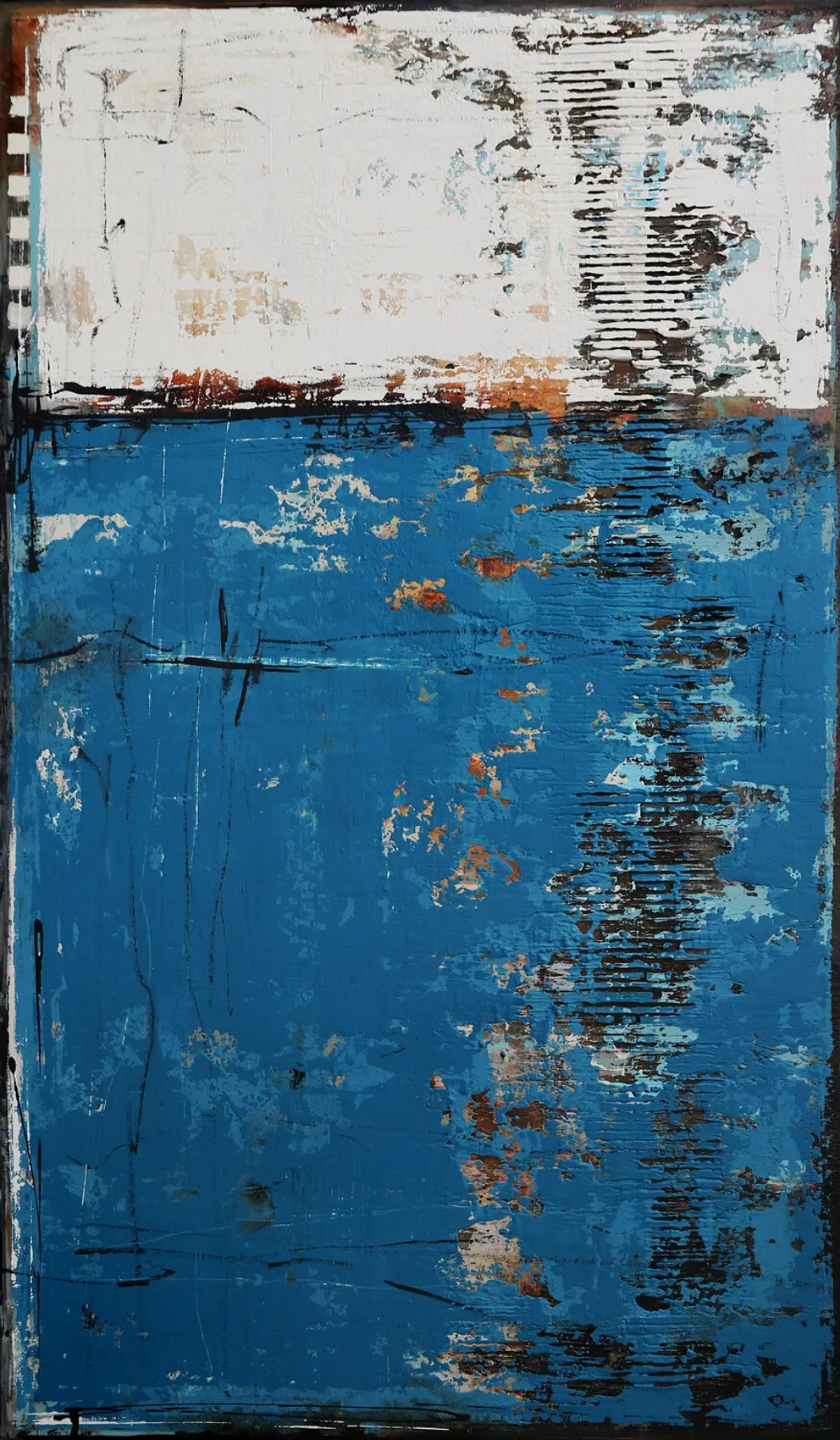
Vintage Blue, Inez Froehlich, 2025
I noticed you have three beautiful dogs (Fanny, Klaus, and Hermann) and have even featured dogs in a few of your works. Do they spend a lot of time with you in the studio while you're painting? Are they your "studio crew"? Perhaps they are the main influencers on your art? :)
Yes, they absolutely are part of my studio life. Fanny, Klaus, and Hermann bring both calm and grounding into the space. When you are deeply immersed in painting, it’s easy to lose track of time – dogs gently bring you back to the present. Are they my main artistic influence? Perhaps not directly. But they embody qualities like authenticity, instinct, and presence. And those qualities definitely find their way into my work.
And for my final question: what is the one thing you want people to take away from your work at this exhibition?
I hope visitors experience a moment of stillness. A pause. A chance to slow down and truly look. If someone leaves the exhibition feeling that they briefly entered a quiet dialogue – either with the painting or with themselves – then the work has fulfilled its purpose.
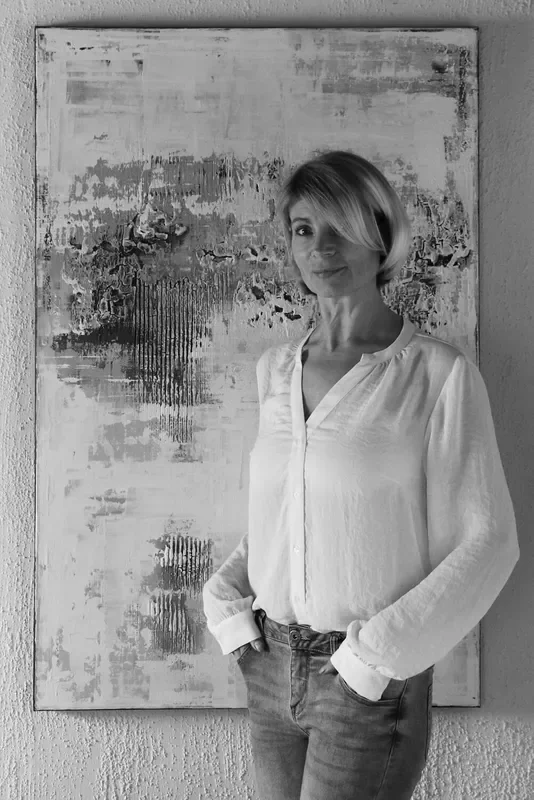
Courtesy of Inez Froehlich
Inez operates between the visible and what has already vanished. Translating the essence of a place isn't about copying what is there – it’s about knowing what to leave out. Inez absorbs the tension of these environments, filtering the noise until only the core remains. The point of her paintings is not to give us a finished interior, but a space for the viewer to bring their own decorations. While exploring these unknown realms, you need to make sure you have a way back. Luckily, three guards stay strong beside her, wet-nosed and always ready to offer a helping paw.
See more of Inez’s work on Instagram.
Article by Vasya Kavka
Based in Ukraine, Vasya Kavka is a writer working at the intersection of contemporary art and digital culture. Through his platform @ambient.delusion, he researches emerging and underground artists, publishing interviews and editorial features that move beyond aesthetics to examine context, creative process and cultural relevance. His work is driven by curiosity and a commitment to thoughtful, accessible storytelling that situates artistic practices within the broader currents shaping contemporary culture.