
WHY EVERY PAINTING IS AN ADVENTURE: A TALK WITH GIOVANNI MERCATELLI
“Every painting is an adventure and a battle, and until that battle is over, my mind is fixed on it: I think about it from morning to night.”
Giovanni Mercatelli is a young emerging artist based in Bologna, Italy although he can often be found in Key West, USA, where he continues to develop his research and artistic practice. Beginning with drawing, he has developed a distinctive painterly practice grounded in oil, acrylic, and collage on canvas. His works unfold through thick, expressive layers where figuration and abstraction collide, often incorporating cut-out figures drawn from 1960s photography. Glossy surfaces and dense gestures heighten the physicality of the canvas, while irony and melancholy intertwine in scenes poised between intimacy and quiet tension.
What follows is an unfiltered conversation with the artist; a fluid exchange that opens up his studio world, tracing the impulses, contradictions, and sensibilities that shape his work.
How and when did your inclination towards art begin?
I would say drawing is something I’ve carried with me for as long as I can remember, since I was a child. At the beginning it was simply a game: I was the one who drew on the school desks. But for me it was just a game, there wasn’t any real awareness yet. After that, I spent three years in the Netherlands studying Industrial Design, and during those rainy years I often stayed in my small room, feeling a certain melancholy, writing and drawing endlessly in my sketchbook. In the Netherlands, drawing became an emotional outlet for me. But I think it began to take shape as something I truly wanted to pursue when I moved here to Key West in 2020. I was staying with my godmother, who is a gallerist, and I had the chance to meet many artists, especially painters. I would watch them and admire them deeply. Part of me thought, “I wish I could be like that.” Perhaps I saw in them a form of freedom, or perhaps, instinctively, I simply loved what they were doing. After that period in Key West, I returned to the Netherlands to pursue a master’s degree in sustainability, and once I completed it, I realized I wanted to try, once and for all, to become a painter.
Do you feel more at ease with drawing or painting?
I’d say I actually feel comfortable with both. However, when I paint, I wish I had the same spontaneity I have when drawing, which for me is truly instinctive. It’s certainly the most immediate approach. Just having a pencil or pen on a sheet of paper, where your hand doesn’t even follow what your mind is doing… you just go. When you begin working on a canvas, everything becomes a bit more complex, because it’s no longer just about moving your hand, it almost becomes a performance. The movements are broader, you have to change colours, and everything becomes a bit slower, more amplified.
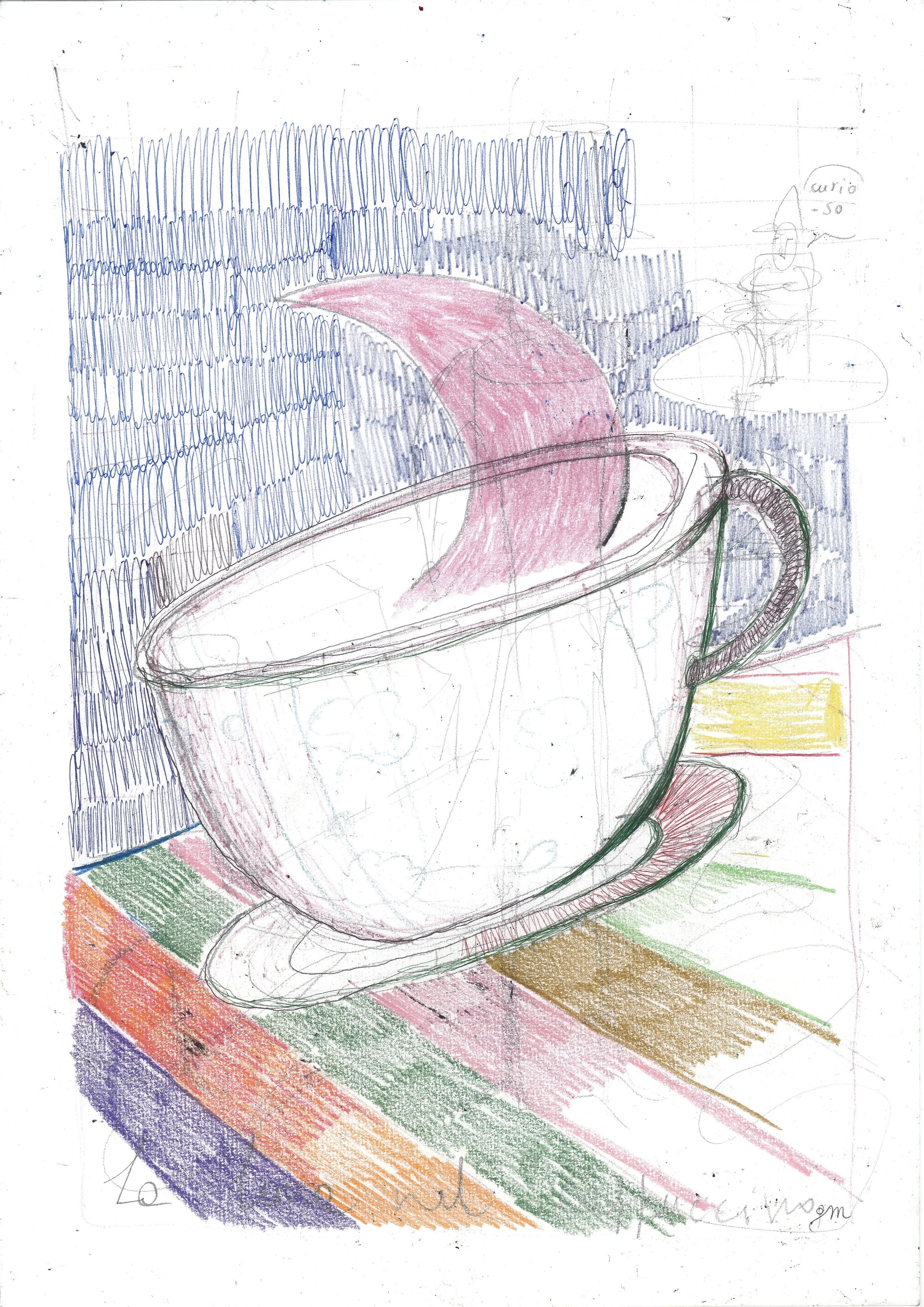
Courtesy of Giovanni Mercatelli
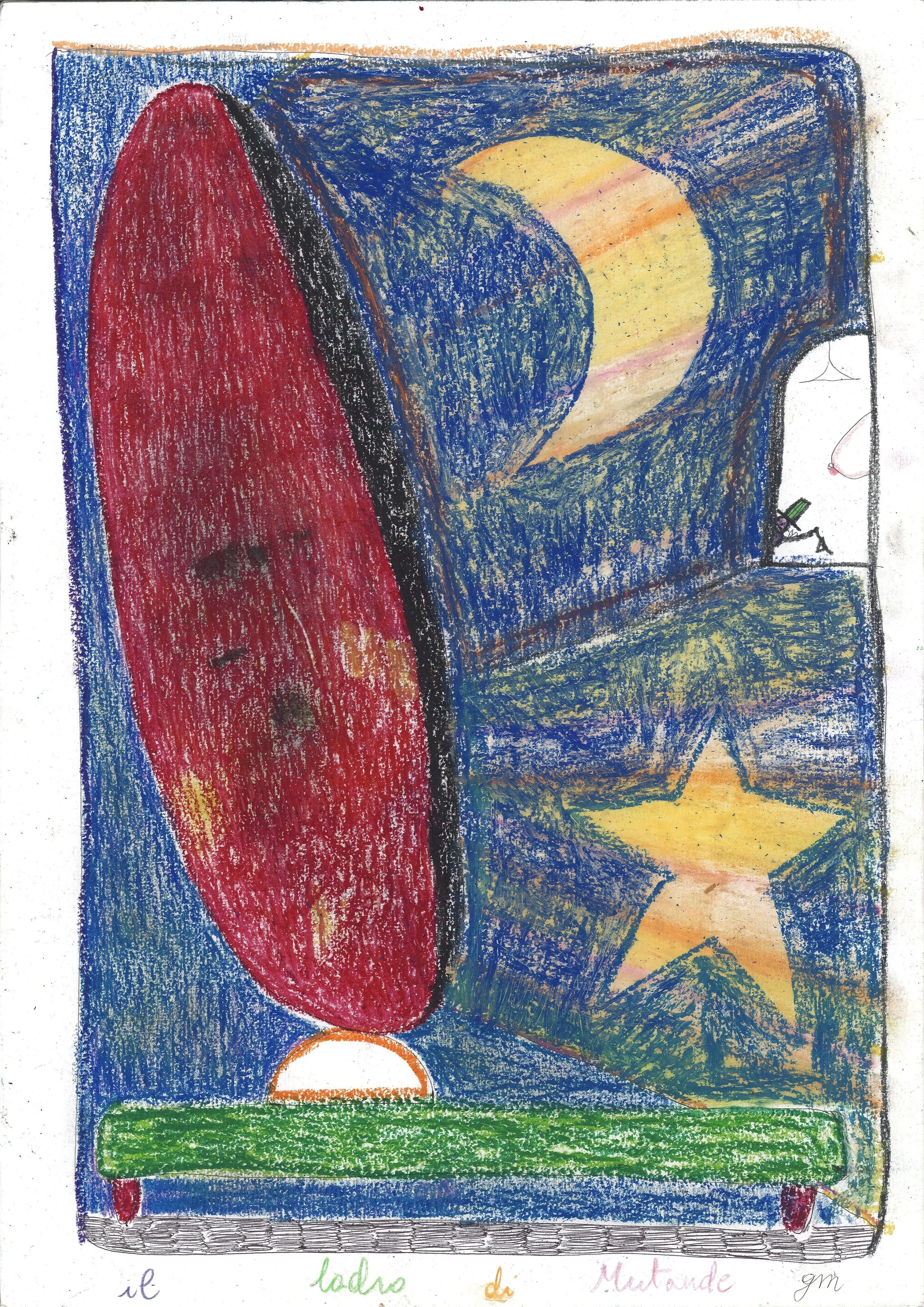
Which artists inspire you today, and what do you try to take from each of them?
There are some artists from the past and some from the present. For example, Philip Guston, a painter from the 1960s, and a contemporary artist like Tal R, a Danish painter. What I love about them is their visceral quality, they are both very instinctive painters. When I look at their works, I genuinely think I wish they were mine, that I could work like that. With Guston, I feel a strong tension every time I look at his paintings: there is great attention, yet you sense he painted “from the gut”. Tal R, on the other hand, has a more naïve, almost childlike imagery that gives me a sense of calm.
Then of course there are other great classics like Francis Bacon, whom I’ve always loved, Mark Rothko and another contemporary painter, Peter Doig. Among contemporaries, I really like the English painter Danny Fox, or Daniel Richter and Oh de Laval, I like that she is very irreverent.
How do you approach the blank canvas?
When I have a few blank canvases in front of me, I often feel a surge of enthusiasm. Maybe the day before (or even a month earlier) I made a drawing I really liked, and wanting about translating it onto canvas, or using it as a starting point. So I begin with energy: perhaps with pencil first, then pastels, gradually giving the image form.
But quite soon, I realise I’m bored. It happens almost automatically. The moment I already know where the painting is going, I lose interest, I lose that sense of adventure. For me, each painting has to feel like stepping into something unknown. I want to throw myself into a process whose outcome I can’t predict. My gestures become a continuous response to what’s happening on the canvas, and the work evolves from there. I like to think of painting as an adventure because it involves risk. Sometimes you’ve created something that is objectively quite good, but your instinct tells you it isn’t right. So you take a risk: you intervene again, you disrupt it, you enter a new phase of struggle.
Then one day you walk into the studio, look at the canvas, and think, “There it is.” You weren’t expecting it, but something has emerged, something that feels true and wonderful.
That feeling of surprise of having created something you didn’t foresee, may be the real reason I paint. Every painting is an adventure and a battle, and until that battle is over, my mind is fixed on it: I think about it from morning to night.
“As I grow, I feel the need to engage with perspective, to interpret and master it in my own way and to create this sense of depth, this invitation into the work.”
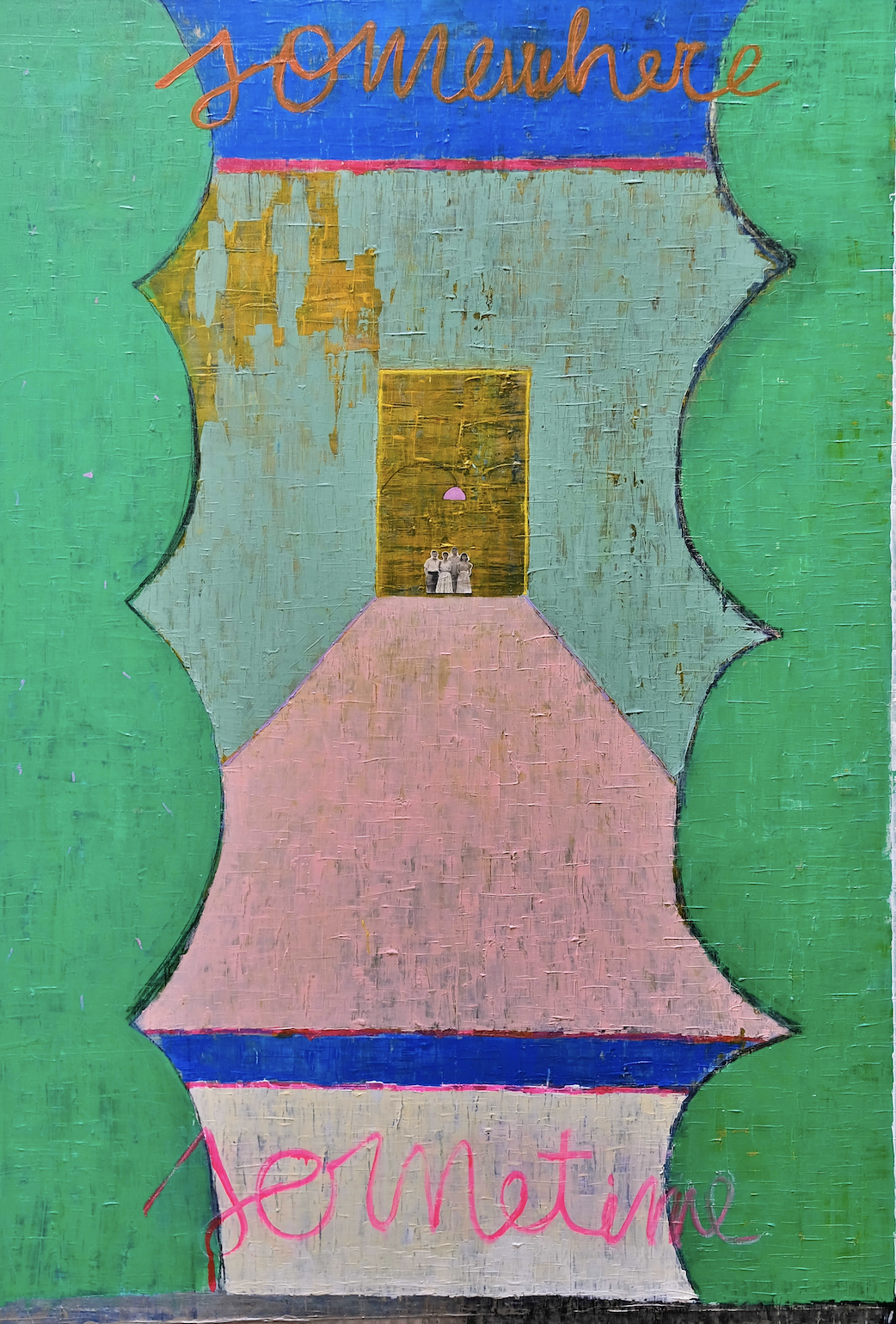
Somewhere Sometime, Giovanni Mercatelli, 2025
Since the beginning, collage has defined you. Why do you use it, and how do you see the dialogue between painting itself and the insertion of an external element?
It started quite accidentally. The first times I painted, I was in my mum’s studio: there were lots of sheets of paper around me, lots of objects, lots of materials I could use... She also used glue for the papier-mâché frames she made, and I began taking it. There were copies of Internazionale (an Italian weekly magazine) in the studio and I remember finding some black-and-white photographs that I loved. So, without overthinking it, I glued them onto the canvas. It seemed to me that they fit well, that they blended naturally with the rest of the painting. They were neither protagonists nor secondary figures: they were simply there, and it felt natural.
Over time I began paying more attention to it, until a friend’s father, who is a photographer and collector, gave me some photographs from the 1960s. Since then, I’ve been quite in love with those characters from the past, first of all for aesthetic reasons.
So from what I understand, these collage elements are always from the past, you never use contemporary photographs?
No, they’re always from the past. Always black and white. It’s as if I were nostalgic for a time I never lived through. Recently, though, I’ve realised that yes, collage is beautiful, but I don’t want to depend on it either. I’m trying to create paintings that don’t use it, in order to learn, not to keep doing the same thing or turn it into a trademark. For me, in any case, they work well with painting. I know that for some people they can feel like quite a strong contrast, but as long as it feels natural to me, I keep them.
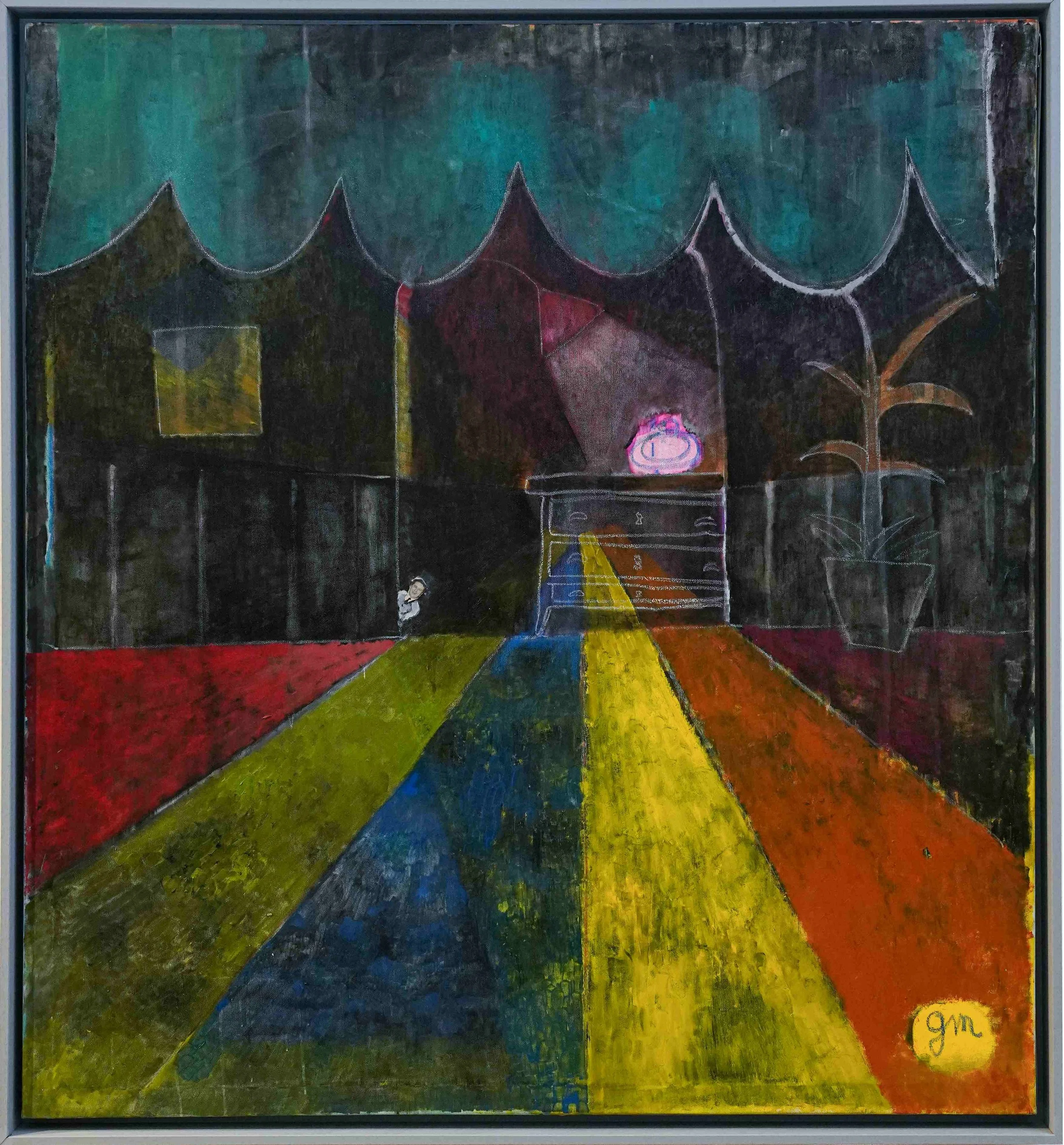
Stealing a Ring for the Love of Your Life, Giovanni Mercatelli, 2025
I noticed your earlier works were flatter, whereas now there’s a certain awareness of space. How are you exploring space, and how do you relate to it?
That’s true. Over time, I’ve realized that I’m particularly drawn to paintings that, in one way or another, allow you to enter them. Whether through perspective, or through elements like doors and windows, they create an opening a threshold. You step inside, you glimpse something beyond, or you imagine what might exist just out of sight.
The idea of entering a painting really fascinates me, and it’s something I’m consciously trying to explore. Two-dimensionality can be incredibly powerful, but I felt I didn’t want to stop there. As I grow, I feel the need to engage with perspective, to interpret and master it in my own way and to create this sense of depth, this invitation into the work.
Perhaps it offers something more: not simply an added element, but a fundamentally different visual and emotional experience.
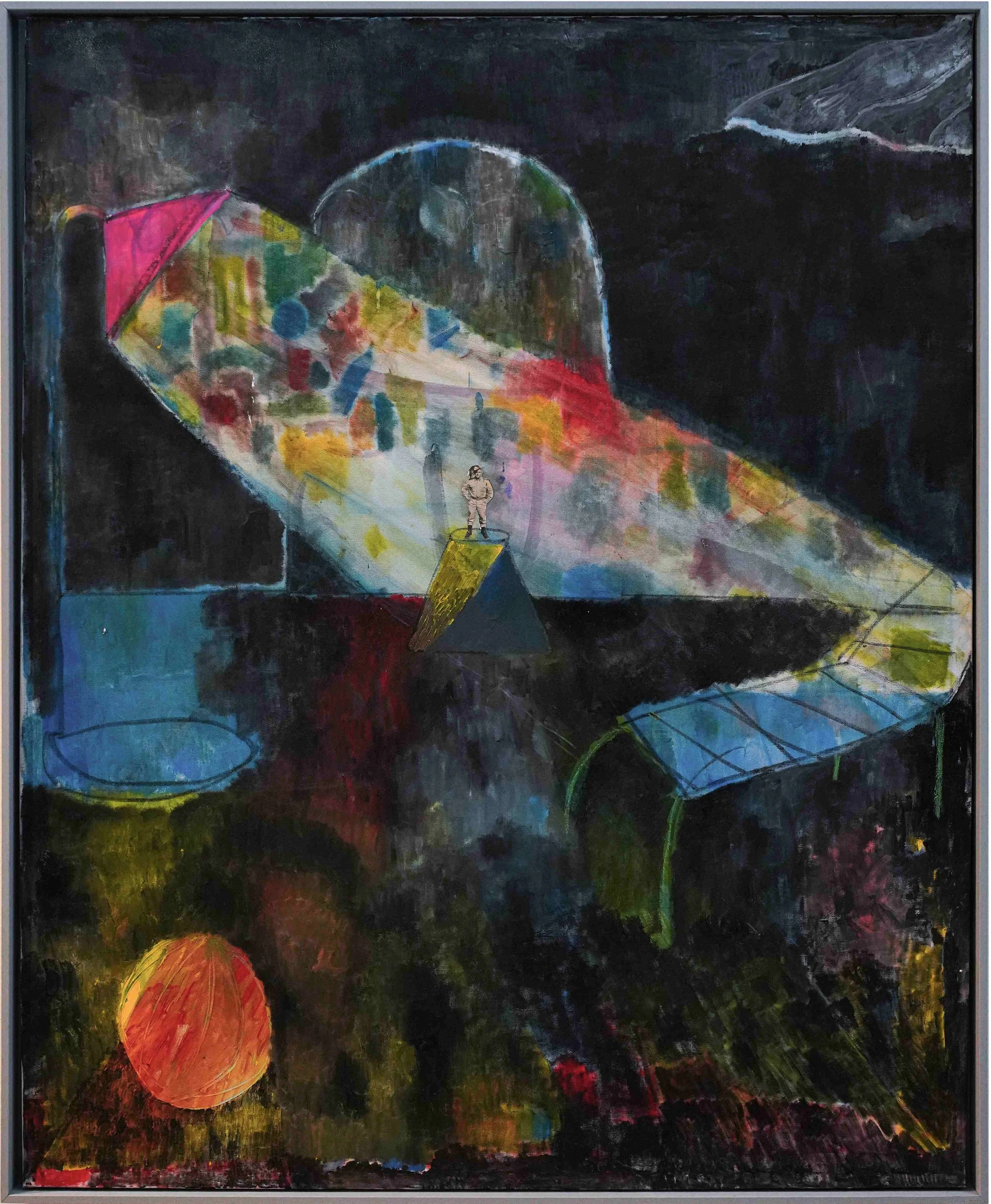
Il Bersagliere, Giovanni Mercatelli, 2025
Your most recent series is When in May. One might expect bright, light, spring-like May colours, yet they’re dark. I like this contrast, especially in works such as Il Bersagliere, Oh Dears, San Silvestro and When in May, where the darkness seems almost swept away by a burst of colour. Is this intentional?
The title When in May refers to a little cycling adventure I took last May, traveling from Merano to Bologna with my tent. I ended up by chance in Rovereto, Italy and I found the MART Museum of Modern and Contemporary Art. That day entry was free, everything felt perfect. Walking around the museum, at one point I saw a small painting by Nicola De Maria, La testa allegra di un angelo bello. It was abstract, small but very colourful, made up of many little squares that harmoniously created a beautiful scene. It really stayed with me. I thought, “When I get home, I want to try making paintings that are this colourful too.”
I had large tins of oil paint that I had never used before (in fact, this is my first series in oils; previously, I worked with acrylics). I began by creating large patches of colour, just to see what would emerge. That was the initial intention. In fact, Il Bersagliere, with that beam of light, is the first piece in the series, and it shows what the entire canvas looked like at the beginning: completely covered in patches of colour.
Then I wanted to build an image on top, but the first attempt didn’t convince me. So I took a large tin of black paint and thought I would cover all the “mess” with black. Slowly, as I covered it, I began creating this contrast between the black and the underlying colours, and I fell in love with it. I found it very strong, very stylish, and decided to continue it throughout the rest of the series. […]. I used black to create order […]. And I realised you can play a great deal with black, especially when there are contrasting colours underneath. It’s not even a pure black, it’s a dirty black. If it were pure black, it would be a wall. Instead, like this, it creates depth; it draws you into something. I like it very much for that reason: it’s a deep colour that takes you elsewhere.
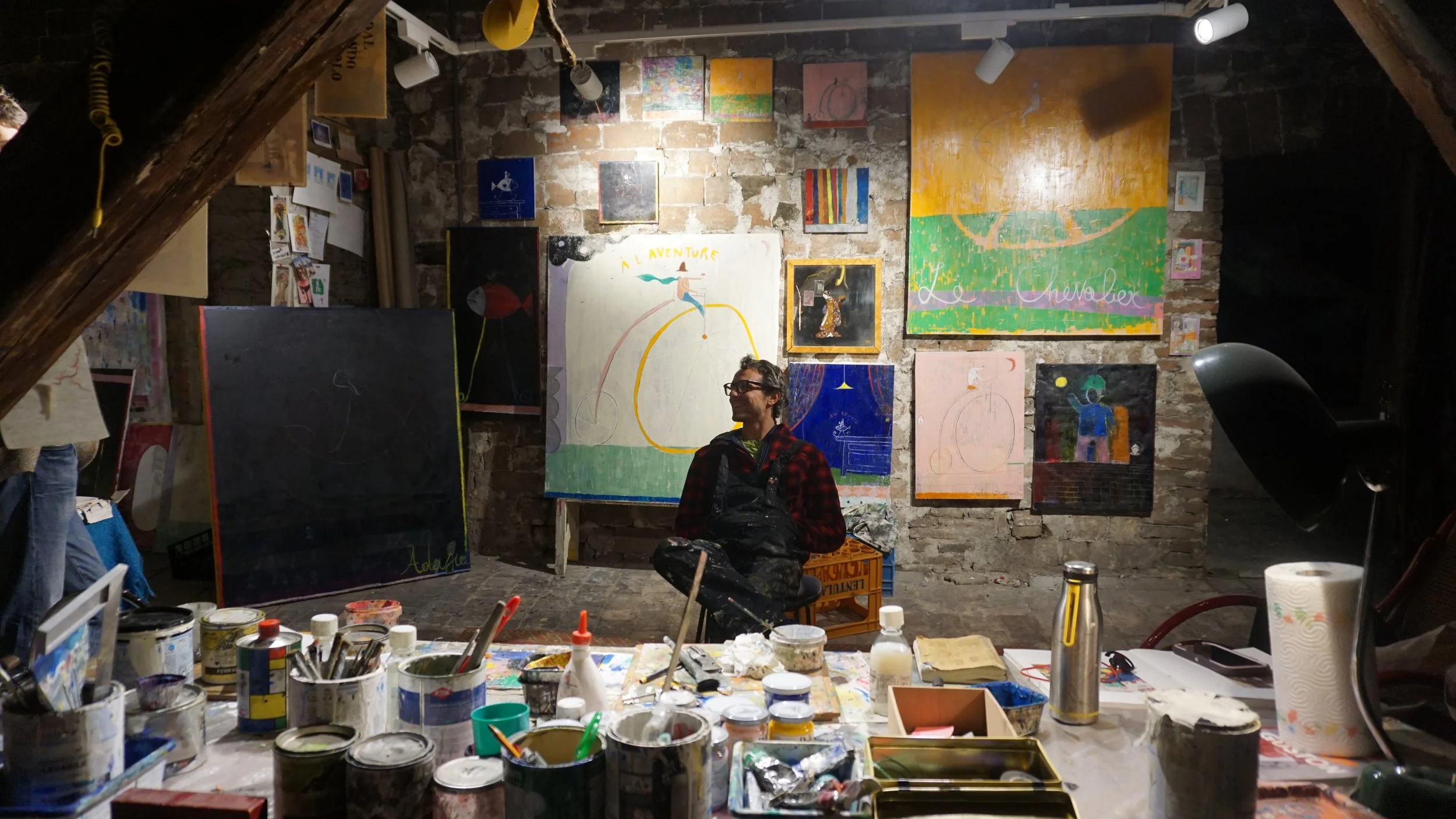
Courtesy of Giovanni Mercatelli
See more of Giovanni’s work on Instagram.
Article by Desideria Manzini
Working between Italy and France, Desideria Manzini specializes in cultural management, strategy, and communication. She has worked and collaborated with private art institutions, contributing to the development and positioning of cultural projects within an international context. Alongside her strategic practice, writing plays a central role in her work: a tool for analysis, critical reflection, and cultural interpretation. Through her texts, she explores the intersections between art, heritage, and contemporary discourse.