
A CONVERSATION WITH DOROTA ČECHOVÁ
The human longing for the unknown has always taken us to the most amazing of places. We crossed the oceans in search of new lands, we microscoped our way into the “essence” of things, and we look towards the furthest stars to try to force the expansion of the borders of our known universe.
One of the most intriguing aspects of the unknown resides within ourselves, though: that which the brain cannot conceive but that depends on it to be. The expression of this foggy area is one of the driving forces behind the work of multidisciplinary artist Dorota Čechová, who ambitiously and beautifully conceived a quasi-encyclopedic book of visualizations of different forms of synesthesia.
We discussed her work “Syn(a)esthesis: Harmony of the Senses,” in which, through the lens of her own experiences and scientific research, she proposes a range of artistic explorations of new ways to experience our senses.
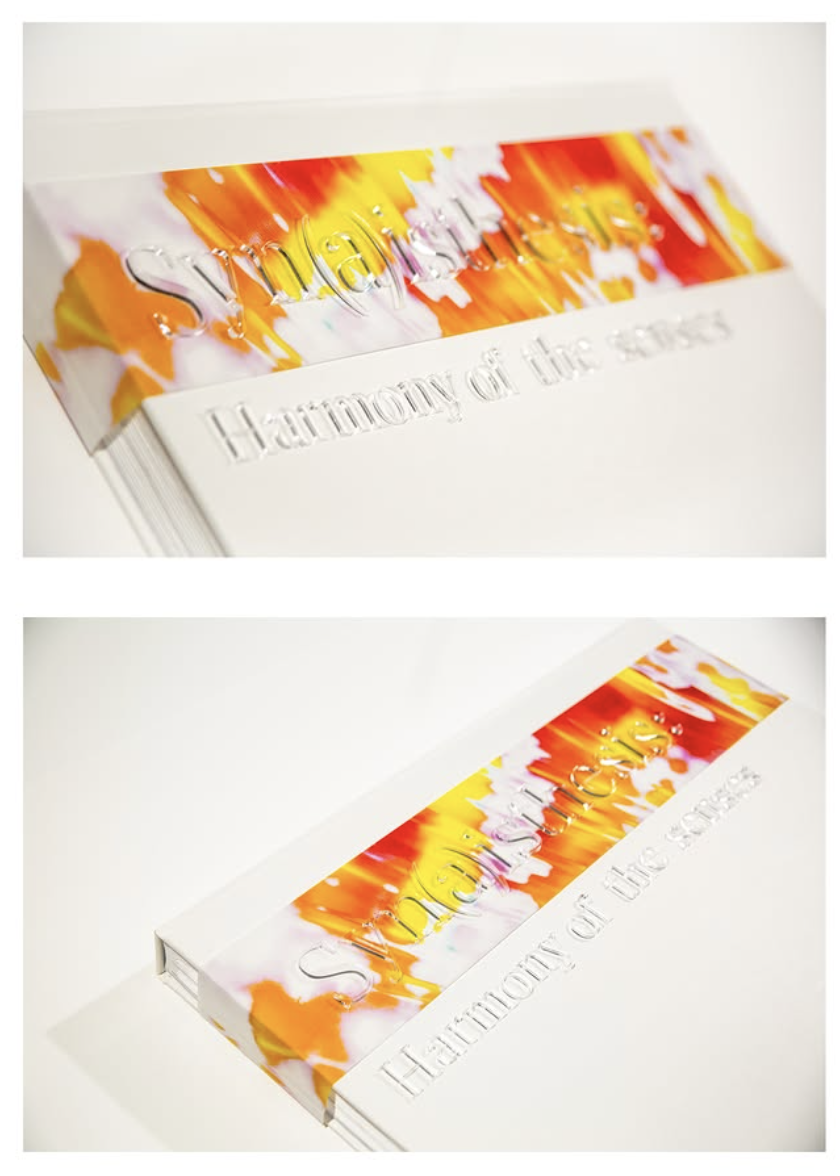
Syn(a)esthesis: Harmony of the Senses, Dorota Čechová, 2026
Renaissance art historian Giorgio Vasari considered colour as a sort of “consequence”, or a subordinated structure when in relation to drawing. We have seen, in the centuries since then, an evolution of the conception of Art in ways that turn lines/drawings around, making them a secondary idea while colour becomes the pillar of an artwork — e.g., the entire Impressionist movement. That is quite aligned to your view of colour as an indissociable force not only in your art, but in your life. Considering its connection to your perception of the world, when you decide to begin constructing an artwork, how do you structure its embryo in your head?
My practice is very much driven by process and experimentation; ideas develop gradually, moving from initial concepts, through moments of chaos and discovery, towards a more curated outcome. Usually, when I am starting a new project, whether it is in response to a brief or a personal project, I start with extensive research, collecting references, and sketching. It often takes time before the work begins to resemble its final form.
I usually let the process take over, without having a clear vision or plan for the outcome. Just a lot of making, sometimes an overwhelming amount. As the project goes on, I start curating from everything that I made, and repeat the process until the project has a clear visual direction.
Opposed to Vasari's approach, for me, colour is always in an indissociable presence. My projects in general are usually led by colour, and rather than arriving at colour after form, I often think through colour from the very beginning.
The publication Syn(a)isthesis: Harmony of the Senses is led by colour entirely, backed by neuroscience. The publication looks at colour not as the aesthetic pillar of the work, but as a projected synesthetic factor and explores the relationships between real vs projected colours (a letter A might be written in red, but I perceive it in green) based on my own perception.
Your work has a large body of processes and outcomes through pure experimentation. What was the most rewarding technique or process you have tried during the creation of your book and why?
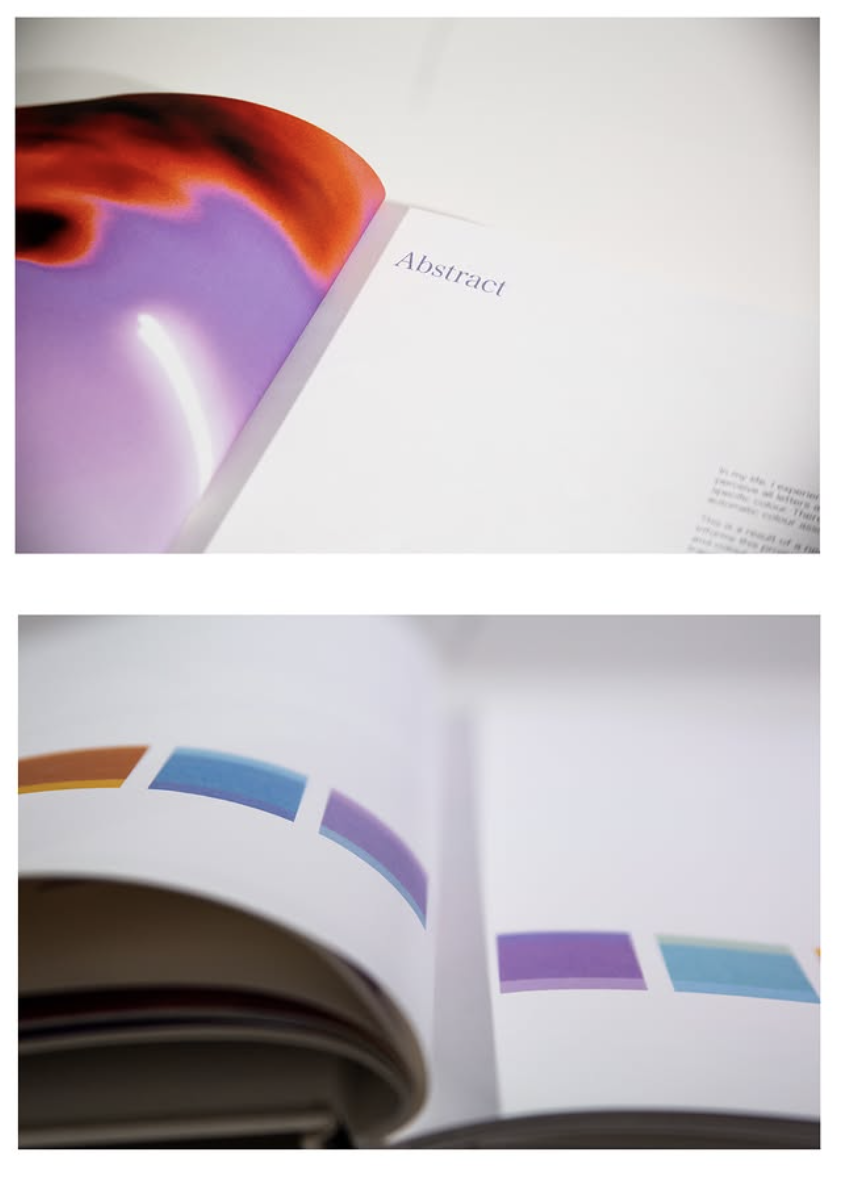
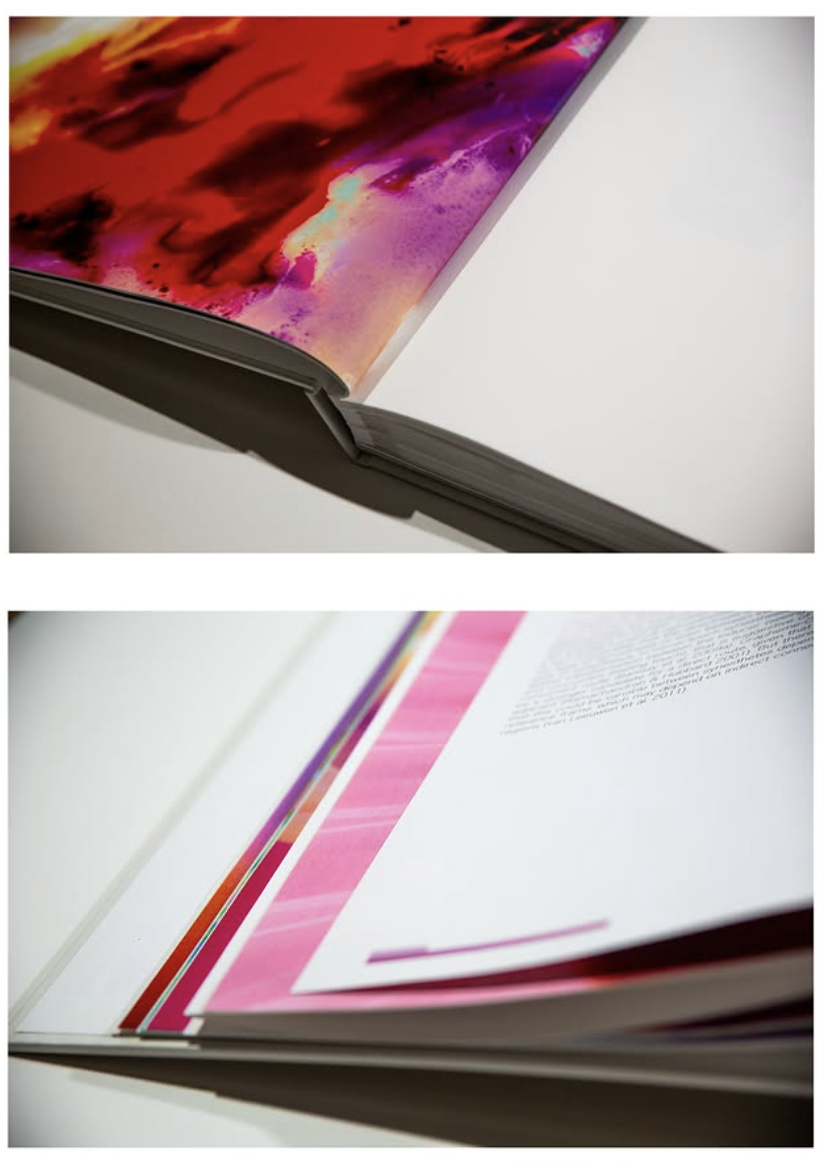
The most rewarding and at the same time most challenging technique I explored during the creation of the publication was the production of colour photograms. This is a camera-less photograph made by placing objects directly on colour photographic paper and exposing it to colour light in a darkroom. The objects which I used to create patterns were Letraset, paper cut-outs, and acrylic letter shapes. I layered these to create compositions and exposed the photographic paper to multiple colour lights on the same print.
The reason I was working with such an experimental process was to engage with colour as a projected synesthetic factor and to recreate the unpredictable, individual associations that occur with Synesthesia. This process and its outcomes, the unexpected colour combinations, type layering and position of graphemes in 2D next to each other, represent the characteristics of grapheme-colour combinations.
What made this technique particularly rewarding was its unpredictability. Factors such as the sensitivity of different photographic papers, the chemistry of the processing solutions, exposure times, filters, and aperture all influenced the final result. The outcome could never be fully controlled, meaning each print revealed new colour interactions and unexpected visual combinations, recreating the unpredictable synesthetic colour associations.
This balance between intention and chance was what made the process exciting, and made achieving varied colourful outcomes the most rewarding part of it. It is definitely still an area of ongoing research and experimentation, which I plan to build on in my practice.
Syn(a)esthesis: Harmony of the Senses, Dorota Čechová, 2026
You mention wanting to convey “multisensory experiences” through your work. Thinking more broadly about these kinds of experiences, I’m interested in learning more about a multisensory experience you've had that has impacted your life and your artistic production.
The publication investigates and visualises three types of Synesthesia, which expand into an installation beyond the page, encouraging the audience to experience it with multiple senses. Blending senses such as sight, touch and sound to recreate these experiences for the viewer.
Since the type of Synesthesia I experience (Grapheme-Colour Synesthesia) causes associations between numbers and letters to specific colours, it impacts me daily. Every letter and number has a projected colour in my subconscious, so essentially, my world is pretty colourful. People's names, days of the week, dates, phone numbers, and any written or spoken grapheme elicit a specific colour perception in my subconscious. It may sound overwhelming, but it is the only way I have always seen my surroundings, and I don't think twice about it.
What had the biggest influence on my artistic production was not the condition itself, but when I began researching it in depth. Before I started this project, I never really paid it much attention and had never fully considered how much these associations shaped my understanding of the world around me. Through the research process, I became increasingly aware that colour is embedded in the way I think and interpret information, and quite literally shapes how I perceive everything.
“Every letter and number has a projected colour in my subconscious, so essentially, my world is pretty colourful.”
There is a structural, brute-force nature to synesthesia, as with any other physical-body condition. When you say colours are embedded in your reality, I can’t help but notice a semantic direction toward it being a constant presence; nevertheless, you choose to use colour freely and with proficiency in a creative outlet. What made you feel compelled to begin creating art? Did colour seem like a natural part of creation from the start?
I tend to implement colour in my work often. Its constant presence is nothing unusual. I have grown up around the creative disciplines, such as painting, jewellery, and photography. I don't remember a time when I wasn't creating something; it has always been a way of life for me. Looking back, I have always worked with a lot of colour, which Synesthesia might have subconsciously influenced at some point, but I never actively considered that connection for most of my life. It simply felt instinctive. It was always natural for me, and my imagery and designs tended to lean towards the saturated side.
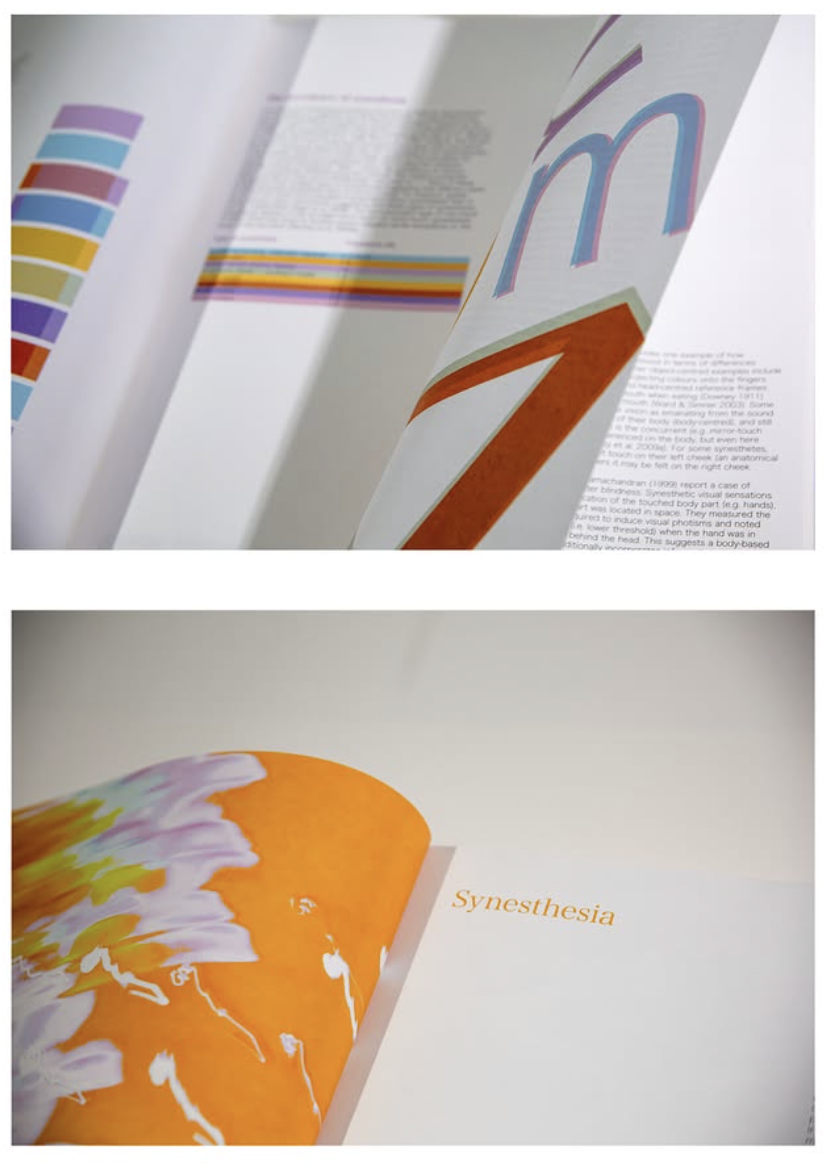
In this project specifically, the colours used — especially the Grapheme-Colour chapter — are based on a visual system of my own embedded projections. It breaks down my experience of colour associations, translating them into systems and figures, examining their characteristics in relation to each other. The project allowed me to move from intuitively working with colour to consciously investigating it as both a scientific and creative framework.
I have a neurological condition which has intervened in everything. Through the process of coming to terms with my diagnosis, it took a long time to be able to sort of twist it in a way that would allow me to create something from the principles of this bodily affection. The processing of my senses and my experiences goes through this machine that is fundamentally operating in a sort of permanent hyperawareness of the Heideggerian uncanny space, as if I am always here but not entirely. From my perception as an observer, your desire to create visualizations of synesthesia does not seem to come from a place of anxiety but expresses this sort of “separation” between your experience of things/objects and others’ (including other people with synesthesia). It is encyclopedic, as scientific as it is artistic, but it has an emotional undercurrent as it includes, and seems to stem from, your personal synesthetic experience of being. What do you want your observer to experience and grasp when viewing it?
I am aware that learning about, understanding, and essentially creating something out of an experienced neurological condition is not an easy task. In my experience, it is quite conceptual and requires a lot of understanding of science to produce an outcome that accurately demonstrates your experience to others.
As you mentioned, this publication does not stem from a place of anxiety, while I have never necessarily experienced a negative experience through the type of Synesthesia I have. The worst thing I experience is when a place, a person's name or a number has an 'ugly' colour association to me that I can't unsee.
So while the publication does stem from a personal experience and would not exist without one, my goal was to research two more types of Synesthesia beyond my experience, namely the Auditory-Tactile Synesthesia and Sound-Colour Synesthesia. Each of these is explained and visualised through a different experimental process.
The aim of this project is to educate and inform the audience about the neurology behind Synesthesia through its scientific contexts and research material by researchers such as Jamie Ward and others. It also allows the audience to see, experience, and visually step into a synesthetic perceptual reality through its installation format. Be present in a reality that a synesthete would experience in their head.
I have also created this work for individuals with lived synesthetic experiences who are not familiar with the neurological and scientific frameworks surrounding the condition, as well as viewers who may have no prior knowledge of Synesthesia, as it incorporates educational, visual, and interactive elements that encourage a broader understanding of the subject from multiple perspectives.
I hope the observer leaves the project with a sense of excitement and inspiration, as it is ultimately intended to be a celebration of Synesthesia.
Syn(a)esthesis: Harmony of the Senses, Dorota Čechová, 2026
Have you ever considered how your art would be if you did not have synesthesia? What differences, technical and personal, do you believe would weigh the most in terms of process and result?
I have always implemented a lot of colour in my work, which might have been a subconscious influence of Synesthesia. When starting a project, even the word "art" itself appears as a mixture of three colours to me. So when brainstorming and thinking about concepts for art, the colours are flowing and creating colour palettes in my head, and I might subconsciously borrow from/develop on them.
Even when I label my calendar or a to-do list for a project I am working on, it is organised in the perceived colour combinations, so every minor part of a creative process for me is influenced by this condition.
I believe that if I didn't experience these daily events of colour projections, and wasn't used to it being essentially everywhere at all times, I would be compelled to use it less in my own work, and potentially find it too overwhelming. The hues, layers and saturation never seem like 'too much' for me; sometimes I have to take a step back and am told that what I am creating is too much colour. I am just used to being around it, which causes me not to find it unusual.
I feel that without Synesthesia, my world and work would be more minimalistic and less colourful. However, it does not seem like that will be something I will ever experience, and I am not complaining.
Syn(a)esthesis: Harmony of the Senses, Dorota Čechová, 2026
See more of Dorota’s work on her Instagram.
Article by Ananda Muylaert
A Paris-based multidisciplinary artist and researcher on the phenomenology of painting, she has produced an extensive body of work in art, music, and poetry. Her artworks and published research on philosophy, essays and poetry have been presented and published in four languages across two continents.
Her artistic practice revolves around the search for rationality in animality (and vice versa) and an infatuation with organic texture, both inside and outside the flesh. More so, there's a desire to portray the relationship of the urban Self with the world around it truthfully, through the worst transgressions and most devastating desertions caused by the domestication of the Human species.
Her previous work experience includes working at the Musée Grand Palais, in Paris, and the Federal Cultural Center of Heritage Paço Imperial in Rio de Janeiro, Brazil, where she worked closely with prestigious institutions such as the Institut Goethe, the Instituto Moreira Salles, and the embassies of France, Japan, and China.