
THE SPACE BETWEEN: DIEGO HERMAN ON FENCES, BELONGING AND THE POLITICS OF LANDSCAPE
Belgian-Mexican artist Diego Herman approaches painting through the spaces we inhabit, divide and attempt to make our own. Fences, roadside landscapes, vegetation and captive animals become recurring subjects through which he explores belonging, displacement and the uneasy boundaries between humans and nature. Moving between traditional oil painting and experimental processes involving spray paint, imprints and thermal imagery, Herman is interested in what happens when apparently ordinary spaces begin to reveal something more personal - and more political. In this conversation, he reflects on the autobiographical nature of his practice, his fascination with fences and liminal spaces, the seductive violence of thermal imagery, and the search for a place to belong.
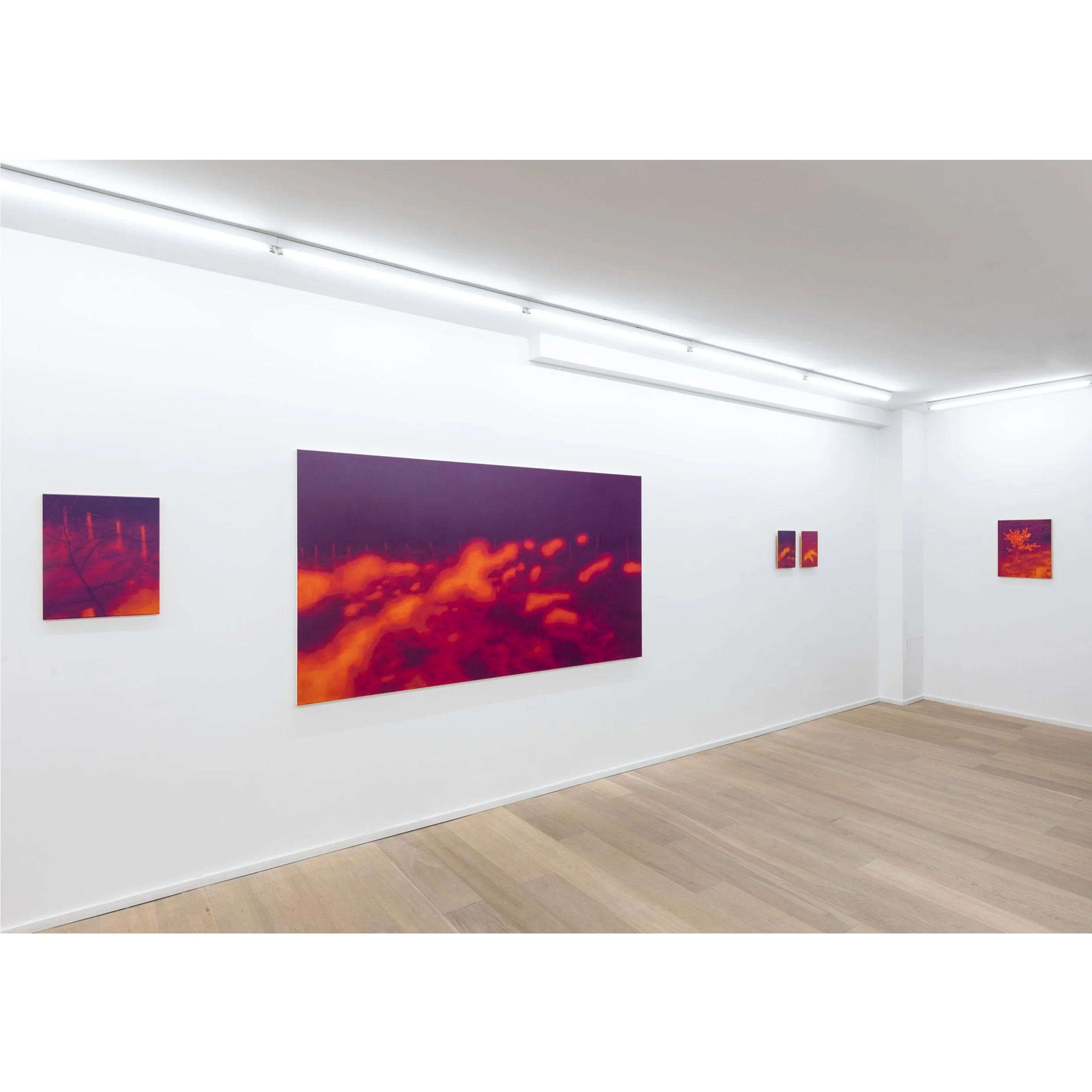
Exhibition view of Diego Herman’s works
You have described your paintings as representations of a “globalised landscape”, while tracing their underlying sense of displacement to growing up in a Belgian-Mexican household. At what point does an apparently anonymous landscape—a lawn, roadside or industrial enclosure—become autobiographical?
I think there are really two parts to that: the idea of a globalised landscape, and the autobiographical aspect. They are connected. In my earlier work, I started noticing things that felt universal. I try to make my paintings understandable to as many people as possible, and one way of doing that is to erase what makes a place immediately recognisable. I like nightscapes, city lights and spaces where you cannot immediately say, “Of course, I know this place.” A house might be suggested by its shape, but it is not specific to one location.
The same is true of the objects I paint. I used to paint those white monobloc plastic chairs, which I had seen everywhere. You find them in Mexico, in Belgium and in many other places. They have a personality, but they are also universal. Everyone recognises them and many people have memories of them. I find that interesting: taking something that might seem blank or banal and painting it as part of a shared experience. The same applies to industrial objects and ordinary fragments of landscape—a roadside, a lamp post, a piece of pavement, a fence. They are not tied to one particular place, and that is part of what fascinates me.
At the same time, the paintings are autobiographical because I paint what I see around me. If I travel, I will paint what I see there. Things I encounter in Mexico and things I encounter in Belgium end up mixed together in the painting, so the final image becomes a kind of fiction: my fiction. The more I painted landscapes, the more they became simplified, with fewer people, until I was concentrating on how space itself is divided. Only later, by looking back at what I had done, did I realise that it was connected to my own experience.
I am part Mexican and part Belgian, but I never really felt that I belonged completely to one place. In Belgium, I am always the Mexican; in Mexico, I am always the Belgian. I also dislike the idea that I am simply “half” of each. I am 100% Mexican and 100% Belgian. Painting helped me understand that. Very often, I only realise what something means to me after I have painted it. I go from intellect to instinct and back to intellect, and sometimes the painting tells me something about myself that I did not understand before. That is why, although the work is autobiographical, I do not want it to become narcissistic. It has to mean something to other people too.
The fence has become one of the most persistent motifs in your work: an everyday object that can suggest property, protection, exclusion or control. How do you prevent such a politically charged symbol from becoming too fixed or illustrative?
I think the key is that I do not want the fence to have only one meaning. A fence can suggest protection, property, exclusion, control, war, greed or even love—something you want to protect. There is one physical object, but there are many reasons for building it. That ambiguity is important to me.
I also came to painting through illustration, so I have had to think a lot about what it means for an image to be illustrative. Illustration is often treated almost as a negative word in the art world: if an image is immediately readable, people can say it is too illustrative. But I had to make peace with that because illustration is where I learned drawing, colour and technique. I do not think a painting should be afraid of being readable. I am more interested in how you play with readability.
With the fence imprints, for example, I use an actual fence in nature as a kind of stencil. The final painting therefore carries the physical trace of that specific encounter: the wrinkles in the fabric, the drips, the blurred areas, the materiality of the paint. At the same time, it is still about fences in general. That physical encounter helps prevent the image from becoming simply an illustration of an idea. When I paint animals, I also often reduce them to silhouettes rather than giving them detailed faces, so they become more ghostly and less literal.
But I am not trying to avoid illustration at all costs. I think we are allowed to do anything in painting. The painters I admire make you feel that there are no limits. Sometimes you need to make a bad painting and then try to fix it. If everything goes exactly as planned, there is no accident and no risk. I like a painting in which you can feel that the painter risked something. The mistakes are often the best parts. You make them, then decide which ones to keep and which ones to cover. There is a balance.
I also have this rule that the earlier you can stop a painting, the better, because the most important things are often there first. You could continue painting forever, but at some point you have to let the work exist.

Yellow heartbreak, 2024, 140 x 250 cm, mixed media on canvas, Diego Herman
Although human figures are largely absent from your paintings, you describe landscape as a political subject—one that reveals how people occupy and divide space. Can absence communicate something about contemporary society that the direct representation of the body cannot?
For me, landscape can actually fulfil the role of a portrait—sometimes more effectively than a portrait itself. A portrait gives you someone's physical appearance, but it does not necessarily tell you how they live, what they think or what they do in the world. Landscape can reveal those things because it shows how people occupy and organise space.
That is why the absence of the human figure is useful. The fence is a human action, a construction that divides one space into two. Once you draw that line, you have a “here” and a “there”, and you create a stranger on the other side. Without the division, there is no stranger in quite the same way. Of course, there are situations in which boundaries can be justified, but when I look at fences I very often feel that they do more wrong than good. They can be built out of fear, greed, war or the desire to protect something, and that makes the symbol ambiguous rather than purely political in one direction.
There is also something autobiographical in the fence for me. I am the meeting point of two cultures, my mother's side and my father's side. I sometimes think of the fence as a self-portrait because it is neither on one side nor the other: it exists in the middle. And unlike a completely solid wall, a fence is not entirely hermetic. Plants can grow through it; insects can pass through it. You can often see through it. So it can be an obstacle and, at the same time, a kind of connection.
That is also why I am interested in liminal spaces—highways, corridors, places that are not particularly beautiful or specific, places that seem to belong to no one. I feel strangely comfortable there. They are in between. Maybe that is a kind of no-man's-land where I feel I belong. The more I paint these spaces, the more I discover that I am not only interested in the fence itself, but in what the fence says about our human need to divide the world.
In your recent exhibition Alone Together, your attention appeared to shift from structures of enclosure towards the animals and plants contained within them. Did this change your own position as a painter—from observing a boundary to attempting a form of identification with what lies behind it?
My position as a painter did not really change, but my sight shifted. In the earlier work, I was looking at the fence quite literally. I was interested in it as an object: the different forms it can take, from beautiful to ugly and aggressive, while still serving the same basic function. It became almost a collection of fences.
Then I started looking more at what was behind the fence. That led me to thermal cameras and eventually to photographing animals in the zoo. The connection was partly technical and partly conceptual. Thermal imaging was developed by the arming industry for war and surveillance; it's also used by hunters. It's used to track living bodies and kill them. It's also used a lot on international borders for surveillance and control.
I went to the zoo in Antwerp and photographed crocodiles, elephants, deer, wolves and apes. The animals were obviously enclosed, often by wire fences, so I was looking at both the visible boundary and what it contained. The thermal imagery also changed the way I could represent them. Instead of seeing an animal simply as an individual body, you see warmth and energy. You see something alive.
That was interesting to me because I do identify with some of these subjects, even though I do not begin a painting thinking, “This is me.” It happens afterwards. A wild animal in a cage or an exotic plant can suddenly feel connected to my own questions about movement, belonging and restriction. But I do not want to reduce everything to my own biography. It is more that the work gives me a way of thinking about those questions through other forms of life.
The palette is also part of that shift. The thermal colours are visually attractive because they create strong contrasts between very bright and very dark areas, while the warmth of the colours can feel almost comforting. I like that contradiction: the technology has a violent history, yet it produces beautiful images, just as a fence can create a beautiful geometric pattern. That tension between beauty and violence is something I want to keep in the work.
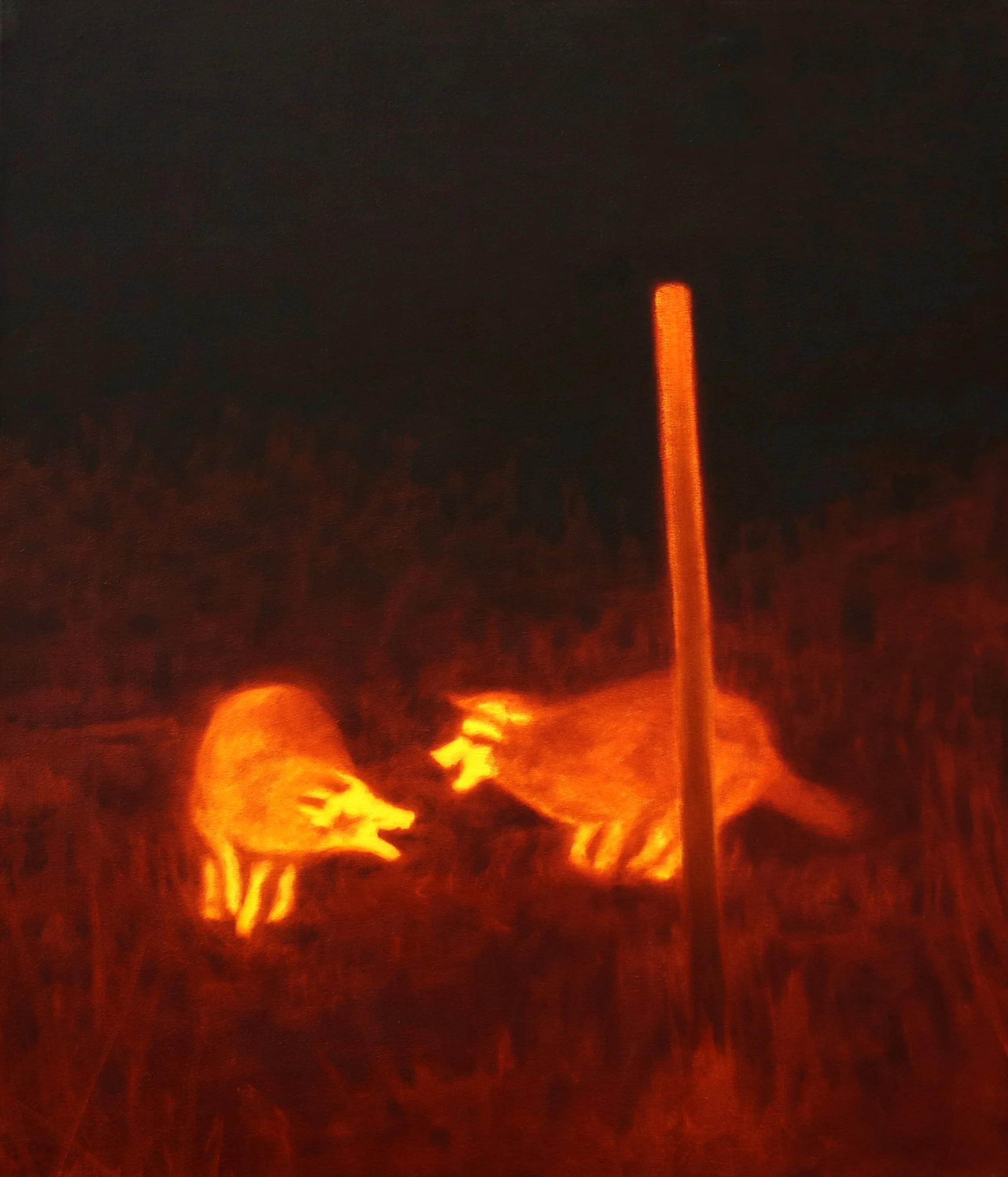
Huge Coyote Problem, 2025, 72x62 cm, oil on canvas, Diego Herman
Several recent compositions adopt a low, almost animal perspective, as though the human world were being observed by something that cannot fully enter it. Does this viewpoint allow you to move beyond the human gaze, or do these animals inevitably become projections of human experiences such as loneliness, displacement and belonging?
The low point of view actually began as a technical consequence of the imprint series. Because I have to find a real fence and use it as a stencil, everything is done at ground level. The paintings are effectively at a one-to-one scale with the fence. That often leaves a lot of space at the bottom for grass and vegetation, and I noticed that this automatically created a very low viewpoint. Once I saw the effect, I started using it deliberately.
It also came from photographing fences very close to the ground, so that the fence is set against the sky. There is something slightly funny about that tension: a fence is supposed to divide space, while the sky is the opposite of that. You cannot really divide it. From there, I became more interested in asking how nature might perceive human activity. How do wild plants and animals experience these borders? A small animal, a frog or a mouse, has a completely different relationship to the same fence.
I like that the low viewpoint can feel almost non-human. In Dutch, there is a word for this kind of perspective that refers to the viewpoint of a frog; in French, we have the more technical term contre-plongée. I like the less technical idea because it suggests that maybe you are seeing the world from another form of life. That gives me some relief.
A larger idea running through much of my work is that humans are not everything. The fence is a very human-centred way of thinking about life: dividing, controlling, assigning territory. But there is life everywhere around it, and it does not necessarily follow those divisions. Plants grow through fences; animals move around them.
I also love the visual effect. The lower viewpoint allows me to paint more sky, while keeping the dense vegetation close to the viewer. I like the contrast between transparent and opaque layers, between the gestural parts and the blocked, almost solid skies. I do not want to make the scene too illustrative.
Your artificial colours refer partly to thermal-imaging technologies associated with warfare, hunting and surveillance. What interests you about translating a technology designed to detect and target bodies into the slow, tactile and potentially seductive medium of painting?
It is actually difficult to say that I am interested in thermal imaging as such, because it happened almost accidentally. I did not set out to make beautiful images from violent technology. Sometimes I even feel uncomfortable about that. There is something troubling about taking a technology associated with warfare, hunting and surveillance and turning it into something beautiful. Human beings and animals should not be treated as prey.
At the same time, I did not want to paint violence literally. The starting point for this work was a hunting video featuring a coyote. I was shocked and disgusted by it. I had a choice: I could paint the dead coyote, or I could paint the animal one second before it was shot. I chose the second. You cannot necessarily tell from the painting that the animal is about to die, so I am representing life rather than the spectacle of death.
That is one of the things I find compelling about thermal imagery. It is basically a thermometer that happens to produce an image. What you see is temperature, and therefore energy. You are not only seeing the animal as a shape; you are seeing warmth and life. Humans would appear the same way. We have different forms, but we are all flesh and warmth. In that sense, the image can make the differences between species feel less important.
There is also a sense of vulnerability and disappearance. Thermal cameras are designed to detect things from a distance, and the bright bodies can appear almost ghostly. I sometimes blur the edges of my painted forms so that they feel as though they are radiating warmth and could vanish.
So the seduction is real, but it is also part of the problem. I do not want beauty to erase the violence behind the technology. I am interested in keeping that contradiction visible: something can be formally beautiful and still carry a disturbing history.
“I am 100% Mexican and 100% Belgian. Painting helped me understand that.”

What does it feel like to belong, 2023, 75x62 cm, oil on canvas, Diego Herman
Your practice moves between oil painting and more experimental processes involving spray paint, printing and unprimed cotton. How does this tension between the handmade and the mechanically transferred affect your understanding of what a contemporary painting can be?
I have a very traditional technical background. I studied painting at the Academy of Fine Arts in Brussels, where we learned the classical foundations: how to stretch a canvas, prepare a surface, work with materials and understand how different layers of paint behave. That matters to me because I think that, if you want to experiment with technique, it helps to know how to build a painting properly first.
We do not always know how contemporary materials will age. Acrylic painting, for example, is still relatively young compared with Renaissance techniques, which we know can survive for centuries. So I am quite conscious of the technical side of painting and of the need for a work to hold together materially.
But knowing the rules does not mean I want to follow them rigidly. What I love in painting is precisely the feeling that anything is allowed. That includes mixing techniques. I can combine oil, acrylic, spray paint, printing and unprimed cotton. Each process creates a different texture, a different way of writing or marking the surface, and I want those different languages to coexist in the same painting.
The imprint series is a good example. I can ask myself what the spray-paint transfer contributes: Can it be the subject? Can it function as a background? What happens if I combine the wrinkles of the fabric with oil paint or another technique? The interesting part is creating a kind of controlled chaos and then making it hold together.
That is also why I would still choose the same academic training. I wanted to learn the classical way of constructing a painting so that I could then experiment with it, rather than experiment without knowing what the consequences would be. For me, contemporary painting does not need to abandon craftsmanship in order to be experimental. The two can create something richer together.

Waiting for Everyone to Leave, 2025, 70x60 cm, mixed media on canvas, Diego Herman
In 2025, your work appeared alongside that of 73 other artists in S.M.A.K.’s survey Painting After Painting. Did seeing your paintings within such a broad account of contemporary painting in Belgium alter how you understand your own position—particularly as an artist whose work resists the idea of belonging to a single place?
Being included in Painting After Painting was a real surprise. I did not know about the exhibition before it happened, and my impression was that I may have been added later in the selection. If that was the case, I can take it as a compliment: perhaps the curators saw the work and liked it enough to include it. Still, my first reaction was almost disbelief—why me? I did not necessarily see myself as someone who would belong in a survey like that, even though I am Belgian and I am a painter.
At the same time, it was a great honour. Painting has such a strong history in Belgium and especially in Flanders, so being part of a major survey of contemporary painting felt significant. I also appreciated the diversity of the exhibition and seeing my work alongside artists I personally admire. You obviously ca nnot like everything in a survey of 73 artists, but I thought the overall quality was very strong.
The exhibition also had a concrete effect on my practice. It gave me visibility and a certain credibility, and I think it was probably the moment when I started to take myself more seriously as a painter. My gallery could refer to the exhibition when presenting my work, and the exhibition publication gave the show a life beyond the museum. So there was definitely a before and an after.
But the question of belonging is still complicated for me. Growing up with mixed heritage, people often describe you as 50/50, and I dislike what that formulation implies. It can make you feel that you are somehow not fully Belgian or fully Mexican. For me, it is the opposite: I am 100% Belgian and 100% Mexican. I do not feel that I belong exclusively to one place, but that does not mean that I do not want to belong. In fact, I think the whole body of my work is driven by precisely that need—to find the place where I belong.
That is why the work can sit within a Belgian survey and, in my mind, could also sit within a Mexican exhibition of contemporary painting. The search for belonging is not solved by choosing one side. It is a journey, and I do not think I will ever completely reach the end of it. Maybe painting is partly a way of making peace with that.
Portrait of Diego Herman
To further explore Diego Herman’s practice, visit his website and follow him on Instagram. The artist is represented by Husk Gallery Brussels.
Article by Alexandra Vîstraș
Alexandra Vîstraș is a Brussels-based cultural observer, policy professional and lifelong theatre enthusiast. With a background spanning cultural management, European policy and communications, she is interested in the ways art, politics and collective imagination intersect, particularly through the lenses of gender, identity and social change.