
In Willehad Eilers’s paintings, pleasure rarely remains innocent for long. Scenes of leisure, celebration and desire unfold with a disarming familiarity, yet something in their loose, restless lines unsettles the promise of happiness. Working across painting, drawing, video and performance, Eilers—also known as Wayne Horse—examines the contradictions of contemporary life without claiming the position of an impartial observer. Instead, he embraces the distortions of his own perspective, finding in human imperfection a form of resistance to a world increasingly organised around efficiency, mastery and control. His paintings become what he calls “moral battlegrounds”: spaces in which humour sharpens into a tool of survival, paradise turns against its inhabitants, and failure reveals its unexpected riches.

The Life and Death of Life and Death, Willehad Eilers, 2026
Oil on canvas; 200x275cm
Image courtesy of the artist
“Mein kleiner Helfer”
Image courtesy of the artist
You work under both Willehad Eilers and Wayne Horse—two names that seem to suggest rather different kinds of artistic identities. Does moving between them still affect the way you work, or have the two personas gradually become indistinguishable?
I grew up in the graffiti scene. Having a different artistic identity is a must if you don’t want to get caught. Later, when I focused on animation and videoclips, even though now unnecessary, the different identity stuck.
My good friend Sixten Lee Diamond Trash gave me this name. In fact, not this name. He gave me the name Wayne Mc Steal. Later that turned into Wayne Champagne, then, the more realistic Wayne Lambrusco, for a while Wayne Lacrosse, which I still think is a great name, and eventually it settled on Wayne Horse.
I do not have the feeling I need the alias anymore, but neither am I bothered by it. Horses are glorious animals. These days I do not choose to use either name for anything in specific, but rather let the occasion choose.
To answer your question, the way I work is no longer influenced by the name I work under at the given moment.
Your images often begin with recognisable situations—social gatherings, desire, leisure, celebration—but then seem to slide into something more unstable. At what point does observation become distortion for you, and what does distortion allow you to see that realism cannot?
There are very few parts in my images that are unrecognizable. That is important to me. The viewer should never have the feeling of not being able to understand what is seen. My paintings are figurative and therefore easily deciphered for both me and the viewer. The real work begins when individual associations come in. Every viewer has different connections to what is being shown.
The story and meaning of the painting is different for everyone depending on the burden of experience the viewer carries. And every interpretation is true. The distortion in the paintings occurs when I linger on a spot. The last missing step to define what is seen gives room to think. It takes the witness out of a ‘what is’ state and gives it a wider interpretable nature.

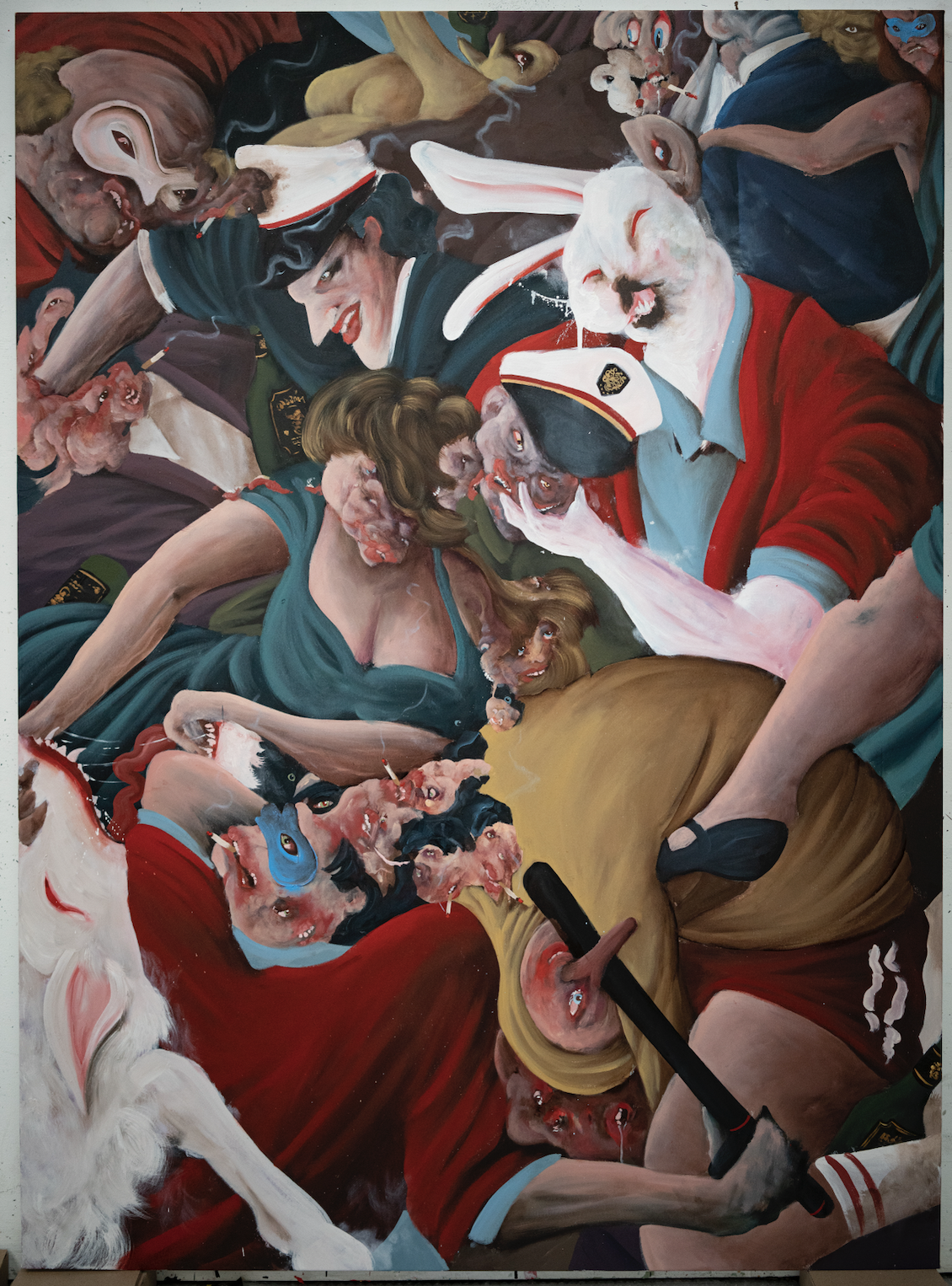
RED ROOM 1 / The Vices Warm Embrace, Willehad Eilers, 2026
Oil on canvas; 160x140
Image courtesy of the artist
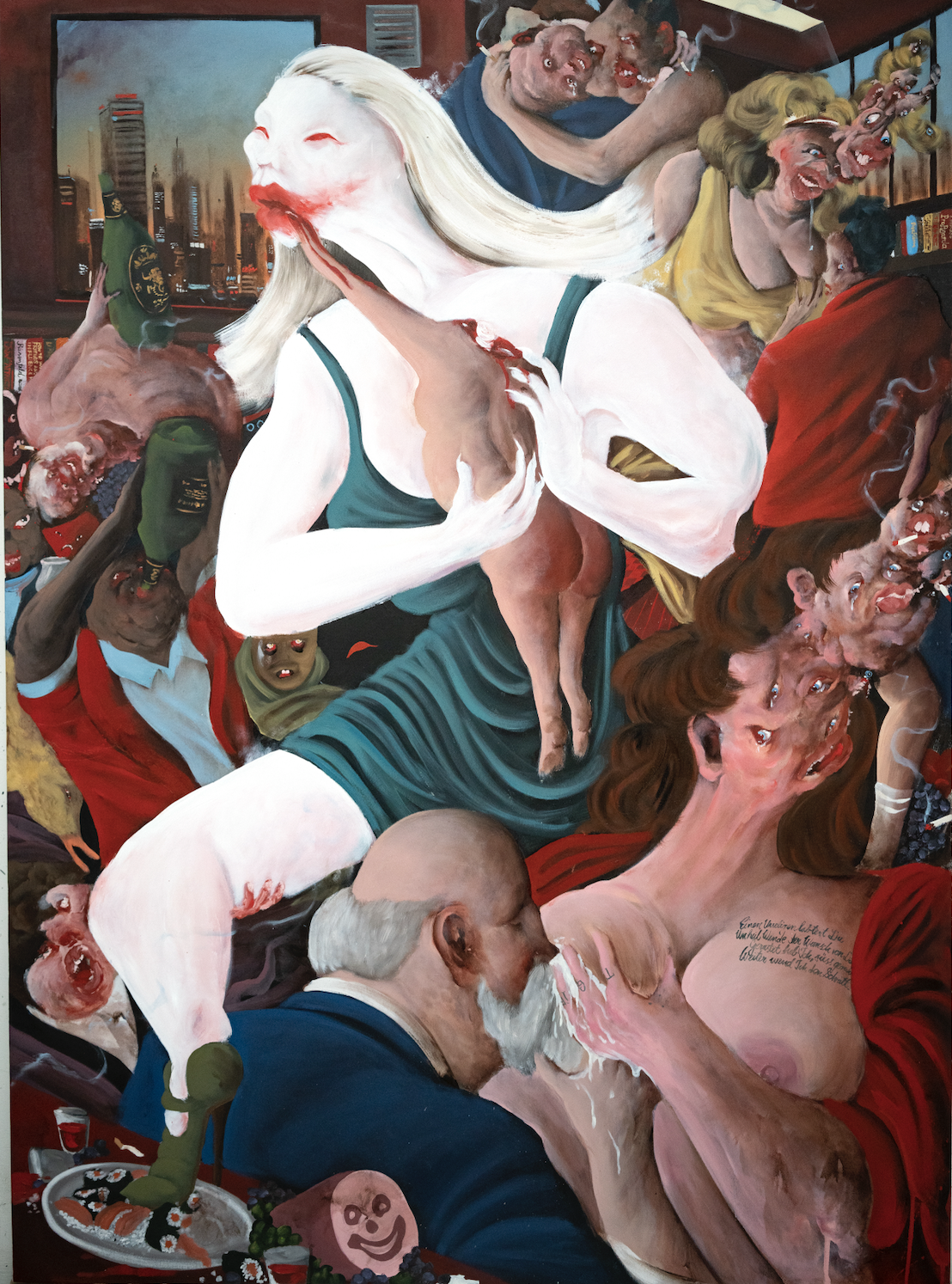
Alle gegen Alle, Willehad Eilers, 2026
Oil on canvas; 50x110 cm
Image courtesy of the artist
Forever Young, Willehad Eilers, 2026
Oil on canvas; 150x110 cm
Image courtesy of the artist
In Cruel Summer, the seaside becomes a setting for excess, appetite and expectation, with pleasure seemingly always on the verge of becoming something more volatile. What interests you about places that are culturally constructed as spaces of happiness—and what happens when that promise begins to crack?
I am fascinated with ‘paradises’. The places we go to to reward ourselves. To fulfill our dreams. Our presence is what cracks our dreams. Like the image of the houseman looking from the outside through the window of his perfectly clean apartment. We destroy what we love, just by having it. A human dilemma. And comedy.
You have described your work as a way of investigating the social and cultural behaviours we absorb almost unconsciously. Do you think of yourself more as someone who documents contemporary life, someone who invents an alternative version of it, or someone who occupies the uncomfortable space between the two?
None of the two. I try to document contemporary life, show it as is, but cannot do it objectively. Everything goes through me, so it is already filtered. This forces me to look at what that means: ‘Me’. A white western male, in his best (haha) years.
I am open about what I am. And my flaws. The way I document takes into consideration that it is me who documents. Eventually, all ego aside, this might be telling. Hopefully it will be worthwhile.
It is not necessarily going to be the best art that will give the best impression of the time we are living in, for future generations. There is a huge gap between our moral code, what we deem right and wrong now, and what this will mean in 100 years, for example.
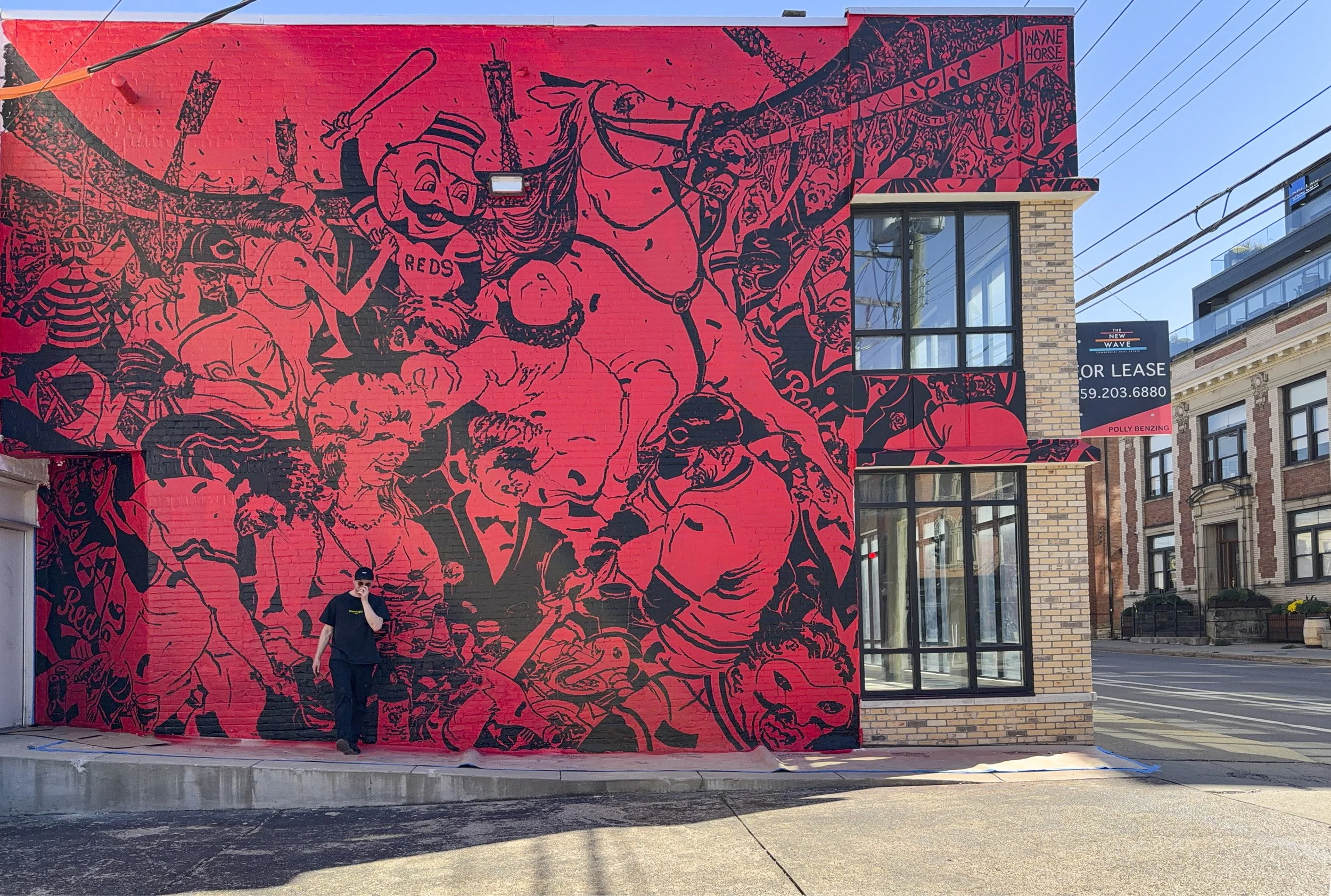
THE REDS cincinnati, Willehad Eilers, 2026
Acrylic on wall
Image courtesy of the artist
There is a fascinating tension between the apparent looseness of your line and the intensity with which your paintings are constructed. You have also spoken about becoming wary of painterly habits and deliberately disrupting your own comfort. How important is it for you to introduce resistance, failure or even physical aggression into the making of a work?
I have struggled for many years to get my drawing hand to express what I feel. To stop trying to impress anyone, and be as is. True, my art is about failure. The beauty and importance of failure. Failure as human gold. Us humans can provide infinite ways of failure.
In the face of the development of the capitalist world, which is getting more effective and service oriented by the second, failure is like a warm cloth. It is us. My work can be understood as a testimony to failure.
I think it is because of that, that I react allergic whenever I notice that I learned a new ‘skill’. That I have found something that I can hide behind. Something impressive. Something commonly regarded as ‘good’. In my case, I find craft counterproductive.
I want my work to communicate the option of getting away with murder. Of freedom and joy. And death.
Your practice extends from painting and drawing into video, installation, performance, writing and the long-running Horse Diaries, recently brought together in Sex Master. Rather than seeing these as separate disciplines, do you think of them as different forms of the same impulse—or does each medium reveal a different version of you?
That is a nice question because I used to think that different media reveal different versions. I have learned that it does not matter, all is one. It is a confidence game. I believe if the impulse is pure enough, it does not matter in what medium it is communicated. Possibly better in ways that one does not master. It lets the intention shine through stronger.
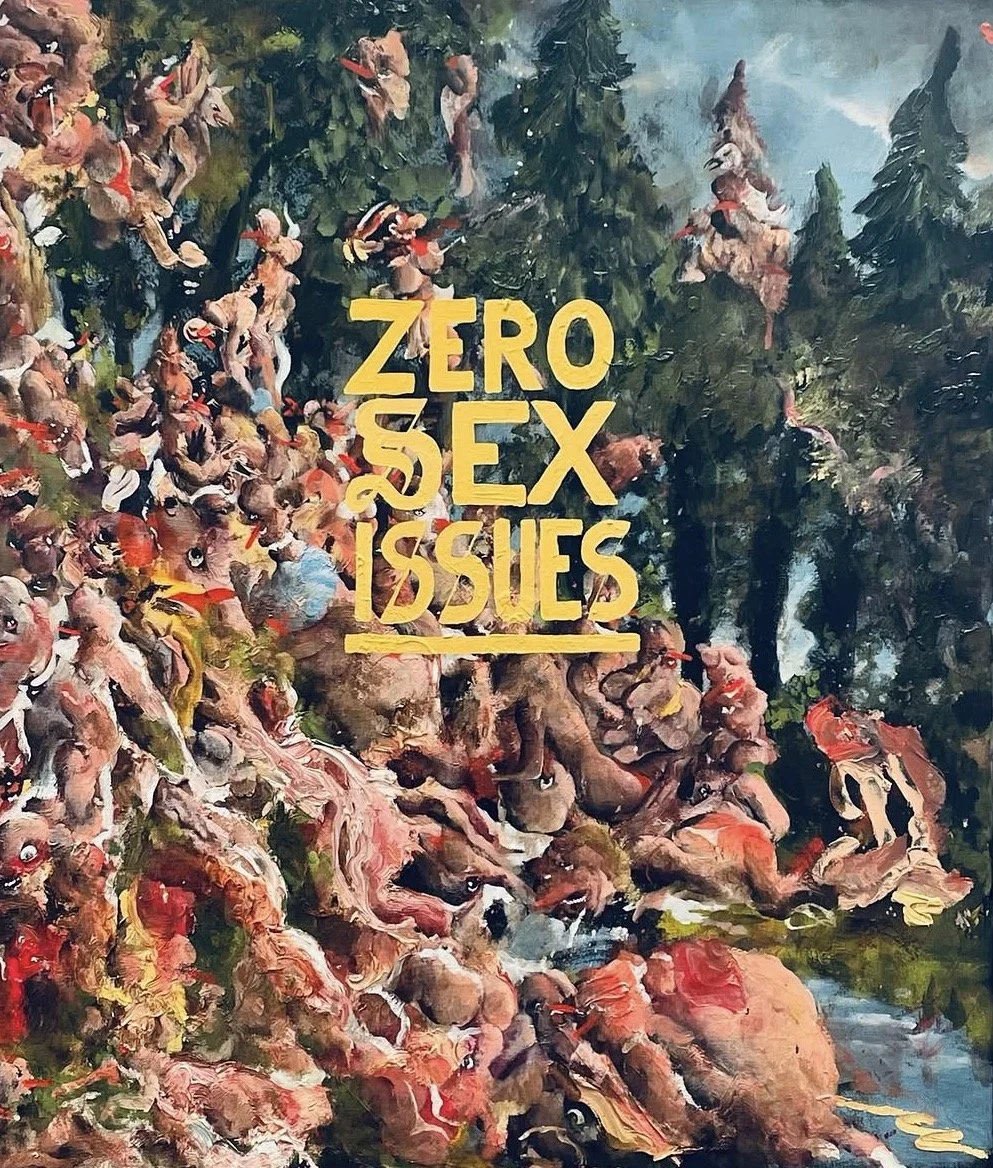
ZERO SEX ISSUES, Willehad Eilers, 2025
Oil on canvas; 80x50cm
Image courtesy of the artist
Humour is everywhere in your work, but it rarely functions simply as comic relief. You have described humour as a kind of tool for confronting difficult realities, while resisting the idea that your work is satire. What can humour communicate about vulnerability, desire or fear that seriousness sometimes cannot?
I see humour as a knife that you sharpen throughout your youth, until the moment comes that you will need it. When disaster strikes. Humour is a way to cope. For those that do not believe in God.
I do not speak about laughs here, even though they are part of the tool. Humour gives a chance of distancing oneself, while grasping a subject at the very core and dissecting it in detail, facing the horror. Humour allows us to observe horrors and discuss them.
Looking at your work, the viewer is rarely given a stable vantage point or a clearly defined story to follow. Do you ultimately want viewers to recognise themselves in your characters, to feel implicated by them, or to remain slightly estranged from what they are looking at?
I often describe my paintings as moral battlegrounds. I want people to see and recognize what they see. Make them witness their associations dance, and hence get a chance to experience themselves. I hope, and this might be one of the few uses of skill and technique, that the image is luring enough, that they do not feel distanced, but dive into it.
This is the reason most of my paintings are not set up like a theatre stage, like the paintings of the old masters. My compositions are more like a snapshot taken with a camera, with figures cut off on the edges. The painting continues beyond the canvas. And the viewer is part of it.
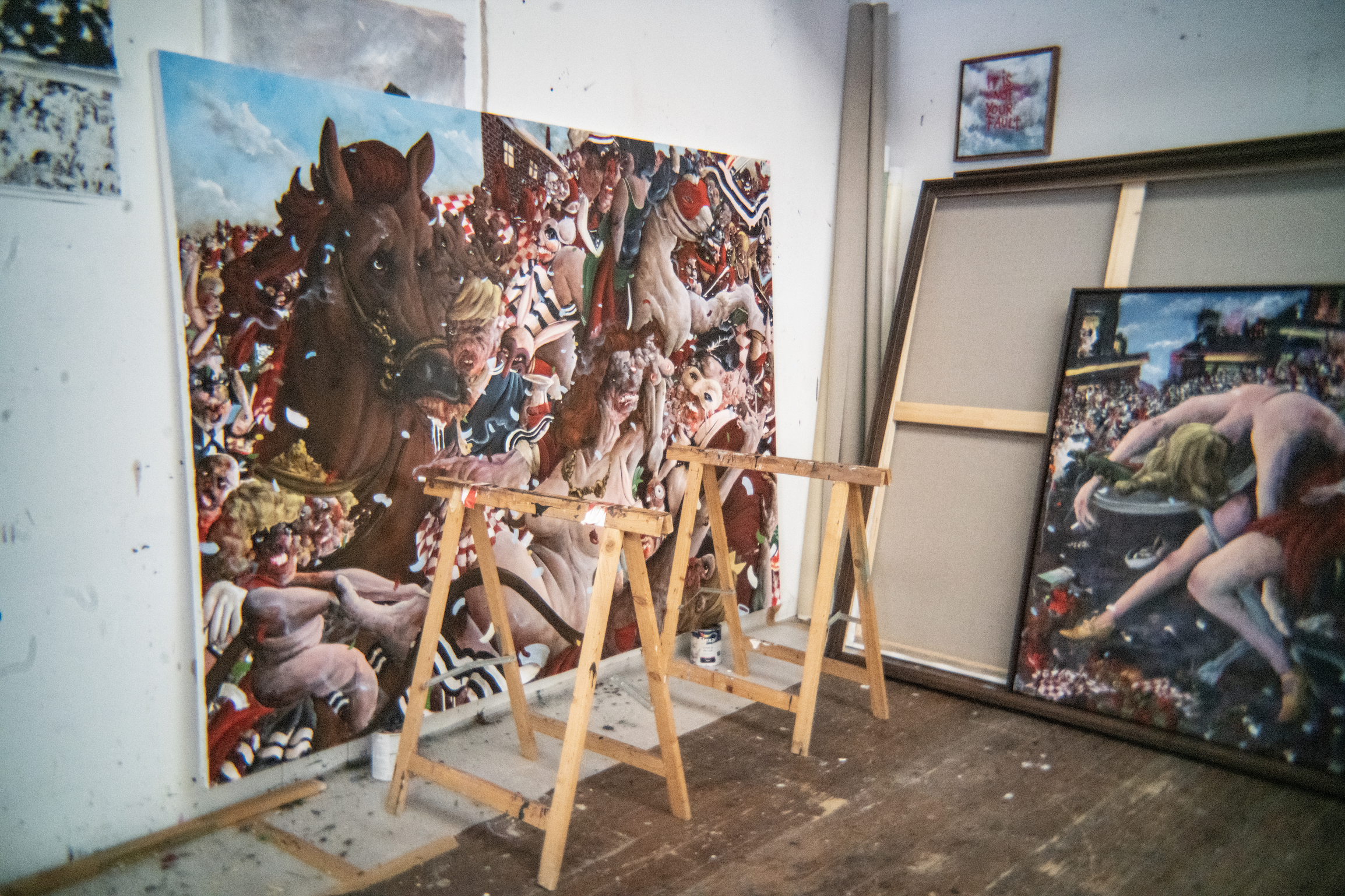
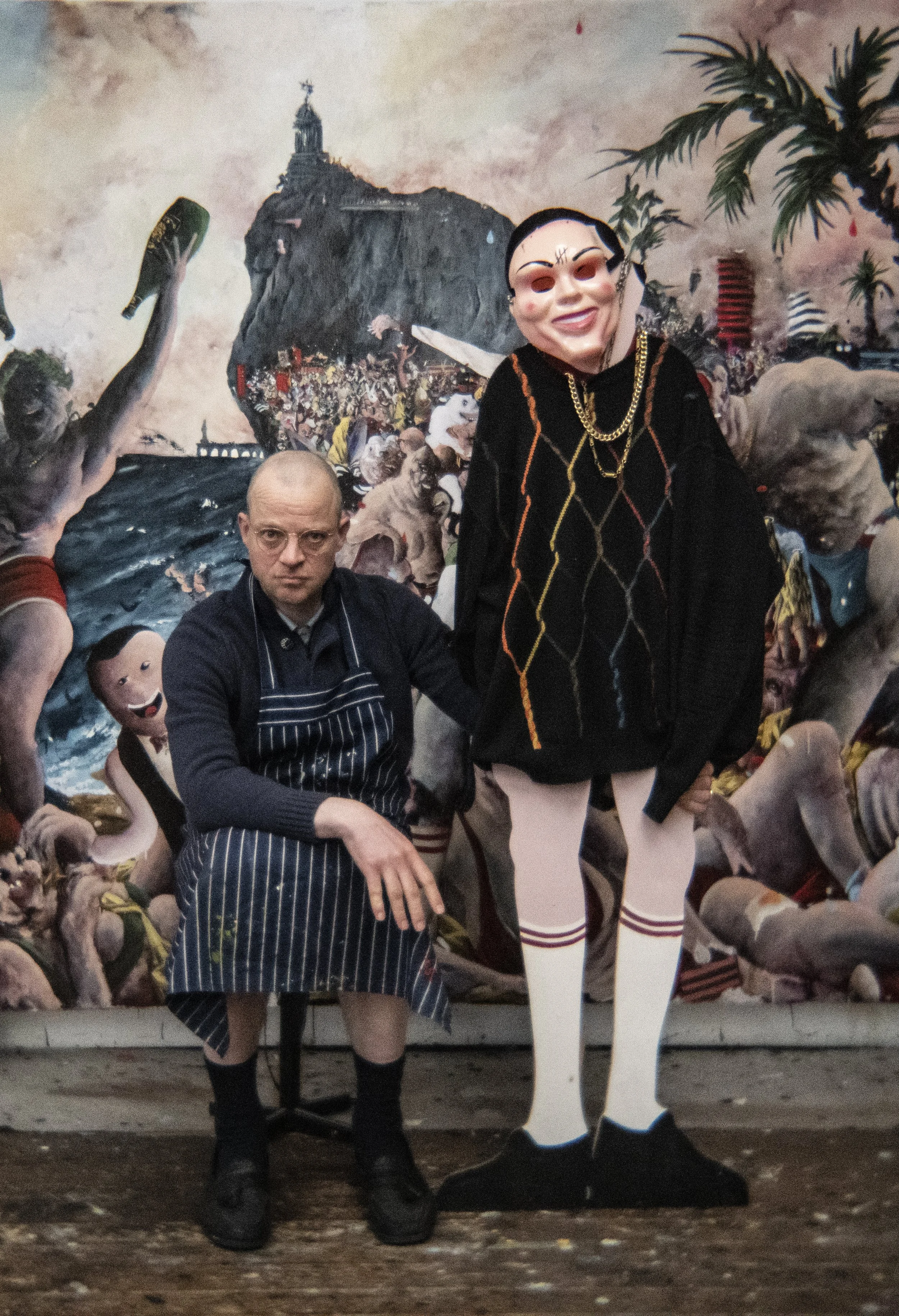
Studio of Willehad Eilers
Image courtesy of the artist
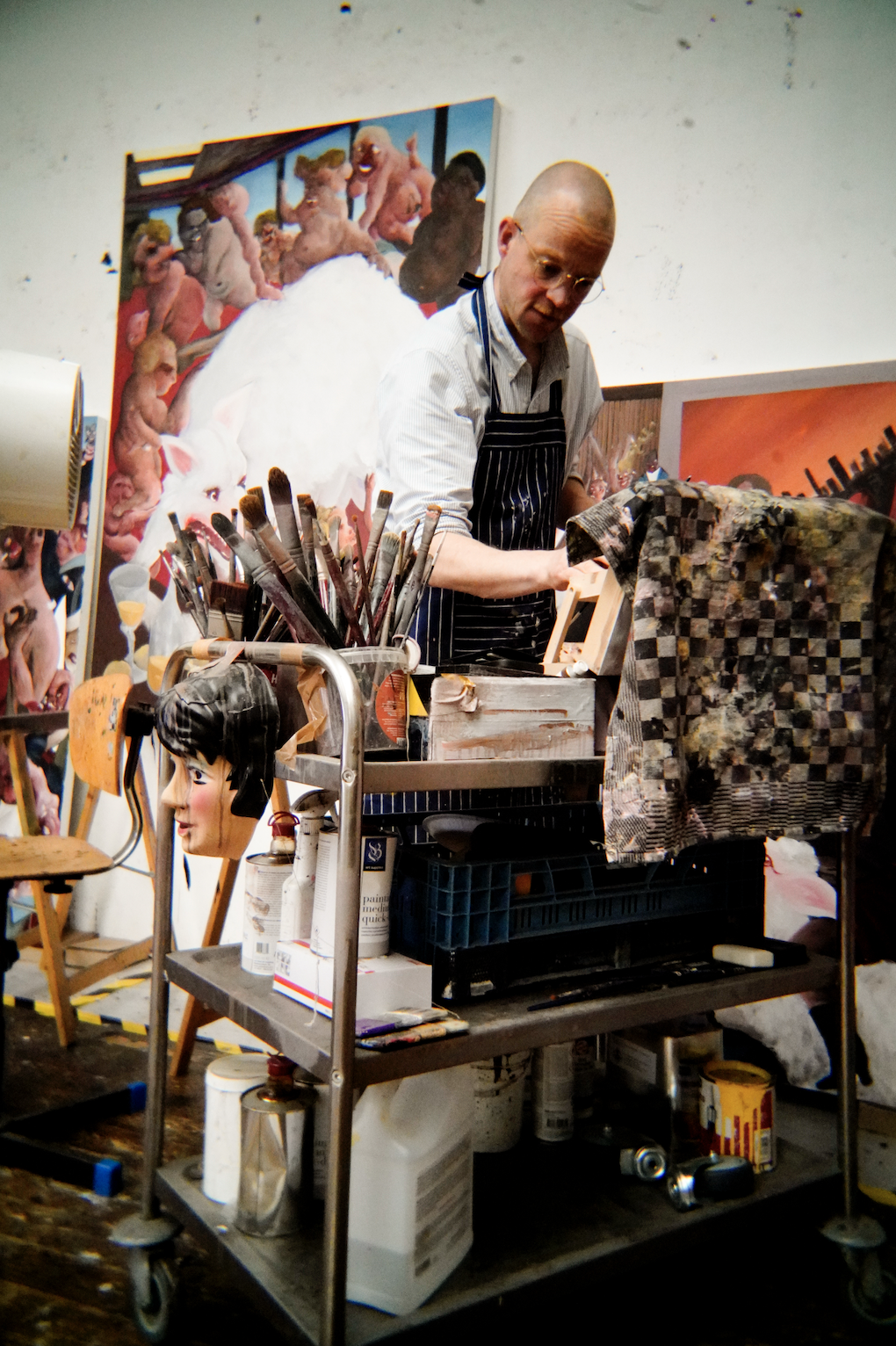
Willehad Eilers in his studio
Image courtesy of the artist
To further explore Willehad Eilers’ practice, visit his website and follow him on Instagram. The artist collaborates with Droste Galladé Gallery and Harlan Levey Projects. His works are available at Management New York Gallery.
Article by Alexandra Vîstraș
Alexandra Vîstraș is a Brussels-based cultural observer, policy professional and lifelong theatre enthusiast. With a background spanning cultural management, European policy and communications, she is interested in the ways art, politics and collective imagination intersect, particularly through the lenses of gender, identity and social change.