THE THREADS OF PHLOX VAN OPPEN
“Textile holds time in a way other materials don’t. It has always felt like the most honest medium to me, something people live with, wear, pass down.”
Life is a yarn ball. The waters from a river that takes its beginning in the mountains of Nepal will eventually find their way to the other side of the world. Products from one country get exported to others. Friends eventually spread across the globe.
There is also a rainbow-coloured yarn ball inside you. Each colour corresponds to an emotion you felt at one moment or another. That ball is always getting bigger. Even now, while you are reading this, it’s being wrapped with a new colour. Imagine a person that you love so much. See? Now you have a new pinkish string.
Phlox is the one who, through conversations, tries to unwrap that yarn ball and organize those strings in such a way that they make a composition. I see this interview as an attempt to examine and follow one such thread - to see where it bends, where it knots, and what story it holds.
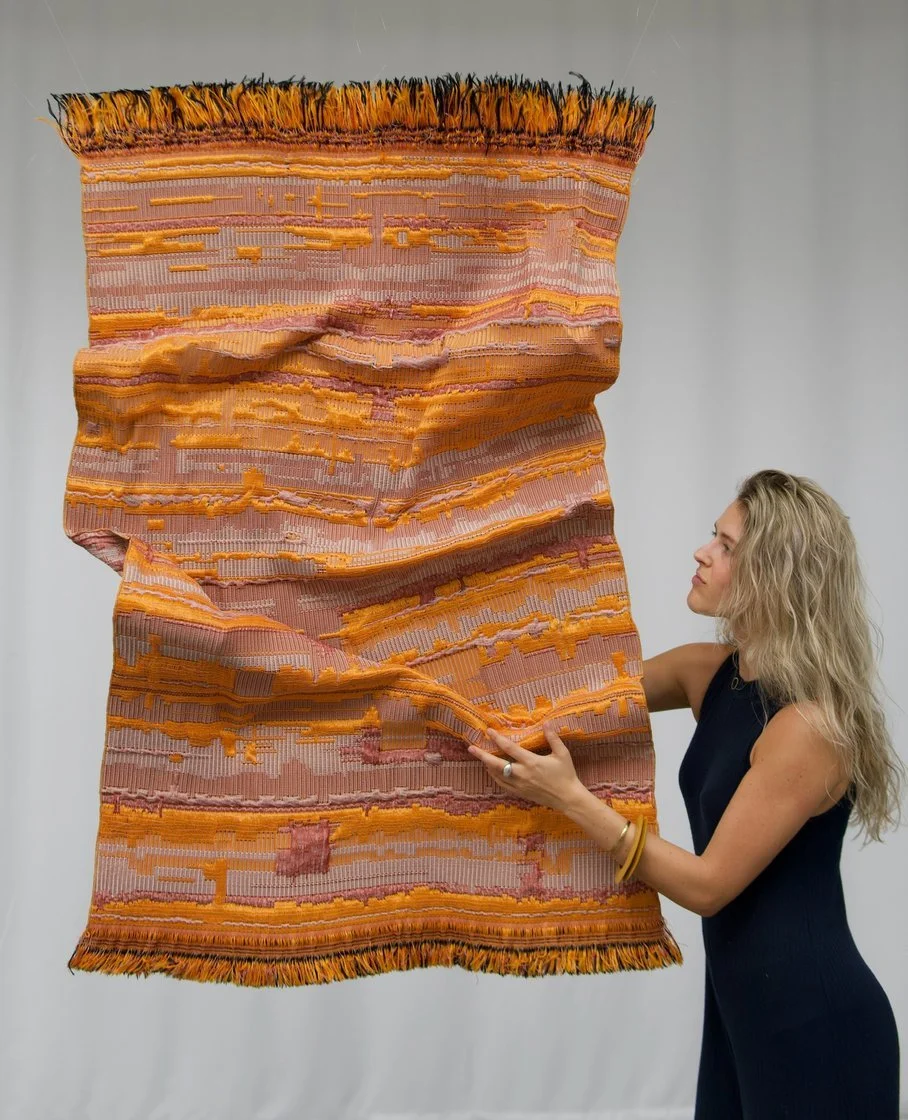
Memory of Folds, Phlox van Oppen
Can you recall your earliest memories of making art?
I remember always being drawn to things you could touch and transform. Collecting materials, taking things apart to see how they were made. I don’t think there was one single moment, more a continuous pull toward making that was always just there.
Showing people your work for the first time could be a crucial moment in an artist's life. Can you tell us about the first time you experienced that? How did that impacted you?
I think the vulnerability of it stays with you. There’s something irreversible about letting someone else into a thing you made privately. What I remember most is that the work suddenly became something outside of me, it belonged to other people’s eyes too, which is both uncomfortable and necessary.
Why do you think you found your comfort specifically in textile?
Textile holds time in a way other materials don’t. It has always felt like the most honest medium to me, something people live with, wear, pass down. I have always worked with my hands from a young age, and there is something about the physical process that feels inseparable from thinking.
“Textiles are meant to be lived with. A rug that’s been walked on has a relationship with a body, and there’s something beautiful in that.”
Looking back at your time at KABK and your ongoing study in the Swedish House of Textiles, what was the most valuable lesson you learned there?
At KABK I learned to trust a concept long enough to see where it leads. To use my direct surroundings, which was my student house with 36 girls as a main source of inspiration and to find new perspectives on everyday materials. Trusting my own creative process and staying curious about new ways of working with materiality became central to how I develop ideas.
At the Swedish School of Textiles the lesson was understanding that technique isn’t separate from meaning. Focusing for two years on one technique gave me the opportunity to really go to the extent of weaving. Exploring different material combinations and breaking traditional assumptions of weaving. Bringing together life stories and the development of a weave, making biography inseparable from the making process. Each decision could be traced back to the conceptual process of my work. Taking those two experiences from both educations together is probably where my practice really started to form.
Could you walk me through your creative process, from the initial spark of an idea to the finishing touch?
My current project, titled Continuous Flux, started with conversations, interviews with women about their lives, memories, and turning points. From their answers I began drawing out the color, structure, material, and post-treatment decisions. What someone described as a period of grief might become a dense, dark layer; a moment of liberation might open into something light and transparent. On the Jacquard loom I work with a monofilament warp and systems of up to twenty-four layers, which allows for a kind of depth that reads differently depending on where you stand. The finishing is physical, shrinking and manual opening processes that transform the cloth after it leaves the loom. The textiles are not fixed surfaces; they can shift and change. This connects to the title Continuous Flux, with the idea that identity, emotion, and life itself are never static, but always evolving.
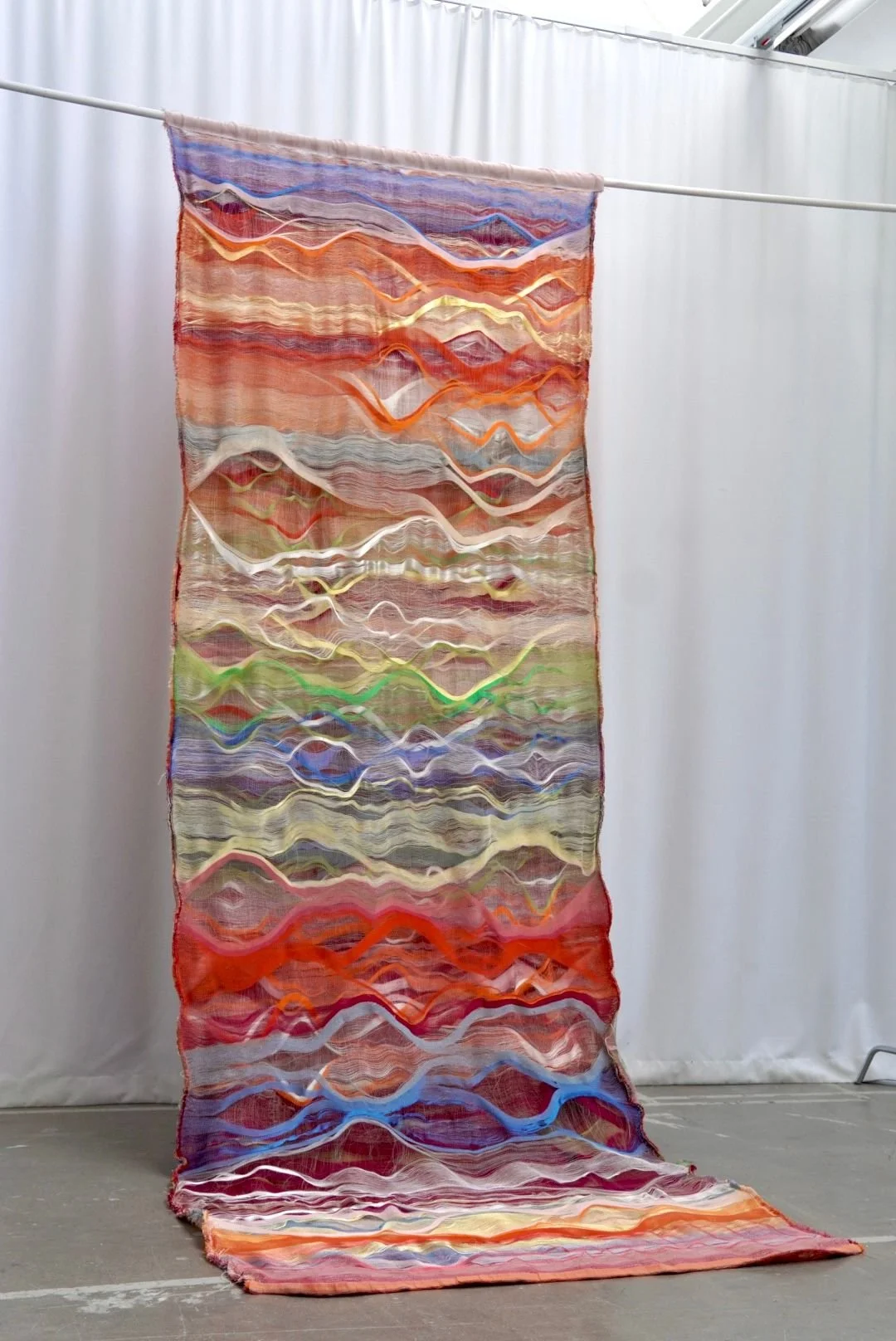
EMPOWERING, RESILIENCE, HOPE, Phlox van Oppen, 2026
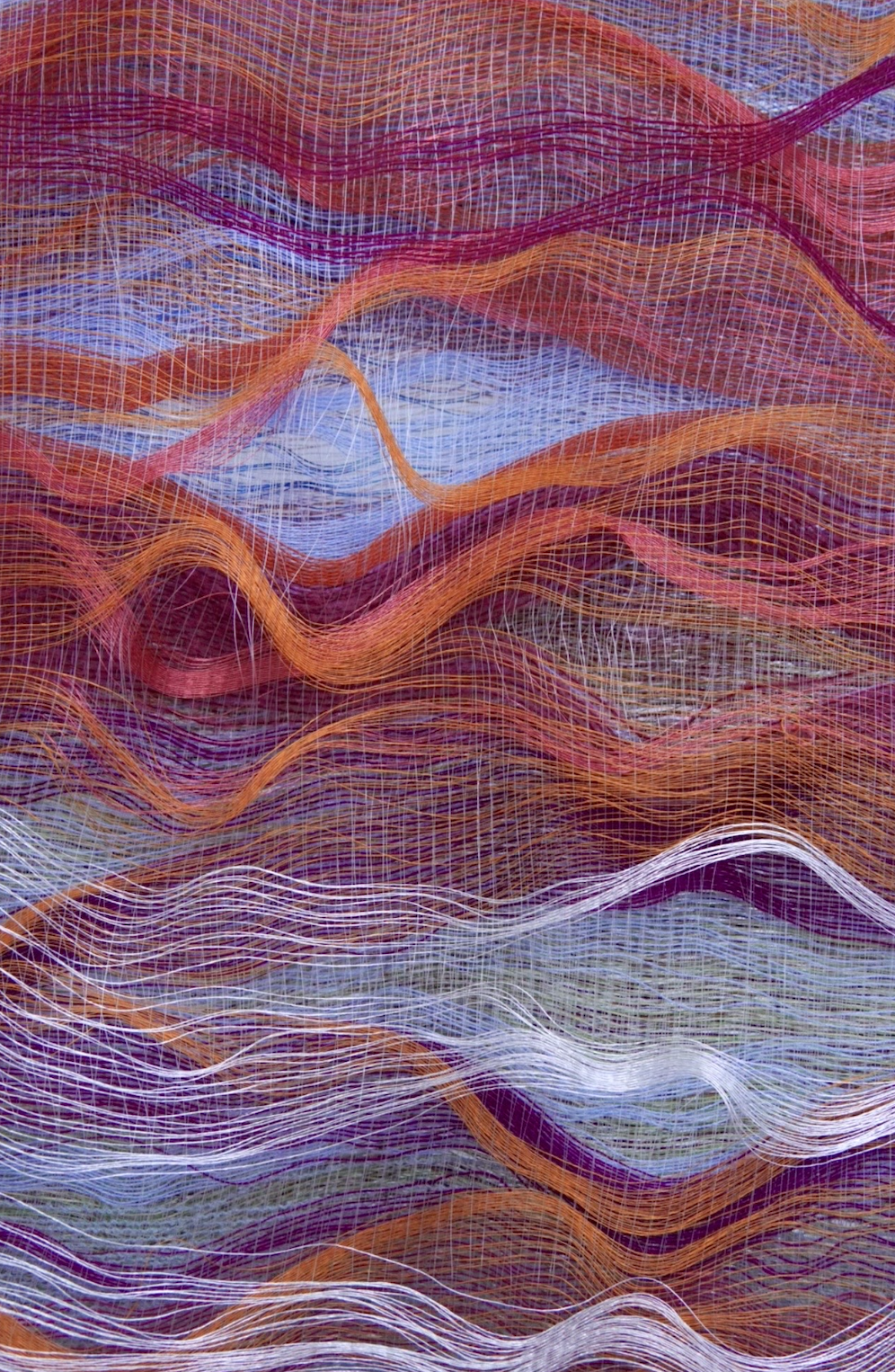
EMPOWERING, RESILIENCE, HOPE, Phlox van Oppen, 2026
What is important for you when choosing a material? Since you are very vocal about using reusable materials and waste management, do you have plans to amplify this message outside of your art in the future?
I am interested in working with what is already around. There is already so much material on this world, why contribute in adding more to this already full planet. For me showing the extend of a material, often every day materials is a challenge but also very satisfying. When I talk to people on a fair and surprise them with explaining what it is made off starts a lot of good conversations. I want to understand where a material comes from and what it is made of. I’ve worked with found and discarded materials, festival wristbands and the lint from the tumble dryer for instance because there’s already a life embedded in them. As for amplifying that outside the work: I think the work is the message and I hope I can inspire to show waste in a different way.
Which artists or specific influences shaped your vision the most?
I have worked for Joana Schneider and Laurence Aegerter, working alongside them shaped deeply how my work developed and how I grew in my practice. Learning from their ways of working with color, materials, and a concept set the foundation for my own practice. Challenging conventional notions of technique and material became the core of my working methods to this day.
Your piece "EMPOWERING, RESILIENCE, HOPE" acts as a vessel for multiple voices. How did it feel to weave all these individual women's stories, colors, and turning points into a single, cohesive work? And can you share a bit more details about how it was created?
The final piece is where all the stories come together. It is a piece about strength, resilience, and how these women found hope. The work is vibrant, with the colors drawn from each individual story meeting in one shared surface. These moments represent the turning points in their lives.
The last question in the interview was: is there anything from your story that you would like to share with other women, perhaps in a different culture or situation? What they said, each in their own words, was some version of the same thing: women hold more than the world expects and give more than it sees. Don’t let others hold you back, just go for it.
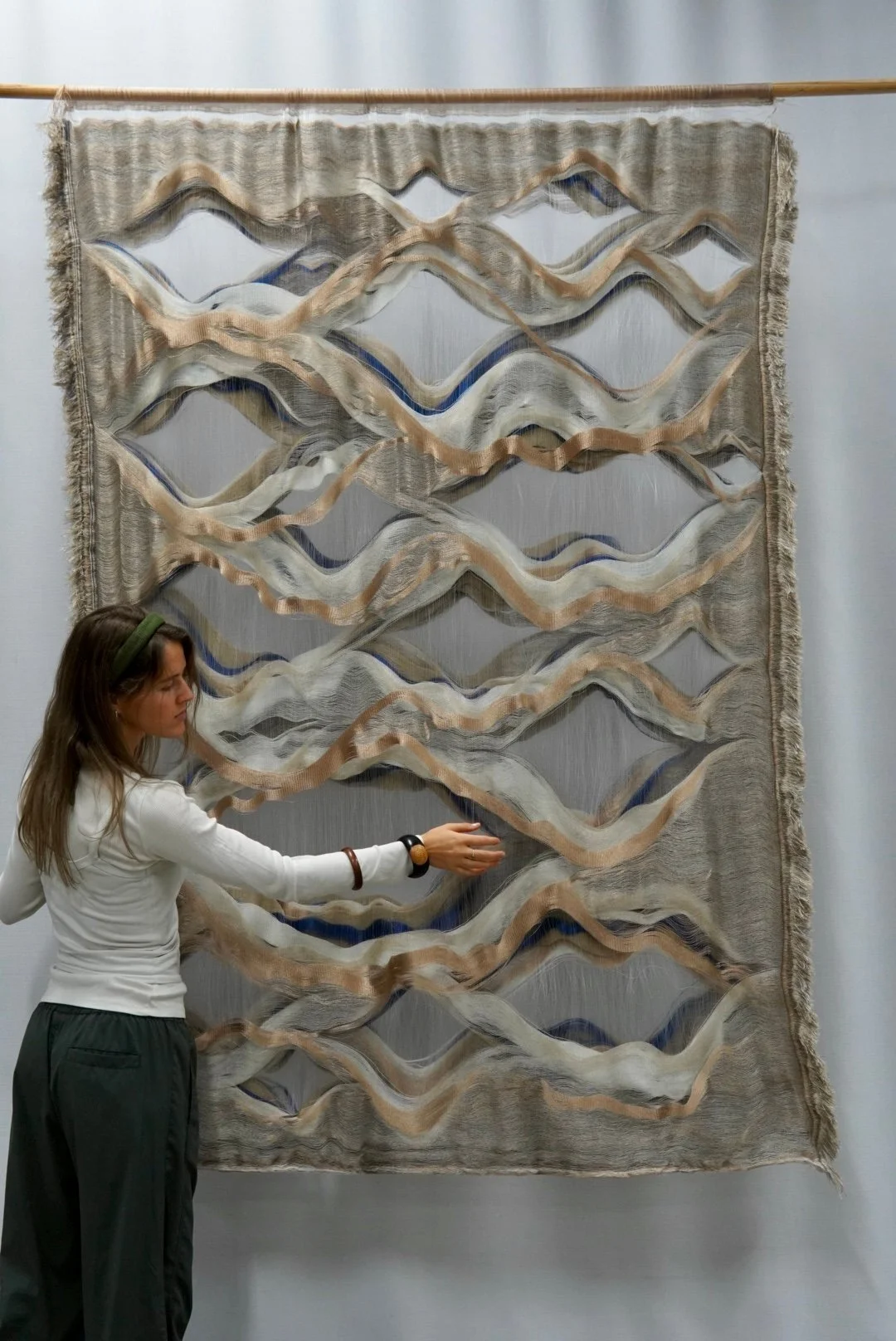
Courtesy of Phlox van Oppen
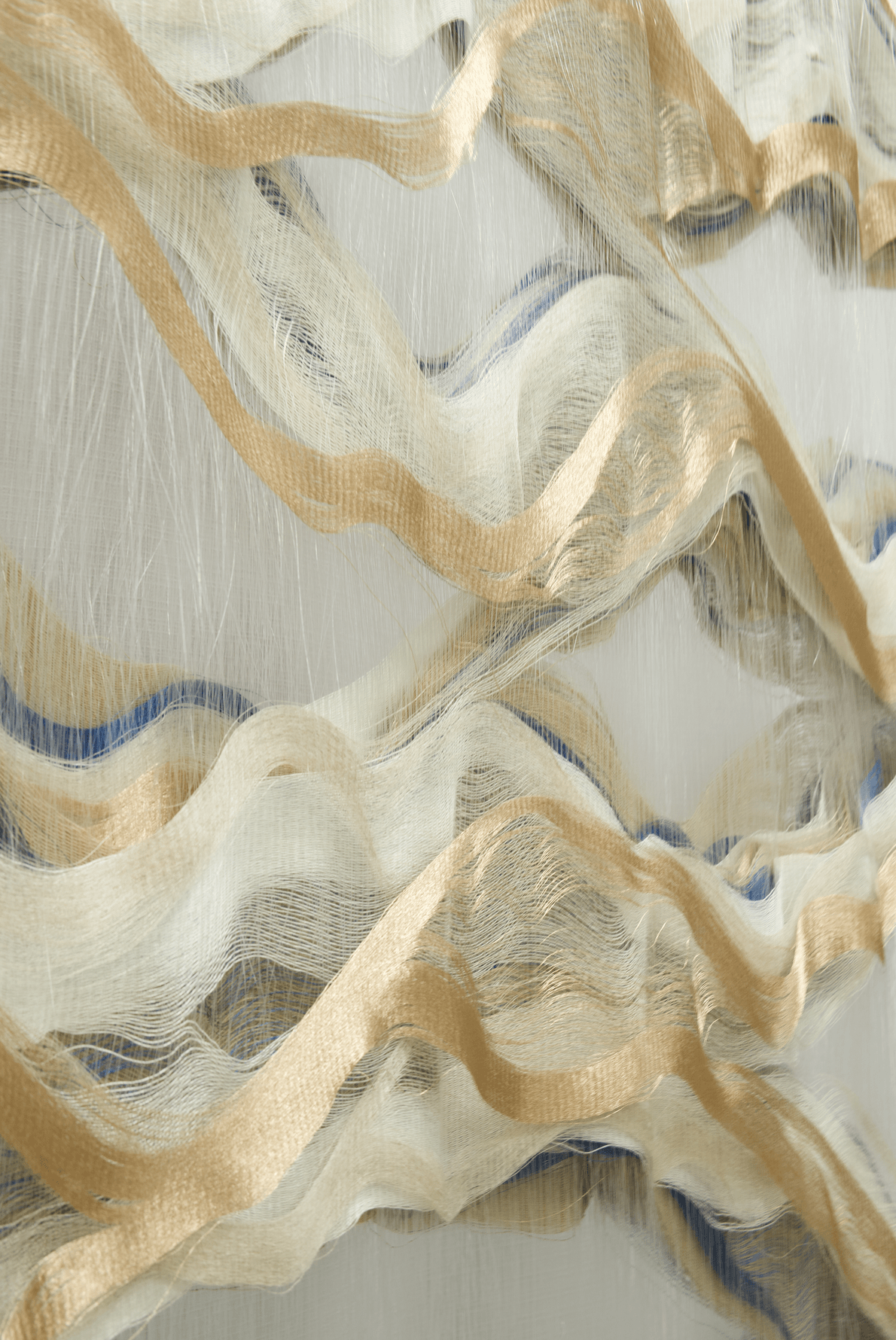
Courtesy of Phlox van Oppen
Since some of your works are very rug-like and deeply tactile, I was wondering does it irritate you seeing people stepping on rugs in everyday life? :)
Honestly, not really! Textiles are meant to be lived with, that’s part of what I love about the medium. A rug that’s been walked on has a relationship with a body, and there’s something beautiful in that. What I’m more interested in is whether people actually feel what they’re touching, or whether they’ve stopped noticing.
When people stand in front of your work at this exhibition, what is the core feeling or conversation with themselves you hope they walk away with?
I hope they feel recognized in some way, even if they don’t know whose story they’re standing in front of. The women I interviewed are specific people with specific lives, but something in telling these life stories always touches something universal. If someone walks away carrying the hope and strength of these stories, feeling that their own life has texture and structure worth paying attention to, that’s enough.
Have we untied that yarn ball in this interview? Not even close. People are so much more complicated than that. We could spend a thousand years speaking with Phlox, and we still wouldn't be anywhere near unraveling everything.
But that is the beauty of it. Every conversation isn’t meant to undo the whole knot - it’s just an attempt to gently pull at a single thread, to trace its texture and see its colour. We might not have unraveled the entire mystery of Phlox van Oppen today, but we managed to isolate one vibrant string and give it a form. And for now, I pass you the end of this string to continue the journey.
See more of Phlox’s work on her website.
Article by Vasya Kavka
Based in Ukraine, Vasya Kavka is a writer working at the intersection of contemporary art and digital culture. Through his platform @ambient.delusion, he researches emerging and underground artists, publishing interviews and editorial features that move beyond aesthetics to examine context, creative process and cultural relevance. His work is driven by curiosity and a commitment to thoughtful, accessible storytelling that situates artistic practices within the broader currents shaping contemporary culture.