What if art is not about finding answers, but learning to question reality itself? In a world shaped by constant imagery, social expectations, and ready-made narratives, art challenges us to look closer, think differently, and discover meanings beyond what is immediately visible. More than an object to admire or a message to consume, art becomes a way of experiencing the world in all its contradictions—a world that can be equally cruel and beautiful.
Matthew Morpheus (Serhii Matveichenko) is a Ukrainian conceptual artist and author whose multidisciplinary practice spans digital collage, painting, installation, and literature. Drawing on a nomadic, multicultural background across Ukraine, Israel, Germany, and the UK, his work explores identity, displacement, conscious perception, and contemporary symbolism through fragmented imagery and layered, non-linear narratives. He is also the author of several philosophical and literary works, including Zero Emotion, Elysium, and Philosophy of the 21st Century: On the Other Side of Truth.
For multidisciplinary artist and author Matthew Morpheus, creativity moves beyond the boundaries of a single medium. Working across drawing, painting, digital collage, installation, and literature, he explores the complexities of human experience through layered imagery, symbolism, and unconventional forms of storytelling. Rather than presenting a fixed narrative or prescribing a single interpretation, Morpheus invites viewers to engage with his work through their own perceptions, memories, and experiences.
In this conversation, we explore the ideas and experiences behind his multidisciplinary practice, the role of fragmentation and symbolism in his work, and his evolving understanding of art as a space for questioning, discovery, and interpretation. We also discuss Zero Emotion, a concept that offers a distinctive perspective on the coexistence of conflicting emotions and the complexities of human consciousness.

“Wheel of Fortune” by Matthew Morpheus, 2018
Gel roll pen on paper, 56.0х76.0 сm
Image courtesy of the artist
Your practice spans several forms, including digital collage, painting, installation, and literature. How did this multidisciplinary approach develop, and what draws you to working across different mediums?
My multidisciplinary practice developed naturally through continuous self-reflection and the search for a visual and written language capable of capturing the contradictions of the modern world. I started drawing in childhood - back then, it was not just a hobby, but a survival mechanism and a way to make sense of reality. Later, while working on my philosophical and literary texts (Zero Emotion, Elysium, Philosophy of the 21st Century: On the Other Side of Truth), I came up against the limits of spoken and written language. There are certain states - the tension between presence and absence, the fragile territory between reality and fiction - that cannot be expressed in words alone, and committing fully to visual art became a point of no return for me.
Working across different mediums - from meditative hand drawing with gel pens (Rainbow Of The Symphony, Wheel Of Fortune) and spray painting to digital collage (New Gods, The Divine Judgment) and installations - gives me, above all, the freedom to interpret my ideas visually. Each technique has its own emotional tone: drawing requires almost monastic concentration and precision, whereas digital collage and multimedia projects allow me to build a dialogue between traditional forms and new technologies, avoiding creative stagnation and expanding the boundaries of perception.
When beginning a new project, do you usually start with a particular image, an idea, an emotion, or a question? Could you walk us through how one of your recent works began?
The start of a new project always depends on the chosen medium, though my starting point is almost always the music that inspires me and a fundamental conceptual question that I set for myself before creating a piece. Music shapes the right mental space and rhythm. Especially when I work with drawing or colour, the process develops spontaneously and intuitively, like a stream of consciousness. When it comes to a conceptual digital collage or an installation, the starting point is a deep exploration of sociocultural shifts, political processes, and hidden mechanisms of power.
A good example is my recent work CULT, which was presented by The Relative Gallery at the Digitalism exhibition during the British Art Fair at Saatchi Gallery in London. This project began with a question about the nature of modern control and how social media has turned into a new kind of digital cult, where attention becomes the main currency and the platform acts as both a prison and a religion. This is the first work created using my new image-to-image methodology: the process felt like an archaeological dig, where I gathered media fragments, surveillance motifs, and visual symbols, reconstructing them again and again until a single critical and visual logic emerged from the separate layers.

“Rainbow Symphony” by Matthew Morpheus, 2013
Gel roll pen on paper, 56.0х76.0 сm
Image courtesy of the artist
As both a visual artist and an author, do you approach storytelling differently when working with images than when working with words? Are there ideas you find easier to express through one medium rather than another?
For me, literature and visual art are two complementary wings of the same philosophical exploration, though the way storytelling works in each of them is fundamentally different. When working with words in my books, I developed a conceptual discourse that unfolds linearly over time - sentence by sentence, argument by argument - allowing me to articulate philosophical ideas and unpack existential paradoxes in detail.
However, written language inevitably has its structural limits. There are borderline states of consciousness and perception - for instance, the simultaneous clash of conflicting emotions beneath a calm surface, or the unspoken tension between memory and forgetting - that words are forced to break apart and explain piece by piece.
Fragmented imagery and non-linear narratives appear in your artistic practice. What possibilities do these approaches offer you that a more linear or conventional narrative might not?
For me, fragmentation is the most accurate reflection of how human consciousness, memory, and 21st-century reality actually work. Unfortunately, a linear narrative inevitably oversimplifies the world, building an artificial chain of cause and effect where, in reality, chaos and order, past and present, and truth and falsehood exist side by side. I prefer to draw on ancient Vedic texts with their non-linear understanding of time and consciousness, and I strive to step beyond one-dimensional storytelling. Using fragmented images and placing contrasting elements side by side in works such as New World Order or The Divine Judgment allows me to visualise the internal contradictions of modern society. By bringing together seemingly unrelated pieces of mass culture, historical references, and philosophical symbols, I create a visual tension that cannot be conveyed in a traditional sequential story. This turns the artwork from a fixed statement into a multidimensional space for reflection.
“Today, ‘home’ for me is no longer a geographical spot on a map, but the state of being ‘here and now’.”
You work with contemporary symbolism and layered visual references. How do you decide which symbols or images belong in a work, particularly when their meanings may differ across cultures or individual experiences?
That is a very interesting point. Choosing symbols for each piece is both an analytical and an intuitive process, which I often compare to visual archaeology. I carry out detailed research into a topic: I study news reports, historical chronicles, philosophical texts (from Sun Tzu to modern media theorists), and visual archives of mass culture. As a result, modified images of the Mona Lisa (Secret Life of Mona Lisa), figures of tech moguls, pop-culture elements, circus motifs (Political Circus), or religious imagery (The Divine Judgment) can all meet within the same space.
The fact that the same symbol can be read differently depending on a viewer's personal experience is not an obstacle for me, but its greatest value. I choose archetypal and modern signs that work on several levels at once: on the surface, they are recognisable almost anywhere in our globalised world, but when they collide with one another, they lose their everyday familiarity and create multiple layers of meaning. Differences in cultural perception only enrich the artwork, allowing each viewer to find their own key to unlocking it.
Your work engages with questions of conscious perception. How do you explore the relationship between what we see, what we believe we see, and what might remain outside our awareness?
Exploring the limits of conscious perception is closely tied to the central philosophy of my entire practice. A human face can only express one visible emotion at a single moment in time: fear, joy, anger, or sadness. Yet beneath this outer surface, dozens of opposite feelings — love and hatred, hope and despair — exist, collide, and intertwine in our minds at the same time. There is a point where these contradictions compress to their limit and shift into a distinct state that I call Zero Emotion.
Another theme I have dedicated part of my research to in my work is the difference between the visible surface, the illusion of perception, and what lies hidden in the depths of the subconscious or behind the facade of the social “spectacle” (drawing in part on the ideas of Guy Debord and Hans Blumenberg). Through dense layers of drawn lines in works like The First After God and Conquistador, or the multi-layered symbolism of my digital collages, I aim to break habitual patterns of automatic looking, encouraging the viewer to look beyond the obvious and face what usually remains outside our awareness.
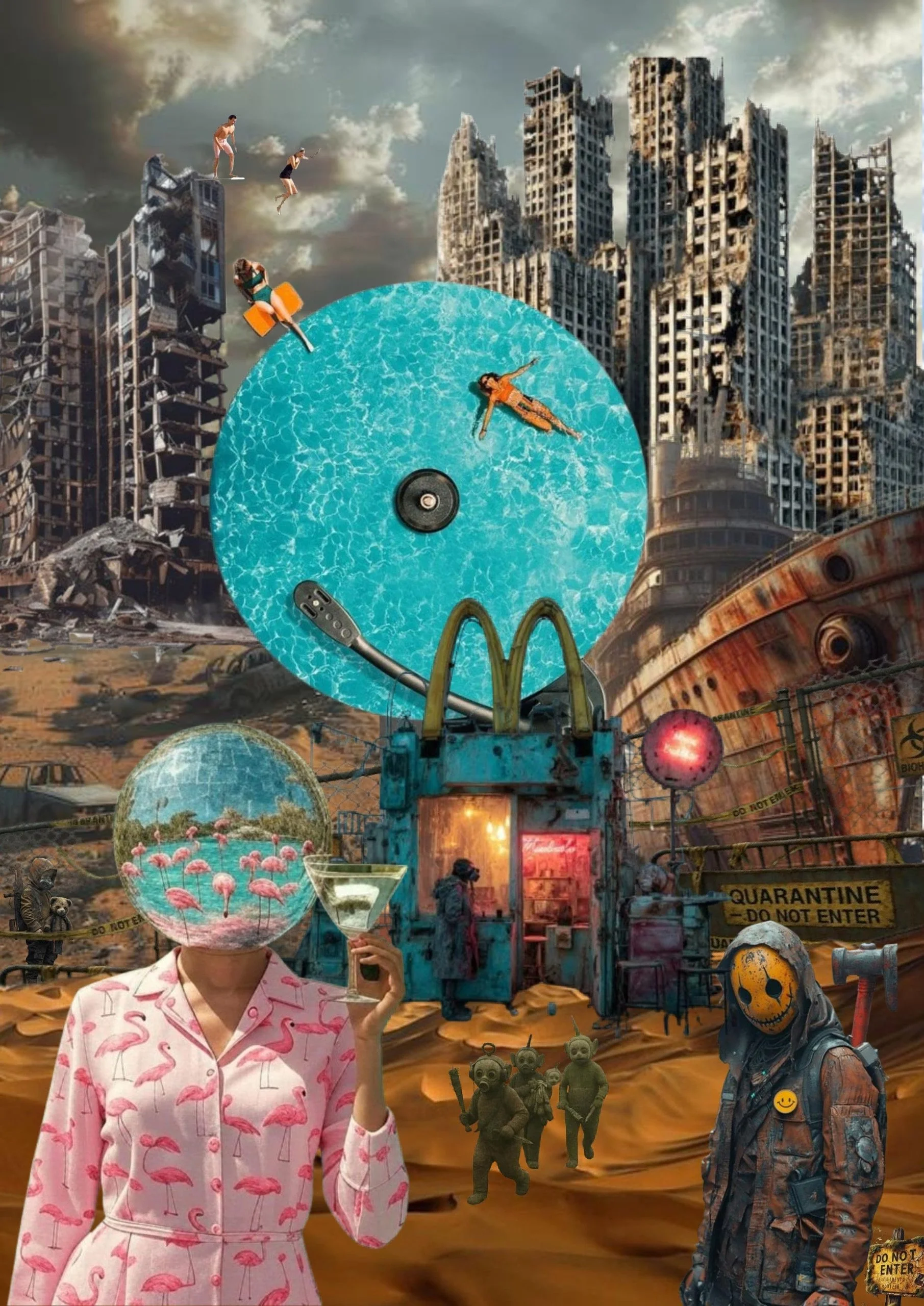
“Ellite” by Matthew Morpheus
Image courtesy of the artist
Some of your work invites viewers to make connections between separate images, symbols, or fragments. How much of the meaning do you establish yourself, and how much do you leave open for the viewer to discover?
I build a strong conceptual and symbolic foundation into every piece, but I never try to force a single correct interpretation onto the viewer. When choosing elements for a composition - whether in a drawing or a digital collage - I give each fragment a specific symbolic weight tied to themes of power, transformation, duality, or alienation. However, my job as an artist is simply to build the architecture of this labyrinth and place the visual triggers within it.
The final meaning of a piece is always born at the moment it meets the viewer, who becomes a full co-author of the work. For me, art is an invitation to a dialogue and a shared search for answers to difficult existential questions. Everyone looks at a canvas or a collage through the lens of their own life experience, memory, and cultural background, so I deliberately leave the space open so that viewers can discover their own hidden emotions and meanings within these connections.
Identity and displacement are among the themes associated with your work. How have these ideas influenced your artistic perspective, and have their meanings changed for you over time?
The experience of migration is at the heart of my artistic worldview. My nomadic path - from growing up in Ukraine, to living in Israel and Germany, and now Scotland - has given me a sense of permanently existing between worlds, languages, and political realities. The meeting of different cultures, traditions, and worldviews has turned my art into a cosmopolitan dialogue, where local traumas and hopes are rethought through the universal lens of the human spirit.
Over time, the very idea of displacement and identity has gone through a deep transformation for me. What once felt like instability, vulnerability, and a search for footing before displacement hardens into a new identity has gradually turned into a powerful source of creative independence and inner freedom. Today, “home” for me is no longer a geographical spot on a map, but the state of being 'here and now'.
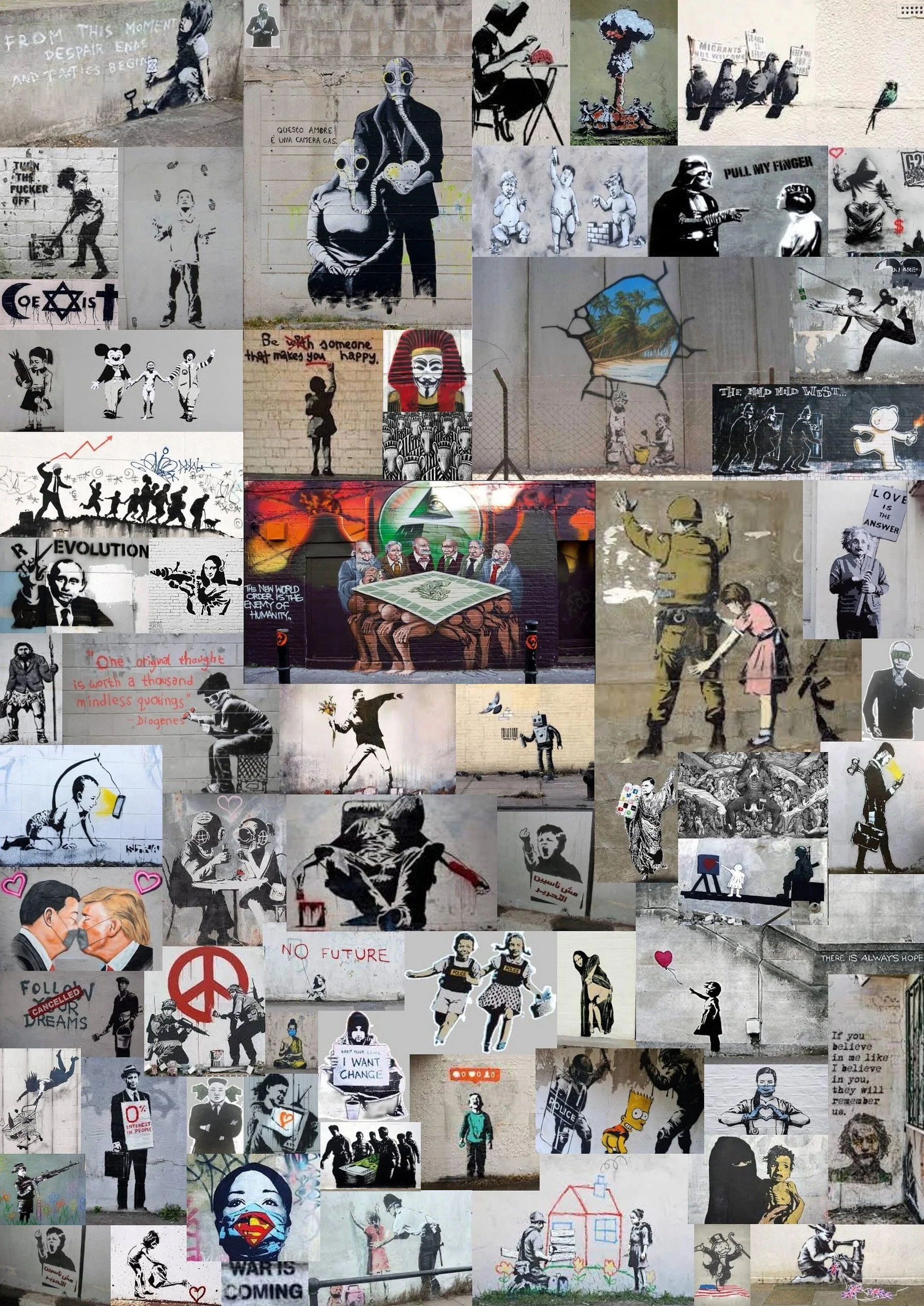
“Voice Of The Street” by Matthew Morpheus
Image courtesy of the artist
When a work combines multiple layers of meaning, how do you know when it is complete? Is there a point at which adding more information would limit the viewer's own interpretation?
During the process, I layer and rearrange elements again and again until a point of quiet equilibrium - a suspended tension between the chaos of the details and the clarity of the structure - finally emerges within the composition.
Of course, there is a fine line beyond which too much information starts to suffocate the artwork and take away room for the viewer's imagination. That is why the walls of my studio in Edinburgh are deliberately kept completely bare - this quiet, minimalist space reminds me that absence is not emptiness, but room for what is yet to be born. In the work itself, I stop at the exact moment when the visual statement becomes dense enough to spark a thought, yet open enough to leave 'breathing room' for the viewer's personal interpretation.
Can you share an example of a viewer's interpretation or response that made you reconsider one of your own works, or notice something you had not consciously intended?
One of the most memorable moments of audience feedback for me happened during the presentation of CULT at the Saatchi Gallery in London, which I mentioned earlier. Because this was the first publicly exhibited piece created using my image-to-image methodology, it was incredibly important for me to see how this new visual language worked in live dialogue with the audience. I was also delighted that the work was chosen to be displayed on the advanced InkPoster system - a pioneering digital art display based on colour ePaper technology that gives digital collage an almost tactile, museum-grade presence.
The audience's reaction exceeded my expectations: many people stopped in front of the piece for a long time, walked away, and came back again to look closely at the smallest details and discuss the themes of total surveillance and digital symbolism with one another. Watching completely different people find their own triggers, personal fears, and unexpected parallels between religious imagery and social media algorithms within the layered structure of CULT made me see the scale of this piece in a new light. This experience confirmed for me that in a multi-layered collage, the artist's subconscious often plants connections that only fully reveal themselves through the collective gaze of the viewers.
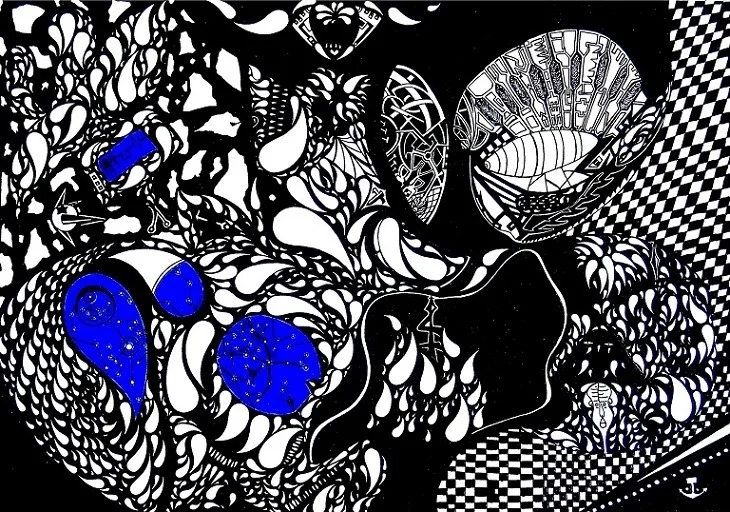
“Prostration” by Matthew Morpheus
Image courtesy of the artist
What questions, themes, or artistic experiments are you most interested in exploring in your work next?
Right now, my artistic research is focused on further developing the Zero Emotion concept and finding new ways to translate it into visual and spatial forms. I am increasingly interested in expanding the boundaries between the physical and digital worlds: I continue to experiment with the image-to-image methodology and aim to bring traditional techniques (painting, hand drawing, and sculptural objects) even closer together with digital art and new technologies.
In addition, an important direction in my current practice involves creating multimedia and interactive installations, including through my work with the Abandoned Artists CIC collective in the UK. I am interested in exploring how to engage the viewer not only visually, but also through sound, space, and touch - blurring the line between the observer and the art object, and creating an immersive environment where a person can directly experience that state of compressed emotional stillness from within.
If you could invite viewers to reconsider one assumption about art, perception, or meaning, what would you want them to think about?
That is an interesting question. When people encounter art and the reality around them, I would like them not to look for simple, ready-made answers forced upon us by consumer society and the media spectacle. Art is not a decorative object or a one-dimensional slogan; it is a state of the soul that teaches us to notice, to question, and to find our own unique path toward understanding our cruel yet deeply beautiful world.
Some questions are not meant to be answered; they are meant to change the way we see the world.
Discover more of Matthew Morpheus's artistic practice and portfolio.
Article by Simin Hosseini
Simin Hosseini is a writer and English language and literature graduate with a keen interest in language, literature, and the art of storytelling. With a background in content writing and literary analysis, she is drawn to the ways words shape ideas, convey meaning, and illuminate the nuances of human experience. Her work reflects a thoughtful approach to language, creativity, and written expression.