UNFIXED LANGUAGE: TRACES BEYOND MEANING
What happens when language stops being a tool for communication and becomes an experience?
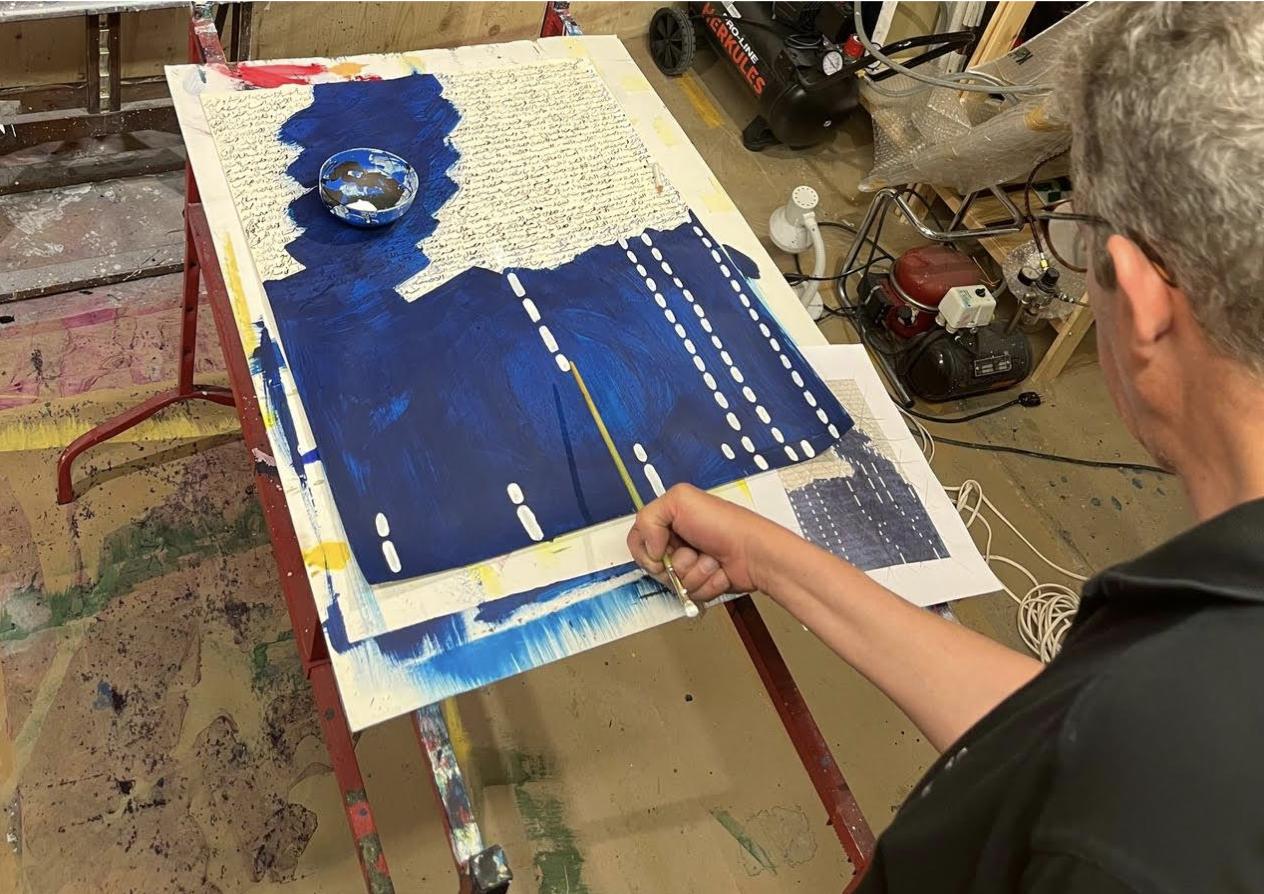
In this painting by Farid Izemmour, Traces_100, the Arabic alphabet is liberated from syntax and narrative, inviting viewers to navigate a world where rhythm, color, and structure take the lead. This exploration is part of a broader modern movement: since the twentieth century, artists across SWANA have reconceptualized calligraphy not as text but as form, gesture, and space. In Traces_100, the author continues this dialogue, fusing centuries of tradition with modern abstraction and algorithmic order. Letters and white marks coexist like traces of memory or data, forming patterns that are both precise and meditative. The work invites viewers to experience language in a new way - through rhythm, structure, and presence rather than through words and fixed meaning.
This essay is based on an interview conducted with Farid Izemmour in February 2026 about his personal artistic process and its relation to the UNFIXED exhibition; all quotations are taken from that conversation and translated from French into English. Izemmour also shared the images included in this document for use in this publication.
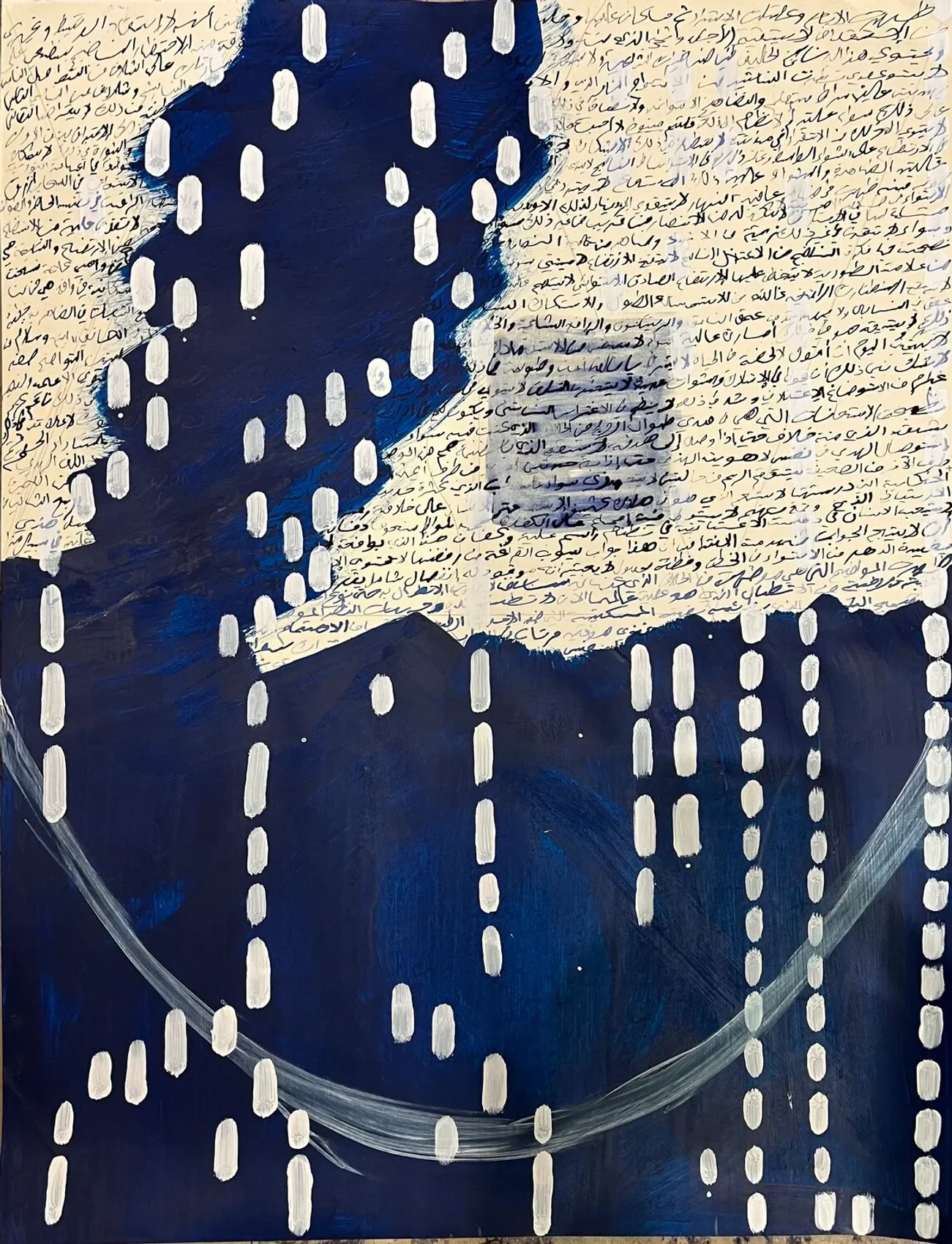
Traces_100 by Farid Izemmour, 2022
I. Beyond Language
In this painting, Farid brings together two writing standards. The dense, handwritten Arabic calligraphy can be seen as a historical and continuous narrative, anchored in tradition and memory. Yet this continuity is disrupted by the other elements of the composition: the white marks descending in rigid vertical sequences and the blue field cutting through the calligraphic surface, rendering it partially unreadable. What once existed as a flowing script becomes fragmented between legibility and abstraction. Letters simply cease to function as a linguistic sign. In Farid’s words: “The letter ceases to be merely a functional vehicle of communication and becomes a visual, emotional, and symbolic entity.”
Instead of treating the script as a means of communication, the calligraphic layer becomes a field of symbols, built in layers. Language turns into space. The viewer is invited to enter, not simply to interpret. This transformation of language into spatial experience reflects the artist’s broader inquiry into the nature of the letter itself: “My work questions human communication at its source. The letter, as a fundamental unit, is for me an infinite territory of exploration. I examine its evolution, its ability to shift status, to free itself from literary language and become pure form.”
This transformation of language implies both continuity and rupture. While the calligraphic gesture remains anchored in classicism and tradition, Farid transforms this artistic heritage into a site of formal exploration, guiding it toward modern abstraction. As he notes: “Gradually, it became my primary visual language, allowing me to move beyond traditional frameworks and explore the letter as an autonomous form, almost fractal.”
This movement toward abstraction participates in a broader twentieth-century exploration of calligraphy as form. Artists such as Erol Akyavaş from Turkey or Parviz Tanavoli from Iran demonstrated that the letter could function not only as script but as structure, surface, and space. From a graphic design perspective, figures such as Ed Fella similarly treated lettering as a visual and symbolic material, often detaching it from semantic clarity so that typography operated as texture, gesture, and image rather than as a transparent vehicle of meaning.
If the abstraction in this painting emerges from within the calligraphic gesture, it finds another expression in the white marks. These repetitive white vertical marks appear coded and rhythmic, functioning as unreadable units rather than linguistic symbols. Although these white marks partially disappear as they pass through the calligraphic field, they retain a persistent presence. The white marks introduce another spatiality, systemic, and digital. Two regimes of inscription meet without merging. The connection between the calligraphic work and the geometric traces lies at the core of the artist’s practice: “freed from syntax and imposed meaning. It becomes a trace, a sign, a memory.”
This juxtaposition also opens two possible readings. On the one hand, it can be understood as the fusion of different systems (historical calligraphy and coded traces) that leads to the emergence of a new unit, a new way of communication. On the other hand, it may suggest the impossibility of their coexistence, highlighting a tension that cannot be resolved. Either way, the painting is structured through contrast: between tradition and abstraction, language and trace, memory and system.
II. Rhythm and Structure
In this second part, we turn our attention to the deep blue field cutting through the calligraphic surface. This shape does not erase the calligraphy but limits the script's readability. Given that the blue field occupies the majority of the pictorial space, its role is therefore fundamental. The blue does not simply function as a background; it expands into the air, diluting the narrative into space. Rather than destroying language, the blue field reorganizes it. Meaning dissolves, and new structures and patterns emerge. The use of blue appears carefully controlled and articulated across the painting: “Each work is built through precise stages… color, depth, spatial ambiguity, and the density of the line all contribute to the construction of the work.”
The saturated blue of the central field contrasts with the faded blue square in the upper right quadrant, while the blue of the calligraphic writing itself suggests an earlier stage. These variations establish a sense of progression and evolution and can be seen as reinforcing the idea that Izemmour’s composition is governed by a precise, deliberate structure rather than chance. As the artist states:“My approach is deeply Cartesian.” Indeed, “Nothing is left to chance.”
Meanwhile, the white marks descend like data columns or counting strokes. Their mechanical rhythm carries continuity beyond semantic content, introducing a new sense of temporality: measured, steady, a pulse, a count, a sequence. The cadence of the white marks recalls the abstract notation of monitoring systems, in which bodies or biological processes are translated into intervals, repetitions, and visual signals. This sense of pulse is carefully constructed: “The placement of the various elements follows structuring principles, particularly those of the golden ratio and rhythmic structure.” These traces appear counted, spaced, and almost algorithmic, evoking a mechanical or systemic origin, perhaps even the traces left by a machine.
Although they suggest the possibility of decoding through pattern and rule, they resist being read. Across the deep blue field, the white vertical marks descend in measured intervals, transforming the surface into a field of beats rather than a space of reading. In this shift, language gives way to architecture. The eye no longer searches for words but follows intervals, densities, and alignment: “These frameworks allow me to create a harmonic reading and guide the viewer’s gaze.”
The painting thus oscillates between rule and surprise. The calligraphic layer, dense and methodical, carries the weight of tradition and deliberate gesture, while the blue field and the white vertical marks introduce variation, interruption, and rhythm. As the artist suggests, it is precisely this duality that fascinates him: “Fractals interest me because they embody this duality between strict mathematical laws and unpredictable forms.”
Each element is carefully placed, yet the painting still breathes, letting the eye wander and notice small variations. This attentive placement extends to the very gestures that create the marks, where each repetition and pause is measured over time, embedding duration into the surface itself. Even the gesture that produces these marks unfolds over time. “Silence, the repetition of the gesture, and the long duration of time are essential. They allow me to enter a state of total openness…”
Here, time takes shape. Repetition becomes meditation. The painting moves from language to rhythm, from semantic clarity to presence.
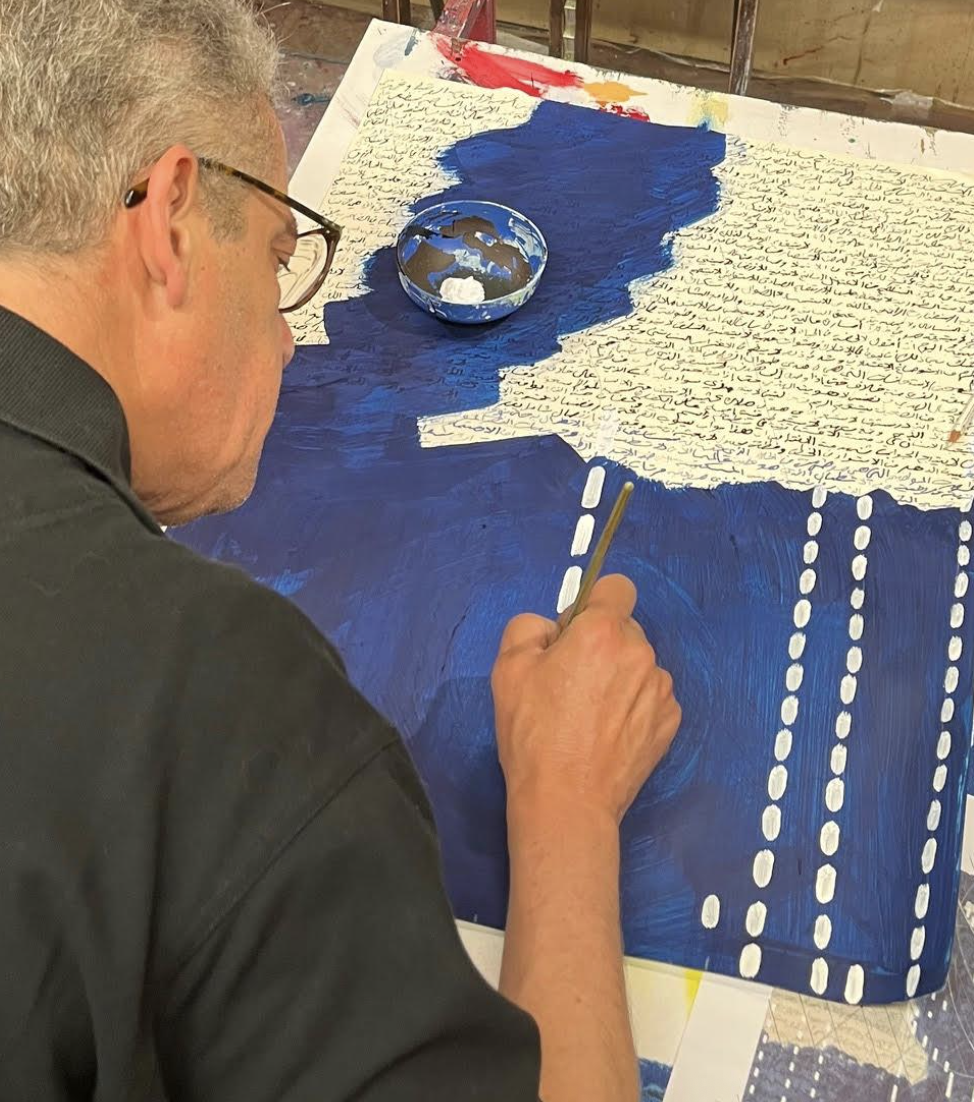
Traces_100 by Farid Izemmour, 2022. Courtesy of Farid Izemmour
III. Between Control and Release
The idea of measured variation explored earlier continues as we encounter the curved line at the bottom, where form engages in a delicate dialogue between control and release. Though the curve matches the white marks in color, its transparency and organic quality set it apart. The curve feels smoother and more fluid, counterbalancing the rigidity of the vertical traces and softening the overall composition. If the vertical marks measure, the curve breathes. It softens the rigid rhythm into a gentle flow. As the artist reminds us, even what appears spontaneous remains measured.
“The paint splashes and variations in the line, though seemingly spontaneous, are controlled.”
Spatially, the line appears to hover, as if gently holding the composition in place. Temporally, it can be read as a parabolic form, recalling the visual language of graphs with peaks and lows. From a scientific perspective, parabolic forms do not convey meaning in a linguistic sense; they register relationships. They map how one quantity changes in relation to another, tracing behavior rather than narrating a story. A parabola has a highest or lowest point, which makes it a shape that implies limits and thresholds. Though fluid in appearance, this line is mathematically precise, holding variation within constraint. Here, the work enters what the artist describes as a space: “between order and chaos.” As he explains, “I construct the work according to a precise framework, and then I accept that chance may intervene. It is from this tension that the final form emerges.”
Traces_100 by Farid Izemmour, 2022. Courtesy of Farid Izemmour
The parabola embodies this release, as the structure becomes secure enough to allow deviation, as highlighted by its precise yet organic nature. In this sense, the work exemplifies what he calls a practice that: “navigates between order and chaos, between deterministic laws and chance, allowing an unstable balance to emerge - one that is constantly evolving.”
The final element to emerge is the almost disappearing white square in the upper right corner of the painting. Like the white marks, its presence over the calligraphic surface introduces ideas of transparency and layering. Yet unlike the vertical strokes, the square does not assert rhythm or repetition. Rather than imposing an additional order, it softens the surface, subtly merging with what lies beneath. Its edges almost blur into the field, creating a quiet zone of fusion rather than interruption. It is precisely within this softened threshold that the artist locates the work’s generative tension: “The moment when control begins to loosen… It is within this intermediate zone - between mastery and surrender - that the most accurate forms emerge.”
The square operates as a threshold rather than a form: neither fully present nor absent, neither foreground nor background. It marks a passage from legibility to abstraction, from structure to field. The square simply exists. It neither asserts nor retreats. It maintains stability without control. The canvas thus becomes “a space of dialogue between rationality and instinct, between science and sensitivity, offering a reading that remains open yet never arbitrary.” In this sense, each painting remains provisional, as the artist acknowledges: “Each work is an attempt, an approach - sometimes even a necessary rupture.”
In conclusion, this painting resists a single reading. It is neither text nor ornament, neither purely abstract nor fully legible; it exists in the suspension between tradition and innovation, order and improvisation. In this liminal space, the viewer becomes a participant: tracing rhythms, noticing subtle shifts in color, feeling the tension between structure and release. Just as letters transform into symbols, and marks into rhythm, the work opens a broader question: how might our own interactions with language, memory, and pattern - across cultures and technologies - be reimagined? In this sense, the painting is UNFIXED; it extends, inviting reflection, exploration, and ongoing dialogue.
See more of Farid’s work on Instagram.
Article by Atakan Temizkan
A graduate in Political Science (BA) and Urban Planning (MSc) from the University of Amsterdam, I work at the intersection of cities, politics, and art. Between Paris, Istanbul, and Amsterdam, I explore questions of justice, ecology, and accessibility in urban environments. Alongside my academic work, I am active in the cultural field, with experience in scenography assistance and art analysis. This informs my view of cities as cultural and political landscapes. My latest publication, for “Non-Boring Mobility Innovations,” examines bike-sharing culture in Istanbul.