
When a few weeks ago I spoke with Brianna Bass, a painter out of Connecticut, one of the first things she asked was, what is it about the way a ribbon of light that gets scattered through a glass of water that we find so beautiful? There is a divine, prismatic phenomenon that people have been drawn to for millenia and at a time when division and contrarianism are emphatically present. How can we allow our attention to be drawn into the magic and serenity of the natural world? There are glorious physical phenomena all around us, and it is our duty to pay attention to how these moments move us. What can they teach us? Brianna posited that when we look outwards, to the cosmos and to science, we are called to the unifying factors of this space we inhabit, and there awaits curiosities and beauty that bring us together.
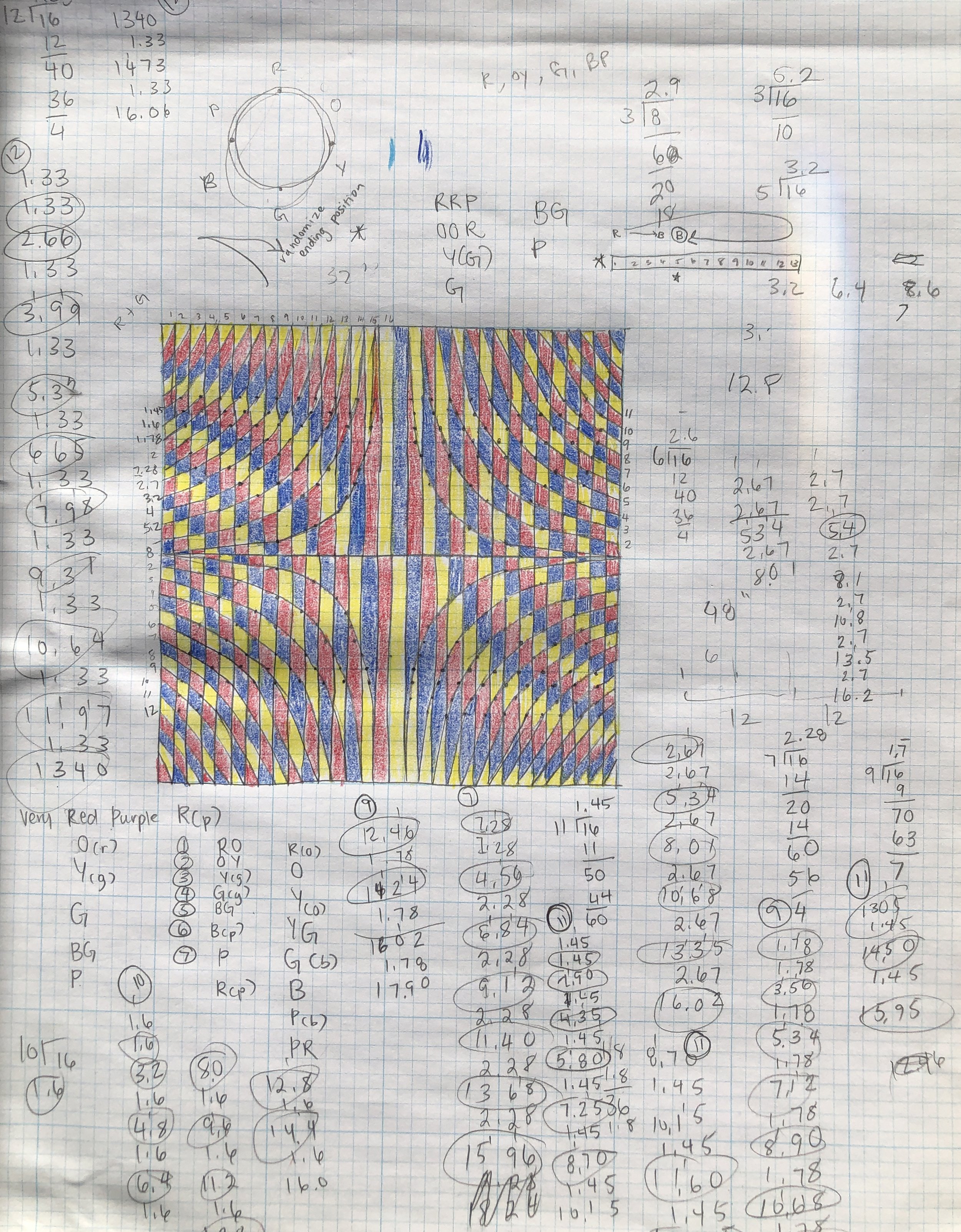
When asked about the systems in which she operates to create her work, Bass did not shy away from the topic of spirituality. Brianna really skillfully navigated this subject matter by describing the bigness of our reality, and the inquiry around and attention paid to all we can see and feel. These are components of the orchestration of the universe. Her work is meticulously created, colors plotted by grid and geometric shapes, with gradations of hues that are intentionally precise. They exhibit an exercise in both understanding mathematical patterns, and the curiosity of how some quizzical rules get implemented to create an image.
Her work inhabits a world between two Agneses; the disciplined and meditative, process based paintings of Agnes Martin and the ethereal, transcendental themes of Agnes Pelton. By abiding by such systems in her work, Bass asks: what arises from layering numerical and visual code on top of one another? What becomes rendered as patterns are repeated? She says that when she works in this way, she is just illustrating something that already exists. She doesn’t need to convince anyone of the magical, spiritual, ethereal knowledge she possesses and feels- because the foundation of this truth in mathematics is irrefutable. Thanks to the accepted systems of math, she is able to use color to illustrate the expansion of divisions and unfurl into realms of uncertainty and relativity. Music, sound ways, light particles, magnetic fields, these are examples of accepted truth.
The universe is a spiritual matrix, and it is factual.
It is grounded in the documented science that we have practiced for hundreds of years and is the foundation upon which we agree on reality.

Luminiferous Ether, Brianna Bass, 2026

Luminiferous Ether (detail), Brianna Bass, 2026
Practice and agreement are specific words that came up in our conversation. When discussing reality, we noted that the nature of disciplines that are ‘practiced’ (like medicine or yoga) are subject to change when better understandings are built upon the shoulders of the knowledge that preceded it. In Carlo Rovelli’s novel, Reality Is Not What It Seems, the italian physicist describes quantum gravity in an accessible and poetic way by providing the context of newtownian physics up to some really mind-bending physics stuff. In it, Rovelli writes, “Reality is a network of granular events; the dynamic which connects them is probabilistic; between one event and another, space, time, matter and energy melt in a cloud of probability.” In his opening lines, it is made clear that our reality is a changing and agreed-upon ephemeral moment that is constructed based on the information we have at the time in conjunction with probable chance. This information is validated by knowledge we hold at a high regard (ie. science) but also bolstered by a kind of felt knowledge, or gnossis, as some would describe it- intuitive and magical. The limits of our scientific reach, specifically in the realms of physics tickle the edges of what we recognize in our spiritual, animal bodies. The relativity and changing nature of reality, of which we conceptualize as solid and fundamental, is represented beautifully by Bass’s study of color. Colors morph based on the light of day, the humidity in the air, proximity to other hues. Our perception of a color can be altered by something as personal as how we are feeling about that particular shade, and yet since we can see color with our eyes, we deem it to be steady and ‘true’. Bass described seeing color as the process of our eyes and our brains working together to build an image. It is the mysterious nature of changing reality that keeps us progressing in the sciences, and calls our greatest minds to roam into the unknown. Rovelli continues in his novel, saying: ‘‘The world is boundless and iridescent; we want to go and see it. We are immersed in its mystery and in its beauty, and over the horizon there is unexplored territory. The incompleteness and the uncertainty of our knowledge, our precariousness, suspended over the abyss of the immensity of what we don’t know, does not render life meaningless: it makes it interesting and precious.’’
“There are glorious physical phenomena all around us, and it is our duty to pay attention to how these moments move us. What can they teach us?”
When asked if the changing nature of reality felt unsettling, Bass replied that it is not unsettling but rather an opportunity for a social value that relies on our collective choice to agree on fundamental truths. In this, it is actually our ability to keep things suspended and be able to look at it from different angles that creates a practice of approaching the world with curiosity and trust.
This is something painting can teach us. This is where art steps in and shows us various ways of practicing seeing the world that all feel true, but we need stewards of rotating the prism of perception that inspire us to inquire about how things are versus how they may be or even, how they ought to be.
The opposite of this is rapid fire, black and white, definitive thinking. No room for questions, no tolerance for mystery. In this way, I see a very clear parallel between systems of power and politics that discourage creative thinking and an opportunity to resist through tender, intentional inquiry. Every conversation we have that shifts our world view, every book we read that offers a new way through or elevation of ancient wisdom is a calculated choice that accumulates into a rejection of rigid, top-down thinking.
If the stimulus is simple arguments surrounding scapegoating, fear mongering, and climate change denial, how can we promote nuanced conversation that imagines a future with compassion, complexity, and things we can't even understand yet? We must ask artists, like Brianna Bass. We must spend time with color, with our values, and with our shadows. This is a place I would like to begin to build and comprehend the challenges and the magic that awaits us.
Don’t Look Down (detail), Brianna Bass, 2022

Don’t Look Down, Brianna Bass, 2022
Article by Emma Hines
Based in Oakland, California, Emma Hines is a writer and painter interested in the intersection of the arts, science, and spirituality. She is building a web of conversation with artists, philosophers, and scientists who are bridging modalities for knowledge in a way that uplifts mystery and magic while also being invigorated and grounded by science. The knowledge we gain from rigorous scientific testing adds a layer of understanding to the knowledge we experience through lived experience, intuition, and alchemization through art, all of which are important for illuminating the multiple complex facets of the universe.