Aurélie Gravas’ paintings do not settle easily. Faces emerge and dissolve, gestures become landscapes, and domestic spaces seem to hover between shelter and something less certain. Working between figuration and abstraction, Gravas builds paintings through looking, waiting and repeated acts of revision, allowing images to surface rather than imposing them. With a recent solo exhibition in Menorca behind her and exhibitions in Ghent this autumn and Brussels in 2027 on the horizon, she reflects on the evolving relationship between instinct and intention, the patience of painting, and the moment a work begins to exist beyond its maker.
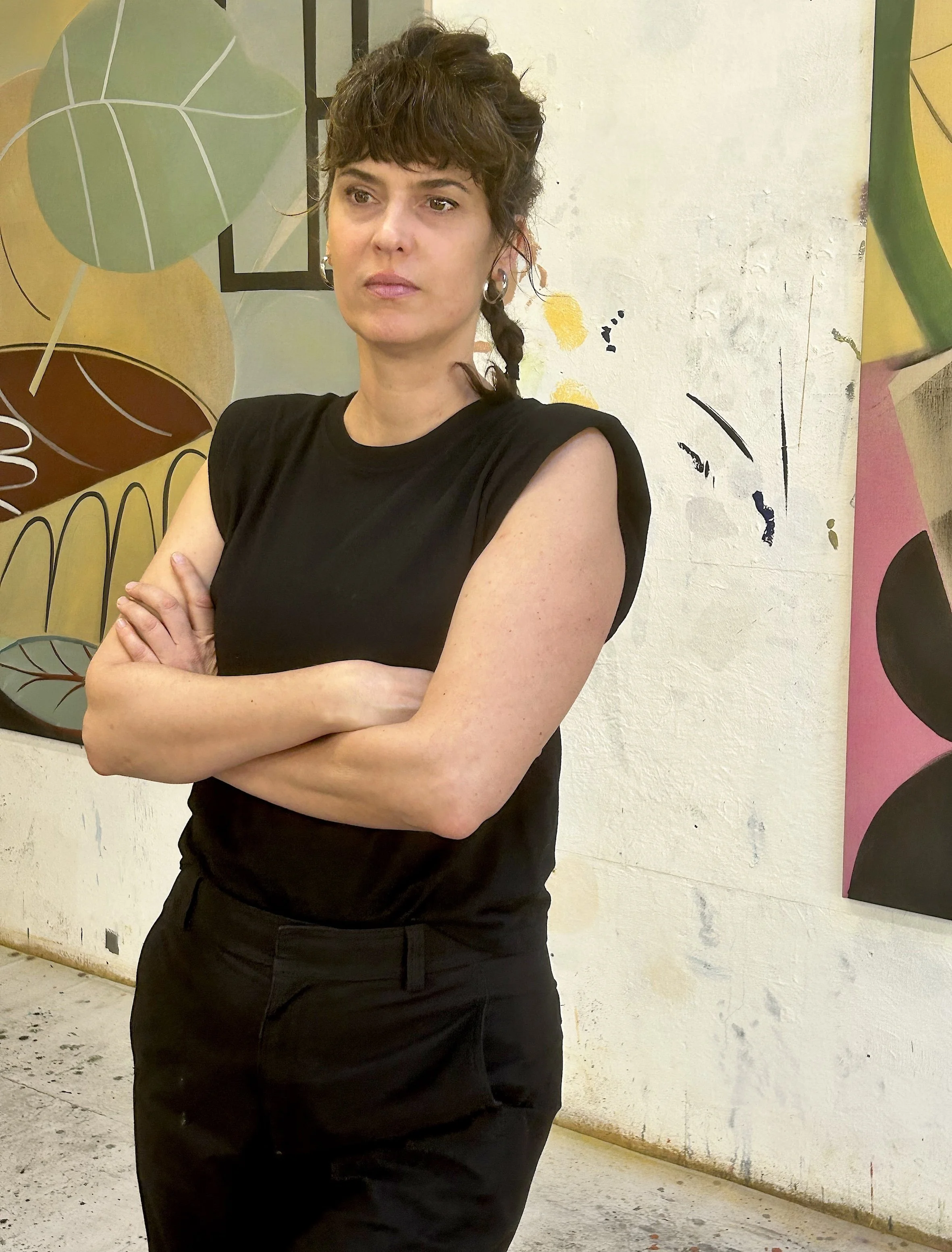
Portrait Aurélie Gravas
Your recent exhibition at Etesian Gallery in Menorca and your forthcoming presentation at Kristof De Clercq Gallery in Ghent mark two moments in your current practice. To what extent do you see them as connected? Is there a question, intuition, or tension that runs through the works you have been developing?
The exhibition “Les mains du miracle” that I created between August-September at Etesian Gallery in Menorca functioned as a link between what I developed in 2024–2025 and what I am currently building, which will be presented between November-December at Kristof De Clercq Gallery in Ghent. I do not work according to the logic of the series, even though all the paintings I present propose a common territory.
It took me a long time to understand what really ran through the Ghent exhibition. All I knew was that I was gradually moving away from human faces towards a broader vision: no longer only the “one” space of the face, but what the figures do, the spaces they inhabit, and the way they exist together.
“Les mains du miracle” at Etesian Gallery presents paintings in which hands are in motion and bodies are engaged in very simple gestures, sometimes ordinary or weary. “Les mains du miracle” is the title of a book by Joseph Kessel: the story of a young prodigious masseur who treats Nazi dignitaries during the war and prevents certain crimes from being committed.
My real tools are my eyes and my hands. I spend a long time looking at the painting before adding something to it or covering part of it, because I need to understand what is happening in it.
Listening to you, one almost gets the impression that the paintings know where they are going before you do. When you begin a canvas, is there nevertheless a concrete starting point? Is it a colour, a shape, a format, an idea?
There is always an intention, of course. Otherwise I would never begin anything. But I believe that none of my paintings is the result of that initial intention.
Take “Le nichoir” [“The Nest Box”] — 170 x 140 cm — oil and pigments on canvas, 2026. I wanted to construct a landscape around a house, but the shapes I was seeing evoked a body. The landscape became a human figure, and the house became a nest box, an object inside that body.
When we go for a walk, our gaze settles here, then elsewhere. We take one path, then another, until we forget the one we had planned to follow at the beginning. There is a form of restorative distraction, a fertile forgetting, and constant concentration. Painting works exactly like that.
Nevertheless, certain elements sometimes impose themselves very early. The hands in this painting, for example, were there from the beginning. Very quickly, I understood that I would not touch them again. They became a fixed point around which everything else was constructed.
There is often a detail like that: a shape, a colour, a light that I immediately feel carries the mood of the painting. I then work around it, letting the rest evolve. There is also the importance of being surprised.
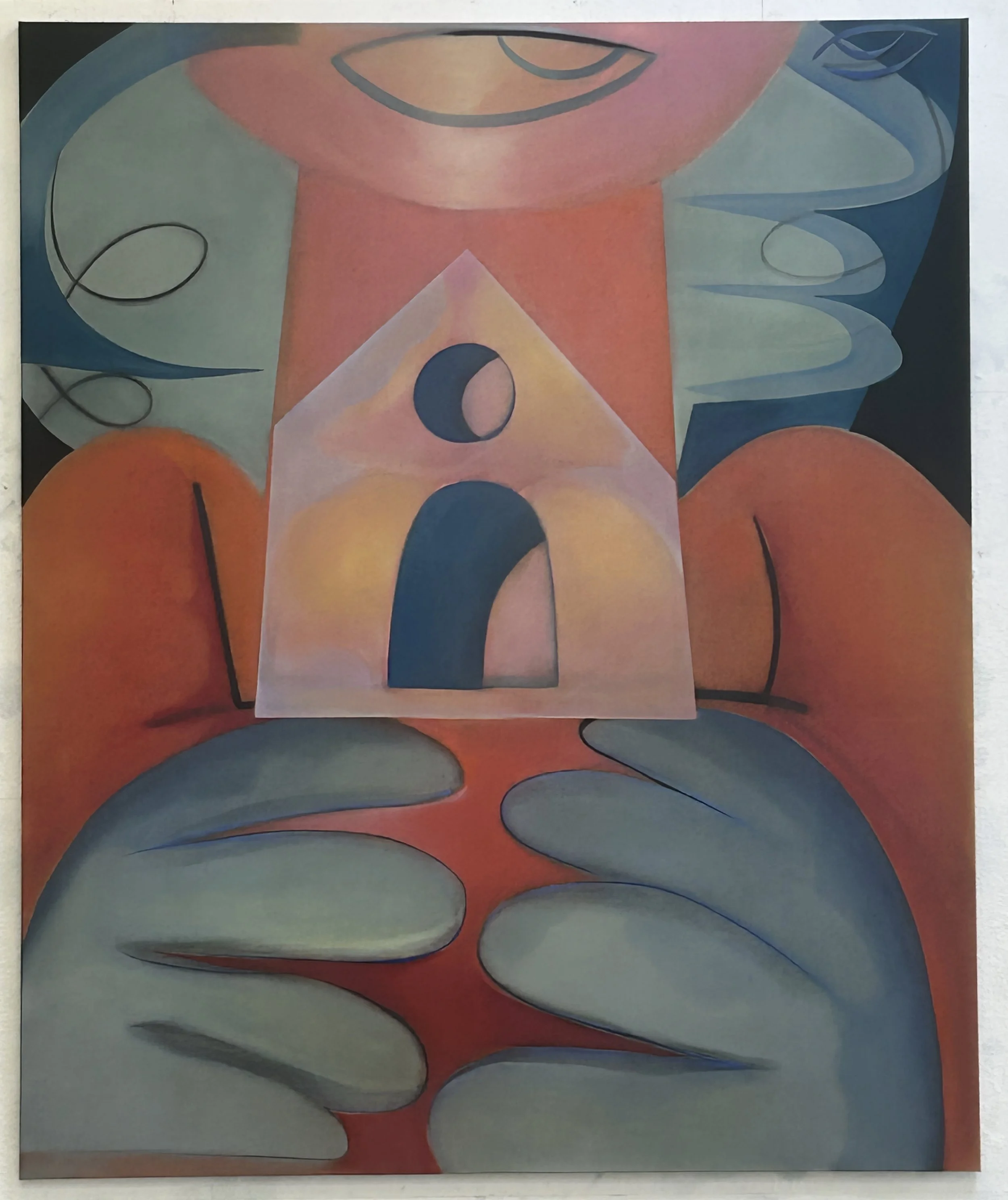
Le nichoir, Aurélie Gravas, 2026
170 x 140 cm; oil and pigments on canvas
Image courtesy of the artist
Your practice has been described as a “strategy of life and survival”, capable of constructing a protective space against what threatens existence. As your work gains visibility and gradually leaves the intimacy of the studio, can this space still function as a refuge? What does it become when it enters the exhibition and art-market system?
I do not know what becomes of my work when it enters the exhibition and art-market system.
Recently, I was interviewed by the art critic and friend Paul Ardenne, who was trying to understand where these paintings came from and what their secret might be. He sees in them a strategy of survival, something related to care. That makes me happy.
I believe there is a form of mystery, a secret that I deeply trust, and which I try to leave a great deal of room for in my life in the studio.
There is something fertile about letting a form emerge, and accepting that you have to wait before making a decision—there are so many possibilities! Time is an ally in my practice. The next gesture is carefully considered before it is made, and it also acts as a surprise.
Waiting for the right moment to act is a strategy. My view of the canvas changes over time. I get rid of my first desire because it is not enough, in order to discover a new energy, a turning point that creates a lasting tension.
So, to answer your question: what becomes of my practice when it enters the market? I simply believe that paintings continue to produce sensations after leaving the studio. During an exhibition at Alice Gallery in 2024 — “A Fan as a Rising Sun” — a woman came up to me: “I hated your work, but…” She was not aggressive; on the contrary, I could sense that she was genuinely troubled. She explained that she had entered the exhibition and that there was nevertheless something she could not name, something that held her there. She bought a large painting.
For me, this may be what happens when a work encounters the market. My work acts gradually on someone who looks at it. That is what painting does to me as a viewer. There are works that move me physically, that alter my breathing and act like revelations.
Your works often occupy an unstable zone between figuration and abstraction. A shape can become a face, a fish, a flower, a flame or a fragment of landscape. At what point do you decide that an image is sufficiently legible—or, on the contrary, sufficiently indeterminate—to consider a work finished?
I need there to be contradictions. Elements that can be very graphic must be able to coexist with much more evanescent areas, in order to create an atmosphere that both holds and loses the gaze. A duality rather than a unity, while keeping the painting harmonious so that one can linger over it for a long time. I avoid a single point of view.
There are gestures that close off the space. Sometimes that is because I am close to the end. But sometimes I realise that I have closed it too early, and then I need to reopen the painting. It is a constant balance between resolving something and opening up a space of possibilities. There is something very satisfying about finding the gesture—the full stop at the end of the painting—which also arrives as a surprise.
In 2024 I made a large painting depicting a female profile with a large hand, but something was missing. Everything seemed to be there: the structure, the material, the colour relationships suited me, but I could not find what the painting was saying. The narrative does not come from me but from what the painting gradually imposes. I added a tiny detail between her imposing fingers, and the painting was finished.
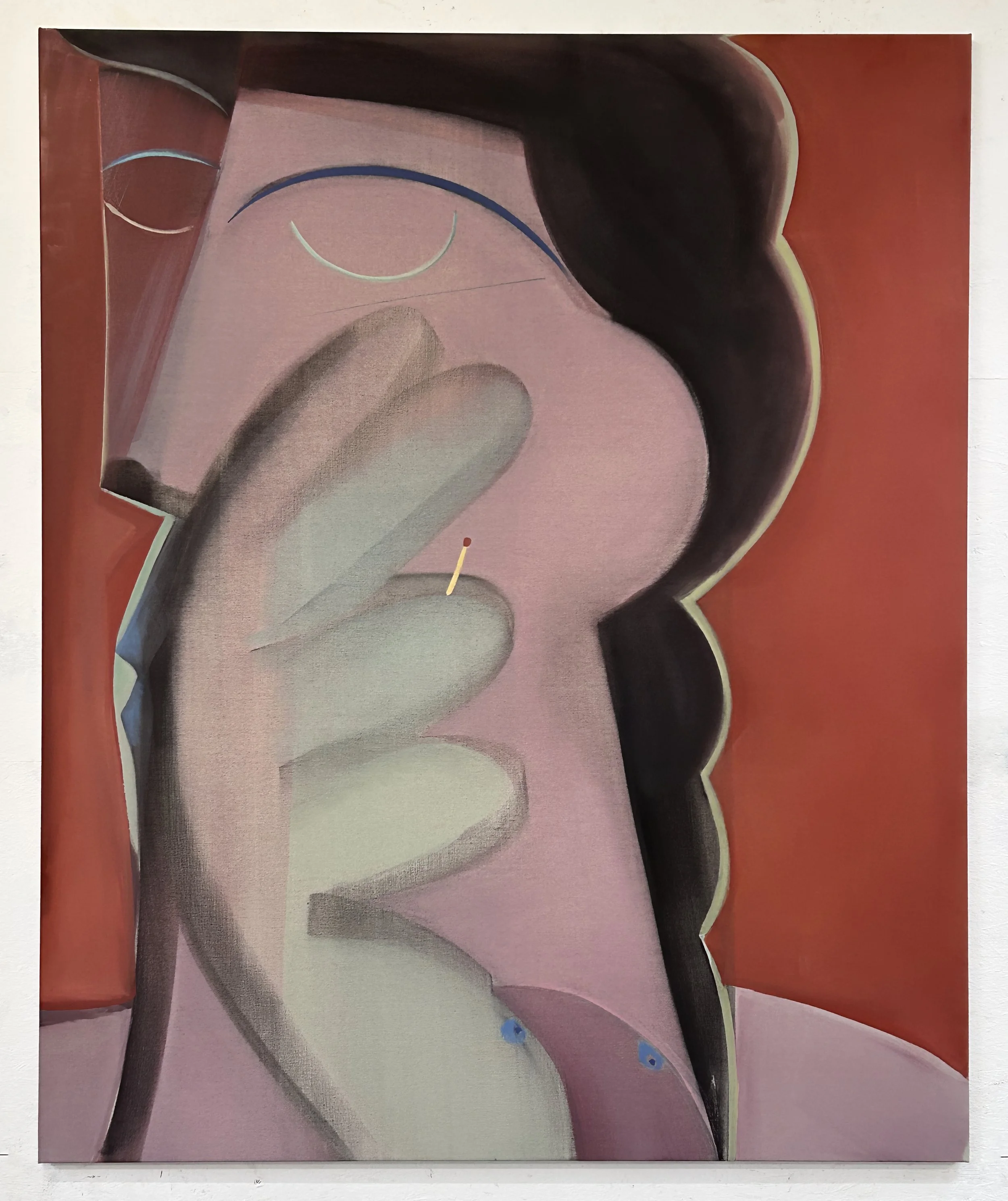
L’Allumette, Aurélie Gravas, 2026
170 x 140 cm, oil and pigments on sheet metal
Private collection, Brussels
My work has evolved since I moved into my new studio (2024–2025). Narrative has taken on a more prominent place. Domestic elements have emerged in my subjects, together with a relationship to shelter/home and its inhabitants. What continues to interest me is what lies beyond the image. Even when it is more legible and more fully embraced, the image allows the painting to emerge differently.
I use colour relationships that evoke moments when the light is changing. The blocks of colour are more nuanced. Using these colours allows me to create a mood in the painting and heighten the sensation. I work on raw linen canvases, prepared with a transparent coating, whose weave sometimes remains very visible. I began using these supports around 2023 because the white of the canvas made me hold back.
I begin lightly, with chalk or charcoal when I have a reference drawing. I do a lot of drawing in ink or charcoal on A4 sheets of paper to loosen the gesture, access other automatisms and other spaces; they sometimes serve as starting points for canvases. Sometimes I want to develop on a large scale a gesture discovered in a small format and discover how to feed the material, how to inhabit the surface.
At other times, the first layers of colour create a surface like a skin and invite me to return to it. The exhibition at Kristof De Clercq Gallery in Ghent will be called “Hosts”, in the sense of welcoming into a space that invites you to stay.
The further the painting advances, the more I work with opacity and material. At that point, something changes; something exists autonomously, outside me: the painting begins to hold me at a distance. The space of the painting no longer calls to me in the same way. I believe this is how paintings end: when I no longer feel that pull to return to them. I would rather look at them from a distance, for a long time.
Faces occupy a central place in your painting, but they never seem to be portraits in the traditional sense of the term. You have, in particular, referred to Emmanuel Levinas’ notion of the “panim”, which does not designate a fixed identity but an encounter with the other. What does this idea of a multiple and open face make possible that the individual portrait perhaps does not?
I never really wanted to make a portrait. Faces appeared in my practice rather unexpectedly, after a painting presented in the exhibition “Faces” at Kristof De Clercq Gallery in 2023. It was one of the first large canvases I made on raw linen. The format was significant—210 x 160 cm—and I had worked with a large wooden stick to which I had attached a piece of charcoal. This allowed me to see the whole painting while also seeing my gesture take place.
I drew large lines in charcoal and then circumscribed them with a black-aubergine paint. I remained in front of the canvas for a long time without being able to return to it. There was something about it that I found sufficient, engaging, intense and right.
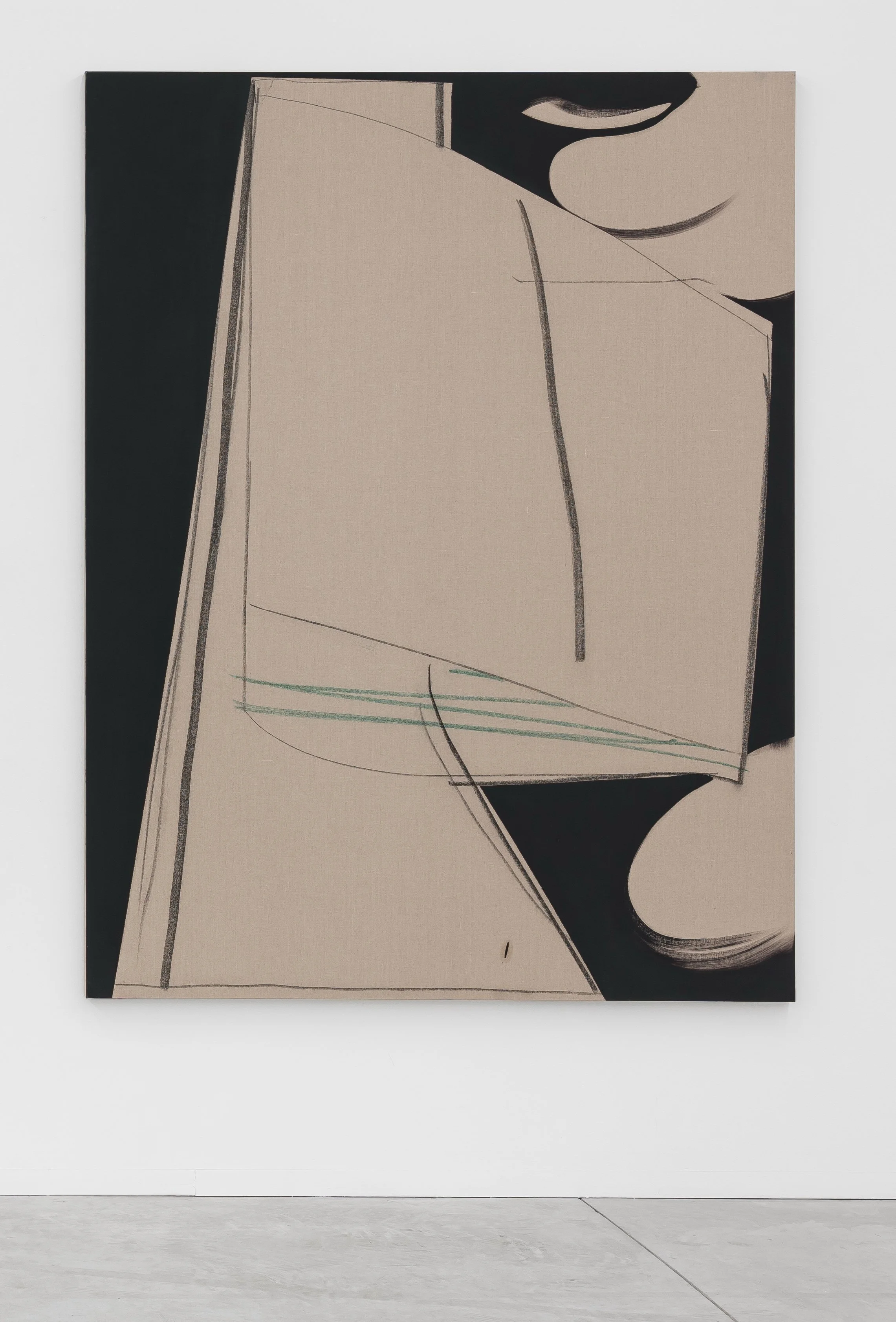
The Weight, Aurélie Gravas, 2023
210 x 160 cm, oil and charcoal on canvas
Image courtesy of the artist
This form evoked both a presence and a space, a human face. As we said earlier, the human mind is constantly trying to recognise shapes. And there are faces everywhere: in a moon, an apple, a cloud, a shadow, a stain on a wall. And forms shift from one state to another.
What interested me in this painting was that this face was not something I had composed. I had discovered it. It had appeared. This allowed me to approach the canvas differently, without having to worry about narrative coherence, perspective, or even the validity of a subject. The face became both the point of entry and the point of exit.
There is always an element of the unknown. Finding a face in a canvas is more like an encounter than a construction. This is also why I recognise myself in Levinas’s idea of the face: it is the other at the same time as it is the self. It is plural, openness, encounter.
I find a face when I create a tension between what seems obvious to me and what surprises me. I avoid the obvious.
In some works, you cut up and assemble different fragments so that they retain their autonomy rather than being definitively fixed. How does this mobility transform your relationship to composition? Does this process also introduce a sculptural or performative dimension into your painting?
These works belong to a particular period in my development, between 2014 and 2016.
At that time, I had a small studio at home and I was pregnant. I no longer wanted to use certain products, so I started drawing a lot on paper. My workspace was filled with large sheets, fragments of drawings and pieces of canvas.
Some parts appealed to me more than others. I gave myself a great deal of freedom to experiment. I could simply say to myself: “This part works, this one less so,” and then cut with a utility knife or tear.
Gradually, I began to notice that these gestures, placed next to one another, produced something interesting. Torn paper could create elegant forms. With canvas, cutting with a utility knife introduced very sharp angles, a tension between the softness of the painted forms and the radicality of the cuts.
This experience profoundly influenced the way I compose today: it allowed me to understand that my painting produced a space of relationships rather than a single space.
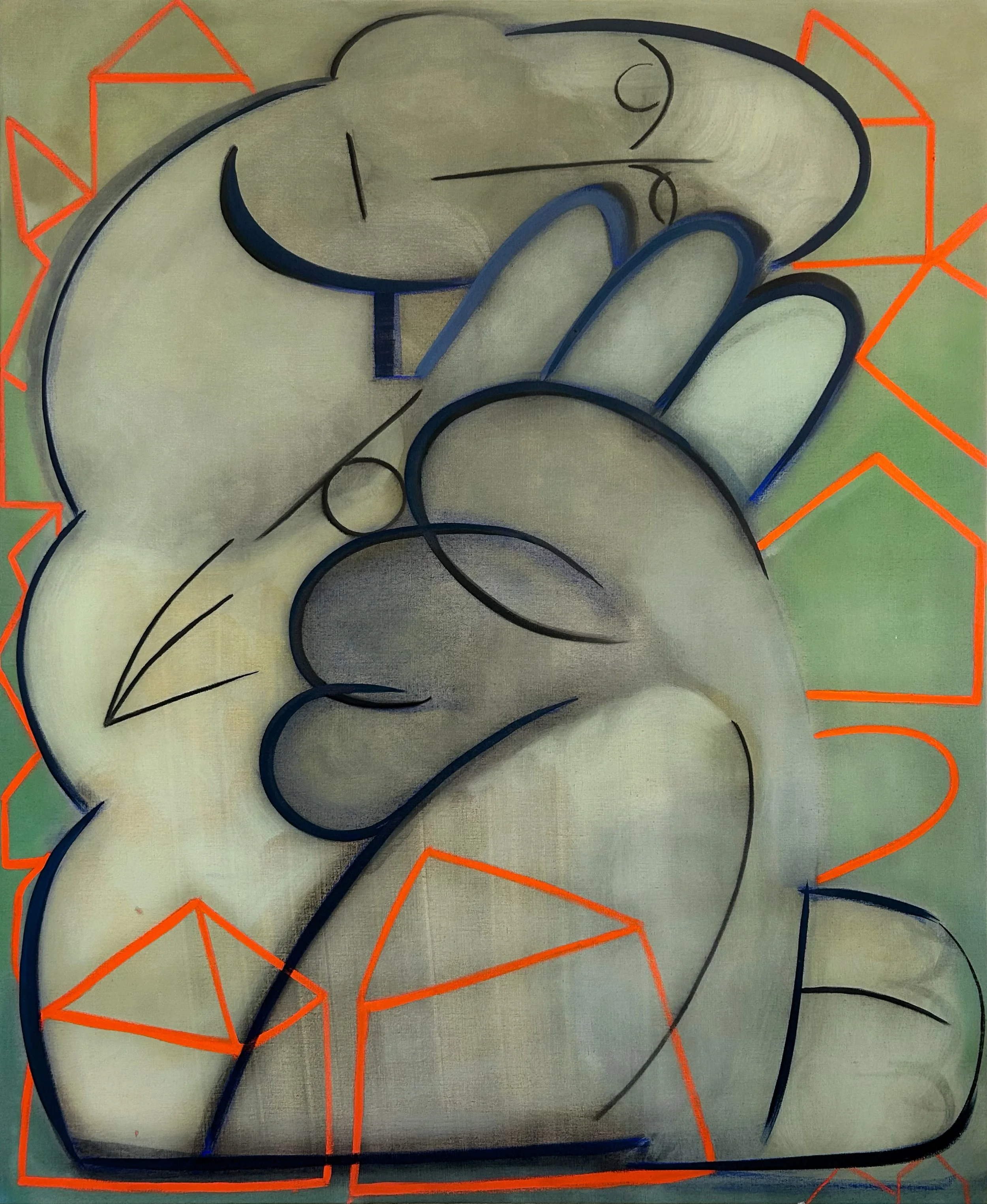
The Resident, Aurélie Gravas, 2026
140 x 115 cm, oil and pigments on canvas
Image courtesy of the artist
You openly engage in a dialogue with several major figures in the history of modern art—Matisse, Miró, Klee, Picasso, Braque, Bram Van Velde and Jawlensky, among others. How do you work with this heritage without allowing yourself to be confined by a relationship of lineage? And what does it mean, for a woman painter in 2026, to practise painting within a historically largely male canon?
In my youth, I was probably confronted with many male views of my work and of me as a person. But for a long time, I was mainly absorbed by the need to construct my painting space. What mattered to me was not finding a place in society as a woman, but finding a place in the studio as a painter.
I was close to painting from a very young age. My parents hung a lot of paintings on the walls. We did not know who had made them; they were often anonymous. I never looked at a work through the identity of the people who had created it. I looked at the works as best I could. It was only as I grew up and went to museums that I discovered that the great artists on display were men.
I built my way of looking through the works that were available to me. I am a woman born in the twentieth century. My pictorial DNA comes largely from the twentieth century. The reach and influence of a work of art are not the same as those of its author. A work becomes something that belongs to the gaze of those who encounter it.
What particularly interests me in twentieth-century artists is the willingness to take risks, the invention of a language, the desire to reach something that seems far removed from satisfying a market. It is this freedom that inhabits me today.
My lineage with the painters you mentioned is evident and acknowledged, but when I paint, everyone leaves my mind: the artists, the critics, family, friends. What matters is that the painting exists.
Over time, my gaze has turned more towards women artists, but I do not necessarily feel the need to construct an opposition or explain it to myself. What matters to me is what the works produce in me.
As for discrimination related to visibility, I have probably encountered it. But for a long time, I was so focused on building my work that I did not even always see the doors that were not opening.
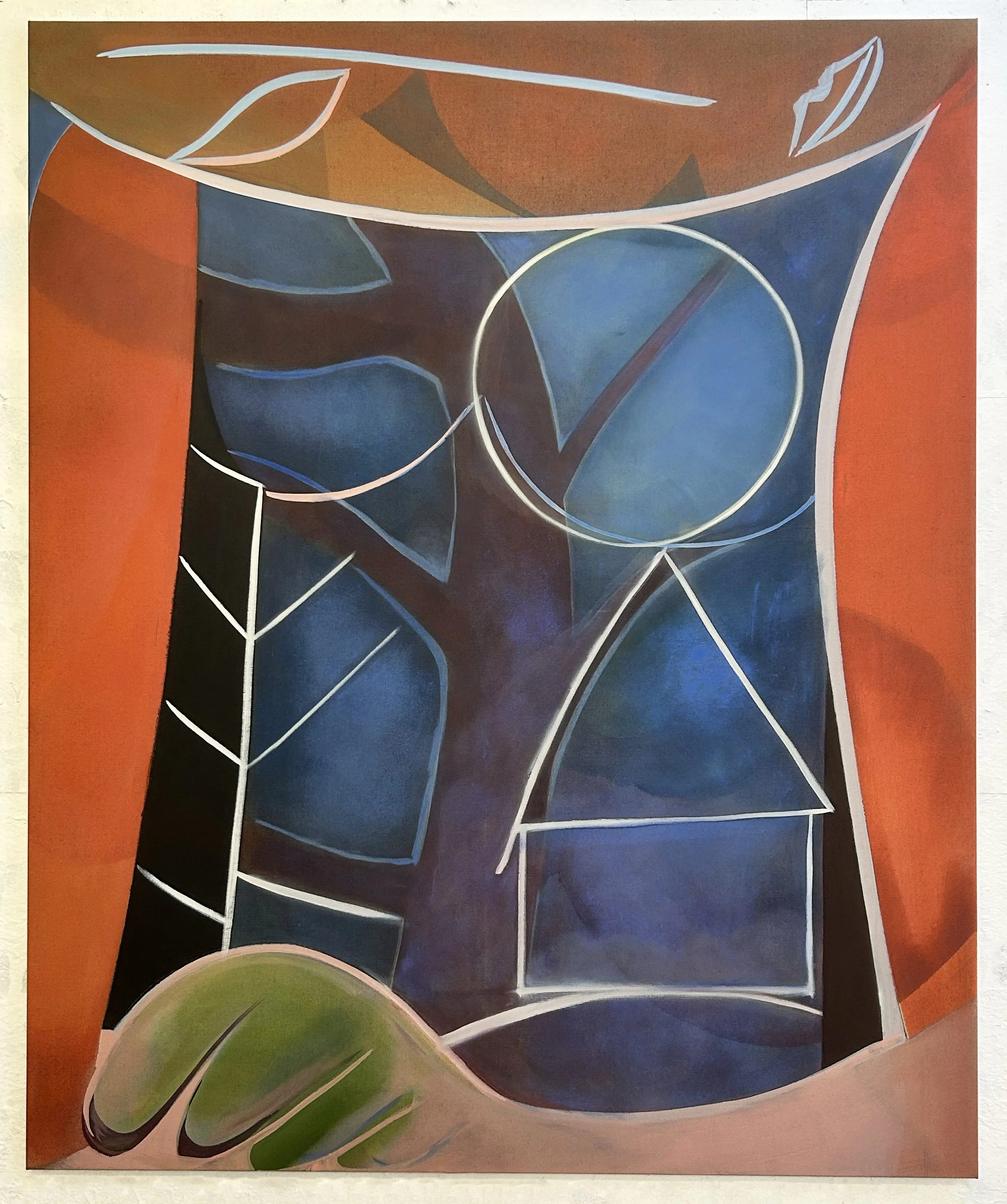
Dedans c'est le paysage, Aurélie Gravas
Image courtesy of the artist
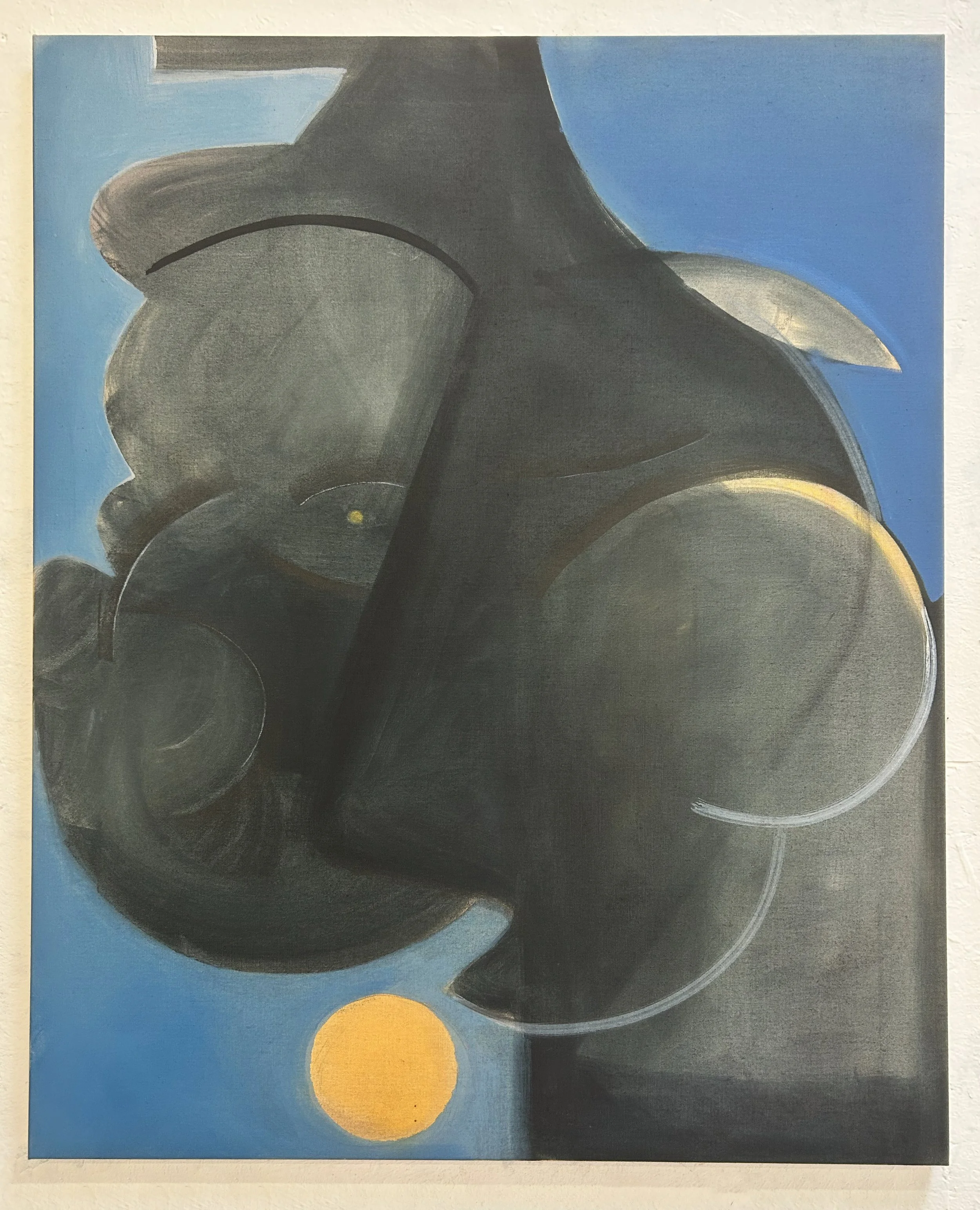
La Lune, Aurélie Gravas
Image courtesy of the artist
You have maintained a parallel musical practice for more than twenty years, and you have explained that music allowed your paintings to free themselves from a certain narrative burden. Even when you work in silence, how do rhythm, repetition, dissonance or improvisation enter into your pictorial gesture and the way you imagine an exhibition?
I do not listen to music when I paint because I do not think about it.
Practising music has transformed the way I make paintings.
One day, I realised that I was mistaken about what painting could contain. I wanted to say certain things in the paintings, when they needed to exist elsewhere, in words set to music. When I found a space to express them differently, the painting was liberated. It could become something else.
There was then a constant movement between the two practices: what painting brought could generate words or ideas. And conversely, music freed painting from an overloaded literary discourse. This allowed the paintings to rid themselves of a certain dramatic excess and recover a form of language that was more purely pictorial.
The question of rhythm is nevertheless always present in my work. Each painting has its own rhythm, but so does an exhibition. Some paintings are silent, others noisier; some are more narrative, others more abstract; some are calmer, others more tense. In an exhibition, perhaps they propose an experience similar to what one can feel when listening to an album: movement, accelerations, pauses, breaths.
Constructing the rhythm of an exhibition allows me silences, interruptions and unexpected links between the works.
As for music itself, we released an album in 2024 (GRAVAS) and gave several concerts. For the time being, as I have several solo exhibitions to prepare, I am focusing mainly on painting.
I feel that I am at the beginning of a new stage in my pictorial work, as if a new world were emerging. Music emerges when the words arrive naturally.
In 2012, you described painting as an act of resistance, precisely because it requires a form of patience that runs counter to the immediacy of our time. Now that images circulate more quickly than ever, what kind of attention would you like to invite the public to develop in front of your works in Menorca and Ghent? What would you like to remain after a first look?
What I would like is for there to be a desire for a second look, then a third, a fourth, a fifth look. For me, the first look determines whether there will be a second. It should be the beginning of a long relationship.
The first look is an entry into the work. I went to see the exhibition devoted to Matisse in Paris; I saw paintings and drawings I had already seen, and my sensations towards them were fresh and new. I think we need to accept that we do not immediately know what we are looking at. Accept that the gaze has layers, and that it takes time.
I do not expect anything in particular from the viewer, because I cannot project onto others anything other than what I experience myself. And what I am seeking is this density of the gaze, this possibility of an experience.
What interests me in painting is precisely this paradox: the initial gesture can come from instinct, from something immediate, almost unreflective. But once the work is finished, it requires, on the contrary, time, presence, a form of engagement from the gaze.
I remember my first meeting with the gallery owner from Ghent, Kristof de Clercq. He had come to my studio to see the works. It is always a particular, slightly stressful moment, because you never know how someone will encounter your work.
He arrived, looked at the paintings and walked around the studio for several minutes; suddenly, he simply let out a kind of sigh. Like a sigh of relief, a sensation had occurred. Perhaps that is what I hope for from an encounter with a work: that there does not necessarily have to be an immediate explanation. That there can be a moment when one feels something before even knowing how to formulate it.
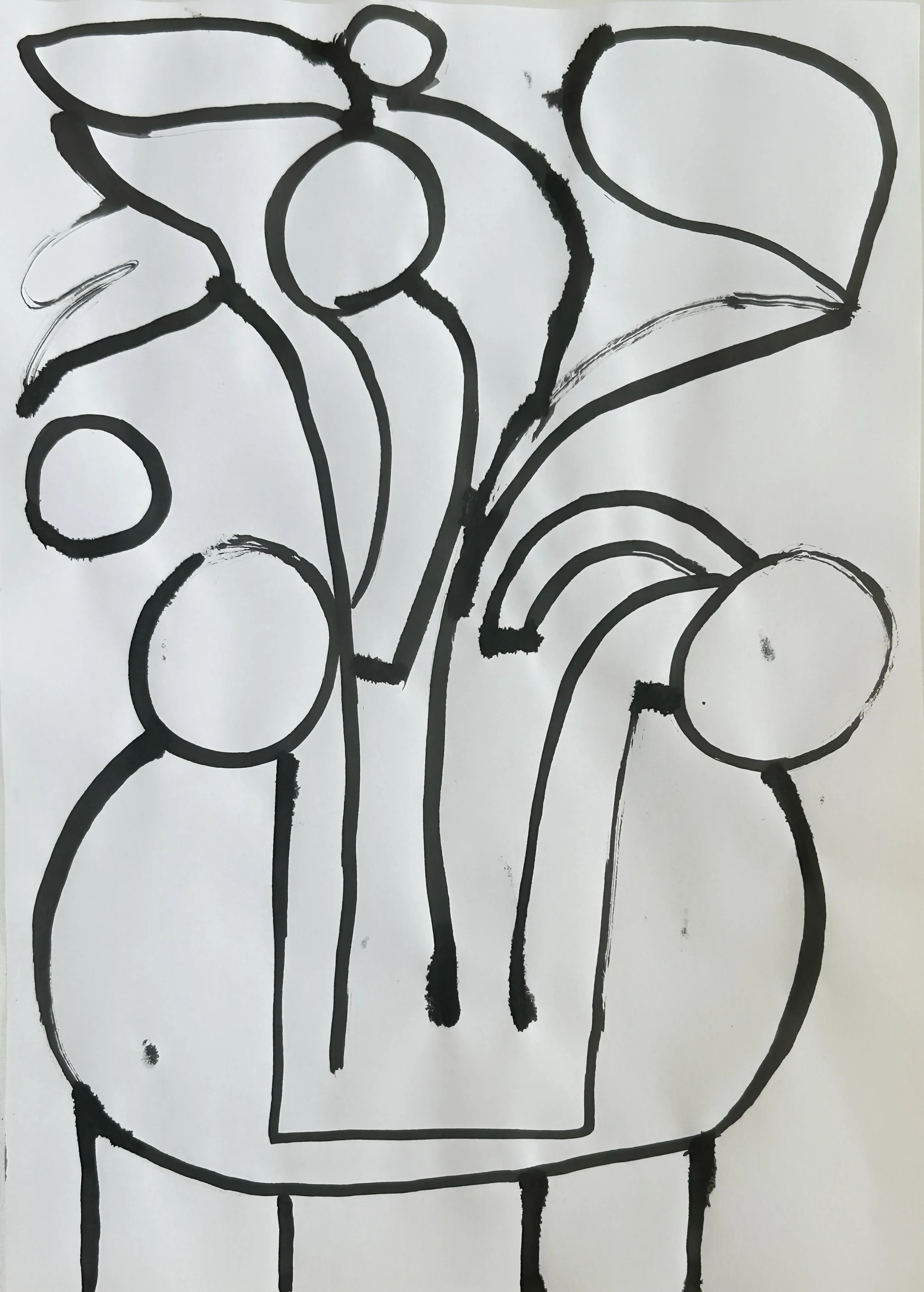
Dessin bouquet, Aurélie Gravas
Image courtesy of the artist
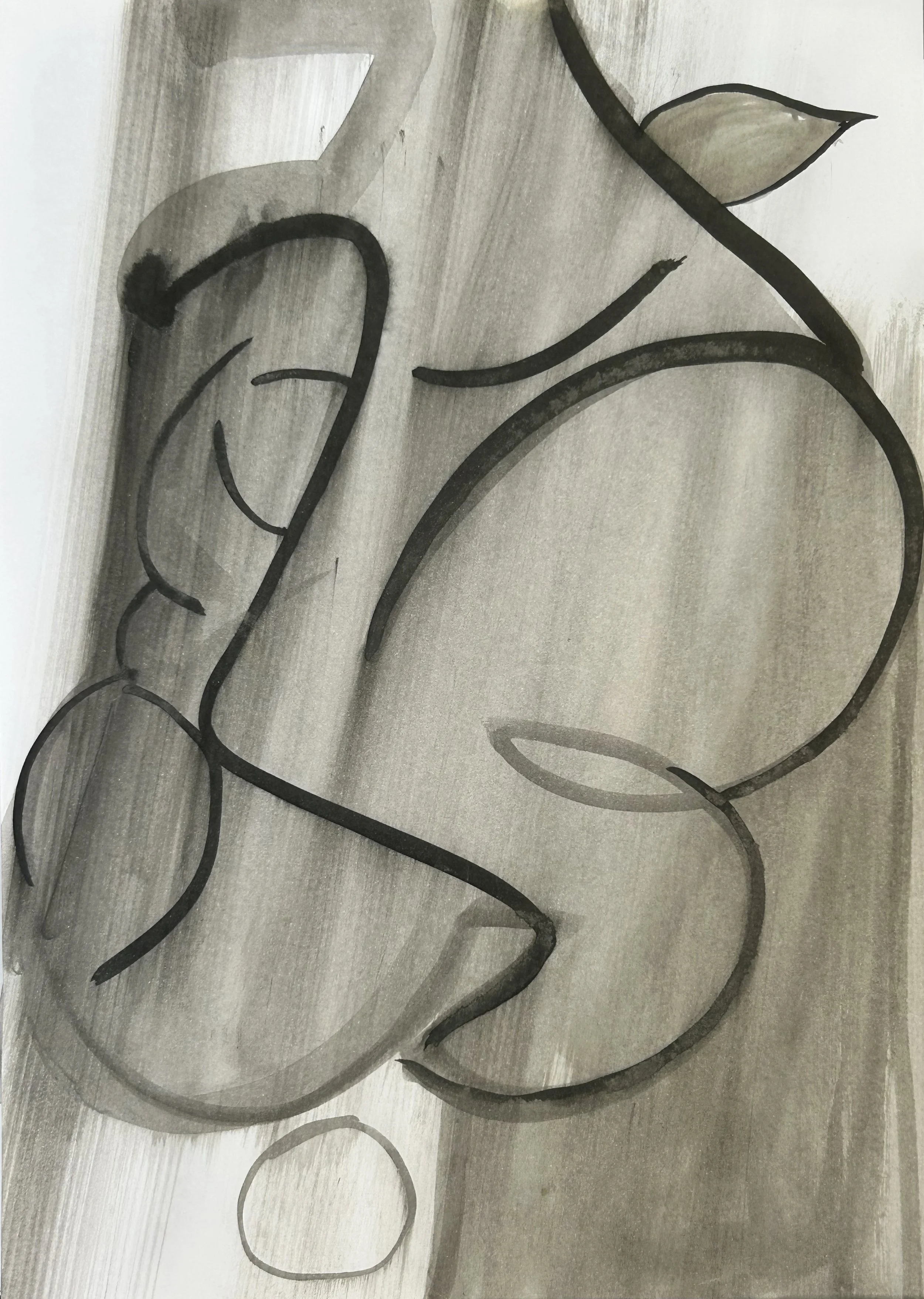
Dessin craché, Aurélie Gravas
Image courtesy of the artist
To further explore Aurélie Gravas’ work, follow her on Instagram. The artist is represented by Kristof de Clercq Gallery in Ghent, and Alice Gallery in Brussels. She collaborates with Almine Rech Gallery, Etesian Gallery and other galleries through collective exhibitions.
Her solo exhibition ‘Hosts’ will be on view in Ghent at Kristof de Clercq Gallery from 22 November 2026 (vernissage) until 19 December 2026.
Article by Alexandra Vîstraș
Alexandra Vîstraș is a Brussels-based cultural observer, policy professional and lifelong theatre enthusiast. With a background spanning cultural management, European policy and communications, she is interested in the ways art, politics and collective imagination intersect, particularly through the lenses of gender, identity and social change.