ART & BUSINESS: NEW SCENARIOS FOR 2026
How art becomes a strategic infrastructure for brands, beyond the old myth of visibility
2026 opens with an uncomfortable certainty for many brands: the market is saturated not only with products, but with languages. Everyone speaks, everyone tells stories, everyone promises values. The result is a constant background noise - elegant, often well designed, yet increasingly indistinguishable.
In this scenario, differentiation no longer comes from optimization, nor from yet another “creative” campaign. It comes from something deeper and rarer: a cultural stance. And this is where art becomes central again. Not as decoration, but as the symbolic infrastructure of the brand.
In recent years, many companies have used art as an accessory language: temporary exhibitions, one-off collaborations, artist talks as PR events. In 2026, this approach reveals all its limits. Art only works when it stops being “one-off content” and becomes process, thought, approach, constant friction.
A brand that truly integrates art accepts a fundamental shift: questioning total control over the message. Because art is not meant to reassure, but to create proactive tension. And today, tension is one of the last tools capable of generating meaning, relevance, memory, and authentic attention.
Brands must become active cultural ecosystems, not mere sellers
In 2026, we will see more clearly than ever a distinction between two types of companies:
those that use art to appear contemporary
and those that think through art in order to remain relevant
The latter do not look for the “right” artist for a brief, but build cultural ecosystems: artistic residencies integrated into corporate processes, collections not as decorative assets but as archives of vision, hybrid projects with no immediate KPIs but long-term symbolic value, and processes that integrate artists as corporate decision-makers.
In a saturated market, value no longer arises from the clarity or visibility of the message, but from its depth and relevance. Art is one of the few tools capable of working on this depth because it introduces ambiguity, stratification, and slowness - elements that traditional marketing has tried to eliminate, and which today return as distinctive factors.
Another key trend of 2026 is the overcoming of the “experience economy” as we have known it. Experience alone is no longer enough. Too many experiences, all too similar. Art, instead, does not promise memorable experiences: it promises perceptual transformations. It changes the way a brand is thought about, not just how it is experienced.
This explains why more and more companies are shifting investments from communication to cultural production. Not storytelling, but story-making. Not campaigns, but contexts. Not engagement, but symbolic relationships.
“Art is not meant to reassure - it is meant to create proactive tension. And today, tension is one of the last tools capable of generating meaning, relevance, memory and authentic attention.”
In 2026, art becomes an escape route from algorithmic standardization
There is also a less explicit, yet decisive aspect: in 2026, brands do not compete only with each other - they compete with platforms, algorithms, and continuous streams of content. In this scenario, art becomes a form of resistance to algorithmic standardization. Where the algorithm tends toward homogenization, art introduces deviation.
And it is precisely this deviation that makes a brand recognizable.
Integrating art today means accepting an uncomfortable question: what kind of vision of the world are we supporting? Because art, unlike marketing, does not communicate values - it puts them into crisis.
2026 will not reward the most visible brands, but the most culturally legible ones. Those that, when observed, clearly reveal which side they stand on. Art, if taken seriously, is one of the last tools capable of building this legibility.
It is not a shortcut. It is a structural choice. And like all structural choices, it is not meant to please everyone. It is meant to be irreplaceable.
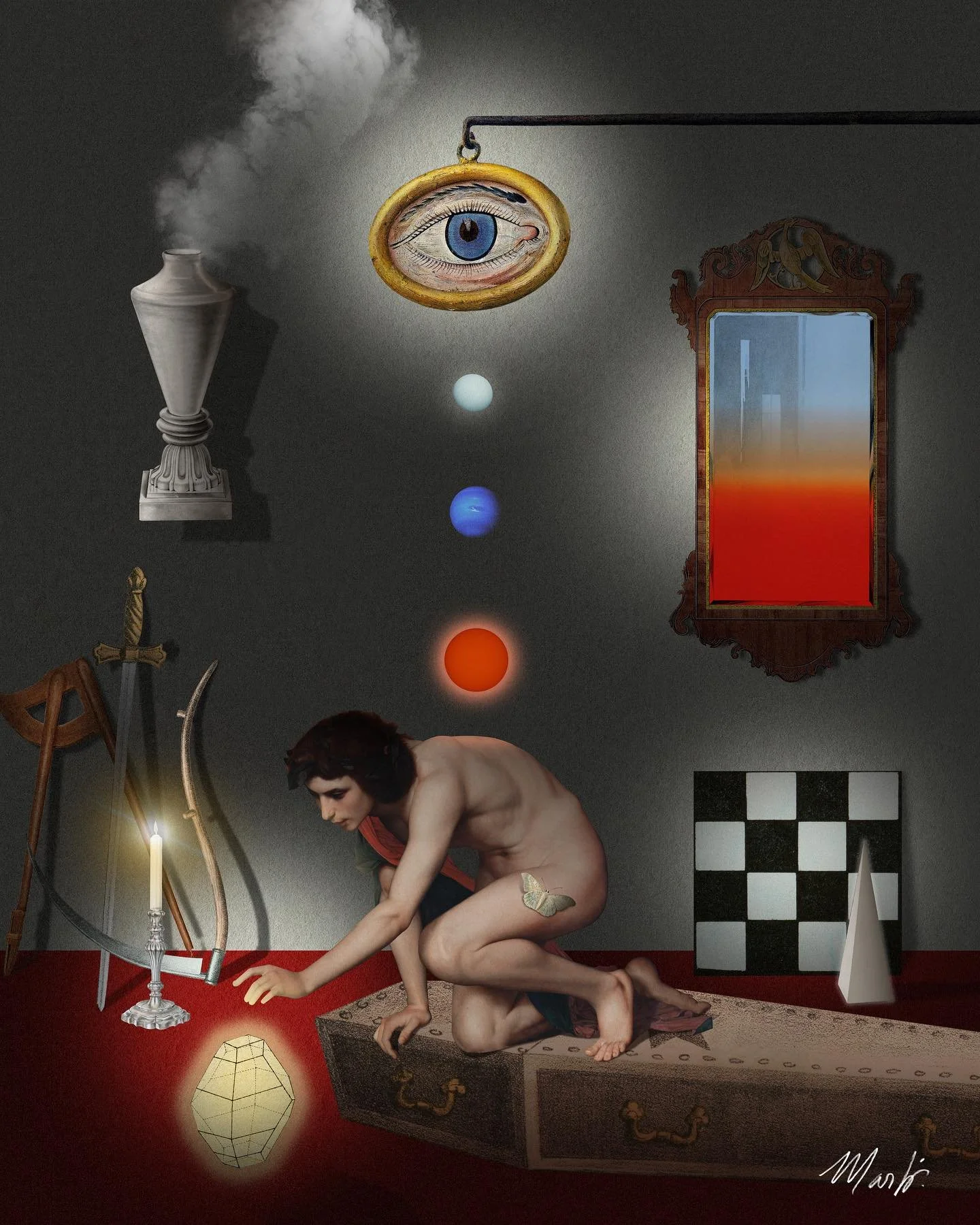
Courtesy of Andrés Martinez Jauregui
Article by Enrico Dedin
Media artist active since 2013, with over 80 exhibitions worldwide. His works are part of the catalogue of Heure Exquise!, distributor of the audiovisual collections of the Musée du Louvre and the Musée d’Orsay. He has been selected for major events and exhibitions, including the 16th Videoart Yearbook curated by art critic Renato Barilli, the Collettiva Giovani Artisti of the Fondazione Bevilacqua La Masa, and The Wrong Biennale, receiving numerous awards and recognitions over the years. His artistic research has also been included in the volume “L’arte del XXI secolo. Temi, linguaggi, artisti” by Viviana Vannucci, professor and international curator. Alongside his artistic practice, he works as an Art Director in the field of multimedia communication. Operating at the intersection of art and communication, he coined the term “Artivator” to define a new role of the artist: a cultural activator for brands, territories, and entities outside the art system. He is also the author of the literary manifesto of Metaluddism, published in the aperiodical Il Foglio Clandestino.