There is a particular silence that settles over a field in the minutes after the mower is switched off, and over a driveway when the last shovelful of snow has been thrown clear. For Gail Rickards, that silence is not an absence but a threshold. It is the contemplative space in which her work begins, a spot where the body is occupied with labor and the mind is, at last, free to wander.
Rickards earned her MFA from the School of the Museum of Fine Arts, Tufts University, in Boston, then relocated to New Hampshire to continue her practice while raising a family. What might have been a retreat from the art world became, instead, a wellspring. Rural living brought with it a new set of circumstances and challenges, and with them an abundance of subject matter. Her work is rooted in that place and reflects the terrain of personal narrative, drawing on the daily life around her.
Her practice moves fluidly among drawing, painting, and small sculptural objects. Line work meanders across wet grounds; abstractions hover between the familiar and the murky, so that an animal or the edge of a woodland may be sensed rather than stated. Beneath it all lies a steady preoccupation with boundaries, perspective, scale, and place, and with the endless maze of inner and outer worlds that she sets out to sort through. Her titles, meanwhile, read like overheard fragments of country life, conversational, wry, and occasionally cryptic.
Rickards has had several solo exhibitions and has shown in numerous group and juried exhibitions in New York, New England, and the Midwest. Currently, she presents a solo exhibition of site-specific work and drawings at Billings Farm & Museum in Woodstock, Vermont, through the Art on the Barns program, where contemporary art meets the working buildings of a farm. We spoke with her about process, humor, and the long work of sustaining a studio practice far from the art world’s centers.
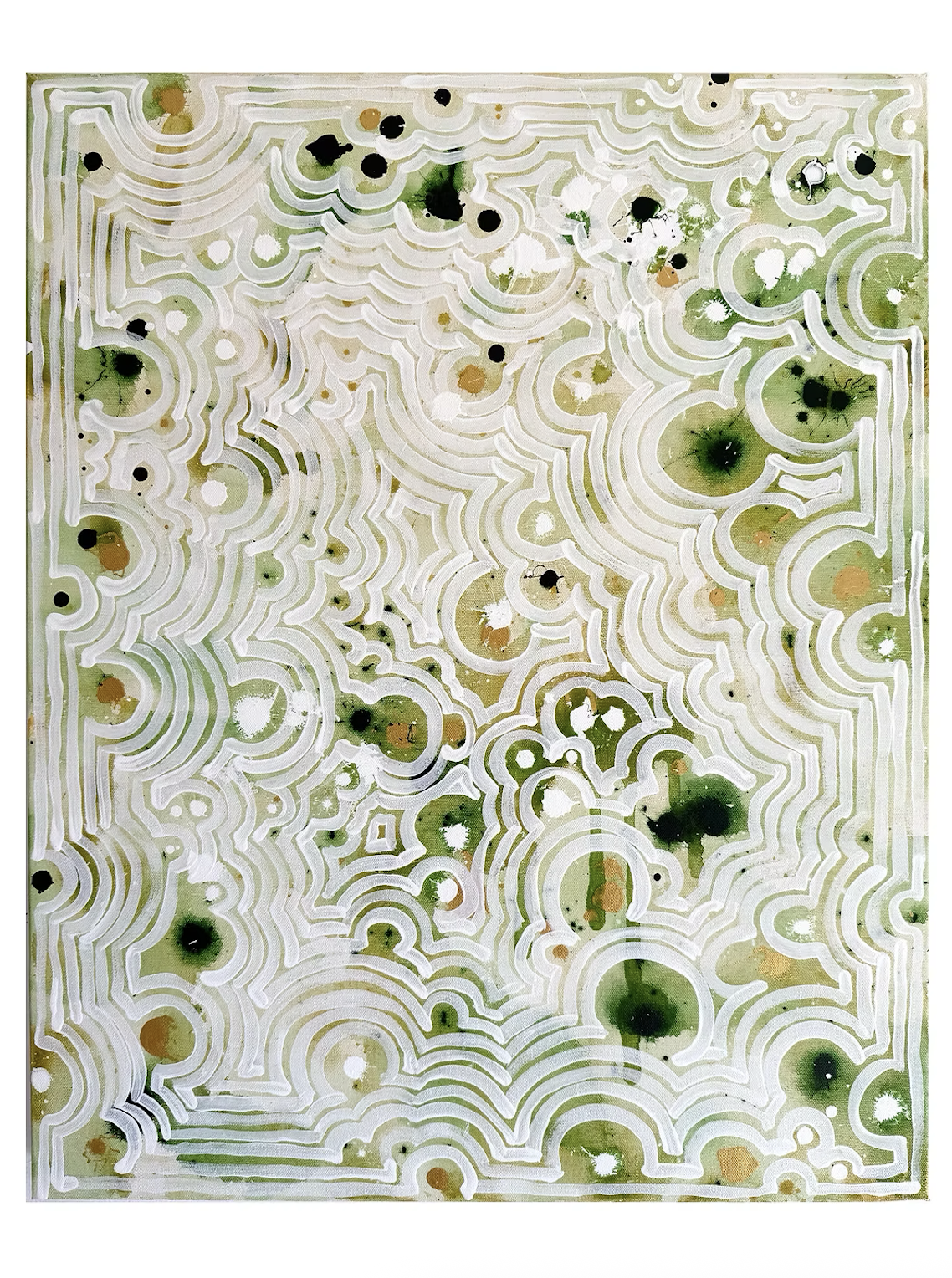
NOVEMBER, Gail Rickards, 2025
Acrylic and gold metallic paint on canvas; 60 x 76 cm
Image courtesy of the artist
After your MFA at the School of the Museum of Fine Arts in Boston, you relocated to New Hampshire to keep making work while raising a family. Did the move change what you wanted to say in your art, or only the conditions under which you said it?
Some of both. Looking back, my environment has always affected what is on my mind and therefore is reflected in my work. Rural living produces a whole new set of circumstances and challenges and, at the same time, has provided a vast landscape of content.
Drawing, painting, and small sculptural objects all have a place in how you work. When an idea first comes to you, do you know which medium it belongs to, or does it find its form as you work?
I tend to know what medium makes sense as the ideas form. I make groups of work simultaneously and shift between different “projects” that are under way so the materials I use naturally relate to the concept. I would say drawing (painting on paper) is my go-to process because of its immediacy. I also find and collect objects and materials that take up space in my studio, and eventually (or not), they seem to demand my attention and become sculptures.
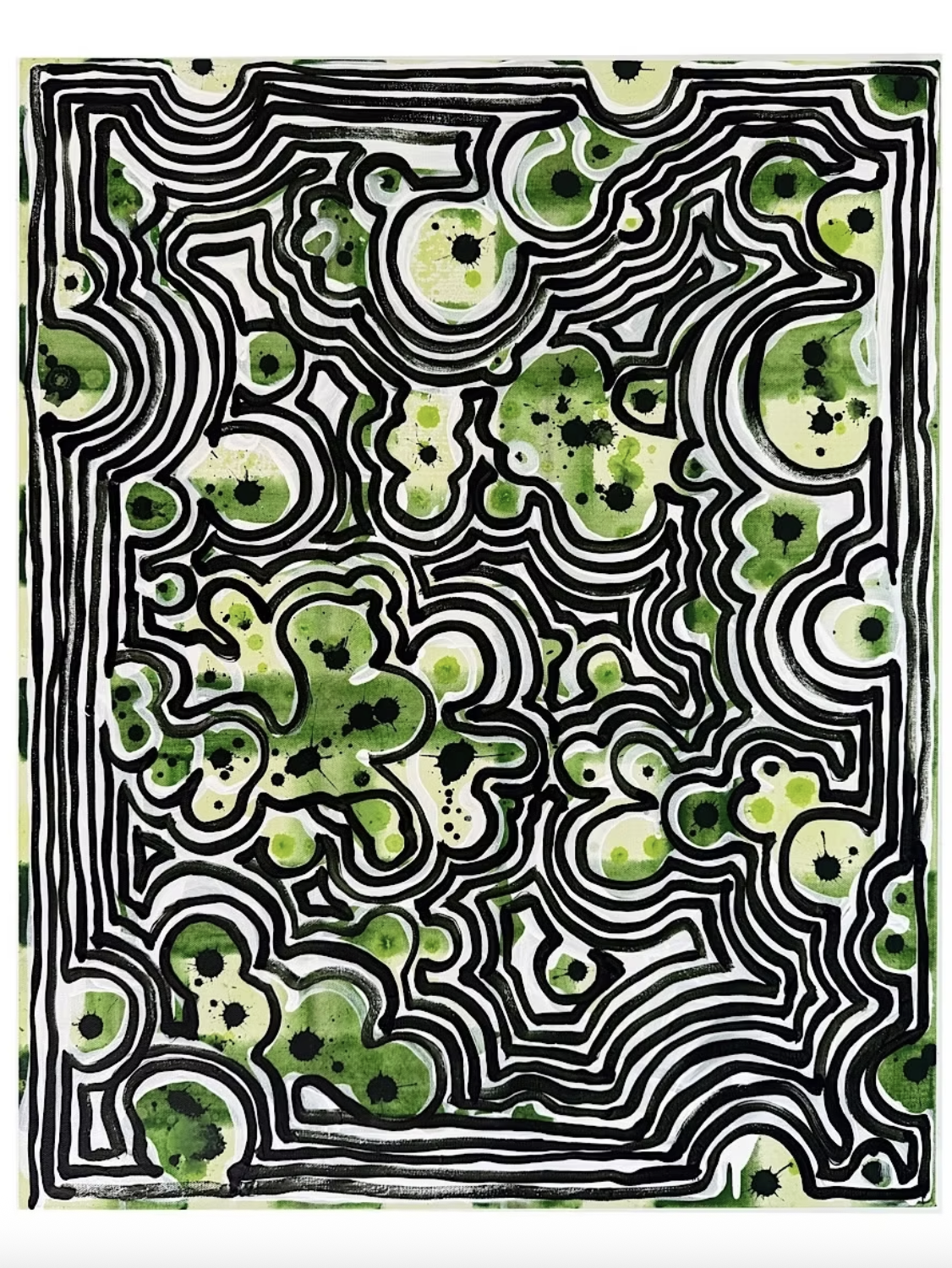
SOMEONE SAID SOMETHING ABOUT THAT, Gail Rickards, 2025
Acrylic on canvas; 60 x 76 cm
Image courtesy of the artist
You've written that you find the patterns and repetition of seasonal work, particularly mowing grass and shoveling snow, "grounding and reassuring." What about them gives you that feeling, and when did you first recognize that the same state of mind was available in the studio? Could you describe the physical experience of mowing or shoveling and how it translates into the way you move through a painting?
I think it’s the quiet, contemplative space that these tasks and chores provide. Its repetition, its nature, its routine, and it's a contained and defined space for thoughts and ideas to surface. It’s similar in the studio. They are both forms of labor and mark-making where I’m considering boundaries, perspective, and time. They are both explorations of landscapes; internal and external.
You describe chores as having "a starting point, a process, and an end." How do you know when a painting is finished?
Sometimes it takes a while, and sometimes it’s just clear. With the paintings in this show, they have certain layers of process… wet painting grounds, marks & drips, and line work… many decisions are made along the way, but the system of layering helps to clarify where it sits in the making of it. It also just needs to feel like most of the problems have been sorted and resolved and that it has reached its end point.
“It’s the quiet, contemplative space that these tasks and chores provide. Its repetition, its nature, its routine, and it’s a contained and defined space for thoughts and ideas to surface.”
These paintings live between abstraction and recognition, where a driveway, an animal, or a woodland edge might be identifiable but is never rendered literally. How do you decide how much to reveal?
I have different ways of working, and I like a balance. There are many times when imagery is involved, but with paintings that are more process-intensive and abstract, my focus shifts to perception and suggestion. This is part intuitive and part concept-driven in an attempt to find a space that mirrors things that feel familiar but can be murky and vague.
Do you want viewers to decode the imagery, or respond more intuitively to the shapes, lines, and colors?
I think both are great ways to approach artwork. I don’t make the work with a clear, specific translation for the viewer in mind, so the catalyst for connection could be conceptual and/or formal, but I do hope it can hold meaning and resonate in some way.
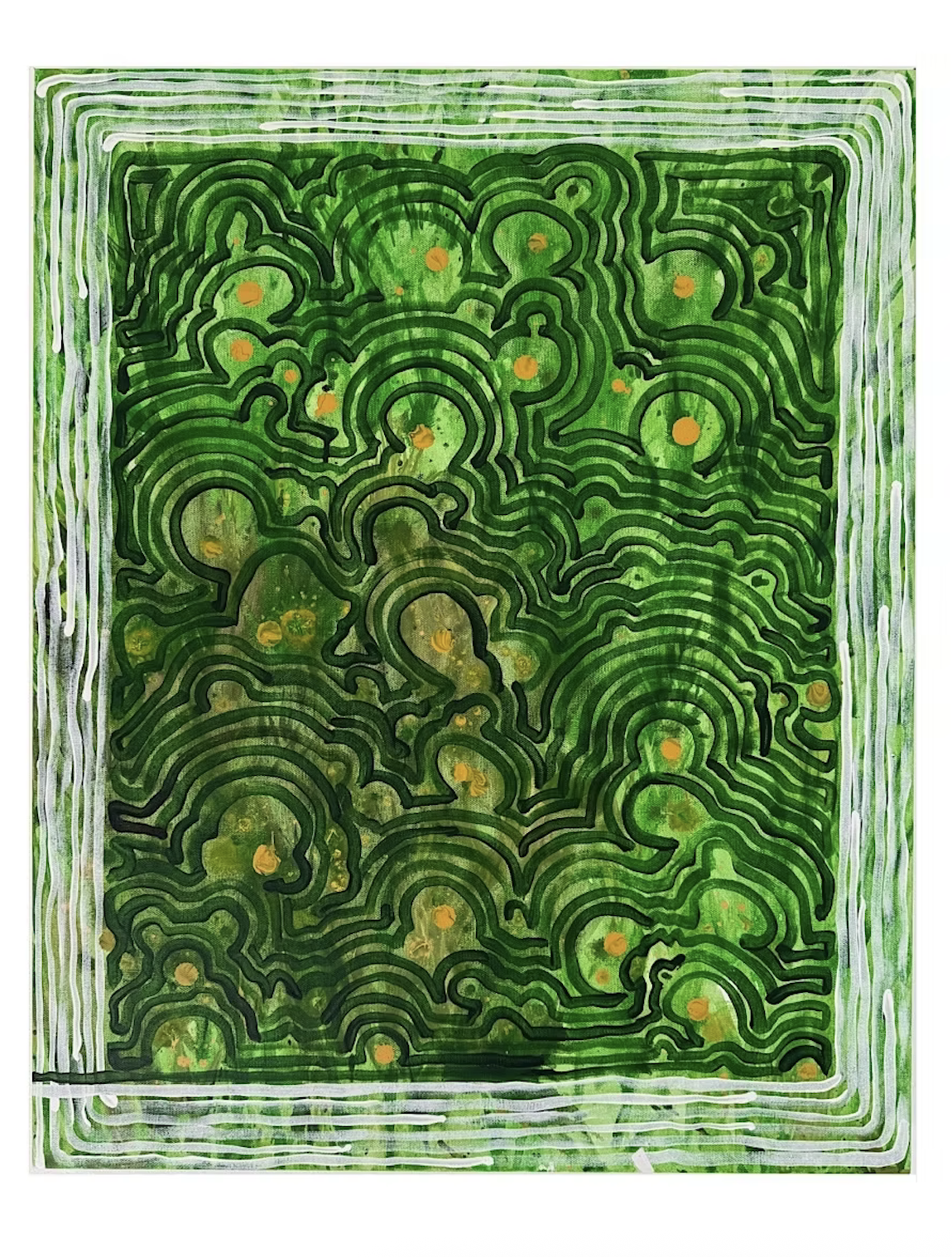
BARKING AT THE WOODS, Gail Rickards, 2025
Acrylic on canvas; 60 x 76 cm
Image courtesy of the artist
The titles have a distinct voice, conversational and funny, sometimes cryptic: Barking at the Woods, Honk If You Love Silence, Someone Said Something About That, Don't Forget to Water the Chickens. They read like overheard phrases or fragments of daily life. When do the titles come to you, and where do they come from?
I do love a good title. They are usually little fragments; words or phrases that stick in my mind, a bumper sticker I saw, or moments that are part of my life in rural New Hampshire. I’m also an avid list maker, and I keep scribbled notes of random things all over the studio. Sometimes the title forms during the making of the piece, and sometimes it’s not until after it’s finished when something I’ve written or heard just seems to fit the piece.
How does that humor coexist with the meditative tone of your artist statement? Is it a way of making heavier feelings approachable, or simply an honest reflection of how life feels?
I think it’s a reflection of how I look at things and an interest in the absurd. Its role in my work is probably one of continued efforts to organize chaos and search for perspective. For me, humor is a reminder as well as a connector in that it is one of the core reflexes of being human.
Is there anything about your work that people consistently miss or misunderstand?
I’m not sure, but this is something I would be curious to know.
I do think with the age of Instagram and image overload, it can sometimes be a challenge to make connections with art by artists who work in multiple disciplines. It may take longer and more attention to investigate the through-lines in an artist’s practice.
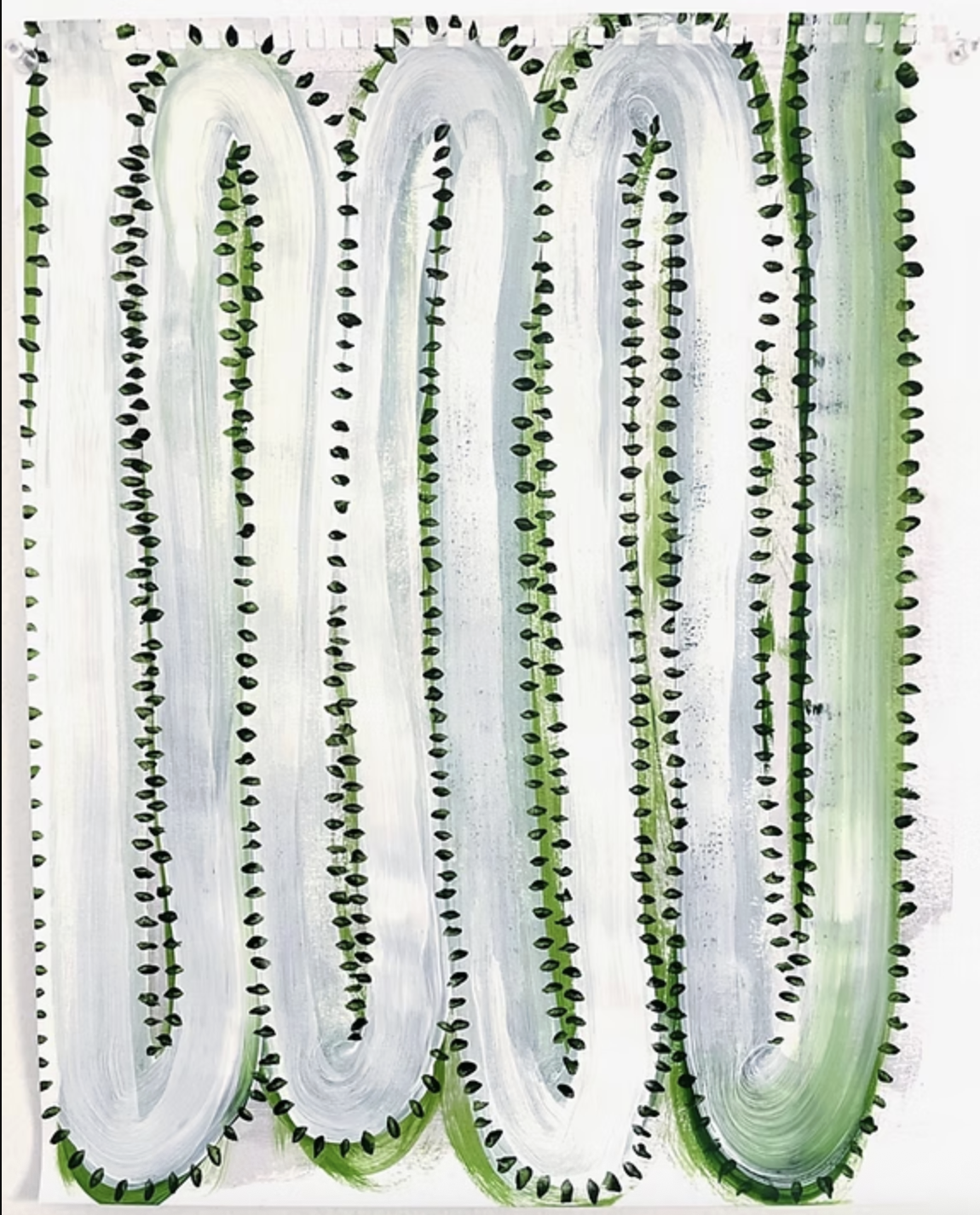
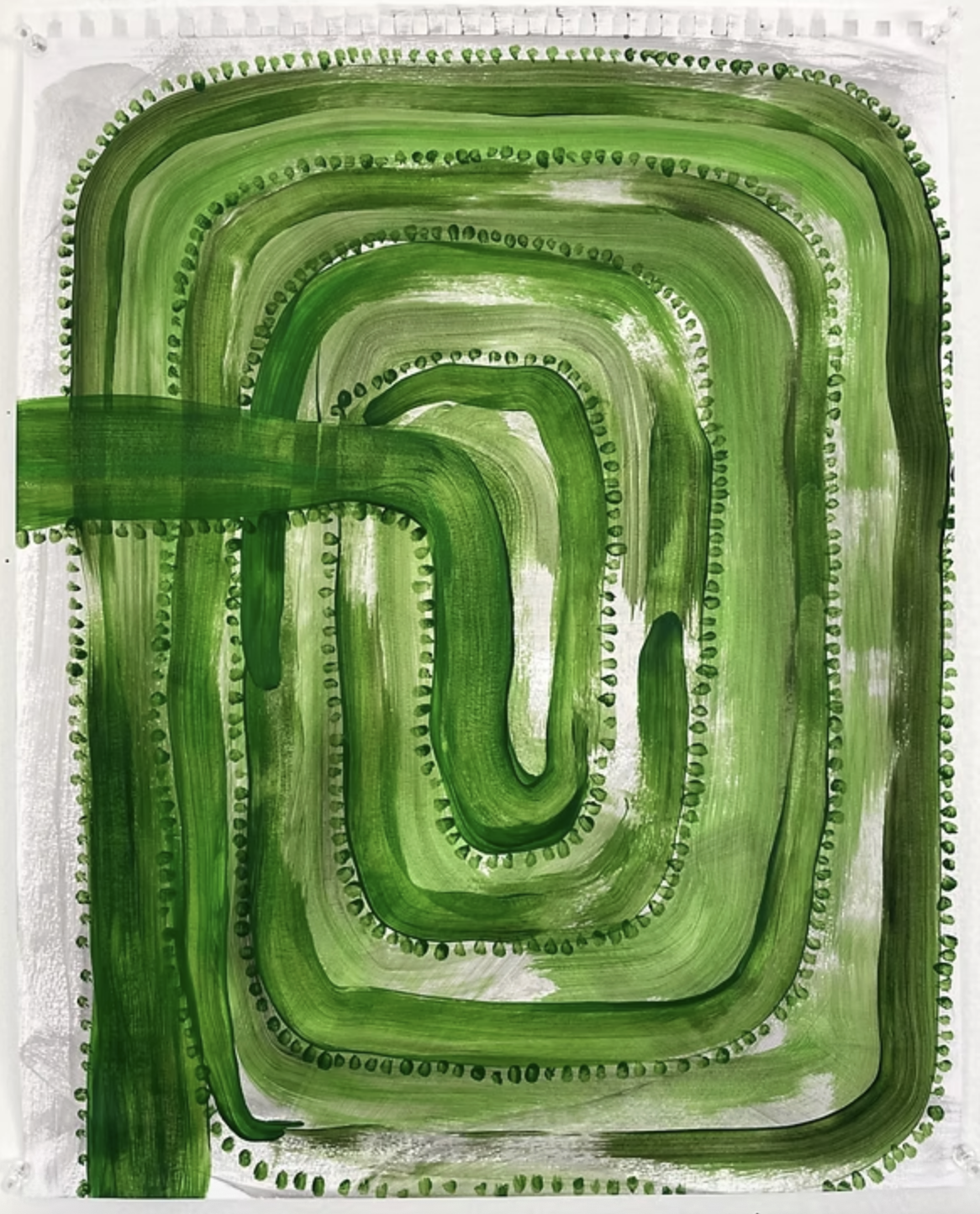
Drawings from THE MOWING AND SHOVELING SERIES, Gail Rickards 2024
Acrylic and metallic paint on paper; 10.16 cm x 45.09 cm and 22.23 cm x 25.4 cm
Image courtesy of the artist
You currently have a solo show of site-specific work and drawings at Billings Farm & Museum through Art on the Barns. How did showing on working farm buildings, rather than in a gallery, influence what you made?
The idea of making contemporary art accessible in places that are unexpected is central to the “Art On The Barns” project at Billings Farm. I chose specific farm buildings with stories that resonated with me personally. I then created work around that reasoning, where the concept for the piece is central to the history and use of the structure as well as a reflection of personal narrative. This is similar to the general problem-solving that happens in my studio practice but with the addition of the site as the starting point of reference.
Many artists, especially those raising families far from art centers, struggle to keep a studio practice alive amid daily demands. You've sustained yours over many years in a rural setting. What would you tell an artist who is in the thick of that struggle? What habits, boundaries, or changes in mindset helped you keep making work, and what do you wish someone had told you earlier?
I’m still in the thick of that struggle even now with more time in the studio, but I try to remind myself to:
- Keep going however you can.
- Embrace sporadic practices…do what you can, when you can, and where you can.
- Have goals and work towards them; if you don’t put yourself out there, absolutely nothing will happen on its own.
- Ignore the word “Emerging”; this is a constructed blip on the timeline of being an artist.
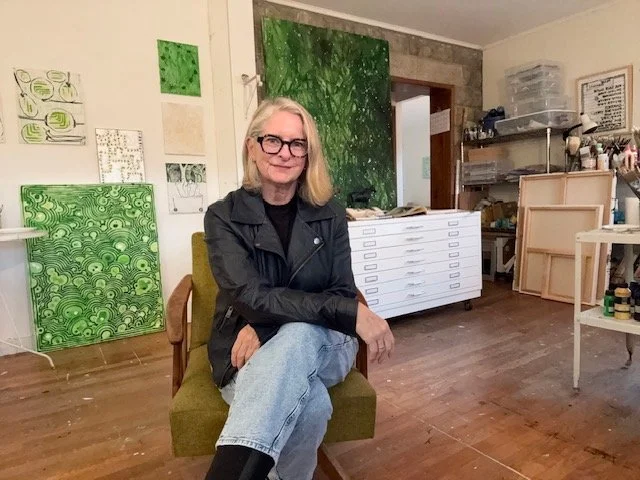
Gail Rickards in her studio
Image courtesy of the artist
Rickards’s work begins with what is closest to hand: a bumper sticker, a mowed field, a scribbled list. Nothing in her practice requires a journey elsewhere; the material is the driveway, the edge of the woods, the barn, the animals, and the chores that fill an ordinary day.
That is also what her work asks of the viewer: to look around with more attention and intention. In an age of scrolling and image overload, it is easy to forget that inspiration is all around, if one knows how to look. Images arrive by the thousand and are gone in a second, while the things in front of us go unseen precisely because they are familiar. Rickards’s paintings slow that process down. Layer by layer, they turn the familiar into something worth a second glance, recognizable enough to feel known and murky enough to hold the eye.
Her work suggests, too, that the mundane and the workaday, so often overlooked, can be the greatest muse. Mowing and shoveling are not interruptions to the real work of art; they are part of how it happens. They offer repetition and routine, a contained space in which thoughts surface, and a way of considering boundaries, perspective, and time that carries straight into the studio. The same is true of her humor, which treats the absurd corners of daily life as material rather than distraction.
There is a kind of faith in all of this. Rickards starts from the chore at hand and the ordinary day it belongs to, and she finds that the day is enough. Seen this way, her practice is a quiet argument for attention itself: that a life, looked at closely, already contains what it needs. As Joan Didion once put it, “Every day is all there is.”
Article by Ana Gabriela Batista
Ana Gabriela Batista is a translator, writer, and editor. Trained in literature and translation studies in Brazil and Italy, she moves between translating and writing with the same attentiveness: to the shifting contours of meaning across languages, and to the rhythm, structure, and weight each word is asked to carry.