
MATTER, MOVEMENT, MEANING: THE WORLD OF CARITA LAUKKONEN
Whether you believe that language is the fundamental shaping aspect of the human experience or not, there’s a massively interesting source of information (and inspiration) to be explored in the patterns, tics, and choices of someone’s speech. The way Carita Laukkonen talks about her own work is filled with physicality: action verbs, anthropomorphization of the creative process.
Before starting to paint, the Finnish artist was an extreme athlete, and there’s a nitid, albeit often ressignified and sometimes even turned upside down, influence of her past on her works. Carita Laukkonen uses her body as much as her mind when conceiving her artworks: her gestures, her position, her choice of materials and her favoured place to paint all demand actual physical effort to some level. Poet Paul Valéry says that a painter “must employ his body” while creating art, suggesting that the transformation of what’s seen (the physical world) into painting can only happen if the painter offers his body to the world; this doesn’t mean simply engaging in movements, but rather comprehending that the body cannot be dissociated from what surrounds it. And painting wasn’t Laukkonen’s first creative venture: “My story as an artist began with writing poems. I poured out my heart by writing poems”, she says, “and in a way, I had already lived one life. That life was my life as an athlete.”
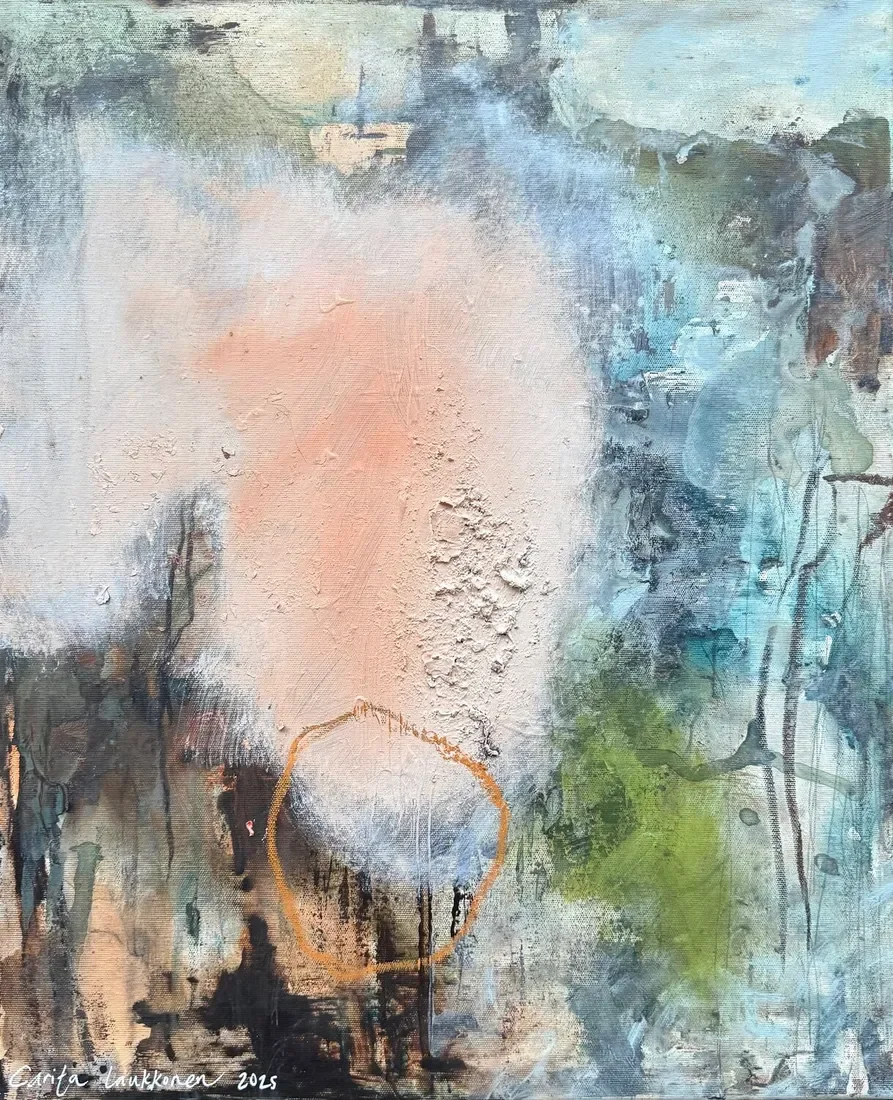
Gentle Embrace by Carita Laukkonen, 2025
The life of an athlete demands an extreme awareness of your own physicality and the limits of what one's body can do, along with understanding how the World’s physical phenomena - friction, weight balancing, buoyancy, gravity - affect performance. However, while being a painter often involves calculated and thorough movements, it takes an entirely different path: you must have the same extreme awareness of Something, this time of the absolute boundlessness of the relationship of our body to the space we occupy. You must learn how to make your hand express that which lives only inside of your consciousness. Consciousness has no other way of reaching outwards if not through a material body, while a body, if not inhabited by consciousness, is unreachable in itself. Carita Laukkonen does an outstanding job when it comes to bridging the gap between the immaterial and the material, catalysing her creativity by listening to all of her mind’s desires: “Sometimes I find myself working and seeing different colors and composing them together while half asleep. My subconscious is doing its job even though I seem to be at rest.”
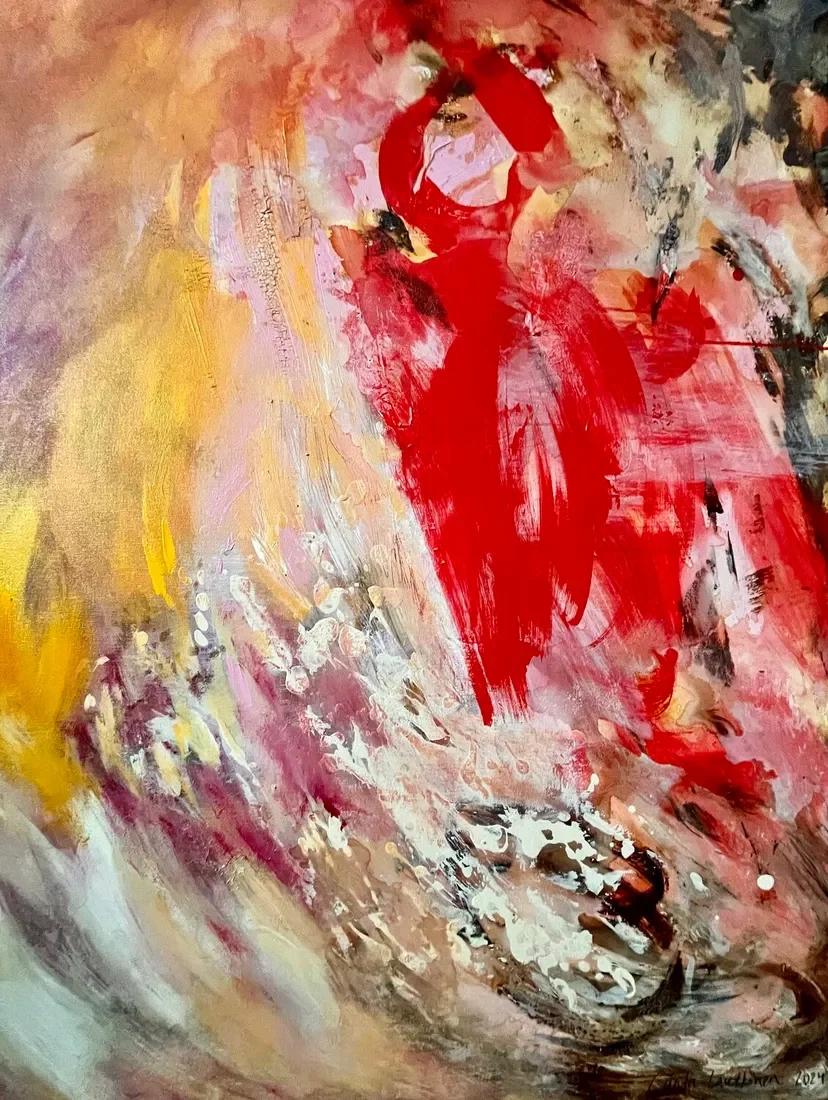
Molting by Carita Laukkonen, 2024
Still about her creative process, the artist says, “I might have a few colours in mind to start with, but otherwise I jump into the adventure very clueless. Sometimes the works are created with ease, as if they were already born inside me and just waiting to come out.” Using strong, vivid wording comes naturally to Laukkonen: “Some works, on the other hand, seem to be under a hard birth.” Action, after action, after action. In Laukkonen’s case, it also extends itself to the position the artist chooses to paint: on her knees, positioned in front of the canvas and listening to what the canvas has to say. “I also really like painting on my knees on the floor because there's something very beautiful about that,” the artist says, “I get to be small and vulnerable, and just pour my heart out on the canvas.” Feeling small can be overwhelming, of course, and feeling overwhelming can be a magnificent emotion. Think of it as the Wanderer in the Fog by Caspar David Friedrich: does the man in the painting feel small because it’s oppressing, or does he look at the fog from above from the unbelievably powerful position of understanding that there’s always something bigger, something more, something unseen, something unexplored?
“Sometimes it’s better to let go of everything and see what really remains. Of course, this requires trust and belief that, ultimately, someone bigger will carry me and my life and all the details related to it.”
Feeling the grandiosity of nature also opens a way for Laukkonen to create. Not only does she choose to paint in nature, but her proccess involves using non-traditional tools - flowers, leaves and other organic materials - as either substitutes for paintbrushes and spatulas or as elements to be printed on the canvas. Other materials, such as pieces of gauze, plastic and small stems, are glued. We know abstract art to often be seen as a total opposition to naturalism, and it finds in this space a wonderful play: the artist uses nature not only as her inspiration but also as the means of materializing her thoughts. “Being in nature helps me to calm down and ground myself, to be present. When I'm present, the work is born as if by itself, not by forcing or pushing,” the artist says about her choice, “and painting in nature inspires me to also grab nature’s gifts, such as branches, and paint with them.”
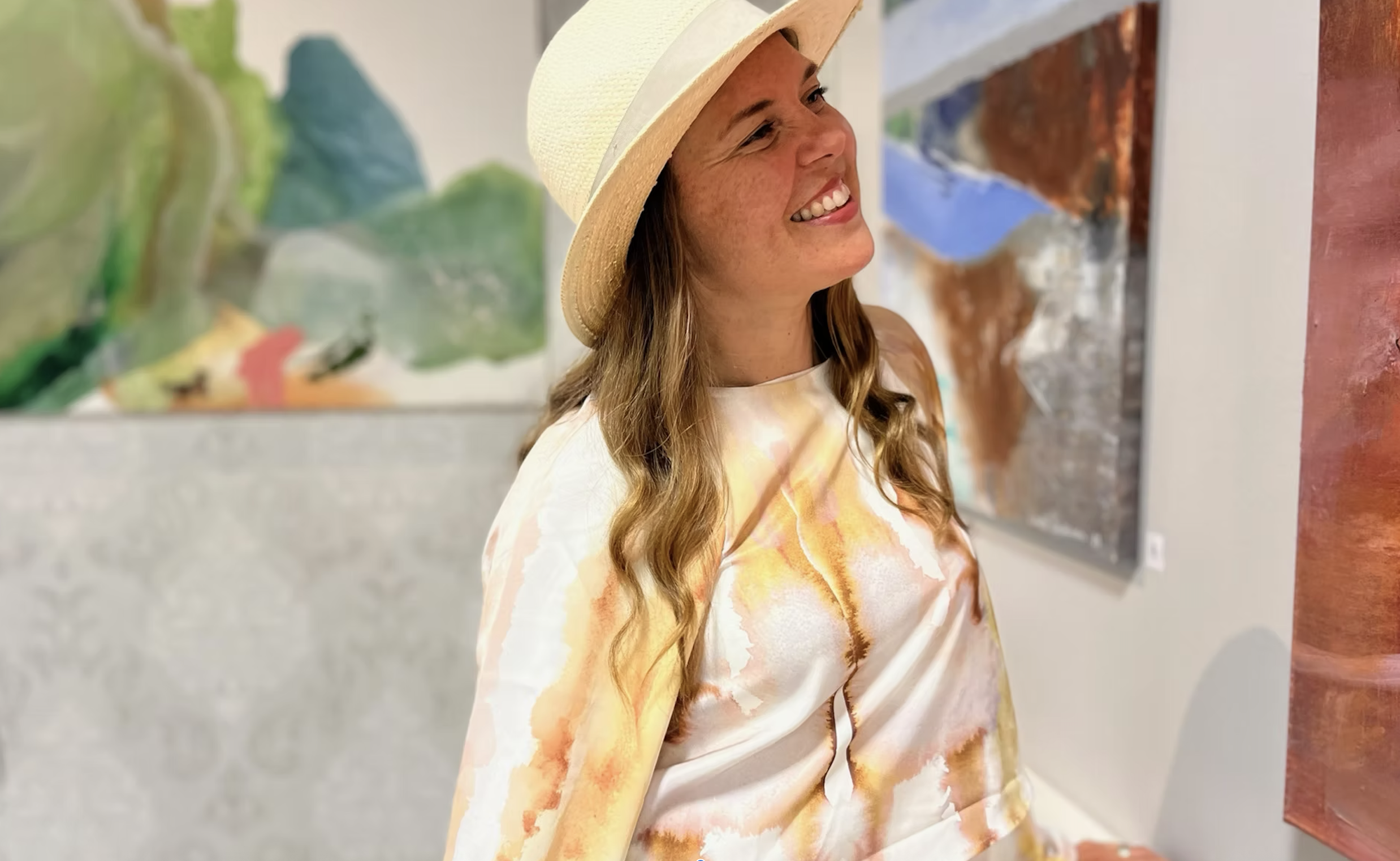
Courtesy of Carita Laukkonen
The works spin and unfold, sometimes reminiscent of a glacier or a fjord, sometimes a simple potpourri of beautiful pastel colours, all bearing traces of the artist’s gestures and whereabouts. Writing about abstract expressionism, art critic Harold Rosenberg affirmed that “what matters always is the revelation contained in the act”. Carita Laukkonen tells me she found balance only later in life - a revelation that, more often than not, takes years to come.
Nevertheless, the consciousness and the subconsciousness, the physical and the metaphysical, all come together perfectly balanced in her paintings. “Sometimes it's better to let go of everything and see what really remains. Of course, this requires trust and belief that, ultimately, someone bigger will carry me and my life and all the details related to it.”
See more of Carita’s work on her Instagram.
Article by Ananda Muylaert
A Paris-based multidisciplinary artist and researcher on the phenomenology of painting, she has produced an extensive body of work in art, music, and poetry. Her artworks and published research on philosophy, essays and poetry have been presented and published in four languages across two continents.
Her artistic practice revolves around the search for rationality in animality (and vice versa) and an infatuation with organic texture, both inside and outside the flesh. More so, there's a desire to portray the relationship of the urban Self with the world around it truthfully, through the worst transgressions and most devastating desertions caused by the domestication of the Human species.
Her previous work experience includes working at the Musée Grand Palais, in Paris, and the Federal Cultural Center of Heritage Paço Imperial in Rio de Janeiro, Brazil, where she worked closely with prestigious institutions such as the Institut Goethe, the Instituto Moreira Salles, and the embassies of France, Japan, and China.